Does Google Document AI Work in China? PIPL Cross-Border, Data Residency & Sensitive-Data Rules
The invoices, contracts, and — the sharp case — scanned IDs, passports, and bank cards your China operation sends Google Document AI to read ARE the personal information, and ID and financial-account numbers are sensitive under PIPL Article 28; Google runs no mainland-China region, so processing them is a cross-border transfer of sensitive personal data. A compliance-first look at the residency, sensitive-data, and cross-border exposure.
Does Google Document AI work in China?
The documents your China operation sends Google Document AI to read — invoices, contracts, and the sharp case of scanned IDs, passports, and bank cards — ARE the personal information, and ID and financial-account numbers are sensitive data you cannot minimize; Google runs no mainland-China region, so every page is processed offshore: a PIPL cross-border transfer of sensitive personal data.
Document AI is a managed, cloud-only OCR and document-processing service; its own regions page offers only the US and EU multi-regions plus a few offshore single-regions, with no mainland-China location. The ID number or account number you extract IS what you sent it to read, so it cannot be anonymized — it is PIPL Article 28 sensitive personal information, and shipping it out is a cross-border transfer (Articles 38-40, with the Article 29 separate consent). The lawful lever is to keep the document processing in-country on a China-resident or licensed domestic path, minimize what crosses the border, obtain the separate consent, and ICP-file any China-facing upload or verification surface — not to make the offshore API reachable.
Whether a given document is sensitive or "important data" turns on what you process and your sector, so settle the specifics with counsel. Our China team can map your exposure →
What Google Document AI's own documentation says about China
| Fact | Primary source |
|---|---|
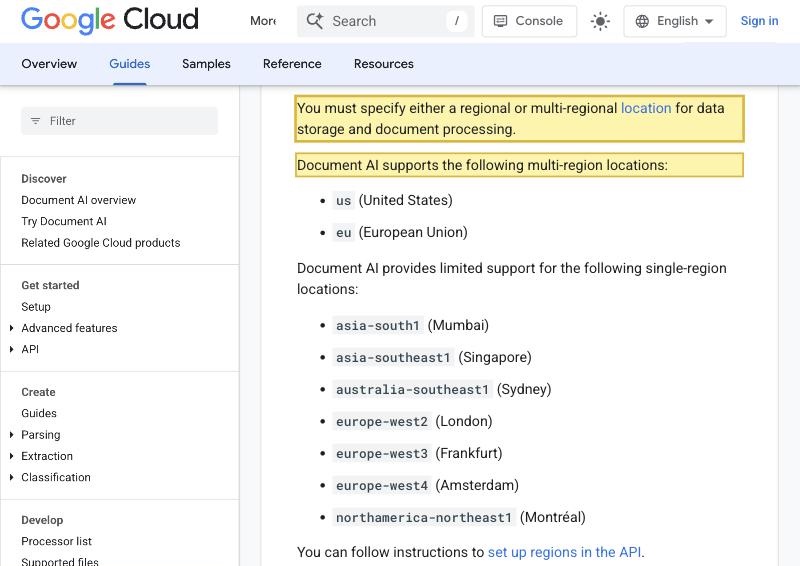
Google Document AI has no mainland-China region. Google's regions documentation requires you to "specify either a regional or multi-regional location for data storage and document processing," and lists only the us (United States) and eu (European Union) multi-regions plus offshore single-regions (Singapore, Frankfurt, Montréal, and others). A China operation's documents are therefore processed offshore. | Google Cloud — Document AI regions (cloud.google.com), retrieved 2026-10-11 |
| The location you pick governs where your documents are stored and processed. Document AI is a managed cloud service, not a customer-deployable on-premises build; the processing executes in the offshore region you select from Google's list, so there is no in-country Google Cloud path for China-collected documents. | Google Cloud — Document AI regions (cloud.google.com), retrieved 2026-10-11 |
| ID numbers and financial-account numbers are sensitive personal information. Under PIPL Article 28, sensitive PI (including ID and financial-account numbers and biometrics) needs a separate specific consent and a prior impact assessment; it cannot be anonymized when it is the very field you OCR, and exporting it is a cross-border transfer under Articles 38-40 (with the Article 29 separate consent). | 21YunBox — China Personal Information Protection Law (PIPL), retrieved 2026-10-11 |
| At volume, in-country storage and a CAC data-export assessment can apply. For a critical information infrastructure operator or high-volume handler, Cybersecurity Law Article 39 (formerly Article 37) requires in-country storage; where volumes or sensitivity cross the thresholds, the export needs a CAC data-export security assessment, and a large corpus of scanned documents can raise the "important data" question. | 21YunBox — China data-export security assessment measures, retrieved 2026-10-11 |
Sources verified by the 21YunBox compliance team on 2026-10-11.
For a mainland-China operation, the question to settle about Google Document AI is not whether its API answers from inside the country — it is what the documents you send it to read actually are, and where they are processed. Document AI is an OCR and intelligent-document-processing service: you upload a file — an invoice, a contract, or in the sharp case a scanned ID card, passport, or bank card — and it extracts the fields. That content IS the personal information, and in a KYC or finance workflow it is the most sensitive kind: an ID number or a financial-account number is sensitive personal information you cannot minimize, because it is the very thing you sent the document to read. Document AI runs as a managed Google Cloud service, and Google operates no mainland-China region — its own regions page offers only US and EU multi-regions and a few offshore single-regions. Several duties therefore bite at once: the content is sensitive PI that cannot be anonymized (Article 28); a PIPL cross-border transfer needing a separate consent (Articles 38–40, 29); an automated-decision question where the extraction drives an outcome (Article 24); residency for a critical-information-infrastructure or high-volume handler; and ICP for any China-facing surface that collects the documents.
Google Document AI in China at a glance
| What decides it | In Google Document AI's own terms — and China's law |
|---|---|
| What you send | Document AI reads the documents you upload — invoices and contracts, and in the sharp case scanned ID cards, passports, driver's licenses, and bank cards. The content IS the personal information; an ID number or a financial-account number cannot be "minimized," because it is the very field you sent the document to read. |
| Where it runs | Document AI is a managed Google Cloud service. Its regions page states you "must specify either a regional or multi-regional location for data storage and document processing," and lists only the us (United States) and eu (European Union) multi-regions plus offshore single-regions (Singapore, Frankfurt, Montréal, and others). There is no mainland-China region. Sending China-collected documents there is a cross-border transfer of personal information (PIPL Articles 38–40 and 29, 数据出境). |
| The sensitive-PI door | Under PIPL Article 28, ID numbers, financial-account numbers, and biometrics are sensitive personal information. Processing and exporting them needs a separate specific consent and a prior personal-information protection impact assessment (PIPIA). You cannot anonymize the ID number — it is the input. |
| Automated decision & residency | Where the extracted data drives an automatic outcome — approve or deny a KYC check, clear an invoice — that is automated decision-making (PIPL Article 24). For a CIIO or high-volume handler, in-country storage applies; at volume or sensitivity, the export itself can require a CAC data-export security assessment, and high volumes raise the "important data" (重要数据) question. |
| The axis | Reachability is not the question. The lawful lever is to keep China-origin document processing in-country — a China-resident or licensed domestic document-processing service — with the Article 29 separate consent, not to make the offshore endpoint faster. The China-facing upload or verification surface also carries an ICP filing duty and needs in-country delivery. |
What you actually send it — and why the content is the risk
Document AI is a document-processing service: you upload a file to a Google Cloud endpoint and receive structured fields back. Because the output is tidy JSON, it is easy to assume the privacy question is about the result. It isn’t. The thing that travels on every request is the document itself — and in the workflows that make Document AI worth buying, that document is an invoice, a contract, or, in identity and finance, a scanned ID card, passport, driver’s license, or bank card. An extracted field you can drop; the ID number or the account number you cannot un-send, and it is the whole reason the page was uploaded. A blank template is not sensitive; a signed KYC packet is. The sensitivity turns on what you process.
Where does that document go? Document AI runs in Google Cloud regions, and Google has no region on the Chinese mainland. Its own regions documentation requires you to pick a location for data storage and document processing and offers only the us (United States) and eu (European Union) multi-regions, plus a short list of offshore single-regions. Choose any of them to serve a user in China and the document leaves the country. Document AI is also offered as a managed cloud service — not a customer-deployable on-premises build — so the processing happens in the offshore location you select, not on hardware you can place inside the mainland. That is what makes a China-resident or licensed domestic document-processing path, rather than a self-hosted copy of Document AI, the honest in-country option.
The doors: sensitive personal data, cross-border transfer, and automated decisions
Start with the data itself. Under PIPL Article 28, ID numbers, financial-account numbers, and biometric characteristics are sensitive personal information. The ID card and bank card a Document AI pipeline exists to read are squarely in that set, and you cannot anonymize your way out: the ID number is the input. Processing and exporting sensitive personal information demands a separate, specific consent and a prior personal-information protection impact assessment (PIPIA) — see China’s Personal Information Protection Law.
Because the document is processed outside the mainland, sending it to Document AI is a cross-border transfer of personal information. PIPL Articles 38–40 put the duty on you, the handler — not on Google — and require notice, a separate consent distinct from the user’s agreement to use the feature (reinforced for sensitive PI by Article 29), and one lawful transfer mechanism: a CAC security assessment, the CAC standard contract, or certification.
Two more doors can open. If the extracted data drives an automatic outcome — a KYC check approved or denied, an invoice cleared, an applicant verified — that is automated decision-making under PIPL Article 24, which gives the data subject a right to an explanation and to refuse a decision made solely by automated means. And residency sits underneath: a critical information infrastructure operator, or a handler above the volume thresholds, must store personal information collected in China inside the mainland — PIPL Article 40 together with the Cybersecurity Law Article 39 (formerly Article 37 — the 2025 Cybersecurity Law amendment, in force January 1, 2026, renumbered the data-localization article from 37 to 39, with the substance unchanged). Where volumes or sensitivity cross the thresholds, the export itself needs a CAC data-export security assessment before it may proceed, and a large corpus of scanned documents can raise the “important data” question under the Data Security Law. None of this is about how fast a result returns.
Calling the API isn’t the question — compliant in-country processing is
The lever is not to make the offshore endpoint faster or more reachable; it is to stop exporting China-origin documents and to process them on an in-country, consented path. Because Document AI is a managed cloud service with no customer-deployable on-premises build, the honest in-country option is a China-resident or licensed domestic document-processing service — a provider that performs the OCR and extraction with the data kept in the mainland — rather than a self-hosted copy of Document AI. Alongside it, the duties travel with the document: obtain the Article 29 separate consent, run the PIPIA, minimize what you capture and retain, and — where the extraction drives an outcome — handle the Article 24 automated-decision rights. What you do not do is build a path that ships the documents offshore and call it local. Whether a given document or image is sensitive or “important data” turns on what you process and your sector, so this is a risk map, not a verdict — settle the specifics with counsel.
The lawful path — map, localize, deliver
There is a lawful way to run document processing for your users in China, and it has a clear shape: China-origin documents are processed from inside the country on a consented footing, the ID numbers and account numbers are treated as the sensitive data they are, and the China-facing surface that collects them is itself filed and delivered in-country. The part 21YunBox owns is that footing, and it is more than advice. Our China team does three things. We map what documents and images flow to the service — whose IDs, accounts, and records they carry, which fields are sensitive under Article 28, where the processing happens and whether any of it is “important data,” whether the extraction makes an Article 24 automated decision, and where you lack a lawful basis (the separate consent, a PIPIA, a transfer mechanism). We localize the processing onto an in-country path — a China-resident or licensed domestic document-processing service — so the documents stay in the mainland instead of being exported, with consent, minimization, and retention handled correctly. And we deliver the China-facing upload or verification surface on ICP-filed, in-country infrastructure — the 21YunBox Optimizer — in front of the stack you already run, with no rebuild and no re-platform.
The result is a document-processing feature that runs legally and compliantly for your users in China. 21YunBox never uses or suggests circumvention of any kind. This is a lawful, data-resident in-country deployment, and where a service is not offered in the mainland we localize onto a licensed domestic equivalent rather than reach offshore.
Related reading:
- China’s Personal Information Protection Law (PIPL)
- Cross-border data transfers under PIPL
- China’s data-export security assessment measures
- How to get an ICP filing for China