Does Avalara Work in China? Data Residency, ICP & Cross-Border Rules
Avalara is offshore cloud tax SaaS: your China transaction data, customer tax IDs and VAT calculations sit in its multicloud platform (AWS/Azure/GCP/OCI) with no mainland-China region — held abroad under PIPL — and it does not replace China's state Golden Tax / fapiao (发票) system. A compliance-first look at the data-residency and ICP doors.
Does Avalara work in China?
Whether you can use Avalara in China is a data-residency and domestic-tax-system question, not a speed one. Avalara is reachable from the mainland — the risk is legal, not performance.
In China, tax is a state system: VAT invoices — fapiao (发票) — are issued and validated through the government's Golden Tax platform and the tax authorities' national e-invoicing service, not inside any foreign application. A foreign tax-automation platform computes and maps tax but does not replace that mandatory domestic issuance channel; it sits on top of it. Meanwhile Avalara runs on offshore multicloud infrastructure with no mainland-China region, so the transaction records and customer tax IDs it holds for your China sales are a cross-border transfer of data that PIPL governs — notice, separate consent, a transfer mechanism, and for a CIIO or high-volume handler, in-country storage.
This is a risk picture, not a verdict — your obligations turn on your volumes, your entity and your role, and the fapiao specifics belong with China tax counsel. Our China team can map your Avalara data and tax-integration exposure with you →
What Avalara's own documentation says about China
| Fact | Primary source |
|---|---|
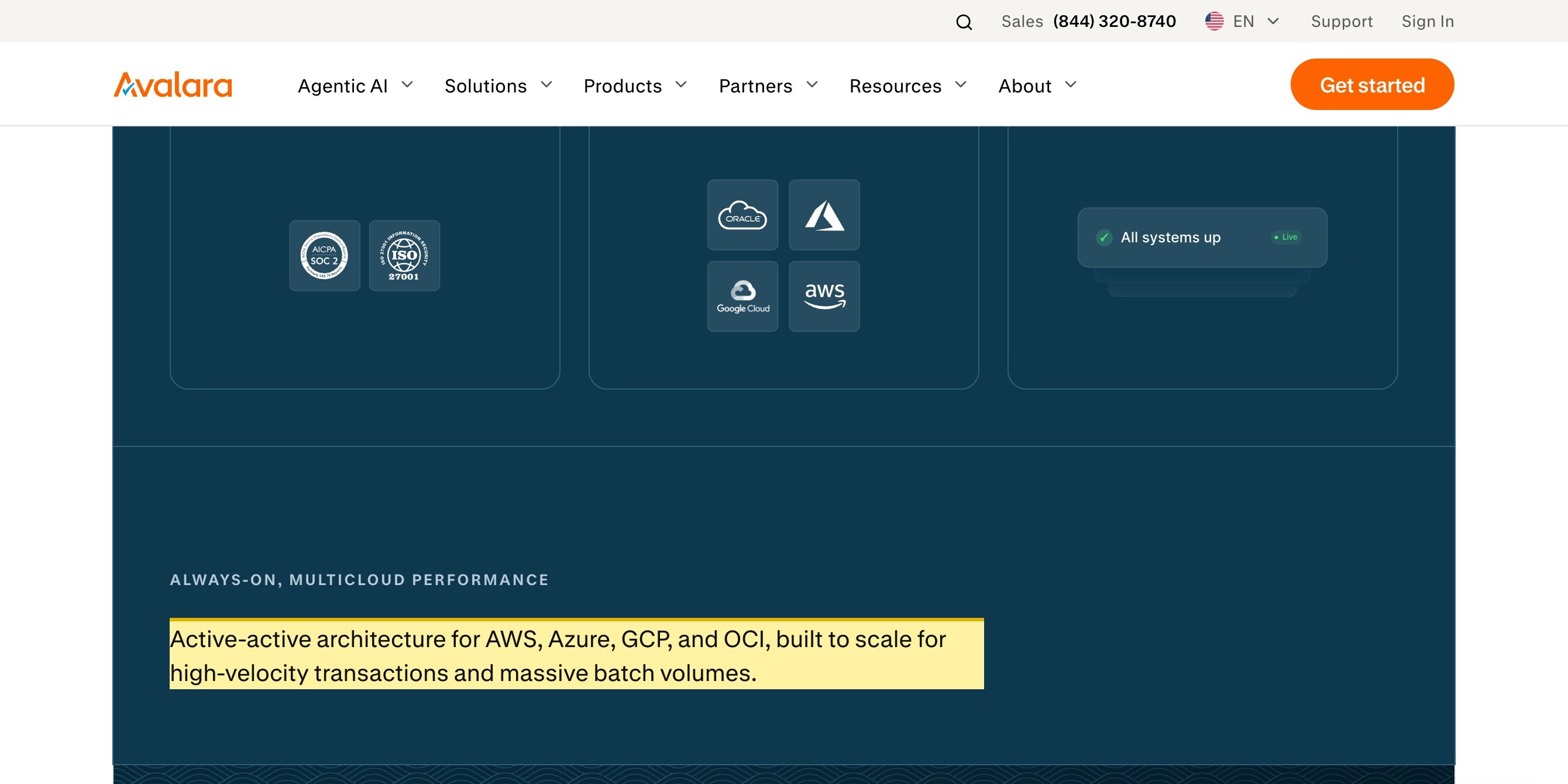
| In Avalara's own words: its platform is “Secure multicloud infrastructure” with “Active-active architecture for AWS, Azure, GCP, and OCI.” That is Avalara's own offshore hyperscaler platform — it offers no mainland-China data region or data-residency option, so the China transaction data and tax IDs it holds rest abroad. | Avalara — Enterprise platform page (retrieved 2026-10-12) |
| Avalara's own Data Processing documentation states it “may use subprocessors (both Avalara affiliates and third parties) located outside the European Economic Area,” and that EU personal data is transferred to Avalara Inc. “as data importer and subprocessor” — confirming Avalara holds and moves customer data to its offshore infrastructure, with no mainland-China residency path. | Avalara — Data Processing Agreement & Privacy Notice (retrieved 2026-10-12) |
| Transaction and tax data your Avalara tenant collects from people and businesses in China is personal and business information under China's law; holding it offshore is a cross-border transfer (数据出境) that needs an Article 13/23 lawful basis and notice plus an Article 38–40 transfer mechanism — a CAC security assessment, the CAC standard contract, or certification. | PIPL — cross-border transfer rules, Articles 13/23 & 38–40 (retrieved 2026-10-12) |
| For a critical information infrastructure operator or a high-volume handler, the Cybersecurity Law's Article 39 (formerly Article 37) requires personal information and important data generated in China to be stored inside the mainland — which an offshore Avalara tenant cannot satisfy. | Cybersecurity Law — data localization, Article 39 (formerly Article 37) (retrieved 2026-10-12) |
Sources verified by the 21YunBox compliance team on 2026-10-12.
For a company running Avalara to handle tax for a mainland-China operation, the deciding question is not how quickly AvaTax returns a rate from Shanghai. It is two things a reachability test never checks: where your China tax data is allowed to live, and how your tax workflow meets China’s mandatory domestic invoicing system. Avalara is a cloud-only tax-automation platform — it calculates VAT and other taxes, stores your transaction records and customer tax IDs, and manages returns and exemption certificates — and it runs on offshore multicloud infrastructure, with no region inside mainland China. So the commercial and tax data it holds for your China sales is processed and stored abroad. That makes this a compliance-risk question first, not a performance one.
And in China, tax is a state system. Value-added tax invoices — fapiao (发票) — are issued and validated through the government’s Golden Tax platform and the tax authorities’ national e-invoicing service, not inside any foreign application. A foreign tax-automation platform can compute and map tax and feed your books, but it does not and cannot replace that domestic issuance channel; it sits on top of it. So the real question for Avalara in China is where the transaction and tax-ID data lives and how the workflow integrates with the mandatory Golden Tax/fapiao regime — never whether the API answers.
Avalara in China at a glance
| What decides it | In Avalara's own terms — and China's law |
|---|---|
| What it holds | The commercial and tax record of your China sales: transaction data (amounts, line items, dates, counterparties), customer and entity tax IDs, the VAT and tax calculations AvaTax runs on them, and the returns and exemption-certificate records tied to each. That is personal and business information China's law cares about. |
| Where it runs | Avalara is a cloud-only SaaS platform. By its own description it is “secure multicloud infrastructure” with “active-active architecture for AWS, Azure, GCP, and OCI” — offshore hyperscaler clouds, and none is a mainland-China region. Avalara offers no China data-residency option, so the data rests abroad. |
| Transaction & tax-ID data | The China transaction records and tax IDs your tenant collects rest in an offshore region — a cross-border transfer under PIPL Articles 38–40, layered on the Article 13/23 notice-and-consent basis. For a critical information infrastructure operator or a high-volume handler, Cybersecurity Law Article 39 (formerly Article 37) requires China-generated personal information and important data to be stored in the mainland. |
| The domestic Golden Tax / fapiao regime | This is the half a reachability check never sees. In China, VAT invoices — fapiao (发票) — are issued and validated through the state Golden Tax platform and the tax authorities' national e-invoicing service. A foreign tax-automation platform computes and maps tax but does not replace that mandatory domestic channel; it must integrate with it. Confirm the fapiao specifics with China tax counsel. |
| A China-facing portal | Any self-service, checkout or invoice/exemption portal served to mainland users is an internet information service, so it carries an ICP filing (备案) duty bound to a mainland hosting resource. An Avalara-hosted surface runs on offshore infrastructure, so it offers no ICP-filing path of its own. |
| Reachability is not the axis | Whether AvaTax answers quickly from the mainland is operational, not the compliance question. What decides it is where the transaction and tax-ID data lives and how the workflow meets the domestic Golden Tax/fapiao system. 21YunBox helps you keep the regulated data in-country, integrate the domestic regime, ICP-file any portal, and deliver it compliantly — the 21YunBox Optimizer — in front of the Avalara you already run. |
What it actually holds — your China transaction and tax data
Avalara is not a static asset like a font or a script; it is the tax engine behind your China commerce, and it concentrates exactly the data China’s law watches. Every taxed transaction it processes carries the amount and line items, the date and the counterparties, and the customer and entity tax identifiers used to compute and report the tax — plus the returns and exemption-certificate records tied to each sale. Because Avalara is a cloud-only SaaS platform running on offshore multicloud infrastructure, with no mainland-China region, that commercial and tax record for your China sales is held and processed abroad by default. A reachability test tells you the rate came back; it tells you nothing about where that transaction history and those tax IDs come to rest.
The doors: data residency, the domestic Golden Tax / fapiao regime, and ICP
The first door is data residency. The transaction records and tax IDs your Avalara tenant collects from people and businesses in China are personal and business information under China’s Personal Information Protection Law, and holding them in an offshore region is a cross-border transfer (数据出境). The duty lands on you, the handler, not on Avalara: Articles 13 and 23 require notice and a lawful basis to collect the data, and Articles 38–40 require a transfer mechanism to send it abroad — a CAC security assessment, the CAC standard contract, or certification. Where records carry sensitive identifiers, PIPL Articles 28–29 raise the bar with a specific-purpose, necessity and separate-consent test. And for a critical information infrastructure operator or a high-volume handler, the Cybersecurity Law’s Article 39 (formerly Article 37 — the 2025 Cybersecurity Law amendment, in force January 1, 2026, renumbered the data-localization article from 37 to 39, with its substance unchanged) requires personal information and important data generated in China to be stored in the mainland, which an offshore tenant cannot satisfy.
The second door is the one that makes a tax platform different from an ordinary SaaS. In China, tax is a government system end to end. VAT invoices — fapiao (发票) — are issued and validated through the state Golden Tax platform and the tax authorities’ national e-invoicing service; issuance does not happen inside a foreign application. A foreign tax-automation platform can calculate tax, map rates and rules, and feed your books, but it does not and cannot replace that mandatory domestic issuance channel — it sits on top of it and must integrate with it. So the question is not whether Avalara “works” but how your China tax workflow meets the Golden Tax/fapiao regime, and where the underlying transaction data lives while it does. Treat the fapiao mechanics as a point to settle with China tax counsel; the compliance point here is that a speed test never surfaces this half at all.
The third door is the ICP filing. If you publish a China-facing self-service, checkout, or invoice/exemption portal to mainland users, you are running a public internet information service, and that turns on an ICP filing (ICP 备案) duty bound to a hosting resource physically inside the mainland. An Avalara-hosted surface runs offshore, so there is nothing on it to file against — tuning the stack does not create the mainland footing a filing needs.
A reachability check never sees this
Avalara is not the kind of service that simply refuses to load in China — the exposure is quieter and more durable than a slow response. Even if AvaTax answered instantly from the mainland, using it would still place your China transaction records and customer tax IDs outside the country, and it would still leave the domestic Golden Tax/fapiao integration unaddressed. A reachability test answers “did the API come back?”; it is blind to where the tax data comes to rest, to who is lawfully allowed to hold it, and to whether your invoicing actually meets the state system. Where the data lives and how the workflow meets China’s tax regime, not how fast the rate arrives, is what China’s law responds to.
This is a risk map, not a verdict that Avalara is “blocked” or “illegal” in China. Which duties bite your case turns on your entity, what your transactions and records actually contain, your role under Chinese law, and your data volumes — worth settling the specifics, and the fapiao mechanics, with counsel before your China operation depends on it.
The lawful path — map, localize, deliver
There is a compliant way to run tax automation for a China operation, and it sits in front of the Avalara your finance team already uses — no rebuild, no second tool, no migration.
First, map: our China team inventories what your Avalara tenant holds — the transaction records, customer and entity tax IDs, VAT calculations, returns and exemption data, and any China-facing portal — establishes where it is hosted (an offshore multicloud region), the ICP status of any public surface, and the consent and residency basis each flow relies on. We build the technical picture; the legal and tax conclusions are settled with counsel.
Then localize/govern: we help you keep the regulated data — the China transaction records and tax IDs — on a lawful in-country path, obtain the Article 13/23 notice-and-consent, and make sure the workflow integrates with the mandatory domestic fapiao/Golden Tax issuance rather than treating a foreign engine as the system of record. Localize means keeping the data on an in-country path — never a route that ships it offshore anyway.
Then deliver: any public China-facing portal is an internet information service, so it carries an ICP filing duty bound to mainland hosting and needs compliant, in-country delivery. 21YunBox stands that up — the 21YunBox Optimizer — in front of what you already run, so it serves your users in China legally and compliantly. 21YunBox never uses or suggests circumvention of any kind — we keep in-country what the law says must stay, deliver the rest compliantly from inside the mainland, and never move data across the border by stealth. Making an offshore tenant merely reachable is not the answer; keeping the regulated data in-country, integrating the domestic tax system, ICP-filing the portal and delivering it compliantly is. 21YunBox is a compliance overlay and partner to the tax platform you already run, not a competitor to it.
Related reading:
- How to get an ICP filing for China
- Cross-border data transfers under PIPL
- China’s Personal Information Protection Law (PIPL)
- China’s Cybersecurity Law


