Does AfterShip Work in China? Data Residency, ICP & Cross-Border Rules
AfterShip ingests your China consignees' names, addresses and phones in bulk and fans that recipient PII out to offshore sub-processors — AWS and Google Cloud in the US, Alibaba SMS in Hong Kong, none in mainland China. A compliance-first look at the PIPL residency, high-volume-storage and ICP doors.
Does AfterShip work in China?
Whether AfterShip works in China is a data-residency and ICP question, not a speed one. AfterShip ingests your China consignees' personal information in bulk — every recipient's name, delivery address and phone number — and, by its own authorized sub-processor list, fans that data out to offshore vendors (Amazon AWS and Google Cloud Platform in the United States, with Alibaba Cloud used only for SMS from a Hong Kong location); none sits in mainland China.
That triggers a cross-border transfer of personal information under PIPL, and because this is high-volume consumer PII the Cybersecurity Law's Article 39 (formerly Article 37) in-country-storage duty can come into play for a CIIO or large-volume handler. The distinctive exposure a reachability check never sees is the fan-out itself — bulk recipient data spread across many offshore sub-processors and carriers — plus the consumer-facing branded tracking page you show shoppers, which is an internet information service carrying an ICP filing duty.
This is a risk picture, not a verdict — your duties turn on your volumes and role. Our China team can map your AfterShip data exposure with you →
What AfterShip's own documentation says about China
| Fact | Primary source |
|---|---|
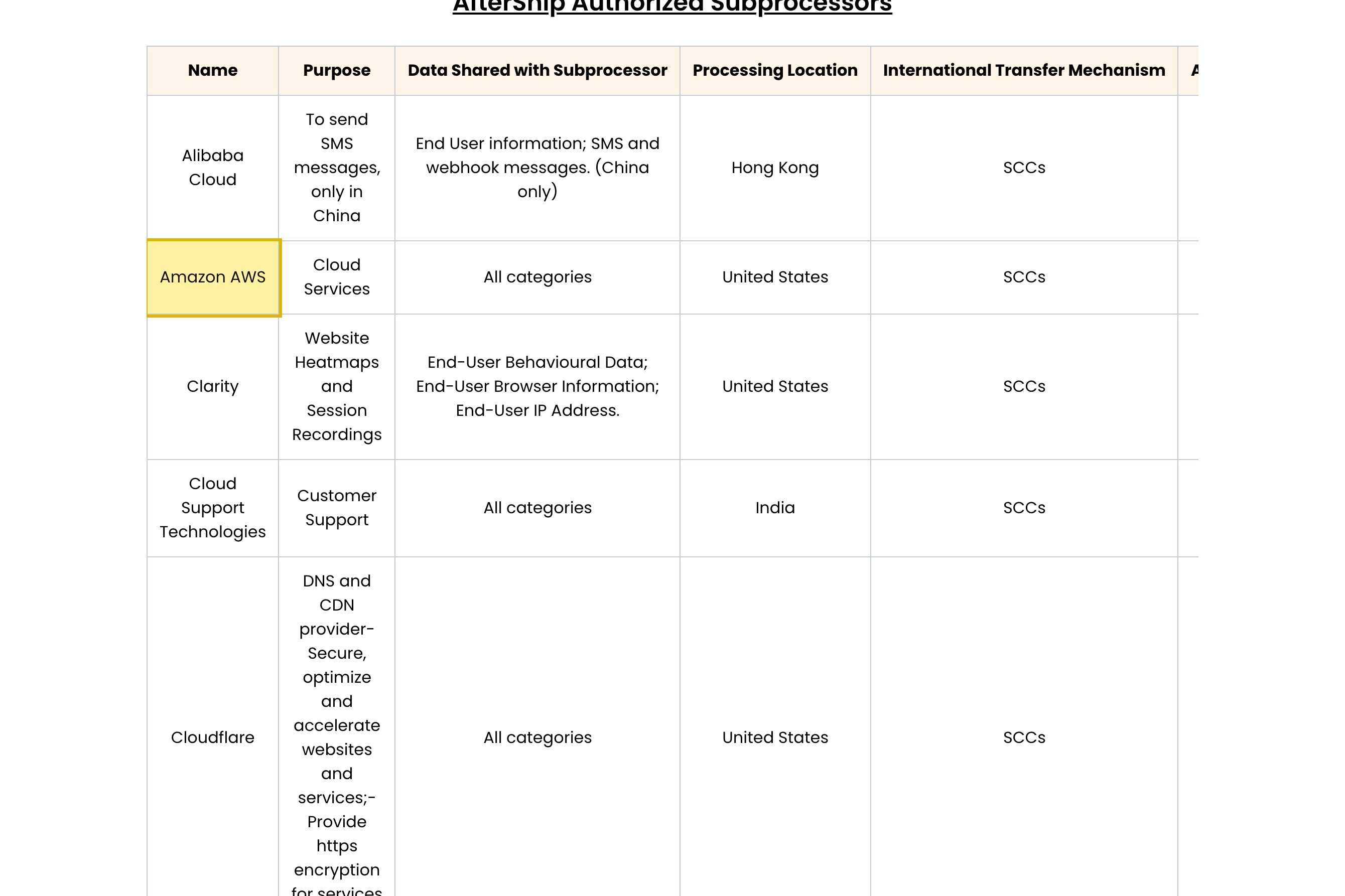
| In AfterShip's own sub-processor list: its cloud hosts "Amazon AWS" and Google Cloud Platform — both receiving "All categories" of data — are located in the "United States," and its only China-capable vendor, "Alibaba Cloud," is used "To send SMS messages, only in China" from a "Hong Kong" location. Every listed sub-processor sits in the United States, India or Hong Kong — none in mainland China. AfterShip is headquartered in Hong Kong, which is not mainland China for data-residency purposes. | AfterShip — List of Authorized Subprocessors (last updated 15 July 2024), retrieved 2026-10-12 |
| The same list shows what is fanned out: "Shipping Information," "Order Information," "End-User Information" and "Tracking Information" are shared with United-States-based vendors including SendGrid and Twilio, and every transfer is covered only by "SCCs" (EU standard contractual clauses) — a GDPR mechanism, not a China cross-border mechanism. AfterShip's own site also advertises more than "1,200+ Carriers" it integrates with, so a China recipient's parcel data touches many offshore parties, not one. | AfterShip — List of Authorized Subprocessors and product site, retrieved 2026-10-12 |
| Because AfterShip holds the name, delivery address and phone number of recipients in China and stores them offshore, that is a cross-border transfer of personal information PIPL governs: the handler (you, the AfterShip customer — not AfterShip) must give notice, obtain separate consent, and satisfy a transfer mechanism — a CAC security assessment, the CAC standard contract, or certification (PIPL Articles 38–40). A delivery address and phone number can be sensitive personal information, raising the Article 28–29 bar. | PIPL — Personal Information Protection Law, Chapter III (Articles 38–43) |
| For a critical information infrastructure operator or a large-volume handler, the Cybersecurity Law's Article 39 (formerly Article 37) — the 2025 amendment in force 1 January 2026 renumbered the data-localization article from 37 to 39, substance unchanged — requires personal information generated in China to be stored in the mainland, which an offshore AfterShip account cannot satisfy. And a China-facing branded tracking page is an internet information service that carries an ICP filing duty bound to mainland hosting. | China Cybersecurity Law — Article 39 (formerly Article 37); ICP filing requirement |
Sources verified by the 21YunBox compliance team on 2026-10-12.
For a company running AfterShip to track parcels into mainland China, the deciding question is not how quickly the tracking page paints from Shanghai. It is where your data is allowed to live and who is allowed to show it — because AfterShip is the post-purchase layer that ingests your China consignees’ personal information in bulk. Every shipment carries a recipient’s name, a delivery address and a phone number; AfterShip takes in that information across all of your China orders, pulls status from the carriers, notifies the shopper by email and SMS, and shows them a branded tracking page. AfterShip is a cloud-only SaaS platform, and by its own authorized sub-processor list it runs on offshore infrastructure — Amazon AWS and Google Cloud Platform in the United States — with no region inside mainland China. So all of that recipient data is held and processed abroad. That makes this a compliance-risk question first, not a performance one.
AfterShip in China at a glance
| What decides it | In AfterShip's own terms — and China's law |
|---|---|
| What it holds | Your China consignees' personal information, in bulk: every recipient's name, delivery address and phone number, plus the order, shipment and tracking records tied to them — and the branded tracking page you show shoppers. This is high-volume consumer PII, one record per parcel. |
| Where it runs | AfterShip is a cloud-only SaaS platform. On its own authorized sub-processor list, its cloud hosts Amazon AWS and Google Cloud Platform are in the United States; its only China-capable vendor, Alibaba Cloud, is used only for SMS from a Hong Kong location; support vendors are in India. No entry is in mainland China. Hong Kong is not mainland China for data-residency purposes. |
| Recipient PII & cross-border | Holding China recipients' names, addresses and phones in an offshore region is a cross-border transfer under PIPL Articles 38–40, layered on the Article 13/23 notice-and-consent. A delivery address and phone number can be sensitive personal information, raising the Article 28–29 bar for separate consent and necessity. |
| High-volume in-country storage | Because this is high-volume consumer PII — one recipient per shipment, at scale — the Cybersecurity Law Article 39 (formerly Article 37) in-country-storage duty can come into play for a critical information infrastructure operator or a large-volume handler, which an offshore AfterShip account cannot satisfy. Treat it as a risk to confirm with counsel, not a settled label. |
| The multi-party fan-out | This is the half a reachability check never sees. AfterShip does not hold the data in one place — its own list shows the recipient's Shipping, Order, End-User and Tracking Information handed to a spread of offshore vendors (email, SMS, CDN, analytics, support), and AfterShip advertises integrations with more than “1,200+ Carriers” it queries for status. A China recipient's details are spread across many offshore parties, not one. |
| A consumer-facing tracking page | The branded tracking page AfterShip serves to mainland shoppers is a public internet information service, so it carries an ICP filing (备案) duty bound to a mainland hosting resource. An AfterShip-hosted page runs on offshore infrastructure, so it offers no ICP-filing path of its own. |
| Reachability is not the axis | Whether the tracking page loads quickly from the mainland is operational, not the compliance question. What decides it is where the recipient PII lives, how far it is fanned out, and whether the tracking page is filed. 21YunBox helps you keep the regulated data in-country, ICP-file the tracking page, and deliver it compliantly — the 21YunBox Optimizer — in front of the AfterShip you already run. |
What it actually holds — your China consignees, in bulk
AfterShip is not a static asset like a font or a script; it is the post-purchase system that sits on top of every China shipment you make, and it concentrates exactly the kind of personal information China’s law cares about most. One record per parcel means, at scale, a standing database of your China recipients — names, delivery addresses down to the door, and phone numbers — joined to order, shipment and tracking detail. A home address and a mobile number are not incidental metadata; they are the sensitive end of personal information. Because AfterShip is a cloud-only SaaS platform hosted, on its own sub-processor list, in Amazon AWS and Google Cloud Platform regions in the United States, that bulk recipient data is held and processed abroad by default — and Hong Kong, where AfterShip is headquartered and where its lone Alibaba Cloud SMS vendor sits, is not mainland China for residency purposes.
The doors: recipient-PII residency, the multi-party fan-out, and the ICP tracking page
The first door is personal-information residency. The recipient identities your AfterShip account collects from people in China are personal information under China’s Personal Information Protection Law, and holding them in an offshore region is a cross-border transfer (数据出境). The duty lands on you, the handler, not on AfterShip: Articles 13 and 23 require notice and a basis to collect the data, and Articles 38–40 require a transfer mechanism to send it abroad — a CAC security assessment, the CAC standard contract, or certification. Because a delivery address and phone number can be sensitive personal information, PIPL Articles 28–29 add a specific-purpose, necessity and separate-consent test. And because this is high-volume consumer PII, for a critical information infrastructure operator or a large-volume handler the Cybersecurity Law’s Article 39 (formerly Article 37 — the 2025 Cybersecurity Law amendment, in force January 1, 2026, renumbered the data-localization article from 37 to 39, with its substance unchanged) requires personal information generated in China to be stored in the mainland, which an offshore account cannot satisfy.
The second door is the one that makes a tracking platform different from an ordinary SaaS, and it is the half a speed test never sees: the fan-out. AfterShip does not keep the recipient’s data in a single store. By its own authorized sub-processor list, the recipient’s Shipping, Order, End-User and Tracking Information is shared with a spread of offshore vendors — email and SMS notification, CDN, analytics and support providers, almost all in the United States under EU standard contractual clauses rather than a China transfer mechanism — and AfterShip integrates more than 1,200 carriers (its own published figure) that it queries for status. Every one of those hops is another party, abroad, touching a China consignee’s name, address or phone. Bulk ingestion plus multi-party fan-out is a far larger exposure than “the page loaded,” and it is invisible to a reachability check.
The third door is the ICP filing. The branded tracking page AfterShip shows your mainland shoppers is a public internet information service, and serving it to users in China turns on an ICP filing (ICP 备案) duty bound to a hosting resource physically inside the mainland. An AfterShip-hosted tracking page runs offshore, so there is nothing on it to file against — tuning the stack does not create the mainland footing a filing needs.
A reachability check never sees this
AfterShip is not the kind of service that simply refuses to load in China — the exposure is quieter and more durable than a slow paint. Even if the tracking page opened instantly, using it would still place your China recipients’ names, addresses and phone numbers outside the country, and fan them out to a line of offshore sub-processors and carriers. A reachability test answers “did the page come back?”; it is blind to where the recipient PII comes to rest, how many parties hold a copy, and whether the consumer-facing tracking page is lawfully filed. Where the data lives and who is allowed to show it, not how fast it arrives, is what China’s law responds to.
This is a risk map, not a verdict that AfterShip is “blocked” or “illegal” in China. Which duties bite your case turns on your entity, the volume of recipients you handle, your role under Chinese law, and what your tracking page exposes — worth settling the specifics with counsel before your China operation depends on it.
The lawful path — map, localize, deliver
There is a compliant way to run post-purchase tracking for a China operation, and it sits in front of the AfterShip your team already uses — no rebuild, no second tool, no migration.
First, map: our China team inventories what your AfterShip account holds — the bulk recipient PII (names, addresses, phones), the order, shipment and tracking records, the sub-processors and carriers it fans data out to, and the branded tracking page — establishes where it is hosted (offshore AWS and Google Cloud regions), the ICP status of the tracking page, and the consent and residency basis each flow relies on. We build the technical picture; the legal conclusions are settled with counsel.
Then localize/govern: we help you keep the regulated data — your China recipients’ personal information — on a lawful in-country path, obtain the Article 13/23 notice-and-consent and the separate consent an address and phone can require, and honor the high-volume in-country-storage duty rather than leaving the data to rest abroad and spread across offshore parties. Localize means keeping the data on an in-country path — never a route that ships it offshore anyway.
Then deliver: the consumer-facing China tracking page is an internet information service, so it carries an ICP filing duty bound to mainland hosting and needs compliant, in-country delivery. 21YunBox stands that up — the 21YunBox Optimizer — in front of what you already run, so your tracking page serves shoppers in China legally and compliantly. 21YunBox never uses or suggests circumvention of any kind — we keep in-country what the law says must stay, deliver the rest compliantly from inside the mainland, and never move personal information across the border by stealth. Making an offshore account merely reachable is not the answer; keeping the recipient data in-country, ICP-filing the tracking page and delivering it compliantly is. 21YunBox is a compliance overlay and partner to the post-purchase platform you already run, not a competitor to it.
Related reading:
- How to get an ICP filing for China
- Cross-border data transfers under PIPL
- China’s Personal Information Protection Law (PIPL)
- China’s Cybersecurity Law


