
Does Heroku work in China?
Whether Heroku works in China is an ICP and data-residency question, not whether Heroku is "blocked." Heroku is a platform-as-a-service that runs on offshore AWS regions and has no region inside mainland China, so a China-facing app is served from offshore — and that one fact sets both answers that matter.
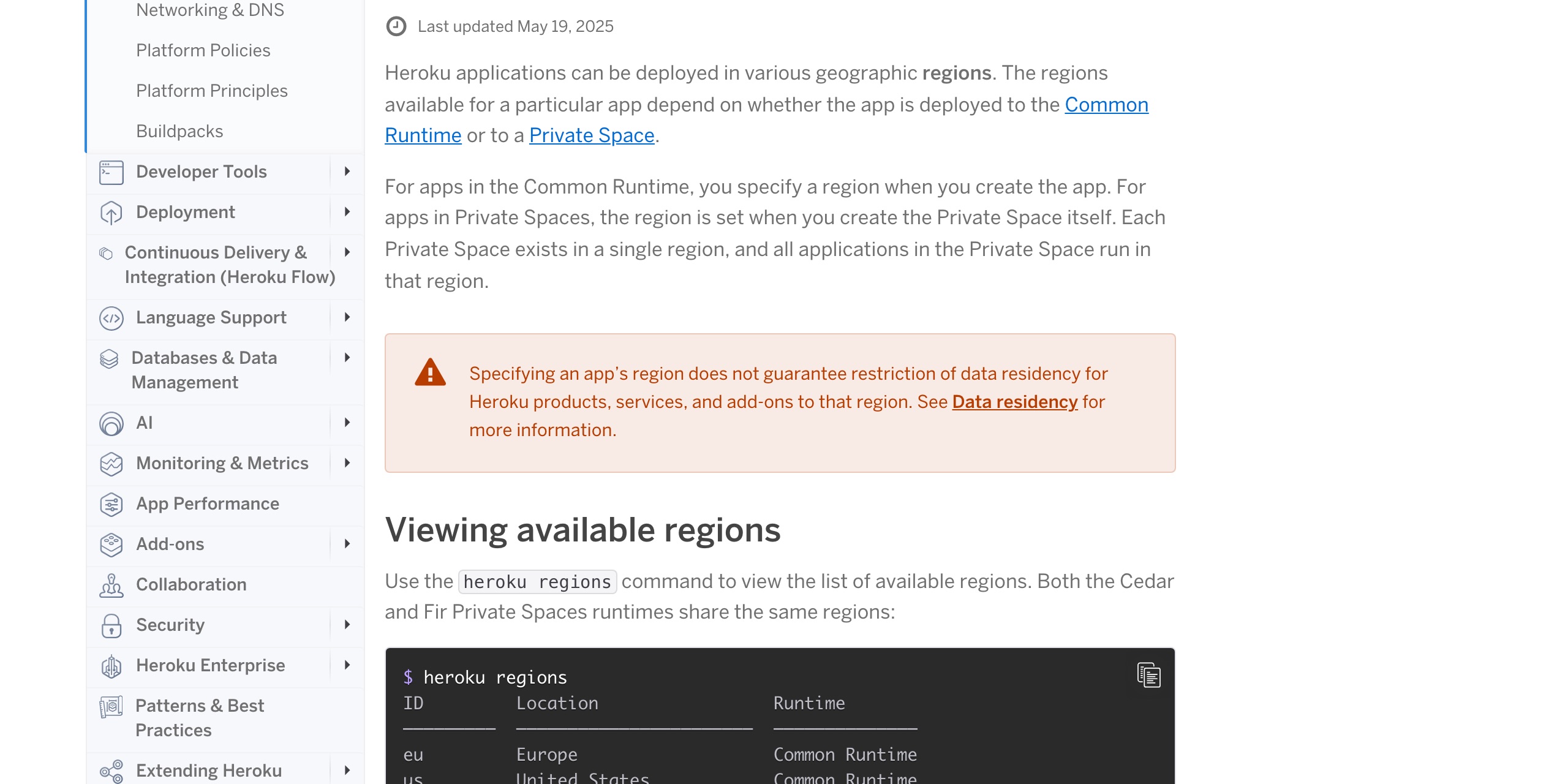
Heroku's own Regions documentation lists only Europe and the United States for its Common Runtime and adds Private Spaces in Dublin, Frankfurt, London, Montreal, Mumbai, Oregon, Singapore, Sydney, Tokyo and Virginia — none in the mainland — and states that "Dynos and databases reside physically in the region where you create them." Two things follow for a China audience: a public mainland app needs an ICP filing tied to a licensed in-country host, which an offshore platform has nothing to attach to; and the personal data your app and its Heroku-managed database hold for Chinese users becomes a cross-border transfer PIPL governs. The table below sets Heroku's own wording against the rule each door triggers.
This is a risk picture, not a verdict — what applies turns on whether you serve the public in China and the personal data your app stores. Our China team can map your Heroku hosting and data exposure with you →
Compliance snapshot
- ✕ Heroku runs on offshore AWS regions — its Common Runtime offers only Europe and the United States, and no Heroku region is in mainland China
- ✕ Served offshore, a public mainland app has no ICP-filing path — the filing needs a licensed in-country host Heroku doesn't provide
- ! Personal data in your dynos and Heroku-managed database sits offshore — for Chinese users that's a cross-border transfer under PIPL
- ! Reachable is not the same as compliant — a Heroku app can load in China yet still create neither an ICP filing nor in-country data residency
- ✓ Compliant path: keep Heroku as your origin and add ICP-filed, in-country delivery and storage in front of it — an overlay, not a rebuild
What actually decides whether you can run Heroku in China
| Fact | Primary source |
|---|---|
| Heroku runs on offshore AWS regions, with none in mainland China. Heroku's Regions documentation lists two Common Runtime regions — Europe and United States — and Private Spaces in Dublin, Frankfurt, London, Montreal, Mumbai, Oregon, Singapore, Sydney, Tokyo and Virginia; not one is in the mainland. Heroku's own Platform API shows these regions map to Amazon Web Services (for example, "the Frankfurt region maps to the Amazon Web Services eu-central-1 region"), so a China-facing app is served from offshore infrastructure. | Heroku Dev Center — Regions, retrieved 2026-10-07 (last updated May 19, 2025) |
| A public mainland app needs an ICP filing, and an offshore Heroku app has nothing to file against. Under State Council Order No. 292 (Article 4) and MIIT Order No. 33, an ICP filing (备案) attaches to a hosting resource physically inside mainland China and to a mainland legal entity. With no mainland region, Heroku offers no in-country resource for the filing — the door is where the hosting sits, not Heroku's code. | State Council Order No. 292 (Measures for the Administration of Internet Information Services), Article 4; MIIT Order No. 33 |
| Your dynos and database physically reside in the region you pick — offshore — which PIPL treats as a cross-border transfer. In Heroku's words, "Dynos and databases reside physically in the region where you create them," and it cautions that "specifying an app's region does not guarantee restriction of data residency" for its wider products and add-ons. With no mainland region, the personal data of Chinese users leaves the country, and PIPL governs it (Chapter III, Articles 38–43: notice, separate consent, and one transfer mechanism — a CAC security assessment, the CAC standard contract, or certification). A CIIO or large-volume handler must keep data collected in China inside the mainland (PIPL Article 40; Cybersecurity Law Article 39 (formerly Article 37)). | Heroku Dev Center — Regions (Data residency), retrieved 2026-10-07; PIPL Chapter III, Articles 38–43 and Article 40; Cybersecurity Law Article 39 (formerly Article 37) |
| The weight of that duty scales with volume and role, not with using Heroku. Under the CAC's March 2024 Regulations on Promoting and Regulating Cross-border Data Flows, a non-CIIO transferring fewer than 100,000 individuals' non-sensitive personal information in a calendar year is exempt from the security assessment, the standard contract and certification — so what you owe turns on your entity and your data volumes, a question for counsel. | CAC — Regulations on Promoting and Regulating Cross-border Data Flows, March 2024 |
Sources verified by the 21YunBox compliance team on 2026-10-07.
Heroku is one of the best-known platform-as-a-service clouds — you push code and it builds, runs and scales your app — and “how to make Heroku work in China” is usually answered as a speed problem. For a mainland-China audience it is really two compliance problems, and they are decided before performance ever enters the frame: where Heroku is allowed to run your app, and where the data it holds is allowed to live. Heroku runs on Amazon Web Services and, by its own documentation, operates no region inside mainland China — so a China-facing Heroku app is reachable, but entirely offshore.
That offshore footing is the half of the question no amount of tuning answers. Below is what Heroku documents about where its regions sit and where your dynos and database physically reside, the ICP filing a public mainland site turns on, and how China’s Personal Information Protection Law treats the data your app collects — drawn from Heroku’s own documentation and China’s own statutes, so the call belongs with your counsel rather than with a benchmark.
Heroku in China at a glance
| What decides it | In Heroku's own terms |
|---|---|
| Where it runs | A platform-as-a-service that runs on Amazon Web Services. Its Common Runtime offers two regions — Europe and United States — and its Private Spaces add Dublin, Frankfurt, London, Montreal, Mumbai, Oregon, Singapore, Sydney, Tokyo and Virginia. None sits inside mainland China; the nearest, Singapore or Tokyo, is still offshore. |
| What runs there | Heroku runs your dynos (app processes) and its managed databases in the region you pick — in its own words, “Dynos and databases reside physically in the region where you create them.” Whatever your app stores lives wherever that region is. |
| Serving the public | A site or app served to mainland visitors from inside China needs an ICP filing tied to a mainland hosting resource. With no mainland region, Heroku offers no ICP-filing path of its own. |
| Your data on Heroku | Personal data of Chinese users held in a Heroku app or a Heroku-managed database sits offshore — a cross-border transfer PIPL governs, plus a data-localization duty for CIIOs and large-volume handlers that offshore regions cannot meet. |
| Is it reachable? | Reachability is a delivery question, not a compliance one. Even when a Heroku app loads for mainland users, it is served from offshore and creates neither an ICP filing nor in-country data residency. |
No mainland region, nothing to file an ICP against
Heroku’s Regions documentation is where the China answer is actually decided. Its Common Runtime gives you two regions — Europe and United States — and its Private Spaces add Dublin, Frankfurt, London, Montreal, Mumbai, Oregon, Singapore, Sydney, Tokyo and Virginia. Not one is in mainland China, and the closest of them, Singapore or Tokyo, is still outside it. Those regions run on Amazon Web Services — Heroku’s own Platform API shows, for instance, that the Frankfurt region “maps to the Amazon Web Services eu-central-1 region” — so wherever you deploy, your app answers from offshore.
That geography settles the licensing question before performance is ever in the picture. A public-facing site or app delivered to mainland visitors from inside China turns on an ICP filing (ICP 备案) under State Council Order No. 292 and MIIT Order No. 33, and that filing must attach to a hosting resource physically located in the mainland. Heroku has none to offer, so there is simply nothing on Heroku for a filing to bind to. “We already run on Heroku” is not the same as being cleared to operate in China: a one-command deploy reaches the mainland, but it does not conjure the in-country footing a filing requires.
Where your China users’ data physically resides
Heroku is explicit about where your data sits. In its Data residency notes it states that “Dynos and databases reside physically in the region where you create them” — and because none of those regions is in the mainland, the personal data your app collects from Chinese users comes to rest in the United States or Europe, never China. Heroku even cautions that “specifying an app’s region does not guarantee restriction of data residency” for its wider products, services and add-ons, so the offshore footprint can be broader than the single region you chose.
Under China’s Personal Information Protection Law that movement of data out of the country is a cross-border transfer, and the obligation falls on the handler — you, Heroku’s customer, not Heroku — to give notice, obtain separate consent, and clear one transfer mechanism: a CAC security assessment, the CAC standard contract, or certification. If you are a critical information infrastructure operator or a large-volume handler, personal information collected in China must be stored in the mainland (PIPL Article 40; Cybersecurity Law Article 39 (formerly Article 37)) — a residency duty none of Heroku’s offshore regions can satisfy. How heavy that duty is scales with your data volumes and your role, which is why it belongs with counsel rather than with a default assumption.
Reachable, yet not cleared for China
China does not categorically block Heroku, and that is exactly what makes the delivery answer misleading. However quickly a Heroku app paints for a mainland visitor, it paints from offshore — and serving it from there produces neither an ICP filing nor in-country data residency. Those are not latencies you can optimize away; they are facts about where your hosting sits and where your data lands. A faster offshore app is still an offshore app, with both compliance doors still shut.
None of this is a verdict on your specific setup. Whether you need an ICP filing, in-country storage, or both depends on what you serve to the public, how much personal data you hold, and who your users are — worth settling with counsel before you build, not after.
Where 21YunBox fits — a compliant overlay, not a migration
You keep shipping on Heroku exactly as you do today — same git push, same buildpacks, same dynos and add-ons. What a mainland-China audience adds is the single thing a platform with no in-country region cannot: compliant, ICP-filed delivery from inside the mainland, placed in front of your existing Heroku origin, with a fixed in-country entry so each visitor’s real IP is not carried across the border. Our China team maps which ICP and data-residency obligations apply to your entity and the data your app holds, handles the ICP filing, and stands up the in-country entry — and, where the law requires your users’ data to stay on Chinese soil, helps you run the data layer inside the mainland. No rebuild, no second codebase, no move off Heroku.
Related reading:
Frequently Asked Questions
Is Heroku blocked in China?
No — but that is the delivery half of the question, and the half that misleads. Heroku is not a service China categorically blocks, so a Heroku app can load for mainland visitors. What it does not do is make that app compliant: Heroku runs on offshore AWS regions with none in mainland China, so a public mainland app has no ICP-filing path, and the personal data in your dynos and Heroku-managed database sits offshore under PIPL. A faster offshore response is still an offshore response.
Can we host our Heroku app inside mainland China?
Not on Heroku itself — its Regions documentation lists no mainland-China region, and there is no migration option that puts your dynos in the mainland. The compliant pattern is to keep Heroku as your origin and add ICP-filed, in-country delivery in front of it for mainland visitors, and — where the law requires your users' data to stay on Chinese soil — stand up in-country storage. Whether you need an ICP filing, in-country data residency, or both is a risk to confirm with counsel.
Can 21YunBox help make our Heroku app compliant in China?
Yes. Our China team can assess your ICP and data-residency exposure for your entity and the personal data your app stores, handle the ICP filing, and stand up ICP-filed, in-country delivery in front of your Heroku origin — and, where the law requires, in-country storage — without moving you off Heroku. Get in touch to work through your specific setup.
