Does Gatsby Cloud work in China?
Gatsby Cloud no longer exists — Netlify, which acquired Gatsby, sunset it and moved existing sites onto its own platform. So the real question is not how to speed up Gatsby Cloud, but how a Gatsby site, hosted elsewhere now, lawfully reaches mainland China — and that turns on two gates its new host cannot clear alone: an ICP filing, and a PIPL-aware way to handle visitor data.
In Netlify's own words, "following our acquisition of Gatsby in February 2023," it is "notifying all Gatsby Cloud customers of an end of service date for Gatsby Cloud products and services," with "direct migration paths to Netlify Cloud" — and "while this will impact the Gatsby Cloud product, it will not impact Gatsby JS." Wherever the framework lands next, that host is global by design: Netlify describes its network as "a global platform" serving "worldwide edge locations," with none in mainland China. Two consequences follow for a public China audience — a site served to the mainland needs an ICP filing tied to a licensed mainland host (State Council Order No. 292; MIIT Order No. 33), which a worldwide edge cannot hold; and a mainland visitor's real IP is personal information, so carrying it offshore is a cross-border transfer PIPL governs. The table below is the vendors' own wording and the rule each gate triggers.
This is a risk map, not a verdict — which gate applies, and how much, turns on your entity, your data and who your users are. Our China team can map your exposure and the filing path with you →
Compliance snapshot
- ✕ Gatsby Cloud is discontinued — Netlify acquired Gatsby and sunset the hosting product
- ✓ Gatsby the open-source framework lives on — your Gatsby site still builds, just on a new host
- ✕ That new host (e.g. Netlify's global edge) is offshore — nothing in-country to hold an ICP filing
- ! Serving mainland visitors from offshore, and carrying their data across the border, raises PIPL questions
- ✓ Compliant path: 21YunBox ICP-filed in-country delivery in front of your new host — an overlay, not a migration
What actually decides whether a Gatsby site can serve mainland China now
| Fact | Primary source |
|---|---|
Gatsby Cloud has been sunset — it is no longer a product you can deploy to. In Netlify's own announcement, "following our acquisition of Gatsby in February 2023," Netlify is "notifying all Gatsby Cloud customers of an end of service date for Gatsby Cloud products and services," with "direct migration paths to Netlify Cloud for all Gatsby Cloud customers." Gatsby's own gatsbyjs.com/products/cloud/ page now returns a permanent redirect straight to that notice. There is no Gatsby Cloud left to "speed up" — the question moved to wherever the Gatsby build is hosted now. | Netlify — "The Evolution of Gatsby Cloud" (netlify.com/blog/gatsby-cloud-evolution), retrieved 2026-10-07; gatsbyjs.com/products/cloud 301 redirect verified 2026-10-07 |
| Gatsby the framework lives on; only the hosting product went away. Netlify is explicit that "while this will impact the Gatsby Cloud product, it will not impact Gatsby JS," and that acquiring Gatsby let it "secure the future of the open source framework." A Gatsby site still builds and ships — it simply deploys on a general host now, with Netlify as the vendor-provided path. Which means "does Gatsby work in China" is really a question about that host, not about a service that has been retired. | Netlify — "The Evolution of Gatsby Cloud" (netlify.com/blog/gatsby-cloud-evolution), retrieved 2026-10-07 |
| The new host is global by design, with no mainland-China presence — so it cannot hold an ICP filing. Netlify describes its network, in its own words, as "a global platform" that ships "to worldwide edge locations," and the page names no mainland-China location (its highlighted figure is "70+ global locations"). A public site shown to mainland visitors needs an ICP filing (备案) bound to a licensed mainland host and a mainland legal entity (State Council Order No. 292; MIIT Order No. 33) — something a worldwide edge, by construction, does not include. | Netlify — Netlify Edge (netlify.com/platform/core/edge), retrieved 2026-10-07; State Council Order No. 292; MIIT Order No. 33 |
| A mainland visitor's real IP is personal information, so serving China from an offshore host is a PIPL question. Carrying every visitor's real IP and request logs out of the mainland to an offshore origin is a cross-border transfer under PIPL (Chapter III, Articles 38–43: notice, separate consent, and one permitted transfer mechanism; Article 40, with Cybersecurity Law Article 39 (formerly Article 37), adds in-country storage for a critical information infrastructure operator or large-volume handler). The compliant design answers it by terminating mainland visitors at an in-country, ICP-filed entry and sending a single fixed in-country IP to your origin. | PIPL Chapter III, Articles 38–43 and Article 40; Cybersecurity Law Article 39 (formerly Article 37) |
Sources verified by the 21YunBox compliance team on 2026-10-07.
This guide once explained how to make Gatsby Cloud load quickly in mainland China. It can’t be that guide anymore, because Gatsby Cloud is no longer a product. Netlify acquired Gatsby and sunset the hosting service, giving existing customers an end-of-service date and a path to migrate their sites onto Netlify’s own platform. What came through the change intact is Gatsby itself — the open-source framework — which still builds and deploys, now on a general host rather than a dedicated one. So the useful question today is not how do I speed up Gatsby Cloud but where does my Gatsby site run now, and what does it take to serve it, lawfully, to people in mainland China? That is a compliance question before it is a performance one — and the rest of this page follows that order.
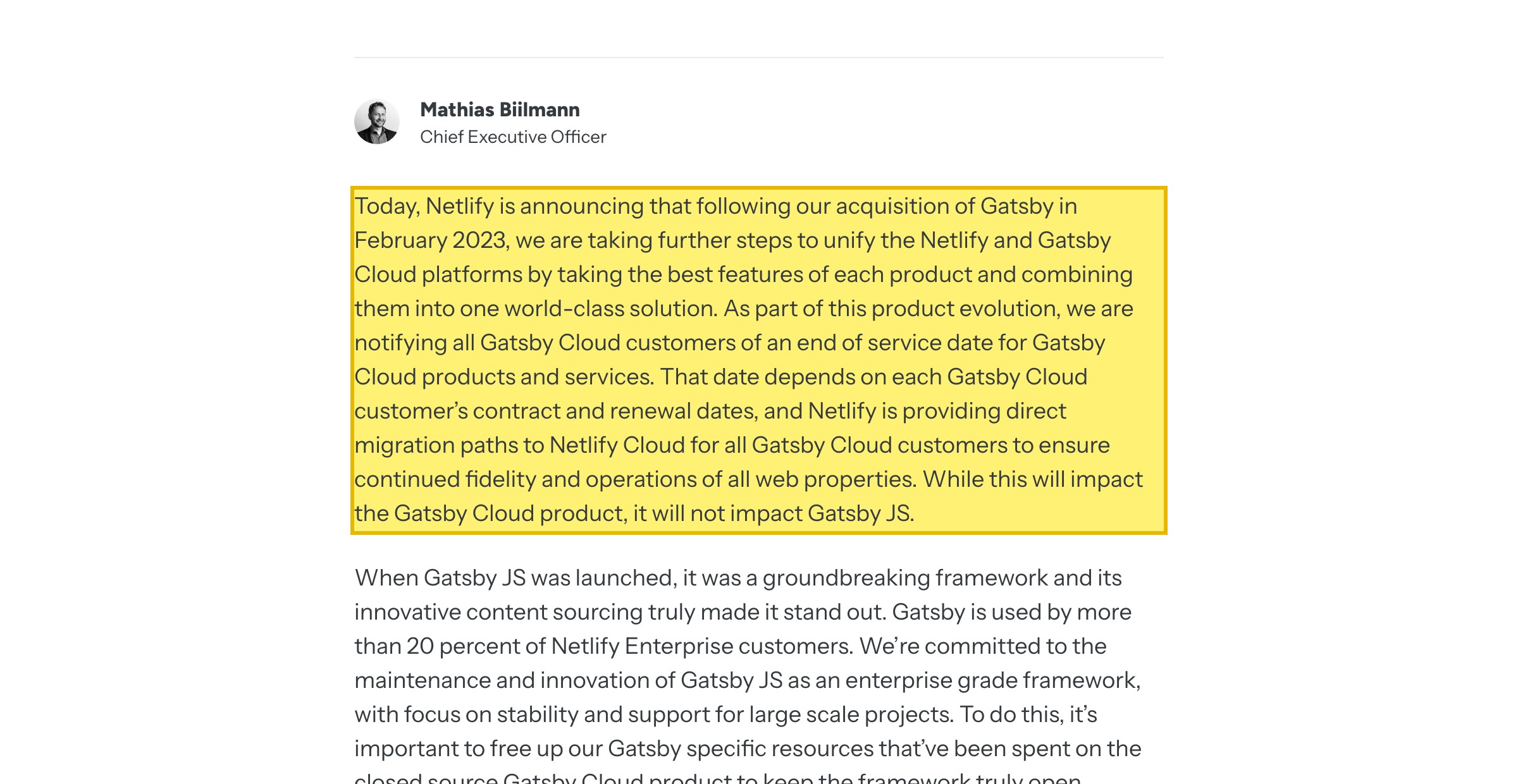
gatsbyjs.com/products/cloud/ URL now redirects here, and the framework continues — “it will not impact Gatsby JS.” Source: netlify.com/blog/gatsby-cloud-evolutionA Gatsby site in China at a glance
| What decides it | In the vendors' own words — and China's own law |
|---|---|
| What happened to Gatsby Cloud | It was discontinued. Following Netlify's “acquisition of Gatsby in February 2023,” Netlify is “notifying all Gatsby Cloud customers of an end of service date,” with “direct migration paths to Netlify Cloud.” |
| What still exists | Gatsby JS, the open-source framework. Netlify: “it will not impact Gatsby JS.” Your Gatsby site still builds and ships — on a new host now. |
| Where a Gatsby site runs now | A global host (Netlify is the vendor-provided path). Netlify Edge is, in its words, “a global platform” shipping “to worldwide edge locations” — none in mainland China. |
| Serving the public in China | Needs an ICP filing tied to a licensed mainland host and a mainland legal entity (State Council Order No. 292; MIIT Order No. 33). A worldwide edge has nothing in-country to hold it. |
| Visitor data at the border | A mainland visitor's real IP is personal information; carrying it offshore is a cross-border transfer under PIPL (Articles 38–43; Article 40 with Cybersecurity Law Article 39 (formerly Article 37)). |
| The working design | Keep Gatsby and your host as origin; add an ICP-filed, in-country entry in front for mainland visitors. An overlay, not a migration. |
First, the correction: Gatsby Cloud is gone
It is worth being exact about what changed, because the name still appears in a great many old tutorials — this one included. Netlify’s announcement is unambiguous: following its acquisition of Gatsby, it is retiring the Gatsby Cloud product and moving customers onto Netlify Cloud. Gatsby’s own product page for Cloud now redirects straight to that notice, which is about as plain a signal as a vendor gives that something is finished. The framework, to be clear, is not going anywhere — Netlify says the change does “not impact Gatsby JS” — but the managed hosting you may remember as Gatsby Cloud is not something you can deploy to today. If you are here because a Gatsby site needs to work in China, the first step is simply to know where that site is hosted now; every compliance question below hangs off that one answer.
Gate one: the filing your new host can’t hold
Serving mainland China was never one problem. It is two, and they fail independently: a page can be genuinely fast and still have no permission to be served there, and it can be fully licensed and still crawl across the border. The second gate is the one teams tend to discover late. A public website shown to people in mainland China needs an ICP filing (备案), and under State Council Order No. 292 and MIIT Order No. 33 that filing attaches to a hosting resource physically inside the mainland and to a mainland legal entity. A Gatsby site on Netlify — or on any worldwide platform — has nothing in-country for the filing to attach to. Netlify is candid about the shape of its network: in its own words it is “a global platform” that ships “to worldwide edge locations,” none of them in mainland China. That makes it a strong global origin and, by the very same fact, not an in-country China presence.
Here is the part that catches people. The one move that finally makes a Gatsby page quick inside the mainland — delivering it from in-country — is the very move that brings it under the filing. Speed and the filing are not two separate errands; they are a single door approached from two sides. Which is why any arrangement that stays offshore to sidestep the filing is also, unavoidably, the arrangement that keeps the slow, filtered border crossing it was trying to escape.
Gate two: visitor data at the border
The filing is about where the site is served from. The second compliance question is about what crosses the border once it is being served. A mainland visitor’s real IP address is personal information under China’s Personal Information Protection Law, and so are the request logs that travel with it. Serving those visitors from an offshore host means their personal data leaves the mainland on every request — a cross-border transfer PIPL governs through Chapter III, Articles 38–43: notice, separate consent, and one permitted transfer mechanism (a CAC security assessment, the CAC standard contract, or certification). For a critical information infrastructure operator or a large-volume handler, Article 40 — read with Cybersecurity Law Article 39 (formerly Article 37) — adds a duty to keep that data inside China.
A compliant design does the opposite of the naive one. It terminates mainland visitors at an in-country entry and sends a single, fixed in-country address on to your Gatsby origin, instead of carrying each visitor’s own IP out of the country. Your origin seeing one in-country address rather than every real client IP is the design working as intended, not a defect to engineer around.
None of this is a verdict on your particular site. It is a risk map — which gate applies, and how heavily, depends on whether you serve the public in China, on your entity, and on the personal data your site handles, and it is worth settling with counsel rather than assumed.
Where 21YunBox fits — a compliant overlay, not a migration
You keep Gatsby, and you keep whatever host you migrated to — Netlify or anything else — as your origin and source of truth. Netlify stays the global platform it is good at being; 21YunBox adds the one piece a worldwide edge structurally cannot: ICP-filed delivery from inside the mainland, placed in front of your existing origin, with no rebuild and no second codebase. Our China team works out which obligations apply to your entity and your data, handles the ICP filing against in-country infrastructure, and stands up the compliant in-country entry that serves your mainland audience while your Gatsby build keeps shipping exactly as it does today. It is an overlay, not a move — the technical half and the regulatory half brought into line with each other, which is the clause most worth checking in any China proposal you receive, from us or anyone else.
Related reading:
Frequently Asked Questions
Is Gatsby Cloud still available — in China or anywhere?
No. Netlify, which acquired Gatsby in February 2023, has sunset Gatsby Cloud and given every customer an end-of-service date tied to their contract, with direct migration paths onto Netlify's own platform. Gatsby Cloud is not a service you can deploy to today, in China or elsewhere. What continues is Gatsby JS, the open-source framework — so a Gatsby site now runs on a general host, and the China question applies to that host rather than to a retired product.
We moved our Gatsby site to Netlify — does that make it work in mainland China?
Treat it as a risk to assess with counsel, not a yes/no. Netlify is an excellent global origin, but its network is worldwide by design with no mainland-China presence, so two things still apply to a public China audience: a site served to the mainland needs an ICP filing tied to a licensed mainland host, which a global edge cannot hold; and a mainland visitor's personal data leaving the country is a cross-border transfer PIPL governs. Both are gates the new host clears no better than the old one did — they turn on where the site is served from, not on which brand hosts it.
Can 21YunBox help our Gatsby site serve mainland China compliantly?
Yes. You keep Gatsby and your chosen host — Netlify or any other — as your origin and source of truth. Our China team maps which obligations apply to your entity and data, handles the ICP filing against in-country infrastructure, and stands up ICP-filed, in-country delivery in front of your origin for mainland visitors: an overlay, not a migration, with no rebuild and no second codebase. Get in touch to work through your specific case.
