Does Weaviate Work in China? PIPL Cross-Border, Data Residency & Self-Hosting
Weaviate's endpoint is reachable from China, but the objects and dense-vector embeddings you load into it are personal information stored at rest — and Weaviate Cloud has no mainland-China region. Indexing your China users' data there is a PIPL cross-border transfer, and embeddings don't anonymize it. A compliance-first look at the residency exposure and the in-country self-host lever.
Does Weaviate work in China?
Weaviate's endpoint is reachable from China, but the objects and dense-vector embeddings you load into it are personal information sitting at rest in an offshore store — Weaviate Cloud has no mainland-China region, so it's a data-residency and cross-border-transfer problem, not a speed one.
You fill Weaviate with your own content — data objects (text, attributes) plus the embeddings computed from them — and it keeps both. When that content describes people in mainland China, indexing it into a US or EU cluster is a PIPL cross-border transfer (数据出境) and, for a CIIO or high-volume handler, runs into an in-country storage duty. Embeddings do not anonymize it: they are derived from personal data and are open to inversion and membership inference, so a store of vectors is a store of personal information — and Weaviate keeps the source objects alongside them. The lawful lever is to keep the index and embeddings in-country by self-hosting the open-source Weaviate Database (the same engine the managed cloud runs), or a licensed in-country managed option — not to make the offshore endpoint reachable.
This is a risk map, not a verdict — settle the specifics with counsel. Our China team can map your exposure →
What Weaviate's own documentation says about China
| Fact | Primary source |
|---|---|
| Weaviate Cloud (WCD) has no mainland-China region. Weaviate's managed cloud is "available across five cloud regions" and is generally available on AWS in US East (N. Virginia) and Europe (Frankfurt) — none in mainland China. Indexing your China users' objects and embeddings there is a cross-border transfer under PIPL. | Weaviate Cloud docs & 'Weaviate Shared Cloud now generally available on AWS' (retrieved 2026-10-10) |
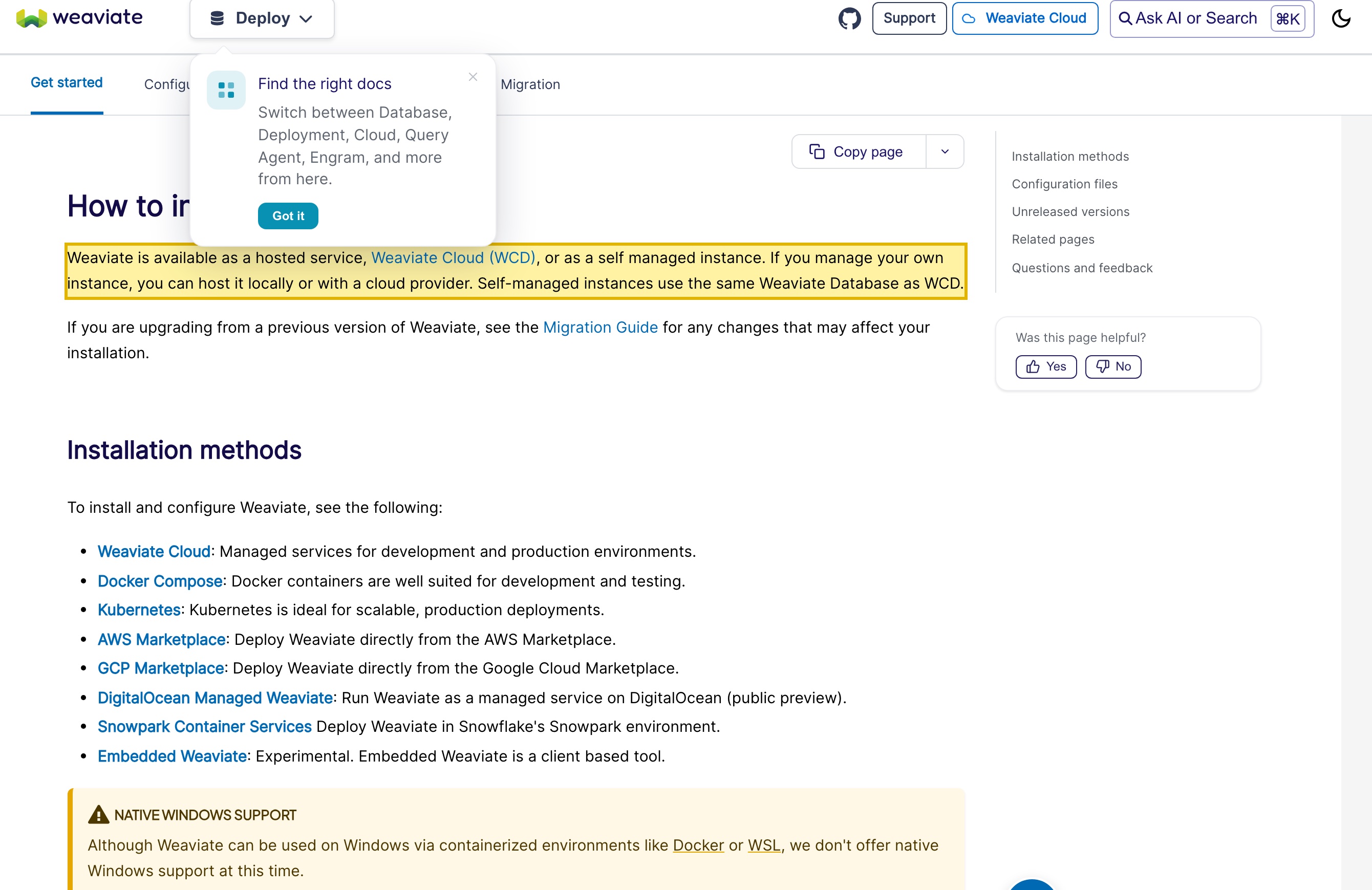
| The core Weaviate Database is open-source and fully self-hostable. Weaviate's docs state it is "available as a hosted service, Weaviate Cloud (WCD), or as a self managed instance," and that "Self-managed instances use the same Weaviate Database as WCD" — BSD-3-Clause, running under Docker or Kubernetes, so the identical engine can run in-country. Some enterprise add-ons in the repo's wl/ folder carry a separate Weaviate License. | Weaviate — Installation / Deploy docs; repository LICENSE (retrieved 2026-10-10) |
| You, not Weaviate, carry the cross-border-transfer duty. PIPL Articles 38–40 require notice, a separate consent, and a transfer mechanism (a CAC security assessment, the CAC standard contract, or certification) before a China user's personal information — the objects you index and the embeddings derived from them — is sent offshore. See the data-export security assessment. | PIPL Articles 38–40; CAC data-export measures (retrieved 2026-10-10) |
| CIIO and high-volume handlers must store China personal information in-country. The Cybersecurity Law's Article 39 (formerly Article 37 — renumbered by the 2025 amendment in force January 1, 2026, substance unchanged) requires in-country storage that an offshore Weaviate index cannot satisfy; embeddings are personal information too (open to inversion and membership inference), so "we only store vectors" does not cure it. | PRC Cybersecurity Law, Article 39 (formerly Article 37) (retrieved 2026-10-10) |
Sources verified by the 21YunBox compliance team on 2026-10-10.
For a product that runs Weaviate for users in mainland China, the first question is usually whether its endpoint can be reached. But reachability is not where the China decision is made. Weaviate is a vector database — its own repository calls it an “open-source vector database that stores both objects and vectors” — which makes it a data-at-rest store: you load it with the content you want to search, the data objects (text, attributes, metadata), and it keeps those objects alongside the dense-vector embeddings computed from them, for semantic and hybrid search and retrieval-augmented generation. For a China-facing product that content routinely describes people, so it is personal information. By default Weaviate runs on Weaviate Cloud (WCD), hosted on AWS in the United States and Europe with no mainland-China region; the core database is also BSD-3-Clause open-source and fully self-hostable. That puts three prongs on the table: a cross-border transfer and residency problem, the fact that embeddings do not anonymize personal data, and the in-country self-host lever.
Weaviate in China at a glance
| What decides it | In Weaviate's own terms — and China's law |
|---|---|
| What you load into it | Data objects — documents, support tickets, product records, knowledge-base articles, user profiles — with their properties (the raw text and attributes), plus one or more dense-vector embeddings per object. Weaviate's own repository describes it as a database that "stores both objects and vectors," so it keeps both the source content and the vectors derived from it. When the objects describe people in mainland China, the whole store is personal information at rest. |
| Where the engine runs | By default on Weaviate Cloud (WCD) — "available across five cloud regions," generally available on AWS in US East (N. Virginia) and Europe (Frankfurt), with no mainland-China region. Indexing China-user objects and embeddings there is a cross-border transfer of personal information (数据出境) under PIPL Articles 38–40, and the duty is on you, the handler. The alternative: run the engine yourself in-country. |
| Embeddings are personal information | A dense-vector embedding is computed from the source text or image; it is not anonymous. Embeddings are open to inversion (reconstructing approximate source content) and membership inference, so a store of embeddings of your users' data is itself a store of their personal information. "We only store vectors" is false comfort — and in Weaviate the source objects sit at rest alongside the vectors anyway. |
| Residency & query-log exposure | A critical information infrastructure operator or high-volume handler owes an in-country storage duty (Cybersecurity Law Article 39, formerly Article 37) that an offshore index cannot satisfy. Query traffic — the search strings you send and the matched records returned — is itself personal information that accumulates in logs wherever the cluster runs. |
| The lawful path | Reachability is not the axis. Keep the index and embeddings in-country — self-host the open-source Weaviate Database (the same engine WCD runs) on mainland infrastructure, or use a managed deployment that runs in-country through a licensed local operator — minimize and pseudonymize what you vectorize, and deliver the querying app in-country on ICP-filed infrastructure. 21YunBox maps, localizes, and delivers; legal conclusions sit with your counsel. |
What you actually store — indexed content and its embeddings
Weaviate is not a page to render; it is a store you fill with your own content. You create collections and load data objects — documents, support tickets, product records, knowledge-base articles, user profiles — each with properties (the raw text and attributes) that Weaviate keeps. For each object Weaviate also stores one or more dense-vector embeddings, numeric representations produced by an embedding model from that object’s content, which is what powers semantic and hybrid search and retrieval-augmented generation. Crucially, Weaviate keeps both: its own repository describes it as an “open-source vector database that stores both objects and vectors.” So the store holds two representations of your users’ information — the source objects and the vectors derived from them. When the objects describe people in mainland China — names, messages, behavior, support history — every one of them is personal information, and the embeddings are personal information too (more on that below). This is a persistent data-at-rest store, not a transient call.
It’s a residency and cross-border-transfer problem — and embeddings don’t anonymize it — under PIPL
Two things bite at once, and most teams only see one. First, the cross-border transfer. The moment you index a mainland-China user’s object into a Weaviate Cloud cluster hosted in the US or EU, you upload their personal information offshore. Under the Personal Information Protection Law that is a cross-border transfer of personal information (数据出境), and the duty is on you, the handler — not on Weaviate. Articles 38–40 require notice, a separate consent distinct from any general terms, and one transfer mechanism: a CAC security assessment, the CAC standard contract, or certification. Above the regulatory thresholds, or where the data qualifies as “important data,” the data-export security assessment (数据出境安全评估) may apply before anything leaves. A critical information infrastructure operator or high-volume handler also owes an in-country storage duty under the Cybersecurity Law’s Article 39 (formerly Article 37 — the data-localization article was renumbered by the 2025 amendment, in force since January 1, 2026, with its substance unchanged) that an offshore index cannot meet; the query traffic — search strings and the records they return — adds its own log of personal information.
Second — and this is the prong most teams miss — embeddings do not anonymize anything. A vector embedding is computed from the source text or image; it is not a random token and it is not anonymous. Published research shows embeddings are subject to inversion (reconstructing approximate source content from the vector) and membership inference (testing whether a given record was in the store), so a collection of embeddings of your users’ data is itself a collection of their personal information, carrying the same residency and cross-border duties as the raw text. “We only send vectors, not raw data” is false comfort — and in Weaviate the point is moot anyway, because it stores the source objects alongside the vectors. None of this turns on how fast the endpoint answers; it turns on whether your China users’ content had a lawful basis to leave the country.
Reaching the endpoint isn’t the question — keeping the index in-country is
So “can we reach Weaviate from China?” is the wrong test. The productive question is how to keep your China users’ objects and embeddings on a lawful, in-country footing — and Weaviate gives you an unusually strong lever, because the core database is genuinely open-source. Weaviate’s own install documentation states it is “available as a hosted service, Weaviate Cloud (WCD), or as a self managed instance,” and that “Self-managed instances use the same Weaviate Database as WCD.” The core database is BSD-3-Clause licensed and runs under Docker or Kubernetes — “Kubernetes is ideal for scalable, production deployments” — so the identical engine can run on mainland infrastructure, keeping the index and the embeddings in-country rather than offshore. Be precise about the license, though: the Weaviate Database core is BSD-3-Clause, while some enterprise add-ons in the repository’s wl/ folder carry a separate Weaviate License — check what you actually deploy.
The lawful path is to keep the data-at-rest store in-country — self-host the open-source engine on mainland infrastructure where you have the operations capability, or use a managed deployment that runs in-country through a licensed local operator — while minimizing and pseudonymizing what you vectorize (index the least identifying content, drop raw identifiers you don’t need) and obtaining the consent the transfer rules require. What this is not is a tunnel that ships the same objects and embeddings offshore anyway; that keeps the endpoint responsive and leaves every PIPL duty exactly where it was. This is a risk map, not a verdict: whether a transfer mechanism, in-country storage, or a reworked consent flow applies to your deployment depends on what you index, how much, and about whom — settle the specifics with counsel before you build.
The lawful path — map, localize, deliver
There is a lawful way to run a vector database for a China-facing product, and it has a shape. First, map: our China team inventories what you load into Weaviate — which objects and properties, what personal information they carry, whether embeddings of personal data are stored (they are), where the cluster runs (a WCD region or self-hosted), the query-log exposure, and on what consent basis China-user data is indexed. We frame the technical picture; you settle the legal conclusions with counsel.
Then localize: keep China-user objects and embeddings in-country. Because the Weaviate Database core is open-source, that can mean self-hosting the engine inside China where you have the capability to run and maintain it, or using a managed deployment that runs in-country through a licensed local operator — in either case minimizing and pseudonymizing what you vectorize and governing any residual transfer. Localizing means keeping the data-at-rest store on an in-country path — never a tunnel that ships the data offshore anyway. Where a license bears on a domestic managed option, that sits with the licensed operator and your counsel; 21YunBox is advisory there.
Then deliver: the China-facing app that queries the index is itself a public-facing service in the mainland, so it carries an ICP filing (备案) duty and needs compliant, in-country delivery — the 21YunBox Optimizer, in front of the stack you already run, with no rebuild and no re-platform. The result is a search-and-retrieval setup that runs legally and compliantly for your users in China. 21YunBox never uses or suggests circumvention of any kind. We are a compliant overlay and partner — not a competitor to Weaviate.
Related reading:
- Cross-border data transfers under PIPL
- China’s Cybersecurity Law (data localization, Article 39)
- China’s data-export security assessment
- How to get an ICP filing for China