Does OpenSearch Work in China? PIPL Cross-Border, Data Residency & Self-Hosting
OpenSearch is a data-at-rest store: the documents you index and the k-NN embeddings it derives are personal information when they describe people in China. The global Amazon OpenSearch Service has no mainland-China region, so indexing China-user data offshore is a PIPL cross-border transfer — a compliance-first look at the residency exposure and the in-country self-host lever.
Does OpenSearch work in China?
OpenSearch is a data-at-rest store of your users' indexed documents and the k-NN embeddings built from them — and the global Amazon OpenSearch Service has no mainland-China region, so for your China users that content sits offshore as a PIPL cross-border transfer with a data-residency question attached.
You load OpenSearch with documents, tickets, logs and records, and its vector engine derives dense embeddings stored alongside the raw payload — all personal information when it describes people in China. Holding it in an offshore cluster is a cross-border transfer under PIPL (notice, separate consent and a transfer mechanism, Articles 38–40), with an in-mainland storage duty for CIIOs and high-volume handlers (Article 40; Cybersecurity Law Article 39 (formerly Article 37)); and because an embedding supports inversion and membership inference, it does not anonymize that duty away. The lawful lever is to keep the index and embeddings in-country — OpenSearch is Apache 2.0 and fully self-hostable on mainland infrastructure, and Amazon OpenSearch Service is also offered in the licensed AWS China (Beijing/Ningxia) partition — not to make an offshore endpoint reachable.
This is a risk map, not a verdict — which transfer mechanism fits, and whether a localization duty applies, turns on your entity, your data volumes and whose data it is. Our China team can map your exposure →
What OpenSearch's own documentation says about China
| Fact | Primary source |
|---|---|
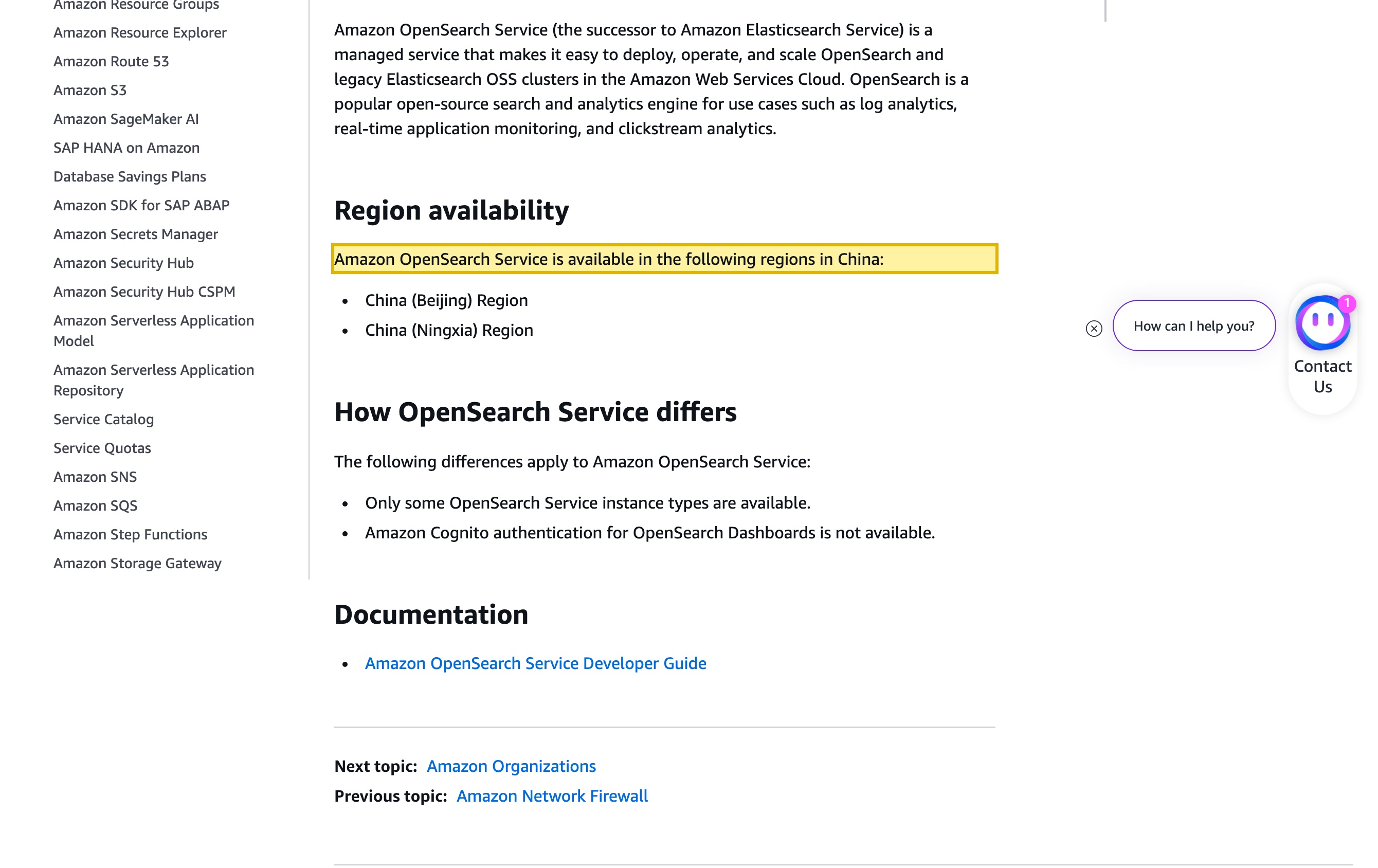
| Amazon OpenSearch Service is available inside the AWS China partition — a genuine in-country managed option. AWS's China documentation states "Amazon OpenSearch Service is available in the following regions in China:" and lists the China (Beijing) Region and the China (Ningxia) Region — the AWS China partition operated by licensed local partners (Sinnet in Beijing, NWCD in Ningxia). It needs a separate AWS China account and only some instance types are available, so treat it as a warn-positive, not a clean global pass — and distinct from the global Amazon OpenSearch Service, which has no mainland-China region. | AWS China Documentation — Amazon OpenSearch Service in Amazon Web Services China (docs.amazonaws.cn), retrieved 2026-10-10 |
| The OpenSearch engine is Apache 2.0 and fully self-hostable — the strongest form of the in-country lever — and its k-NN engine stores embeddings. OpenSearch is the Apache 2.0 open-source search and vector engine, governed by the OpenSearch Software Foundation under the Linux Foundation, so you can run it on infrastructure you choose, including mainland China. Its built-in k-NN vector engine turns text and images into dense-vector embeddings stored in knn_vector fields for semantic search and RAG — personal information at rest when derived from your China users' data. | OpenSearch — opensearch.org (Apache 2.0; OpenSearch Software Foundation / Linux Foundation) and k-NN developer guide, retrieved 2026-10-10 |
| Indexing China-user content offshore is a PIPL cross-border transfer — and embeddings don't exempt it. The documents you index and the embeddings derived from them are personal information when they describe people in China, so holding them in an offshore cluster is a cross-border transfer under PIPL: you, the handler, must give notice, obtain a separate consent, and clear one transfer mechanism (a CAC security assessment, the CAC standard contract, or certification) under Articles 38–40. Because an embedding supports inversion and membership inference, "we only send vectors" is not an exemption. | PIPL Articles 38–40 (cross-border transfer of personal information), retrieved 2026-10-10 |
| For CIIOs and high-volume handlers, China-collected personal data must stay in the mainland — no offshore cluster can meet that. Critical information infrastructure operators and handlers above the regulators' volume thresholds must store China-collected personal data in-country (PIPL Article 40; Cybersecurity Law Article 39 (formerly Article 37)). The 2025 Cybersecurity Law amendment, in force January 1, 2026, renumbered the data-localization article from 37 to 39, with the substance unchanged. A self-hosted OpenSearch cluster on mainland infrastructure, or the licensed AWS China partition, can satisfy that duty where the global managed service cannot. | PIPL Article 40; Cybersecurity Law Article 39 (formerly Article 37), retrieved 2026-10-10 |
Sources verified by the 21YunBox compliance team on 2026-10-10.
For a China-facing application, the deciding question about OpenSearch is not whether a cluster endpoint is reachable — it is where the content you index and vectorize is allowed to live. OpenSearch is a data-at-rest store: you load it with the documents, tickets, logs and records you want to search, and it keeps them in an inverted index and — through its built-in k-NN vector engine — as dense-vector embeddings for semantic search and RAG. For your China users that content is personal information, resting wherever the engine runs. OpenSearch is the Apache 2.0 open-source engine, under the OpenSearch Software Foundation (Linux Foundation) and fully self-hostable — which is exactly the lever. Three prongs decide the risk: residency and cross-border transfer of the indexed content; that embeddings are personal information you cannot anonymize away; and keeping the index in-country by self-hosting the open engine rather than reaching an offshore cloud.
OpenSearch in China at a glance
| What decides it | In OpenSearch's own terms — and China's law |
|---|---|
| What you load into it | OpenSearch keeps the documents, logs, tickets and records you index in an inverted index, and — through its k-NN vector engine — the dense-vector embeddings plus the payload and source text stored alongside them. When that content describes people in China it is personal information held at rest, not a transient cache. |
| Where the engine runs | You either self-host the Apache 2.0 engine on infrastructure you choose, or use a managed service. The global Amazon OpenSearch Service runs in AWS regions outside the mainland, so indexing China-user data into any offshore cluster is a cross-border transfer by you (数据出境; PIPL Articles 38–40). Amazon OpenSearch Service is also offered in the AWS China (Beijing/Ningxia) partition via a licensed local operator — an in-country option, not a global pass. |
| Embeddings are personal information | A k-NN embedding is computed from a person's text or image; it supports inversion (approximate reconstruction of the source) and membership inference, so it is not anonymized. A store of embeddings of your China users' data is itself a store of personal information — "we only send vectors, not raw data" is not a cross-border exemption. |
| Data localization and query logs | A critical information infrastructure operator or high-volume handler must keep China-collected personal data in the mainland (PIPL Article 40; Cybersecurity Law Article 39 (formerly Article 37)). Search strings and query logs also carry personal information and the same residency duty. |
| Reaching the endpoint isn't the axis | Whether the cluster answers is not the compliance question. The durable move is to keep the index and embeddings in-country — self-host the open-source engine on mainland infrastructure, or use the licensed in-country managed option — and to minimize and pseudonymize what you index. The public app that queries the index still carries an ICP filing duty. |
What you actually store — indexed content and its embeddings
OpenSearch is, in AWS’s own words, “a popular open-source search and analytics engine for use cases such as log analytics, real-time application monitoring, and clickstream analytics.” What makes it a compliance object is not the queries it answers but what it keeps to answer them. When you index a document, OpenSearch stores the original _source and builds an inverted index over its fields; when you run semantic search or RAG, its k-NN vector engine (through the neural-search and ml-commons components) turns text or images into dense-vector embeddings written to knn_vector fields, and the raw payload and metadata — user IDs, source snippets, timestamps — are routinely stored alongside each vector so a match can be tied back to a record.
So an OpenSearch cluster built from your China users’ support tickets, chat logs, profiles and documents holds their personal information three times over: as the original indexed text, as the inverted index derived from it, and as the embeddings derived from that. All of it is personal information at rest, and it lives wherever the cluster runs — a US or EU region of the global managed service, a self-hosted cluster offshore, or in-country infrastructure. The index is not a cache in front of your data; it is your data, in transformed form.
It’s a residency and cross-border-transfer problem — and embeddings don’t anonymize it — under PIPL
Because the indexed content and its embeddings are personal information, keeping them in a cluster that runs outside the mainland is a cross-border transfer of personal information (数据出境) that China’s Personal Information Protection Law governs directly. As the handler — you, not the engine vendor — you must give notice, obtain a separate consent, and clear one transfer mechanism (a CAC security assessment, the CAC standard contract, or certification) under PIPL Articles 38–40. If you are a critical information infrastructure operator, or you process personal information above the regulators’ volume thresholds, that China-collected data must also be stored in the mainland (PIPL Article 40; Cybersecurity Law Article 39 (formerly Article 37) — the 2025 Cybersecurity Law amendment, in force January 1, 2026, renumbered the data-localization article from 37 to 39, with the substance unchanged) — a residency duty no offshore cluster can meet.
The prong most teams miss is embeddings. It is tempting to treat a vector index as exempt because it stores arrays of floating-point numbers rather than names and addresses. That instinct is wrong in the way that matters here. An embedding is computed directly from a person’s message, ticket or document, and it preserves enough of the original to support inversion — approximate reconstruction of the source text — and membership inference, deciding whether a given person’s record was in the training or indexed set. A store of embeddings of your China users’ data is therefore itself a store of their personal information, carrying the same residency and cross-border duties as the raw text; “we only send vectors, not raw data” is a false comfort. Query strings and search logs sit under the same rule, because they too reveal who searched for what.
Reaching the endpoint isn’t the question — keeping the index in-country is
Whether an OpenSearch endpoint is reachable from the mainland is not the axis. The axis is where the index and embeddings are allowed to rest, and OpenSearch gives you an unusually clean answer: because the engine is Apache 2.0 and fully self-hostable, you can run it on in-country infrastructure and keep the index and embeddings on the mainland — the honest, strong form of the lever. Where a managed service is preferred, Amazon OpenSearch Service is offered inside the AWS China partition — the China (Beijing) Region operated by Sinnet and the China (Ningxia) Region operated by NWCD — which is a genuine in-country residency option through a licensed local operator (it needs a separate AWS China account, and only some instance types are available). Treat that as a warn-positive, not a clean global pass, and keep it distinct from the global Amazon OpenSearch Service (US, EU and other regions), which has no mainland-China region. Either in-country path is paired with minimizing and pseudonymizing what you index, and governing any residual transfer. What it is not is a tunnel that answers queries from the mainland while shipping the data offshore anyway — that keeps the personal information exactly where the law does not want it.
This is a risk map, not a verdict: whether a localization duty applies, and which cross-border mechanism fits, turns on your entity, how much personal data you hold, and whose it is — settle the specifics with counsel before you build.
The lawful path — map, localize, deliver
OpenSearch stays your search and vector engine; nothing moves off it. What 21YunBox adds is the compliance overlay around the stack you already run — no rebuild, no second codebase.
- map — inventory what content you index and vectorize, what personal information it carries, whether embeddings of personal data are stored, where the engine runs (a global managed region, a self-hosted offshore cluster, or in-country), the query-log exposure, and your consent basis.
- localize — keep China-user indexed content and embeddings in-country: self-host the Apache 2.0 engine on mainland infrastructure, or use the licensed in-country managed option, and minimize and pseudonymize what is indexed, governing any residual cross-border transfer.
- deliver — the app or site that queries the index carries an ICP filing duty and needs compliant, in-country delivery (the 21YunBox Optimizer) in front of the stack you already run.
21YunBox is a compliant overlay and partner, not a competitor to OpenSearch. 21YunBox never uses or suggests circumvention of any kind. The outcome we close on is simple: OpenSearch runs legally and compliantly for your users in China.
Related reading:
- Cross-border data transfers under PIPL
- China’s Cybersecurity Law and data localization
- China’s data export security assessment measures
- How to get an ICP filing for China