Does Veriff Work in China? Biometric & ID-Document Data Residency, PIPL Sensitive PI & Cross-Border
Veriff verifies people by capturing their government-ID document and a facial-biometric scan — so for mainland China the question isn't whether it loads, it's data residency and sensitive personal information. Veriff's own Data Processing Addendum keeps the data it handles inside the European Economic Area, with no mainland-China region, which turns the biometric and ID data it collects from your Chinese users into a cross-border transfer of sensitive personal information under PIPL — with a possible CAC data-export security assessment, an in-country storage duty for a CIIO or large-volume handler, and no footing for an ICP filing. A compliance-first look at the sensitive-PI, cross-border and data-residency exposure, and the lawful in-country path.
Does Veriff work in China?
Reaching Veriff isn't the test. Veriff verifies people by capturing their government-ID document and a facial-biometric scan — so for mainland China the question is whether that sensitive data was allowed to leave the country, and where it comes to rest.
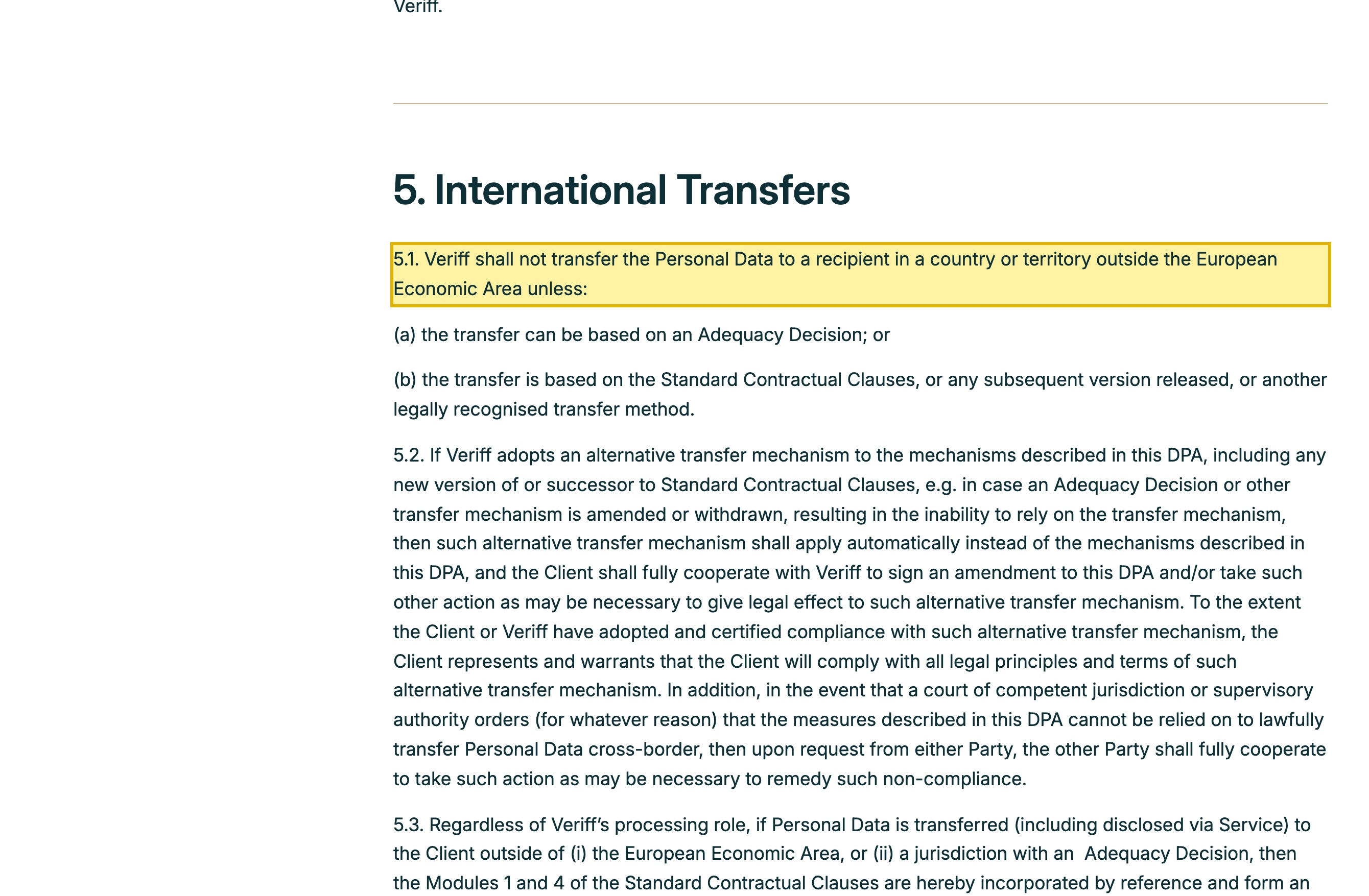
Veriff is an Estonia-based processor, and its own Data Processing Addendum says it "shall not transfer the Personal Data to a recipient in a country or territory outside the European Economic Area" absent an adequacy decision or the Standard Contractual Clauses. The face scans and ID images it collects are, in Veriff's own words, data that "may be considered biometric data and/or sensitive Personal Data" — so sending them to an EEA tenant is a cross-border transfer of sensitive personal information under PIPL (notice, a separate consent and a transfer mechanism; Articles 28, 38–40), one that at volume can require a CAC data-export security assessment before anything leaves. For a CIIO or large-volume handler there is an in-country storage duty (PIPL Article 40; Cybersecurity Law Article 39 (formerly Article 37)), and a China-facing verification page served from inside the mainland needs an ICP filing bound to a mainland host Veriff doesn't offer. The table below is Veriff's own wording against the rule each line triggers.
This is a risk map, not a verdict — what you owe turns on your data volumes, whether the identity data is sensitive, your role as handler and who your users are, and it's worth settling with counsel. Our China team can map your exposure with you →
What Veriff's own documentation says about China
| Fact | Primary source |
|---|---|
| Veriff's own contract keeps the data inside the EEA — not China. Veriff's Data Processing Addendum states that it "shall not transfer the Personal Data to a recipient in a country or territory outside the European Economic Area" unless "the transfer can be based on an Adequacy Decision" or "the transfer is based on the Standard Contractual Clauses." Mainland China is outside the EEA and holds no EU adequacy decision, so the identity data Veriff processes for your China users comes to rest offshore — a cross-border transfer of personal information under PIPL (notice, separate consent and a transfer mechanism, Articles 38–40). | Veriff Data Processing Addendum (ver-sdpa-2301) §5.1, retrieved 2026-10-09; PIPL Articles 38–40 |
| Veriff itself flags what it captures as biometric and sensitive. Its Privacy Notice says the service collects "photographs taken from you and your document" and derives "face scans and other measurements" that "may be considered biometric data and/or sensitive Personal Data." Under PIPL, biometric characteristics and government-ID data are sensitive personal information (Article 28) — processing requires a specific, separate consent, a demonstrated necessity, and a personal-information protection impact assessment (Articles 29 and 55), all of which sit with you as the handler. | Veriff Privacy Notice §§4.1–4.2, retrieved 2026-10-09; PIPL Articles 28–29, 55 |
| Veriff's infrastructure is AWS- and EEA-centric, with no China footprint. Its Security & Compliance page states "Backups are stored and encrypted in AWS servers" and that "Veriff has obtained and maintains ISO/IEC 27001:2022 Certification" and "is compliant with SOC 2 Type II, GDPR and has obtained Cyber Essentials certification" — global and EEA frameworks, none of them a mainland-China hosting region. With no in-country region on offer, there is no mainland resource for your China users' biometric and ID data to live on, and none to anchor an ICP filing. | Veriff Security & Compliance, retrieved 2026-10-09 |
| Sensitive biometric data at volume can force a government security review — and for some handlers must stay in China. A cross-border transfer of sensitive personal information, or of personal information above regulatory thresholds, can require a CAC data-export security assessment (数据出境安全评估) before anything leaves the country. And where the handler is a critical information infrastructure operator or moves personal information at volume, data collected in China must be stored in the mainland (PIPL Article 40; Cybersecurity Law Article 39 (formerly Article 37)) — a duty an EEA identity store cannot meet. | PIPL Articles 38–40; Cybersecurity Law Article 39 (formerly Article 37); CAC Measures for the Security Assessment of Outbound Data Transfers, retrieved 2026-10-09 |
Sources verified by the 21YunBox compliance team on 2026-10-09.
For a company onboarding or KYC-verifying users in mainland China, the first instinct with Veriff is to ask whether the verification flow loads from inside the country. That is the wrong first question. Veriff verifies a person by capturing an image of their government identity document and a scan of their face, then matching the two — and for China the decision is not whether that flow is reachable, but whether the sensitive data it collects was allowed to leave the country at all, and where it then comes to rest. Those are questions of China’s law, and they sit upstream of latency. Veriff settles the residency half in its own documentation.
Veriff is an Estonia-based identity-verification provider, and it runs no verification infrastructure inside mainland China. Its own Data Processing Addendum sets the European Economic Area as the boundary for the personal data it handles, and its security page points only to AWS and to EEA and global certifications — with no mainland site to choose. The moment a Chinese user’s ID-document image, photographs and face scan are processed in that offshore environment, you have made a cross-border transfer (数据出境) of what is, in Veriff’s own words, “biometric data and/or sensitive Personal Data,” and a stricter part of China’s law decides whether that was permitted.
Veriff in China at a glance
| What decides it | In Veriff's own terms — and China's law |
|---|---|
| What it is | Veriff is an identity-verification (eKYC) service: it lets a customer “verify your identity document e.g. driver's license, passport or ID card,” captures “photographs taken from you and your document,” and derives “face scans and other measurements” to match a person to their document. It holds a tightly identifying record of a real person — their ID papers and their face. |
| Is it reachable from the mainland? | Reachability is an operational matter, not the China decision, and this page publishes no latency figure for it. Even a verification flow that responds instantly can be non-compliant — what governs is where the data goes and whether it had a lawful basis to leave China. |
| Where does the data sit? | In the EEA. Veriff's Data Processing Addendum states it “shall not transfer the Personal Data to a recipient in a country or territory outside the European Economic Area” absent an adequacy decision or the Standard Contractual Clauses; its security page says “Backups are stored and encrypted in AWS servers.” Its lead authority is the Estonian Data Protection Inspectorate. There is no mainland-China region. |
| What's collected is sensitive PI | Veriff itself says the face scans and document data it extracts “may be considered biometric data and/or sensitive Personal Data.” Under PIPL, biometric characteristics and identity-document data are sensitive personal information (Article 28): processing needs a specific, separate consent, a demonstrated necessity, and a personal-information protection impact assessment. |
| Collecting China data into it | Loading a Chinese user's ID image and face scan into an EEA tenant is a cross-border transfer (数据出境) under PIPL (Articles 38–40): notice, a separate consent, and one transfer mechanism. Because the data is sensitive and biometric, a transfer at volume can require a CAC data-export security assessment; a CIIO or large-volume handler also owes in-country storage under the Cybersecurity Law's Article 39 (formerly Article 37) that an offshore region cannot meet. |
| Serving the public | A China-facing onboarding or verification page actually served to mainland visitors from inside China needs an ICP filing bound to a mainland hosting resource. Veriff names no mainland region, so there is nothing of its own to file against. |
| The lawful path | Keep China identity verification in-country — a consented, in-country verification route (a CAC-filed or licensed domestic KYC option) that processes and stores the biometric and ID data in the mainland — while Veriff continues to serve your other markets, and deliver the China-facing surface in-country on ICP-filed infrastructure. 21YunBox maps, localizes and delivers; it never uses or suggests circumvention of any kind. |
Availability: reachable or not, residency is the decision
Veriff’s China position is set in its own documentation, not by a load-time test. Its Data Processing Addendum draws the line at the European Economic Area, and its Security & Compliance page names only AWS and EEA/global frameworks — “Veriff has obtained and maintains ISO/IEC 27001:2022 Certification,” and “Veriff is compliant with SOC 2 Type II, GDPR and has obtained Cyber Essentials certification.” None of that is a mainland-China hosting footprint.
So “can the verification widget reach Veriff from Shanghai?” is the wrong test. The real question is where the ID and face data it captures from your China users sits, and whether it was allowed to leave the country at all — which is why this page publishes no first-party China latency or reachability figure for Veriff: speed is not the axis for a decision that turns on residency, sensitivity and consent. One temptation worth naming: when a cross-border verification call from the mainland is inconsistent, the instinct is to force it through a network workaround. 21YunBox neither uses nor suggests any such circumvention — it is both a compliance risk and beside the point. The productive question is how to keep the China identity data on a lawful footing in the first place.
What Veriff holds is sensitive personal information — consent sits on top
This is where an identity-verification vendor differs from an ordinary SaaS tool. Veriff’s whole function is to collect the most identifying data a person has: “photographs taken from you and your document,” and “face scans and other measurements” derived from them to “compare the End-User’s face to identity document photos.” Veriff itself says this extracted data “may be considered biometric data and/or sensitive Personal Data,” and under China’s Personal Information Protection Law that classification carries weight. Biometric characteristics and government-ID data are sensitive personal information (PIPL Article 28), and processing sensitive PI demands more than a general agreement to your terms: a specific, separate consent, a demonstrated necessity and sufficiency of purpose, and a personal-information protection impact assessment before collection begins (Articles 29 and 55).
That duty sits with you, the handler who operates the onboarding flow — not with Veriff, the processor. Veriff gives you controls that can help, and it limits what it discloses, but those reduce exposure; they do not discharge the consent, necessity and assessment obligations China’s law puts on you. Whether a given attribute counts as sensitive in your flow, and what your consent screen must say, are questions to settle with counsel before you rely on the verification step.
An EEA identity store is a cross-border transfer of China data
Here is the gate most teams miss. A Veriff environment governed by its DPA is, by its own terms, inside the EEA — outside the mainland. The ID images, photographs and face scans it processes for a person in China are personal information, so sending them to that environment is a cross-border transfer of personal information under PIPL. The law puts the duty on the handler — you, the organization running the verification — not on Veriff the processor: Articles 38–40 require notice, a separate consent distinct from any general agreement, and one transfer mechanism — a CAC security assessment, the CAC standard contract, or certification.
Because the data is sensitive and biometric, the bar is higher than for ordinary records. Above the regulatory thresholds — or where the data qualifies as “important data” — that transfer may require China’s data-export security assessment (数据出境安全评估) before anything leaves the country, and a large-scale flow of biometric and identity data is exactly the kind of transfer that invites one. And if your organization is a critical information infrastructure operator, the Cybersecurity Law’s Article 39 (formerly Article 37 — the data-localization clause was renumbered when the 2025 amendment to the Cybersecurity Law took effect on January 1, 2026, with its substance unchanged) requires that personal information generated in China be stored in China — an in-country storage duty an EEA tenant simply cannot satisfy. None of this turns on how quickly a check completes; it turns on whether the data had a lawful basis to be abroad. Which of these bite your specific deployment is a risk to confirm with counsel against what your verification flow actually captures.
No mainland region to file against — and why “pick a region” isn’t the fix
A public-facing onboarding screen, sign-up flow or verification page actually served to mainland visitors from inside China turns on an ICP filing (ICP 备案) under State Council Order No. 292 and MIIT Order No. 33, and that filing has to attach to a hosting resource physically in the mainland. Veriff provides none, so there is nothing on Veriff to file against — the same structural gap the residency duty exposes, seen from the licensing side.
The obvious move is to flip Veriff’s data region closer to China and call it local — but Veriff’s boundary is the EEA, and no EEA region is in the mainland, so moving a tenant from one European locality to another merely relocates the cross-border transfer; it does not end it. Keeping China identity data in-country means standing up a China-resident route for the verification itself. And here the nature of the product points the way: verifying a mainland resident’s identity document ultimately runs against China’s own resident-identity system, which is reachable only through licensed domestic channels — so the compliant pattern for China users is a consented, in-country verification step, with the biometric and ID data processed and stored in the mainland, while Veriff continues to verify users in the markets where it already serves you. That split — what must stay in China, what may run abroad — is the heart of the work, and it is a legal question before it is a technical one.
This is a risk map, not a verdict: whether you owe separate consent, a transfer mechanism, a data-export security assessment, in-country storage, an ICP filing, or some combination depends on your entity, the identity data you capture, your role as handler, and who your users are — worth settling with counsel before you rely on it.
The lawful path — map, localize, deliver
There is a compliant way to verify identities for a China-facing presence, and it has a shape. First, map: our China team works through your PIPL exposure on both fronts — the processing of sensitive biometric and ID data, and its transfer out of the country — pinning down which records collected in China must stay in the mainland, what may lawfully leave, where a data-export security assessment or an Article 39 storage duty applies, and what your separate-consent and impact-assessment steps have to cover. The legal conclusions are settled with counsel; we build the technical picture that feeds them.
Then localize: we help you adopt and integrate a China-resident verification route for your mainland users — a consented, in-country KYC option that verifies a Chinese resident’s document through a licensed domestic path and keeps the face-scan and ID data processing and storage inside the country — so onboarding keeps working while that sensitive data stops leaving China by default, and you keep Veriff for the markets it already covers.
Then deliver: the China-facing onboarding or verification surface your users actually reach is itself a public service in the mainland, so it carries an ICP filing (备案) duty and needs compliant, in-country delivery. 21YunBox delivers it in-country — the 21YunBox Optimizer — set in front of what you already run, with no rebuild and no re-platform. The result is identity verification that runs legally and compliantly for your users in China. What we never do — and what no one lawfully can — is hand you a route around China’s data-export rules or around any network restriction: we localize what must stay and deliver in-country, and we never move personal information out of China by stealth.
Related reading:
- Cross-border data transfers under PIPL
- China’s data-export security assessment
- China’s Cybersecurity Law (data localization, Article 39)
- How to get an ICP filing for China