Does Plaid Work in China? Financial-Account Data, PIPL Cross-Border & No Mainland Coverage
Plaid's own coverage names the US, Canada, the UK and Europe — not mainland China — so there is no Chinese bank to connect through it, and the first question isn't speed. The account numbers, balances and transaction history Plaid retrieves are financial-account personal information, which PIPL treats as sensitive; pulling a China-resident's data into Plaid's offshore platform is a cross-border transfer, and China's bank-data access is a licensed, in-country market. A compliance-first look at the coverage, cross-border, sensitive-PI and licensing exposure, and the lawful in-country path.
Does Plaid work in China?
Whether Plaid can serve a mainland-China audience is first a question of coverage, data residency and financial-data licensing — not speed. Two things decide it, and neither is latency: Plaid does not connect mainland-China bank accounts, and the account data it holds is sensitive personal information under China's law.
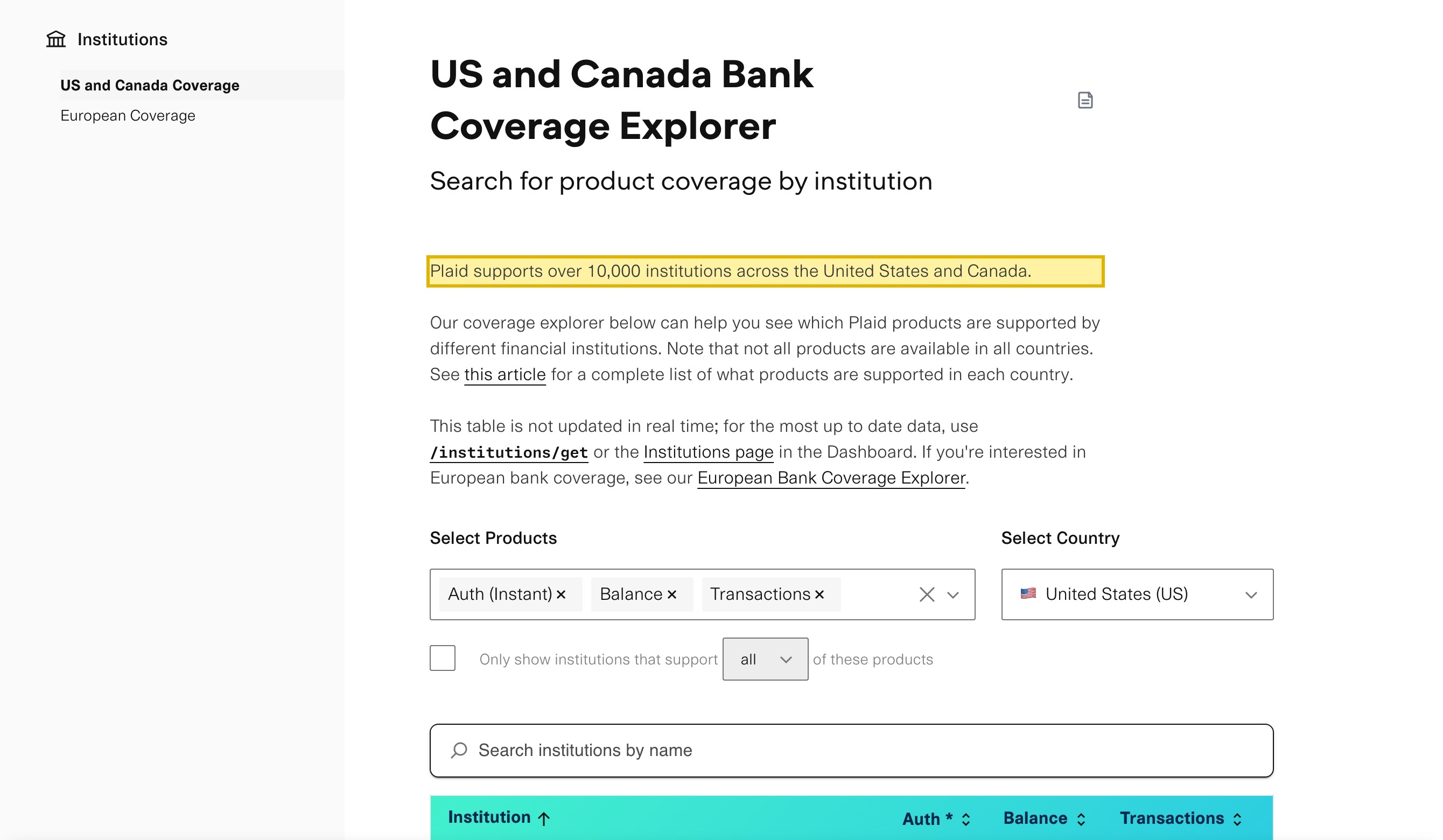
By Plaid's own documentation it "supports over 10,000 institutions across the United States and Canada," with the UK and Europe behind a separate explorer and no mainland-China institution listed — so there is no Chinese bank to connect through Plaid. Separately, the account and routing numbers, balances and transaction history it retrieves are financial-account personal information — expressly sensitive under PIPL Article 28 — so pulling a China-resident's data into Plaid's offshore platform is a cross-border transfer (数据出境) needing notice, a separate consent, a transfer mechanism, and (because it is sensitive) a further specific consent on top. The table below is Plaid's own wording and the rule each line triggers.
This is a risk map, not a verdict — what you owe turns on your data volumes, your role as handler and who your users are, and it's worth settling with counsel. Our China team can map the lawful path with you →
What Plaid's own documentation says about China
| Fact | Primary source |
|---|---|
| Plaid's own coverage names the US, Canada, the UK and Europe — not mainland China. Plaid's documentation states it "supports over 10,000 institutions across the United States and Canada," routes Europe through a separate "European Bank Coverage Explorer," and on its global page describes "over 95% bank coverage and localized support across 20 countries" across "North America, UK, and Europe." No mainland-China institution is listed anywhere — there is no Chinese bank you can connect through Plaid. | Plaid Docs — Institutions (US and Canada Bank Coverage Explorer); Plaid Global coverage page, retrieved 2026-10-09 |
| The data Plaid handles is financial-account personal information — sensitive under PIPL. Plaid links apps to users' bank accounts to retrieve account and routing numbers, balances and transaction history; in its own words it can "track spending data across credit cards, checking, savings, and student loan accounts." Under PIPL Article 28, "financial accounts" are expressly sensitive personal information, which carries a stricter standard: a separate, specific consent and a demonstrated necessity before the data may be processed at all. | Plaid product documentation, retrieved 2026-10-09; PIPL Article 28 |
| Pulling a China-resident's account data into Plaid's offshore platform is a cross-border transfer. Plaid processes on infrastructure outside the mainland, so loading a person-in-China's bank-account data into it moves sensitive personal information out of the country — a cross-border transfer under PIPL (数据出境). The handler (you, Plaid's customer — not Plaid) owes notice, a separate consent, and one transfer mechanism (Articles 38–40); because the data is sensitive, a further specific consent on top, and above thresholds a data-export security assessment before anything leaves. | PIPL Articles 38–40; China data-export security assessment measures, retrieved 2026-10-09 |
| China's bank-data access is a licensed, in-country market — and serving the public triggers an ICP filing. Access to personal financial information in China is not an open-banking free market; it runs through licensed domestic financial channels under financial-sector supervision, with personal financial information expected to stay in-country. For a critical information infrastructure operator or large-volume handler, personal information collected in China must be stored in the mainland (Cybersecurity Law Article 39 (formerly Article 37); PIPL Article 40). And any China-facing onboarding or payment page served from inside the mainland needs an ICP filing (State Council Order No. 292; MIIT Order No. 33) bound to a mainland hosting resource Plaid does not provide. | PIPL Article 40; Cybersecurity Law Article 39 (formerly Article 37); State Council Order No. 292; MIIT Order No. 33, retrieved 2026-10-09 |
Sources verified by the 21YunBox compliance team on 2026-10-09.
For a fintech, or any app that links to its users’ bank accounts, the first instinct with Plaid is to ask whether its API can be reached from inside mainland China. That is the wrong first question. Two things settle the China decision before latency ever enters it, and Plaid answers the first in its own documentation: Plaid operates no bank-data connectivity in mainland China — its coverage is the United States, Canada, the UK and Europe — and the account data Plaid retrieves is financial-account personal information that China’s law treats as sensitive. So “does Plaid work in China?” splits into two compliance questions — is there anything to connect, and may that data lawfully leave the country — and neither is about speed.
Plaid runs no bank-data network inside the mainland. Its own institutions documentation lists coverage across the United States and Canada, routes the UK and Europe through a separate coverage explorer, and names no mainland-China institution anywhere. There is, in plain terms, no Chinese bank you can link through Plaid — which makes the China decision a question of residency, consent and licensing, not of how fast an endpoint responds.
Plaid in China at a glance
| What decides it | In Plaid's own terms — and China's law |
|---|---|
| What it is | Plaid is a financial-data network — an open-banking connectivity layer that links apps to users' bank accounts to retrieve account and routing numbers, balances, transaction history and account-holder identity (its Auth, Balance, Transactions, Identity and Assets products), alongside an Identity Verification (KYC) product. Each is a record about an identifiable person's finances. |
| Does it operate in mainland China? | No. Plaid's own coverage states it “supports over 10,000 institutions across the United States and Canada,” with the UK and Europe behind a separate “European Bank Coverage Explorer,” and its global page frames coverage as “North America, UK, and Europe.” No mainland-China institution is listed — there is no Chinese bank to link through Plaid. |
| Is it reachable from the mainland? | Reachability is beside the point. Even where an API call completes from China, there is no mainland institution to connect, and the data would still be leaving the country. We publish no China latency figure; speed is not the axis for this decision. |
| What kind of data is it? | Financial-account personal information — account and routing numbers, balances, transaction history, account-holder identity. Under PIPL Article 28, “financial accounts” are expressly sensitive personal information, which carries a stricter standard: a separate, specific consent and a demonstrated necessity before processing begins. |
| Collecting China account data into it | Loading a China-resident's bank-account data into Plaid's offshore platform is a cross-border transfer (数据出境) under PIPL Articles 38–40 — notice, a separate consent, and one transfer mechanism — and, because the data is sensitive, a further specific consent on top. A data-export security assessment may apply above thresholds; a critical information infrastructure operator or large-volume handler owes in-country storage (Cybersecurity Law Article 39 (formerly Article 37)). |
| Serving the public | A China-facing onboarding, bank-linking or payment page actually served to mainland visitors from inside China needs an ICP filing bound to a mainland hosting resource. Plaid provides none, so there is nothing of its own to file against. |
| The lawful path | Route China-resident bank-data connectivity through a licensed domestic financial channel with consented, in-country processing and storage, and deliver the China-facing app surface in-country on ICP-filed infrastructure. 21YunBox maps, localizes and delivers; it never uses or suggests circumvention of any kind. |
Reachability isn’t the axis — coverage and residency are
Plaid’s position here is set by its coverage and its architecture, not by a load-time test. On the wire, Plaid’s endpoints may well respond from Shanghai — but that settles nothing, because there is no mainland institution to connect and, separately, any China-collected financial data would still be leaving the country. Plaid’s documentation states plainly that it “supports over 10,000 institutions across the United States and Canada,” routes European coverage through a separate “European Bank Coverage Explorer,” and on its global page describes “over 95% bank coverage and localized support across 20 countries” across “North America, UK, and Europe.” Not one of those is the mainland.
That is why this page publishes no first-party China latency or reachability figure for Plaid: speed is not the axis for a decision that turns on coverage, residency and licensing. One operational temptation is worth naming only to dismiss it — forcing a connection to an offshore financial endpoint through a network workaround. 21YunBox neither uses nor suggests circumvention of any kind; it is both a compliance risk and beside the point. The productive question is how to keep the China financial data on a lawful footing in the first place.
Financial-account data is sensitive personal information — and it would be leaving the country
Here is the gate most teams miss. Plaid’s whole function is to read an identifiable person’s finances — account and routing numbers, balances, a running transaction history, and the account-holder identity behind them; in Plaid’s own words it can “track spending data across credit cards, checking, savings, and student loan accounts.” Under China’s Personal Information Protection Law, that is not ordinary personal information. Article 28 lists “financial accounts” expressly among sensitive personal information — the category whose leak or misuse could readily harm a person’s dignity or property — and sensitive personal information carries a stricter standard before anything is processed at all: a separate, specific consent and a demonstrated necessity, not a general agreement buried in a sign-up flow.
Load a China-resident’s bank-account data into Plaid’s offshore platform and a second duty stacks on the first: the processing becomes a cross-border transfer of personal information (数据出境). PIPL puts that duty on the handler — you, the app operating the integration, not Plaid the processor: Articles 38–40 require notice, a separate consent for the transfer distinct from the consent to process, and one transfer mechanism — a CAC security assessment, the CAC standard contract, or certification. Above certain thresholds, or where the data qualifies as “important data,” the transfer may also require China’s data-export security assessment (数据出境安全评估) before anything leaves. And if your organization is a critical information infrastructure operator, the Cybersecurity Law’s Article 39 (formerly Article 37 — the data-localization provision was renumbered by the 2025 amendment that took effect on January 1, 2026, with its substance unchanged) requires that personal information generated in China be stored in China, which an offshore financial-data platform cannot satisfy. Because the data here is both sensitive and financial, every one of these duties applies at its strictest. Which of them bite your specific integration is a risk to confirm with counsel against what you actually collect.
China’s bank-data access is a licensed, in-country market — so “point Plaid at a Chinese bank” isn’t the fix
Set the coverage gap aside for a moment, and the obvious move — treat a Chinese bank like any other institution and connect it — runs straight into how China regulates bank data. Access to personal financial information in China is not an open-banking free market where any aggregator may plug in; it runs through licensed domestic financial institutions and payment channels under financial-sector supervision, with personal financial information expected to be processed and stored in-country. That is a structural difference from the US and UK markets Plaid is built for, not a tuning problem — and it is a legal question before it is a technical one.
The licensing question has a delivery twin. A public-facing onboarding flow, bank-linking screen or payment page actually served to mainland visitors from inside China turns on an ICP filing (ICP 备案) under State Council Order No. 292 and MIIT Order No. 33, and that filing has to attach to a hosting resource physically in the mainland. Plaid provides none, so there is nothing of Plaid’s to file against — the same in-country gap the residency duty exposes, seen from the licensing side. Keeping China account-connectivity lawful therefore means two things at once: a licensed domestic route for the financial data, and ICP-filed in-country delivery for the app surface your users actually reach.
This is a risk map, not a verdict: whether you owe a separate consent, a transfer mechanism, a data-export assessment, in-country storage, a licensed domestic channel, an ICP filing, or some combination depends on your entity, the financial data you hold, your role as handler, and who your users are — worth settling with counsel before you rely on it.
The lawful path — map, localize, deliver
There is a lawful way to run account connectivity and identity for a China-facing presence, and it has a shape. First, map: our China team works through your PIPL exposure on both fronts — the sensitive-data processing and the cross-border transfer — identifying which financial and identity records collected in China must stay in the country, what may lawfully leave, where a data-export security assessment or an Article 39 storage duty bites, and what your consent and notice flow must cover before a single account is linked. The legal conclusions are settled with counsel; we build the technical picture that feeds them.
Then localize: because Plaid itself has no mainland coverage and no in-country footing, China account-connectivity cannot simply be Plaid pointed at a different region — there is no such region. We help route China-resident bank-data connectivity through a licensed domestic financial channel with consented, in-country processing and storage, so the account data stops leaving the country by default, while you keep Plaid for the US, Canadian and European markets where it already serves you.
Then deliver: the China-facing onboarding, bank-linking or payment surface your users actually reach is itself a public service in the mainland, so it carries an ICP filing (备案) duty and needs compliant, in-country delivery. 21YunBox delivers it in-country — the 21YunBox Optimizer — set in front of what you already run, with no rebuild and no re-platform. The result is account connectivity and identity that runs legally and compliantly for your users in China. What we never do — and what no one lawfully can — is hand you a route around China’s financial-data or data-export rules, or around any network restriction: we localize what must stay and deliver in-country, and we never move personal information out of China by stealth.
Related reading:
- Cross-border data transfers under PIPL
- China’s data-export security assessment
- China’s Cybersecurity Law (data localization, Article 39)
- How to get an ICP filing for China