Does Tencent Cloud Work in China? Data Residency, ICP & Cross-Border Rules
Tencent Cloud runs Chinese-mainland regions, is MIIT-licensed and supports ICP filing, so data deployed there rests in-country by design — but that is not automatic compliance: you still owe your own ICP filing, a mainland entity and MLPS, and sending China data back to an offshore HQ is still a PIPL cross-border transfer.
Does Tencent Cloud work in China?
Whether Tencent Cloud "works" in China is a data-residency and licensing question, not a reachability one. Tencent Cloud is a mainland-based cloud — it runs regions inside the Chinese mainland, is MIIT-licensed, and supports ICP filing — so personal data you deploy in a mainland region rests in-country by design. That settles one door; it does not settle compliance.
In-country infrastructure is the start of a lawful China presence, not the whole of it. The ICP filing (备案) is still yours to obtain, and it requires a mainland China business entity — a foreign company without one cannot file. Multi-Level Protection Scheme (MLPS / 等级保护) obligations attach to you as the system operator. Residency only holds if you actually deploy in a mainland region; Tencent Cloud also runs regions outside the mainland. And if you replicate China users' data back to an offshore headquarters — for group analytics, HR or a parent-company data lake — that round-trip is itself a cross-border transfer under PIPL. "Our data is on Tencent Cloud" does not mean "no cross-border problem."
This is a risk picture, not a legal ruling — your duties turn on your entity, your role and your data volumes. Our China team can map your Tencent Cloud exposure with you →
What Tencent Cloud's own documentation says about China
| Fact | Primary source |
|---|---|
| Tencent Cloud operates multiple regions inside the Chinese mainland. Its Regions and Zones documentation lists mainland regions including "North China (Beijing)," "East China (Shanghai)," "South China (Guangzhou)" and "Southwest China (Chengdu)," among others — so data deployed in one of these regions physically rests on Chinese soil. Residency is satisfiable by design, but only when you deploy in a mainland region: Tencent Cloud also operates regions outside the mainland, and choosing one of those keeps the data offshore. | Tencent Cloud — Regions and Zones (tencentcloud.com), retrieved 2026-10-14 |
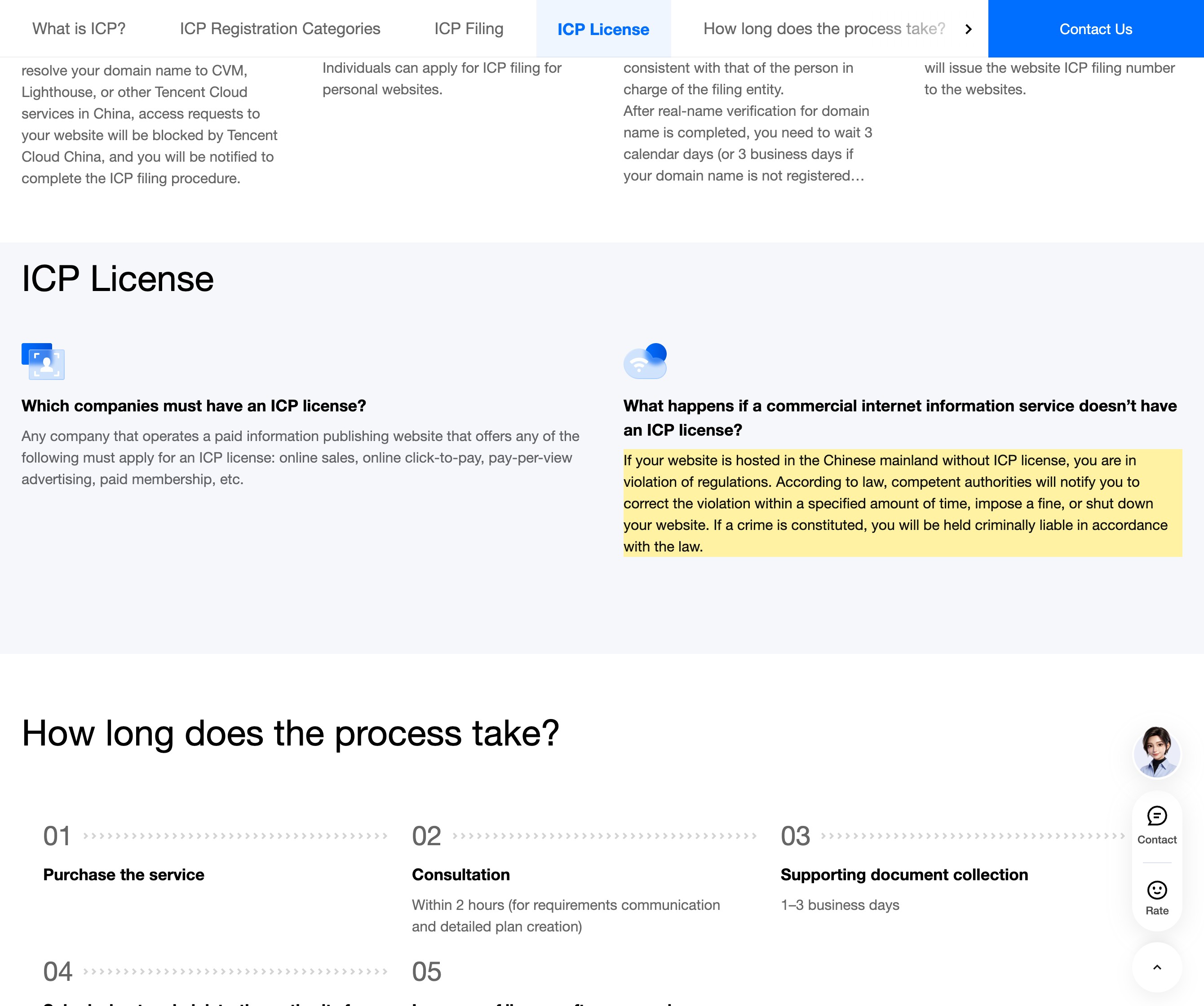
| Hosting in the Chinese mainland brings a mandatory ICP filing, and it is the customer's obligation. Tencent Cloud's ICP registration page states: "If your website is hosted in the Chinese mainland without ICP license, you are in violation of regulations." The cloud facilitates the filing, but it is tied to your own domain and mainland entity — which is why in-country infrastructure alone does not make a public-facing service compliant. How ICP filing works → | Tencent Cloud — ICP Registration Support (tencentcloud.com), retrieved 2026-10-14 |
| An ICP filing (备案) is a legal prerequisite for any public-facing service to mainland users, and it requires a mainland China business entity. The filing is tied to a mainland hosting resource and a Chinese-registered entity under the ICP regime (State Council Order No. 292; MIIT Order No. 33) — a foreign company with no mainland entity cannot file, so a Chinese cloud region does not by itself put you in filing compliance. | State Council Order No. 292 (Measures on the Administration of Internet Information Services); MIIT Order No. 33 |
| Data on a Chinese cloud can still cross the border. If you replicate or export China users' personal information back to an offshore headquarters — group analytics, HR, a parent-company data lake — that round-trip is a cross-border transfer under PIPL (Articles 38–40): notice, separate consent, and one transfer mechanism. A critical-information-infrastructure operator or high-volume handler also owes in-country storage (PIPL Article 40; Cybersecurity Law Article 39 (formerly Article 37)). | PIPL Articles 38–40 and Article 40; Cybersecurity Law Article 39 (formerly Article 37) |
Sources verified by the 21YunBox compliance team on 2026-10-14.
For a mainland-China audience, the question worth asking about Tencent Cloud is not whether it answers from Shanghai or how quickly an instance spins up — both are routine. It is where your users’ personal data is allowed to come to rest, and on what legal footing your public-facing service runs. Here Tencent Cloud starts from a different place than a foreign cloud: it is a mainland-based provider that operates regions inside the Chinese mainland, holds the telecom licensing a Chinese operator carries, and supports ICP filing. Deploy your workload in one of its mainland regions and the data physically rests on Chinese soil — so the data-residency door can be satisfied by design. That is a genuine head start. It is not the finish line.
The trap is reading “our data is on a Chinese cloud” as “our China compliance is handled.” In-country infrastructure settles where the bytes sit; it does not settle whether you filed the public-facing service, whether you have the mainland entity that filing requires, whether your system meets its operator-level security duties, or whether that data quietly flows back out again. A Chinese cloud removes the residency problem only for the data you actually keep in a mainland region — and only until you copy it somewhere else.
Tencent Cloud in China at a glance
| What decides it | In Tencent Cloud's own terms — and China's law |
|---|---|
| Where the data physically rests (the region reality) | Tencent Cloud runs regions inside the Chinese mainland — Beijing, Shanghai, Guangzhou, Chengdu and others — so a workload deployed in one keeps its data on Chinese soil. It also runs regions outside the mainland; residency is satisfied only if you deploy in a mainland region, not an overseas one. |
| In-country infrastructure is not automatic compliance | A mainland region settles where the data rests; it does not file your service or license your entity. The ICP filing is still yours, Multi-Level Protection Scheme (MLPS / 等级保护) duties attach to you as operator, and consent and data-classification rules still apply. |
| The ICP filing (备案) and the entity behind it | Any public-facing service to mainland users needs an ICP filing tied to a mainland hosting resource and your own domain; Tencent Cloud states a mainland-hosted site without one “is in violation of regulations.” Filing requires a mainland China business entity (State Council Order No. 292; MIIT Order No. 33) — a foreign company without one cannot file. |
| Your China users' records when they leave again | Even with the primary copy in a mainland region, replicating China users' personal information back to an offshore HQ — analytics, HR, a group data lake — is a cross-border transfer under PIPL (Articles 38–40): notice, separate consent, one transfer mechanism. |
| The in-country storage duty (CIIO / high-volume handler) | A critical-information-infrastructure operator or high-volume handler must keep China personal information on the mainland (PIPL Article 40; Cybersecurity Law Article 39 (formerly Article 37)). A mainland region can meet this duty — an offshore copy of the same data cannot. |
| Reachability is not the axis | Whether the endpoint answers from China is a delivery matter, not the legal test; where the data rests and where it flows is. The lawful levers are to deploy in a mainland region, file the China-facing surface, and govern any cross-border back-haul. |
Where the data actually rests
Choose a Tencent Cloud region and you are choosing where your data physically lives. Its regions-and-zones documentation lists several inside the Chinese mainland — North China (Beijing), East China (Shanghai), South China (Guangzhou), Southwest China (Chengdu) and more — and a workload placed in one of them keeps its data on Chinese soil. That is the residency door, and on a mainland-based cloud it is satisfiable by design.
But residency only holds where you actually deploy. Tencent Cloud, like other large providers, also operates regions outside the Chinese mainland; a workload placed in one of those keeps your China users’ data offshore, with every cross-border consequence that follows. “We’re on Tencent Cloud” is not the same statement as “our China users’ data is in a mainland region” — the second is the one that matters, and it has to be a deliberate, verified choice rather than an assumption.
In-country infrastructure is not the whole of compliance
A mainland region settles residency; it does not file your service or license your entity. Any public-facing service to mainland users needs an ICP filing (备案), tied to a mainland hosting resource and to your own domain — and, in Tencent Cloud’s own words, a site “hosted in the Chinese mainland without ICP license” is “in violation of regulations.” The cloud facilitates that filing, but the obligation is yours, and the ICP regime requires a mainland China business entity to file at all (State Council Order No. 292; MIIT Order No. 33). A foreign company without a mainland entity cannot inherit compliance simply by renting Chinese infrastructure.
On top of filing sit operator-level duties. Multi-Level Protection Scheme (MLPS / 等级保护) obligations attach to you as the operator of the system, not to the cloud that hosts it, and the notice, consent and data-classification duties under the Personal Information Protection Law govern how you handle the personal data inside it. In-country infrastructure is the start of compliance; these are the rest of it.
The cross-border transfer a Chinese cloud does not remove
Here is the exposure that survives even a flawless in-country deployment — and that no reachability or region check will ever surface. Organizations rarely let data sit in one place. The China region feeds a global analytics warehouse; employee records sync to a group HR system; customer tables replicate into a parent-company data lake; logs ship to a headquarters security platform. Every one of those round-trips takes China users’ personal information back out of the country, and each is a cross-border transfer under PIPL (Articles 38–40) — owing notice, separate consent and one transfer mechanism — whether or not the primary copy rests on a Chinese cloud. A critical-information-infrastructure operator or high-volume handler owes an in-country storage duty on top (PIPL Article 40; Cybersecurity Law Article 39 (formerly Article 37)). “Our data is on Tencent Cloud” answers where the data rests; it says nothing about where the data goes.
Why a reachability check misses this
Point a probe at a Tencent Cloud endpoint from Shanghai and you will measure a clean connection — and learn nothing about the question that decides lawfulness. A region check can tell you the data is in Beijing; it cannot tell you whether you filed the service, whether your entity can file at all, whether your MLPS obligations are met, or whether a nightly job is replicating that same data to a headquarters warehouse abroad. The risk here is not that the cloud is slow or unreachable — it is mainland-based and performs well — but that in-country infrastructure gets mistaken for finished compliance while the filing, the entity, the operator duties and the back-haul go unexamined. A speed or uptime test reports “fine” on precisely the setup that carries the most unexamined regulatory risk.
The lawful path — map, localize, deliver
21YunBox is a compliant overlay, not a migration — and a partner to the cloud you run on, not a competitor to it.
- Map. We read your PIPL cross-border, data-residency, data-localization (CII), ICP and MLPS obligations against your entity, your data volumes and whose personal information actually sits in the system — including where that data flows after it lands, so the back-haul is in scope from the start.
- Localize. We help you keep China users’ personal information in a mainland region so it rests on Chinese soil, file the public-facing service correctly, and keep consented, in-country storage for what must stay. Localize means keeping the data in-country — not a route that ships it offshore anyway.
- Deliver. Any China-facing surface in front of your workload — the app, the API edge, the admin and reporting portals your mainland users reach — runs over ICP-filed, in-country delivery (the 21YunBox Optimizer), in front of the stack you already run. No rebuild, no second codebase.
Running on a Tencent Cloud mainland region keeps your China data in-country, but it is the beginning of compliance, not the end: the ICP filing, the mainland entity, MLPS, consent and the governance of any cross-border back-haul still have to be done. This page maps exposure; it is not a legal ruling. Your actual duties turn on your entity, how you classify the data, your transfer volumes and whether you are a critical-information-infrastructure operator — so settle those specifics with qualified China counsel before you rely on any single path. 21YunBox never uses or suggests circumvention of any kind.
Related reading
- Cross-border data transfers under PIPL
- China’s Cybersecurity Law and data localization
- China’s Personal Information Protection Law
- How to get an ICP license for a website in China


