Does Baidu AI Cloud Work in China? Data Residency, ICP & Cross-Border Rules
Baidu AI Cloud is a mainland Chinese cloud — China regions, MIIT-licensed, ICP record-filing supported — so data deployed there is resident by design. But that is not automatic compliance: you still owe your own ICP filing and mainland entity, MLPS, and governance of any China data sent back offshore under PIPL.
Does Baidu AI Cloud work in China?
Whether Baidu AI Cloud works in China is a data-residency, ICP and cross-border question, not a speed one. It is a mainland Chinese cloud, so reaching it from inside China is a given — what decides the answer is where your data rests, on what filing your service runs, and whether any of it leaves the country.
Baidu AI Cloud runs mainland-China regions and is MIIT-licensed, so by its own documentation a workload deployed in a mainland region keeps data on Chinese soil — the residency question that defeats foreign clouds with no China region is settled by design. But in-country infrastructure is not automatic compliance. Its own Region FAQ states that record-filing is "not directly related with the regional selection, but the business form," so a public service still needs an ICP filing tied to your own mainland entity, plus MLPS as the operator. And if China users' personal information is copied back to an offshore HQ, analytics stack or CRM, that round-trip is itself a cross-border transfer the PIPL governs — a Chinese cloud does not remove it.
This is a risk picture, not a legal verdict — your obligations turn on your entity, your data volumes, your role and where your data actually flows. Our China team can map your Baidu AI Cloud exposure with you →
What Baidu AI Cloud's own documentation says about China
| Fact | Primary source |
|---|---|
| In Baidu AI Cloud's own words: "Region refers to each physical node distributed globally," and its Region documentation lists mainland-China data centers including North China - Beijing, South China - Guangzhou and East China - Suzhou — so a workload deployed in a mainland region keeps its data on Chinese soil. It also operates non-mainland regions (its docs list a Singapore region), so residency is satisfied only if you deploy in a mainland-China region specifically. | Baidu AI Cloud Docs — Reference: Region, retrieved 2026-10-14 |
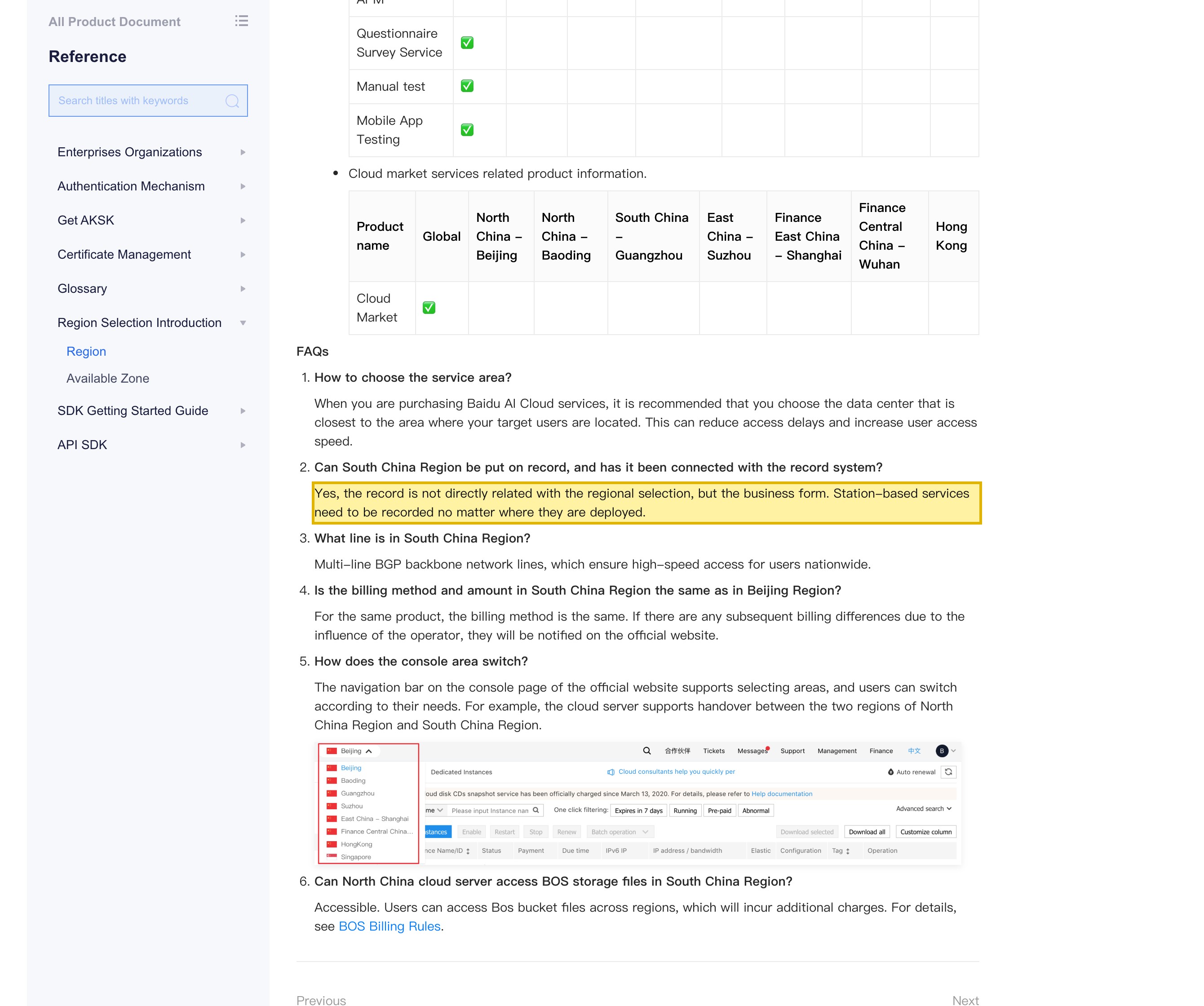
| Baidu AI Cloud's own Region FAQ, asked whether a mainland region "can ... be put on record," answers that record-filing is "not directly related with the regional selection, but the business form," and that "Station-based services need to be recorded no matter where they are deployed." ("Record" here is ICP 备案.) A public-facing service to mainland users therefore needs an ICP filing tied to your own mainland entity — something in-country infrastructure alone does not supply. | Baidu AI Cloud Docs — Reference: Region (FAQ), retrieved 2026-10-14 |
| Holding or copying the personal information of people in China offshore — including replicating it from a China region back to an overseas HQ, analytics warehouse or CRM — is a cross-border transfer governed by the PIPL (Articles 38–40): notice, separate consent, and one transfer mechanism (a CAC security assessment, the standard contract, or certification). Deploying on a Chinese cloud does not remove this duty if data still leaves the country. | Personal Information Protection Law (PIPL), Articles 38–40 |
| A critical-information-infrastructure operator or large-volume handler must store China personal information inside the mainland (Cybersecurity Law Article 39 (formerly Article 37) — the 2025 amendment, in force 1 January 2026, renumbered the data-localization article from 37 to 39, substance unchanged; PIPL Article 40). Any public service to mainland users also needs an ICP filing, which requires a mainland-China business entity. | Cybersecurity Law Article 39 (formerly Article 37); PIPL Article 40 |
Sources verified by the 21YunBox compliance team on 2026-10-14.
For a mainland-China audience, the useful question about Baidu AI Cloud is not whether it is reachable or quick from inside the country — it is a Chinese cloud, so that much is a given. The question is a legal one: where the personal data your application handles is allowed to rest, on what filing your public-facing service runs, and whether any of that data still leaves the country. Baidu AI Cloud is a mainland-based cloud platform — it operates data centers inside China, is MIIT-licensed, and supports the record-filing (ICP 备案) a China-facing service needs. Deploy a workload in one of its mainland regions and the data it holds rests on Chinese soil by design, which settles the residency question that trips up foreign clouds with no China region. But in-country infrastructure is the beginning of compliance, not the whole of it — and a cloud being Chinese does not, by itself, close the cross-border question.
Here is the part a reachability check — and a simple “is our data on a Chinese cloud?” answer — never sees. Even with your workload in a Baidu AI Cloud mainland region, if you replicate or export the personal information of people in China back to an offshore headquarters, a global analytics warehouse, a CRM or a parent-company data lake, that round-trip is itself a cross-border transfer under PIPL. “Our data is on a Chinese cloud” is not the same claim as “we have no cross-border transfer.” And because Baidu AI Cloud also offers AI and machine-learning services, it is worth checking whether any inference or training on China users’ data is processed outside the mainland — another transfer to account for.
Baidu AI Cloud in China at a glance
| What decides it | In Baidu AI Cloud's own terms — and China's law |
|---|---|
| Where the data physically rests (the region reality) | Baidu AI Cloud runs mainland-China regions — its Region documentation lists North China - Beijing, North China - Baoding, South China - Guangzhou, East China - Suzhou and two finance regions. Deploy a workload in a mainland region and the data rests on Chinese soil by design. It also runs non-mainland regions (its docs list a Singapore region), so residency holds only if you pick a mainland region specifically. |
| In-country infrastructure is not automatic compliance | A mainland region satisfies residency; it does not supply the filing. Any public service to mainland users still needs an ICP filing (备案) tied to your own domain — and an ICP filing requires a mainland-China business entity. The cloud facilitates the filing; it cannot hold it for you. |
| Your obligations as the system operator (MLPS) | Running a system inside China attaches Multi-Level Protection Scheme (等级保护) duties to you as the operator — classification, protective measures and, at higher grades, assessment. These sit on top of residency and ICP, and a Chinese cloud does not discharge them for you. |
| The back-haul the cloud does not fix (the real second door) | If China users' personal information is copied out of the China region to an offshore HQ, analytics stack or CRM, that export is a cross-border transfer under PIPL (Articles 38–40): notice, separate consent, and one transfer mechanism. Hosting on a Chinese cloud does not remove this if data still leaves the country. |
| AI / ML processing adds its own transfer question | Baidu AI Cloud also sells AI and machine-learning services. If personal data from users in China feeds model inference or training that runs outside the mainland, that is a separate cross-border transfer to assess — and, for generative-AI services offered to the public in China, its own filing regime may also apply. |
| Reachability is not the axis (and the China-facing surface) | Whether the service is reachable from China is a delivery matter, not the legal test; data-at-rest residency, the ICP filing and the back-haul analysis are. The lever is to deploy in a Baidu AI Cloud mainland region, stand up the ICP filing, entity and MLPS footing, and run any China-facing dashboards, APIs and admin portals over ICP-filed, in-country delivery. |
Where the data actually rests
Baidu AI Cloud’s own Region documentation describes a region plainly: “Region refers to each physical node distributed globally.” Among the areas it lists are mainland-China data centers — North China - Beijing, North China - Baoding, South China - Guangzhou, East China - Suzhou, and finance regions in Shanghai and Wuhan. Deploy a workload in one of those and the compute, storage and the personal data it holds sit inside mainland China. That is the residency outcome a foreign cloud with no China region cannot offer, and it is why a Chinese cloud starts from a genuinely different position.
The qualifier is that Baidu AI Cloud also operates regions outside the mainland — its documentation lists a Singapore region, for example. Choosing one of those would place the data offshore and reopen exactly the cross-border question a mainland region avoids. So “it’s on Baidu AI Cloud” does not settle residency by itself; deploying in a mainland-China region specifically is what does.
In-country infrastructure is not the same as compliance
A mainland region answers where the data rests. It does not answer whether your public service is filed, whether you are entitled to file, or whether you have met your duties as an operator. Those are separate obligations that a Chinese cloud facilitates but cannot hold on your behalf.
Baidu AI Cloud’s own Region FAQ makes the first point directly. Asked whether a mainland region “can … be put on record,” it answers that record-filing is “not directly related with the regional selection, but the business form,” and that “Station-based services need to be recorded no matter where they are deployed.” In other words, picking the China region does not file your site for you — any public-facing service to mainland users needs an ICP filing (备案), and that filing is tied to a mainland-China business entity. A foreign company without one cannot file in its own name.
On top of the filing sit operator duties. A system run inside China attaches Multi-Level Protection Scheme (等级保护) obligations — you classify the system, put protective measures in place, and at higher grades face assessment. None of that is discharged by the cloud being Chinese; it attaches to you as the operator of the system.
The cross-border transfer a Chinese cloud does not remove
This is the half a competitor’s reachability probe — and a one-line “our data is on a Chinese cloud” reassurance — cannot see. Keeping a workload in a mainland region is necessary, but it governs only the data that stays there. The moment China users’ personal information is replicated or exported out of the China region — to a global data warehouse, an offshore CRM, an HR or finance system, or a parent-company data lake — that export is a cross-border transfer the PIPL governs, with its own notice, separate-consent and transfer-mechanism duties (a CAC security assessment, the standard contract, or certification). Where the obligation is heaviest — a critical-information-infrastructure operator or a large-volume handler must keep China personal information on the mainland (Cybersecurity Law Article 39 (formerly Article 37) and PIPL Article 40) — an uncontrolled back-haul is precisely what breaks it.
The AI and machine-learning services Baidu AI Cloud offers carry the same question in a different shape: if personal data from users in China is sent to inference or training that runs outside the mainland, that too is a cross-border transfer to account for.
Why a reachability check misses this
Point a probe at a Baidu AI Cloud endpoint from Shanghai and you will measure a healthy connection — and learn nothing about the question that matters. A Chinese cloud answers from inside China; that is the easy part, and it is exactly the trap. The exposure is not whether the service responds, it is whether you deployed in a mainland region or an overseas one, whether your public surface is ICP-filed against a mainland entity, whether you have met your operator duties, and whether China users’ personal information is quietly being copied back offshore without a lawful basis. A connectivity or uptime test cannot see where data rests, on what filing a service runs, or when a border was crossed — so it reports “fine” on exactly the cases that carry the most regulatory risk.
The lawful path — map, localize, deliver
21YunBox is a compliant overlay, not a migration — and a partner to your cloud and data teams, not a competitor to them. The point is not “use a Chinese cloud instead of something else”; it is to make clear what a China region does and does not settle, and to close the rest.
- Map. We read the PIPL cross-border, data-residency, data-localization (CII), ICP and MLPS obligations against your entity, your data volumes and whose personal information actually sits in the system — including any replication back to an offshore HQ — so you know which duties bite before anything moves.
- Localize. We confirm the workload is deployed in a Baidu AI Cloud mainland region, not an overseas one, so China users’ personal data stays on Chinese soil — and bring the ICP filing, mainland entity and MLPS footing into place. Localize means an in-country deployment and the filings behind it, not a route back to an offshore region.
- Deliver. Any China-facing surface in front of the stack — the dashboards, the APIs, the admin and reporting portals your mainland users reach — runs over ICP-filed, in-country delivery (the 21YunBox Optimizer), in front of what you already run. No rebuild, no second codebase.
Running on a Baidu AI Cloud mainland region keeps the data in-country, but it is the start of compliance, not the end: the ICP filing, the mainland entity, MLPS, separate consent and governance of any back-haul still have to be done. This page maps exposure; it is not a legal ruling. Your actual duties turn on your entity, how you classify the data, your transfer volumes, whether any China data is replicated offshore, and whether you are a critical-information-infrastructure operator — so settle those specifics with qualified China counsel before you rely on any single path. 21YunBox never uses or suggests circumvention of any kind.
Related reading
- Cross-border data transfers under PIPL
- China’s Personal Information Protection Law (PIPL)
- China’s Cybersecurity Law and data localization
- How to get an ICP license for a website in China


