Does Google Cloud CDN Work in China? Data Residency, ICP & Cross-Border Rules
Google Cloud CDN caches and serves mainland users' request and response data at Google edge locations, and Google Cloud runs no region inside mainland China — so a China-facing origin can't be ICP-filed and that data is handled offshore under PIPL. A compliance-first look at residency, CDN licensing and ICP.
Does Google Cloud CDN work in China?
Whether you can run Google Cloud CDN for a mainland-China audience turns first on where your users' request and response data is handled and whether the delivery can be filed in-country — a residency and licensing question, not the fast edge most teams notice first. Google Cloud CDN caches and serves from Google's global edge network, and Google Cloud operates no region inside mainland China.
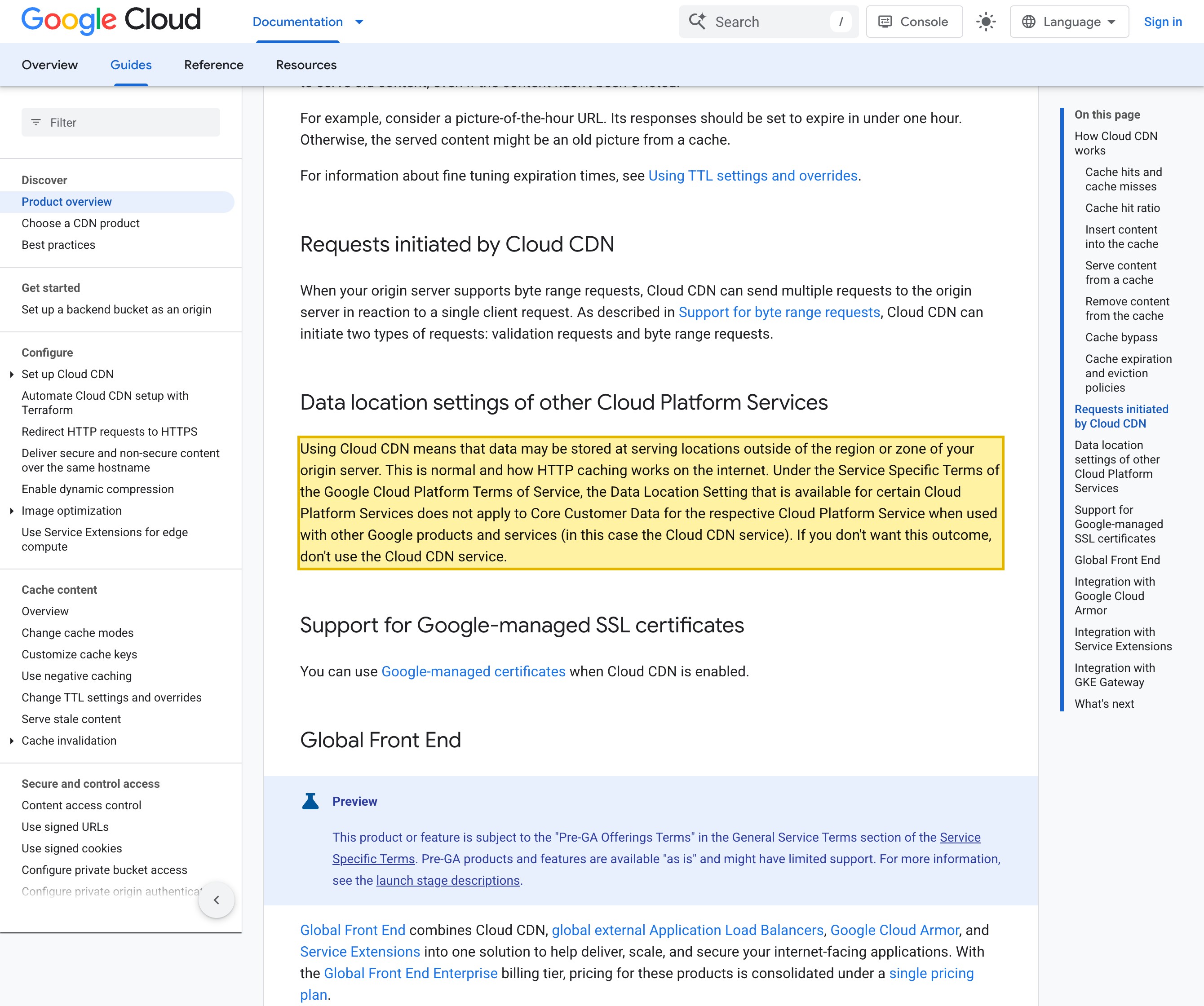
By Google's own Cloud CDN documentation, "data may be stored at serving locations outside of the region or zone of your origin server" — and with no mainland region, for visitors in China those serving locations are offshore. That makes two obligations live at once: handling mainland users' connection and request data (IP, headers, cookies, the URLs they fetch) at an offshore edge is a cross-border transfer PIPL governs, and delivering a public service to mainland users requires an ICP filing bound to a mainland hosting resource Google Cloud does not provide. The table below pairs Google's own wording with the rules it triggers — plus the compliant, in-country path.
This is a risk picture, not a verdict — your duties turn on your data volumes and whether you are a CIIO. Our China compliance team can map your Google Cloud CDN exposure with you →
What Google Cloud CDN's own documentation says about China
| Fact | Primary source |
|---|---|
| In Google's own Cloud CDN documentation: "Using Cloud CDN means that data may be stored at serving locations outside of the region or zone of your origin server." Cloud CDN "uses Google's global edge network to serve content closer to users," caching and serving from Google edge locations — so the request and response data of people in China is handled at those edge locations, not necessarily where your origin sits. | Google Cloud — Cloud CDN overview, retrieved 2026-10-14 |
| Google Cloud operates no region inside mainland China. Google Cloud's own global locations show no Beijing, Shanghai, Shenzhen or Guangzhou region, and there is no Google Cloud equivalent of a separate mainland-China partition to deploy into. With no mainland region, a China-facing Cloud CDN origin has no in-country hosting resource to bind an ICP filing to. | Google Cloud — Global locations / regions, retrieved 2026-10-14 |
| Because a CDN edge terminates mainland visitors' connections and handles their personal information — IP addresses, request headers, cookies and requested URLs — then caches responses, doing that at locations outside the mainland is a cross-border transfer of personal information under PIPL. The handler (you, the Google Cloud customer, not Google) must give notice, obtain separate consent, and satisfy one transfer mechanism: a CAC security assessment, the CAC standard contract, or certification (PIPL Articles 38–40). | Personal Information Protection Law (PIPL), Chapter III, Articles 38–40, retrieved 2026-10-14 |
| For a CIIO or large-volume handler, personal information collected in China must be stored inside mainland China (PIPL Article 40; Cybersecurity Law Article 39 (formerly Article 37) — the 2025 amendment, in force January 1, 2026, renumbered the data-localization article from 37 to 39, substance unchanged). An offshore CDN cannot meet it, and delivering content to mainland users is a licensed activity that still requires an ICP filing bound to a mainland hosting resource. | Cybersecurity Law Article 39 (formerly Article 37); PIPL Article 40; ICP filing regime, retrieved 2026-10-14 |
Sources verified by the 21YunBox compliance team on 2026-10-14.
For a mainland-China audience, the question worth asking about Google Cloud CDN is not whether the edge answers a request or how quickly it does — both are routine. It is where mainland users’ request and response data is allowed to be terminated, cached and served, and on what legal basis. Google Cloud CDN is Google’s content-delivery layer: it sits in front of your origin on Google’s external load balancer and caches and serves your content from Google’s global edge network, as close to the user as possible. For a visitor in the mainland, though, “as close as possible” still lands outside the country, because Google Cloud operates no region inside mainland China. So the deciding questions are residency and licensing: may that request data lawfully be handled offshore, and may a public service be delivered to mainland users from a CDN that cannot be filed in-country?
Two legal doors open at once, and neither is about speed. First, data residency: a CDN edge necessarily handles a visitor’s connection and request data — their IP address, request headers, cookies, and the URLs and content they fetch — and caches the responses. Terminate and cache that for people in China at edge locations outside the mainland and you are making a cross-border transfer of personal information under PIPL. Second, licensing and filing: any public-facing service delivered to mainland users must be tied to an ICP filing bound to a mainland hosting resource, and operating content-delivery to mainland users is itself a licensed value-added telecom activity — neither of which a foreign CDN with no mainland presence can satisfy on its own. That second half is the part a reachability test can never report: a probe sees the edge respond and calls it “fine,” while the request data is being handled offshore and the delivery has no in-country footing to file against.
Google Cloud CDN in China at a glance
| What decides it | In Google Cloud CDN's own terms — and China's law |
|---|---|
| Where the request and response data is handled (the region reality) | Cloud CDN caches and serves from Google's global edge network, and in Google's own words "data may be stored at serving locations outside of the region or zone of your origin server." Google Cloud runs no region inside mainland China — no Beijing, Shanghai, Shenzhen or Guangzhou region, and no Google Cloud equivalent of a separate mainland partition — so for mainland visitors those serving locations are offshore. |
| What a CDN edge handles, and why it is personal information | A CDN is not a passive pipe. The edge terminates the visitor's connection and handles their IP address, request headers, cookies and the URLs and content they request, then caches the responses. For a China-facing service that is the personal information of people in the mainland passing through, and where it is handled is a legal question, not a performance one. |
| Your China users' request data when the edge is offshore | Handle and cache the personal information of people in China at edge locations outside the mainland and you are making a cross-border transfer under PIPL (Articles 38–40): notice, separate consent, and one transfer mechanism — a CAC security assessment, the CAC standard contract, or certification. |
| The in-country storage duty (CIIO / high-volume handler) | A critical-information-infrastructure operator or high-volume handler must keep China personal information on the mainland (PIPL Article 40; Cybersecurity Law Article 39 (formerly Article 37) — the 2025 amendment, in force January 1, 2026, renumbered the data-localization article from 37 to 39, substance unchanged). A CDN that caches and serves offshore structurally cannot meet it. |
| CDN licensing and the ICP filing gate | Delivering a public service to mainland users requires an ICP filing bound to a mainland hosting resource, and running content-delivery to mainland users is a licensed value-added telecom activity. With no mainland region, Google Cloud has nothing in-country to file against — so a mainland-facing Cloud CDN origin cannot be ICP-filed. This is the hard blocker, and it is independent of how fast the edge is. |
| Reachability is not the axis (and the lawful lever) | Whether the edge responds from China is a delivery matter, not the legal test; data-in-handling residency and the filing gate are. The lawful levers are to keep China personal information in-country where localization applies, and to put the China-facing surface on ICP-filed, in-country delivery in front of your Google Cloud origin. |
Where the data actually rests — and is handled
Google Cloud CDN works by caching and serving your content from Google’s edge network, close to the requester. In Google’s own documentation, “using Cloud CDN means that data may be stored at serving locations outside of the region or zone of your origin server” — the whole point of a CDN is that the serving location is wherever the edge is, not wherever your origin sits. The question for a mainland audience is simply where that edge is, and Google Cloud’s answer is: not in mainland China. Google Cloud operates no region inside the mainland — there is no Beijing, Shanghai, Shenzhen or Guangzhou region to select, and no Google Cloud equivalent of the separate mainland partitions some other platforms run through a local operator. So a mainland visitor’s request is terminated, cached and served from an edge outside the country, and every byte of request and response data that passes through it is handled offshore.
That is a different kind of residency question from a database, but it is a residency question all the same. A database is where data comes to rest; a CDN is where the live request stream is handled and where responses are cached. Both put the personal information of people in China somewhere, on some legal basis — and for Google Cloud CDN that somewhere is, by design, outside the mainland.
What a CDN edge handles is personal information
It is tempting to treat a CDN as plumbing that moves anonymous bytes, but the edge sees exactly the data that China’s law cares about. To serve a request it handles the visitor’s IP address, their request headers and cookies, and the specific URLs and content they ask for; it then caches the responses it returns. Taken together that is the personal information of your mainland users — who they are, where they are connecting from, and what they are doing — being terminated and stored at a location outside the country.
That is why residency, not reachability, is the test. When that request stream for people in China is handled at an offshore edge, you are making a cross-border transfer, and PIPL Articles 38–40 govern it: notice, separate consent, and one lawful transfer mechanism — a CAC security assessment, the CAC standard contract, or certification. The security-assessment measures set when that assessment is mandatory rather than optional, and the exposure scales with the volume and sensitivity of what crosses the border. On top of the transfer rules sits a harder duty: a critical-information-infrastructure operator or high-volume handler must store China personal information inside the mainland — PIPL Article 40 and the data-localization rule in Cybersecurity Law Article 39 (formerly Article 37) — which an offshore edge, by definition, cannot satisfy. And running content-delivery to mainland users is itself licensed: it needs an ICP filing bound to a mainland hosting resource that Google Cloud, with no mainland region, cannot provide.
Why a reachability check misses this
Point a probe at your Cloud CDN endpoint from Shanghai and you can measure a fast response — and learn nothing about the question that matters. The edge answers just as well from an offshore location; that is precisely the trap. The exposure is not that the CDN is slow or unreachable, it is that the connection and request data of people in China is being terminated, handled and cached outside the country without a lawful transfer basis, that a CIIO or high-volume handler owes an in-country storage duty an offshore edge cannot meet, and that the delivery itself has no mainland footing to carry an ICP filing. A speed or uptime test cannot see where data is handled, on what legal footing it crossed the border, or whether the delivery can be filed in-country — so it reports “fine” on exactly the cases that carry the most regulatory risk. That is the half of the picture a reachability-only view structurally cannot show.
The lawful path — map, localize, deliver
21YunBox is a compliant overlay, not a migration — and a partner to Google Cloud and to your delivery team, not a competitor to them. There is no claim here that Google Cloud has a mainland region; it does not. What we add is the in-country footing it cannot provide, arranged around the stack you already run.
- Map. We read the PIPL cross-border, data-residency, data-localization (CII) and ICP obligations — and the CDN-licensing gate — against your entity, your data volumes and whose personal information your edge actually handles, so you know which duties bite before you change anything.
- Localize. Where the law requires your China users’ personal information to stay on the mainland, we keep consented, in-country storage for what must stay, on licensed in-country infrastructure. Localize means an in-country footing, not a route back to an offshore edge.
- Deliver. The China-facing surface in front of your origin — the content, assets and APIs your mainland users request — runs over ICP-filed, in-country delivery (the 21YunBox Optimizer), in front of the Google Cloud origin you already run. You keep Google Cloud CDN for the rest of the world; no rebuild, no second codebase.
This page maps exposure; it is not a legal ruling. Your actual duties turn on your entity, how you classify the data your edge handles, your transfer volumes and whether you are a critical-information-infrastructure operator — so settle those specifics with qualified China counsel before you rely on any single path. 21YunBox never uses or suggests circumvention of any kind.
Related reading
- Cross-border data transfers under PIPL
- China’s Cybersecurity Law and data localization
- China’s data-export security assessment measures
- How to get an ICP filing for a website in China


