Does Seismic Work in China? PIPL Cross-Border, Data Residency & Employee-Data Rules
Seismic (the Seismic Enablement Cloud) runs on Microsoft Azure in US, Canadian, European, UK, Swiss, Australian and Japanese regions — none in mainland China. Your China team's employee personal information and internal content sit on that offshore cloud, a PIPL cross-border transfer, and Seismic profiles your reps through engagement and readiness analytics under Article 24. A compliance-first look at the residency, employee-data and automated-decision exposure, and the lawful in-country path.
Does Seismic work in China?
Your China sales team's employee personal information and your internal content sit on Seismic's offshore Azure cloud — it has no mainland-China region — a PIPL cross-border transfer, and Seismic profiles your China reps through engagement and readiness analytics under Article 24.
Seismic (the Seismic Enablement Cloud) holds your sales collateral, playbooks, LiveDocs, digital sales rooms and Seismic Learning courses — content that can carry customer personal information — plus the seller directory and the engagement, content-usage and training-readiness analytics it generates about each rep. Because the platform runs only in US, Canadian, European, UK, Swiss, Australian and Japanese regions, holding your China team's employee data there is a PIPL cross-border transfer, and the readiness scores and engagement rankings it builds about individuals open the Article 24 automated-decision door. The lawful lever is to keep the employee data and internal content in-country, handle the profiling duty, and ICP-file any China-facing surface — not to make the offshore platform reachable.
Whether your internal content is 'important data' and which duties bite turns on your sector and workforce — settle the specifics with counsel. Our China team can map your exposure →
What Seismic's own documentation says about China
| Fact | Primary source |
|---|---|
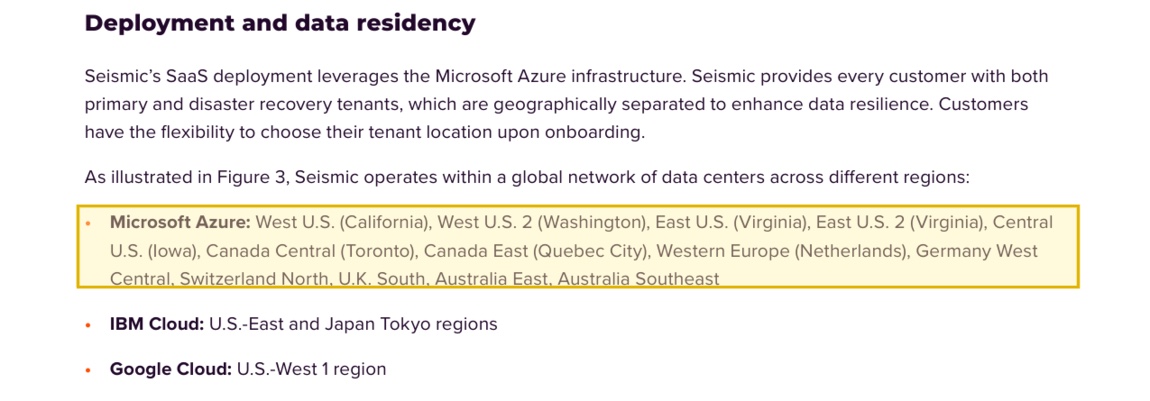
| Seismic runs on Microsoft Azure with no mainland-China region. Its SaaS places each customer's primary and disaster-recovery tenants, chosen at onboarding, in US, Canadian, Western European, German, Swiss, UK, Australian and Japanese regions (with IBM Cloud and Google Cloud for parts of the stack) — none in mainland China, so your China team's data is stored offshore. | Seismic — “The Seismic Advantage: Security, Privacy, and Compliance” whitepaper, “Deployment and data residency”, retrieved 2026-10-11 |
| Seismic profiles the reps and buyers who use it. The Enablement Cloud tracks content engagement and “capturing engagement metrics” across what sellers send and buyers open, and Seismic Learning adds practice scores and a readiness scorecard that rank each rep against a baseline — profiling that, over a China workforce, engages PIPL Article 24 on automated decisions. | Seismic — Buyer Engagement product page (seismic.com), retrieved 2026-10-11 |
| Running Seismic for China staff is a cross-border transfer of their personal information. Because the data sits offshore, PIPL Articles 38–40 require a transfer mechanism (a CAC security assessment, the CAC standard contract, or certification) and Articles 13/23 require notice and a basis to collect it. See cross-border data transfers under PIPL. | 21YunBox — Cross-border data transfers under PIPL, retrieved 2026-10-11 |
| Scoring employees by automated analytics engages PIPL Article 24. When profiling informs a decision about an individual, the person may refuse a decision made solely by automated means, and profiling must offer an option not targeted at their personal characteristics. See China's Personal Information Protection Law. | 21YunBox — China's Personal Information Protection Law (PIPL), retrieved 2026-10-11 |
Sources verified by the 21YunBox compliance team on 2026-10-11.
For a company running Seismic for a mainland-China sales operation, the question is not whether the Seismic Enablement Cloud loads from Shanghai. It is where your China sellers’ employee personal information and your internal content live — and that Seismic is scoring those sellers. Seismic is a sales-enablement and knowledge platform: it holds your collateral, playbooks, LiveDocs, digital sales rooms and Seismic Learning (formerly Lessonly) courses, and it generates engagement, content-usage and training-readiness analytics on the reps who use them. Its SaaS runs on Microsoft Azure, with tenants chosen at onboarding from US, Canadian, European, UK, Swiss, Australian and Japanese regions — none in mainland China. For a China operation that is a PIPL cross-border transfer of your reps’ personal information (Articles 38–40) layered on the consent to collect it (Articles 13/23); an Article 24 automated-decision door where the analytics profile those reps; the residency of internal content that can carry customer personal information or, at volume, “important data”; and an ICP filing for any China-facing surface Seismic serves.
Seismic in China at a glance
| What decides it | In Seismic's own terms — and China's law |
|---|---|
| What it holds | Two things. Your internal content — sales collateral, playbooks, LiveDocs, digital sales rooms and Seismic Learning (formerly Lessonly) courses — some of it confidential, some of it carrying personal information about the customers and prospects it describes. And your workforce's personal information — the seller directory and profiles, plus the engagement, content-usage and training-readiness data Seismic generates about each rep. For a China team, that directory, those profiles and that activity data are personal information under PIPL. |
| Where it runs | Seismic's SaaS runs on Microsoft Azure, with primary and disaster-recovery tenants chosen at onboarding from US, Canadian, European, UK, Swiss, Australian and Japanese regions (with IBM Cloud and Google Cloud for parts of the stack) — and no mainland-China region and no 21Vianet sovereign partition. For a China operation, your sellers' employee personal information processed in those offshore regions is a cross-border transfer (数据出境) under PIPL Articles 38–40. |
| The automated-decision door | Seismic does not just store your reps' data; it profiles it — content-engagement scores, who-opened-what dashboards, and, in Seismic Learning, practice scores and a readiness scorecard that rank each rep against a baseline. When that profiling drives or informs a decision about an individual, it is automated decision-making under PIPL Article 24: the person may refuse a decision made solely by automated means, and profiling must offer an option not targeted at their personal characteristics. |
| Employee-PII & content residency | Collecting your China sellers' personal information needs the Article 13/23 notice-and-consent; sending it offshore needs a transfer mechanism (a CAC security assessment, the CAC standard contract, or certification). For a critical information infrastructure operator or a high-volume handler, China-collected personal information must be stored in China; internal content at volume or in a sensitive sector can also be "important data" under the Data Security Law. Most employee directory and engagement data is ordinary — not sensitive — personal information. |
| Reachability is not the axis | Whether the Seismic tenant answers quickly from the mainland is an operational matter, not the compliance question. What decides it is where your China employees' personal information and your internal content live, and that the platform profiles those employees. 21YunBox maps the exposure, helps you keep the employee data and content on a lawful in-country path, handles the Article 24 duty, and delivers any China-facing surface compliantly, with an ICP filing — in front of the stack you already run. |
What it actually holds — your internal content and your people’s data
Seismic sits on top of your sales organization and holds two kinds of data. The first is your internal content: the collateral, playbooks, presentations, LiveDocs and digital sales rooms your teams build and send, and the Seismic Learning courses and practice scenarios your reps complete. Much of it is confidential, and some of it carries personal information about the customers and prospects it describes or is shared with. The second is your workforce’s personal information: the seller directory and user profiles, and — the part a reachability review never sees — the behavioral data Seismic generates about each rep. Every document opened, every piece of content sent, every buyer interaction tracked through a shared link, and every lesson completed becomes an analytics record tied to a named individual. For a China sales team, that directory, those profiles and that activity data are personal information under Chinese law. And because Seismic’s SaaS runs on Microsoft Azure in offshore regions — chosen at onboarding, but never mainland China — all of it is processed and stored outside the country. Seismic offers no mainland-China region and no Microsoft 365 operated by 21Vianet sovereign-cloud partition, so there is no in-country Seismic tenant to point a China operation at.
The doors: employee personal data, cross-border transfer, and automated decisions
Once your China sellers’ data is held in an offshore region, a separate body of law decides whether it was allowed to go there. The directory, profiles and activity records are personal information under China’s Personal Information Protection Law, and holding them abroad is a cross-border transfer (数据出境). PIPL puts the duty on the handler — your China entity, not Seismic: Articles 13 and 23 require notice and a basis to collect employee data in the first place, and Articles 38–40 require a transfer mechanism for sending it offshore — a CAC security assessment, the CAC standard contract, or certification — with the associated notice and, where it applies, a separate consent. Most of this is ordinary personal information, not the sensitive category, so the default duties apply rather than the heightened sensitive-data ones — but the volume and nature of what you concentrate in one offshore platform still matter.
The distinctive exposure is the analytics. Seismic does not merely store your reps’ data; it profiles it — content-engagement scores, who-opened-what dashboards, and, in Seismic Learning, practice scores and a readiness scorecard that rank each rep against a baseline. When that profiling drives or informs a decision about an individual — a readiness rating, an engagement ranking, a coaching or performance nudge — it is automated decision-making under PIPL Article 24. Article 24 lets the individual refuse a decision made solely by automated means and requires that profiling offer an option not targeted at personal characteristics. Analytics that watch and score a China workforce also sit against China’s employee-data and workplace norms. This is the half a pure-reachability check misses: the platform is continuously profiling your China employees, offshore.
Two further doors turn on scale and role. If your organization is a critical information infrastructure operator or a high-volume handler, the Cybersecurity Law’s Article 39 (formerly Article 37 — the 2025 Cybersecurity Law amendment, in force January 1, 2026, renumbered the data-localization article from 37 to 39, with its substance unchanged) requires personal information generated in China to be stored in China, which an offshore tenant cannot satisfy. And the internal content itself — if it is voluminous or sits in a sensitive sector — can qualify as “important data” under the Data Security Law, which adds its own export controls. Which of these bite your specific case turns on your sector, your data volumes and your role under Chinese law.
Logging in isn’t the question — compliant in-country employee data is
The fix is not to make an offshore Seismic tenant reachable from the mainland — reachability was never the question. It is to put your China employees’ personal information and your internal content where the law needs it: on an in-country path. That means keeping the China seller directory, profiles and activity analytics — and the internal content that describes your business and your customers — on a China-resident path or a China-legal domestic alternative, with data minimization, so only what may lawfully leave the country crosses the border. Obtain the Article 13/23 notice-and-consent for the employee data, put an Article 38–40 transfer mechanism behind anything that does cross, and handle the Article 24 automated-decision duty and its opt-out for the rep analytics. Then any China-facing surface the platform serves — an external knowledge base, a customer-facing microsite, a public help center — is an internet information service in the mainland and carries an ICP filing duty bound to a mainland hosting resource, plus compliant in-country delivery. In-country means keeping the data on an in-country path — never a tunnel that ships it offshore anyway. None of this is a verdict that Seismic is “blocked” or “illegal” in China; it is a residency-and-exposure map, and whether your internal content is “important data” and which duties bite turns on your sector and your workforce — worth settling the specifics with counsel before your China operation depends on it.
The lawful path — map, localize, deliver
There is a compliant way to run a sales-enablement platform for a China operation, and it has a shape — one that sits in front of the Seismic stack you already run, with no rebuild and no migration.
First, map: our China team inventories what Seismic holds for you — the internal content (collateral, LiveDocs, sales rooms, Seismic Learning courses) and the employee personal information (the seller directory, profiles, and the engagement, content-usage and readiness analytics) — establishes where each is processed and stored today (an offshore Azure region), whether the platform profiles individuals under Article 24, the consent and transfer basis each flow needs, and whether any content is “important data.” We build the technical picture; the legal conclusions are settled with counsel.
Then localize: we help you keep the China employee data and internal content in-country — on a China-resident path or a China-legal domestic alternative, with minimization — obtain the Article 13/23 notice-and-consent, put an Article 38–40 mechanism behind anything that crosses the border, and handle the Article 24 automated-decision duty and its opt-out. Localize means keeping the data on an in-country path, never a route that ships it offshore anyway.
Then deliver: any China-facing surface the platform serves — a public knowledge base, an external microsite, a customer help center — needs compliant, in-country delivery and carries an ICP filing duty. 21YunBox delivers it in-country — the 21YunBox Optimizer — in front of what you already run, so it runs legally and compliantly for your users in China. 21YunBox never uses or suggests circumvention of any kind — we keep in-country what the law says must stay, deliver the rest compliantly from inside the mainland, and never move personal information across the border by stealth. 21YunBox is a compliance overlay and partner to the platforms you already use, not a competitor to them.
Related reading:
- Cross-border data transfers under PIPL
- China’s Cybersecurity Law
- China’s Personal Information Protection Law (PIPL)
- How to get an ICP filing for China