Does Microsoft Viva Work in China? PIPL Cross-Border, Data Residency & Employee-Data Rules
Microsoft Viva is the employee-experience suite on Microsoft 365 — Connections, Engage, Insights, Learning, Glint — and it is not offered on Microsoft 365 operated by 21Vianet, so for a China workforce it runs offshore: your employees' directory, profiles and internal content become a PIPL cross-border transfer, and the suite profiles your China staff under Article 24. A compliance-first look at the residency, employee-data and automated-decision exposure.
Does Microsoft Viva work in China?
Your China workforce's employee personal information and your internal content sit on Microsoft Viva's offshore global cloud — Viva is not offered on Microsoft 365 operated by 21Vianet, the China sovereign cloud — so running it for your China staff is a PIPL cross-border transfer, and the suite profiles your China employees under Article 24.
Viva is the employee-experience layer on Microsoft 365: it holds your whole China workforce's directory, profiles and internal communications (Viva Connections, Viva Engage), the learning catalog, and the engagement and "Insights" analytics that score how individuals work (Viva Insights, Glint, Pulse). Because Microsoft does not offer Viva on the 21Vianet sovereign cloud, that employee data is processed on Microsoft's worldwide commercial cloud — a PIPL cross-border transfer of employee personal information that needs notice, a separate consent and a transfer mechanism, on top of the Article 13/23 consent to collect it. The profiling the suite performs is automated decision-making under PIPL Article 24, which lets an employee refuse a decision made solely by automation. The lawful lever is to keep the employee data and internal content in-country, handle the profiling duty, and ICP-file any China-facing surface — not to make the offshore platform reachable.
This is a risk map, not a verdict — which duties bite turns on your sector and workforce, so settle the specifics with counsel. Our China team can map your exposure →
What Microsoft Viva's own documentation says about China
| Fact | Primary source |
|---|---|
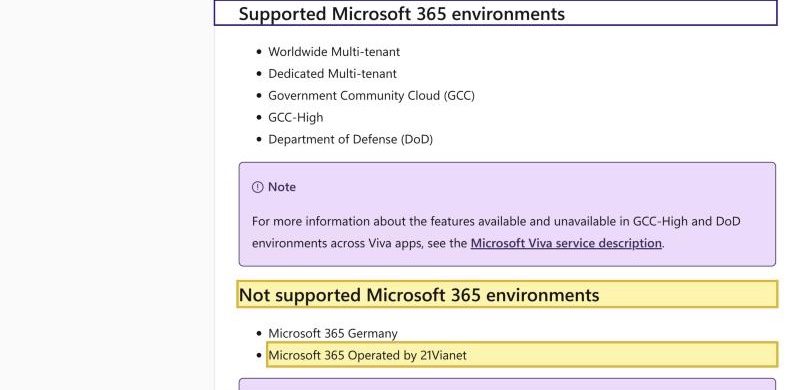
| Microsoft lists "Microsoft 365 Operated by 21Vianet" as a not-supported environment for Viva Insights. The Viva Insights environment-requirements page shows the supported clouds as Worldwide Multi-tenant, Dedicated Multi-tenant and the US government clouds (GCC, GCC-High, DoD), and names "Microsoft 365 Germany" and "Microsoft 365 Operated by 21Vianet" as not supported — so the analytics that profile your China employees are not offered on China's sovereign cloud. | Microsoft Learn — Environment requirements for Viva Insights (retrieved 2026-10-11) |
| Microsoft's Viva service description confirms "Office 365 Operated by 21Vianet isn't in scope at this time." The same description defines Viva as "an integrated employee experience platform built on Microsoft 365 and Microsoft Teams" — Connections, Engage, Insights, Learning, Glint and Pulse — holding the directory, internal communications and engagement analytics for your whole workforce, run on Microsoft's global commercial cloud for a China operation. | Microsoft Learn — Microsoft Viva service description (retrieved 2026-10-11) |
| Processing your China employees' data offshore is a cross-border transfer under PIPL. Storing or processing your workforce's directory, profiles and engagement data outside the mainland triggers PIPL Articles 38–40 — the handler (your China entity) owes notice, a separate consent and a transfer mechanism (a CAC security assessment, the CAC standard contract, or certification), on top of the Article 13/23 notice-and-consent to collect it. | 21YunBox — Cross-border data transfers under PIPL (Articles 38–40) |
| Profiling employees is automated decision-making under PIPL Article 24; a CIIO or high-volume handler must store China data in China. Engagement scores and work-pattern analytics that inform a decision about an individual fall under PIPL Article 24, which lets the person refuse a solely-automated decision; and Cybersecurity Law Article 39 (formerly Article 37) requires China-generated personal information to be stored in China for those handlers. | 21YunBox — China PIPL (Article 24) and Cybersecurity Law (Article 39, formerly 37) |
Sources verified by the 21YunBox compliance team on 2026-10-11.
For an enterprise running Microsoft Viva for a mainland-China workforce, the question is not whether the app opens in Microsoft Teams from Shanghai. Viva is the employee-experience suite layered on Microsoft 365 — Viva Connections (the intranet gateway), Viva Engage (communities, the successor to Yammer), Viva Insights (analytics of how people work), Viva Learning, and the Glint and Pulse engagement surveys. In one place it concentrates two things China’s law cares about: your whole China workforce’s directory, profiles and internal communications, and the engagement and “Insights” analytics that profile each individual employee. Microsoft 365 operated by 21Vianet — the China sovereign cloud — exists, but Viva is not offered on it; Microsoft’s own documentation lists it among the environments where Viva is not supported, so for your China workforce Viva runs on Microsoft’s global commercial cloud, offshore. The doors that follow: a cross-border transfer of employee personal information under PIPL Articles 38–40, the Article 24 automated-decision duty over the profiling analytics, internal-content residency and “important data,” in-country storage for a CIIO or high-volume handler, and ICP for any China-facing surface the suite serves.
Microsoft Viva in China at a glance
| What decides it | In Microsoft Viva's own terms — and China's law |
|---|---|
| What it holds | Built on Microsoft 365 and Teams, Viva concentrates your internal company content and communications (Viva Connections' intranet, Viva Engage communities and storyline, Viva Learning's catalog), the whole China workforce's directory and profiles drawn from your Microsoft Entra graph, and the engagement, usage and "Insights" analytics that score how individuals work (Viva Insights, Glint, Pulse). That directory and engagement data is personal information about your China employees — ordinary personal information, not the sensitive category. |
| Where it runs | Microsoft 365 operated by 21Vianet — the China sovereign cloud — exists and keeps data in China, but Viva is not offered on it. Microsoft's Viva Insights documentation names "Microsoft 365 Operated by 21Vianet" a not-supported environment, and the Microsoft Viva service description states it "isn't in scope at this time." So for a China workforce Viva runs on Microsoft's worldwide commercial cloud — a cross-border transfer (数据出境) of employee personal information under PIPL Articles 38–40. |
| The automated-decision door | Viva does not merely store employee data; it profiles it — engagement scores, work-pattern analytics, adoption and "readiness" dashboards, who-read-what, survey sentiment. When that profiling informs a decision about an individual, it is automated decision-making under PIPL Article 24: the employee may refuse a decision made solely by automation, and profiling must offer an option not targeted at their personal characteristics. This is the half a reachability review misses — the platform is watching and scoring your China staff, offshore. |
| Residency and consent | Collecting employee data needs the PIPL Article 13/23 notice-and-consent; sending it offshore needs a transfer mechanism and a separate consent. For a CIIO or high-volume handler, Cybersecurity Law Article 39 (formerly Article 37) requires China-generated personal information to be stored in China. Internal content at volume or in a sensitive sector can raise the "important data" (重要数据) question. |
| Reachability is not the axis | Whether Viva loads quickly in Teams from the mainland is an operational matter, not the compliance question. What decides it is where your workforce's employee data and internal content live and that the suite profiles your people. 21YunBox keeps the employee data and internal content on a lawful in-country path, helps you handle the Article 24 profiling duty, and delivers any China-facing surface compliantly with an ICP filing — in front of the stack you already run. |
What it actually holds — your internal content and your people’s data
Microsoft Viva is not a single app; it is a suite of employee-experience modules layered on Microsoft 365 and surfaced in Microsoft Teams. Viva Connections is the intranet gateway — company news, policies, benefits, resources and employee-resource-group communities in one customizable app. Viva Engage carries internal conversations, announcements, storyline posts and virtual events; it is the evolution of Yammer. Viva Learning pulls a learning catalog into the flow of work, and Viva Amplify runs internal communications campaigns. Because every module sits on Microsoft 365, it draws on your Microsoft Entra directory and the SharePoint and Exchange content behind it — which is to say Viva reaches across your whole workforce graph and the internal content your China operation produces.
On top of that content sits an analytics layer that is the sharp edge for China. Viva Insights derives personal, manager and leader views of how people work — focus time, meeting load, collaboration patterns, after-hours activity — and Viva Glint and Viva Pulse run org-wide and team engagement surveys with trend dashboards. These generate per-individual engagement, usage and “readiness” signals about named employees. Where does all of this run for a China workforce? Microsoft 365 operated by 21Vianet, the sovereign cloud, keeps base Microsoft 365 data inside China — but it is a distinct cloud, and Viva is not one of the services it offers. Microsoft’s Viva Insights environment-requirements page lists “Microsoft 365 Operated by 21Vianet” under its not-supported environments; the Microsoft Viva service description says Office 365 operated by 21Vianet “isn’t in scope at this time”; and the 21Vianet platform plans bundle no Viva module at all (MyAnalytics, the Viva Insights data plan, is off across every plan). To use Viva for your China employees, then, you run it on Microsoft’s global commercial cloud — and their directory, profiles, internal communications and engagement analytics are processed there, offshore.
The doors: employee personal data, cross-border transfer, and automated decisions
Your China workforce’s directory, profiles, internal communications and engagement analytics are personal information about your employees under China’s Personal Information Protection Law. Processing them on an offshore cloud is a cross-border transfer (数据出境), and PIPL puts the duty on the handler — your China entity, not Microsoft: Articles 38–40 require a transfer mechanism (a CAC security assessment, the CAC standard contract, or certification) and a separate consent for the overseas transfer, on top of the Article 13/23 notice-and-consent for collecting employee data in the first place. On residency, if your organization is a critical information infrastructure operator or a large-volume handler, the Cybersecurity Law’s Article 39 (formerly Article 37 — the data-localization provision was renumbered by the 2025 Cybersecurity Law amendment that took effect on January 1, 2026, with its substance unchanged) requires personal information generated in China to be stored in China, a duty an offshore suite cannot meet. And your internal content, at volume or in a sensitive sector, can raise the “important data” (重要数据) question under the Data Security Law.
The distinctive door is Article 24. Viva does not just hold employee data; it profiles it — engagement scores, work-pattern analytics, adoption and “readiness” dashboards, survey sentiment, signals about who read what. When that profiling drives or informs a decision about an individual — a readiness ranking, an engagement flag, a nudge — it is automated decision-making under PIPL Article 24, which lets the data subject refuse a decision made solely by automated means and requires that profiling offer an option not targeted at their personal characteristics. Analytics that watch and score a China workforce also sit against China’s employee-monitoring and labor norms. A review that asks only “does Viva load from Shanghai” never reaches this door; the platform is observing and ranking your China employees, from offshore. Which of these duties bite your specific case turns on your sector, your data volumes and your role under Chinese law.
Logging in isn’t the question — compliant in-country employee data is
The fix is not to make an offshore Viva reachable from the mainland — reachability was never the question, and Viva already opens in Teams from China. It is to put your employees’ data and internal content where the law needs it: keep the China workforce’s directory, profiles, engagement analytics and internal content on an in-country path — a China-resident path or a China-legal domestic employee-experience and engagement alternative — with data minimization, so what describes and scores your China staff stays inside the country and only what may lawfully leave crosses the border. Obtain the Article 13/23 notice-and-consent, handle any Article 24 automated-decision and profiling duty and its opt-out, and treat any internal content that could be “important data” accordingly. Keeping the data in-country means exactly that — an in-country path, never a tunnel that ships the employee data offshore anyway. Then any China-facing surface the suite serves — a public knowledge base, an external communications microsite, a customer-facing help center — is an internet information service in the mainland and carries an ICP filing (备案) duty with compliant in-country delivery. None of this is a verdict that Viva is “blocked” or “illegal” in China; it is a risk map, and whether your internal content is “important data” and which duties bite turns on your sector and workforce — settle the specifics with counsel before your China operations depend on it.
The lawful path — map, localize, deliver
There is a compliant way to run an employee-experience program for a China operation, and it has a shape. First, map: our China team inventories what Viva holds for your China workforce — the directory and profiles, the internal communications and content, and the engagement, usage and “Insights” analytics — establishes where each is processed today (Microsoft’s offshore commercial cloud, since Viva is not offered on the 21Vianet sovereign cloud), whether the suite profiles individuals under Article 24, the consent and transfer basis each flow needs, and whether any internal content is “important data.” We build the technical picture; the legal conclusions are settled with counsel.
Then localize: we help you keep the China employee data and internal content in-country — on a China-resident path or a China-legal domestic alternative — with minimization, obtain the Article 13/23 notice-and-consent, and handle the Article 24 automated-decision and profiling duty and its opt-out. Localize means keeping the data on an in-country path, never shipping it offshore by another route.
Then deliver: any China-facing surface the suite serves — a public knowledge base, an external microsite, a help center — needs compliant, in-country delivery and carries an ICP filing duty. 21YunBox delivers it in-country — the 21YunBox Optimizer — in front of what you already run, with no rebuild and no re-platform. The result is an employee-experience program that runs legally and compliantly for your users in China. 21YunBox never uses or suggests circumvention of any kind — we keep in-country what the law says must stay, deliver the rest compliantly from inside the mainland, and never move employee personal information across the border by stealth.
Related reading:
- Cross-border data transfers under PIPL
- China’s Cybersecurity Law (data localization, Article 39 / formerly 37)
- China’s Personal Information Protection Law (PIPL)
- How to get an ICP filing for China