Does Oracle EPM Cloud Work in China? Financial Data Residency, MNPI & PIPL Cross-Border
Oracle EPM Cloud is reachable from mainland China, so residency, not speed, is the question. Oracle Fusion Cloud EPM runs on Oracle Cloud Infrastructure, which has "no data centers in China," so the budgets, consolidated results and close data your China entity feeds in rest offshore — a cross-border transfer under PIPL. A compliance-first look at the residency, MNPI and sensitive-PI exposure and the lawful in-country path.
Does Oracle EPM Cloud work in China?
For a finance platform the China question is not whether the dashboard opens — it does — but where the numbers it holds are allowed to rest, and Oracle EPM Cloud keeps them offshore.
Oracle Fusion Cloud EPM runs on Oracle Cloud Infrastructure, and Oracle's own Cloud Hosting and Delivery Policies state it has “no data centers in China,” so the budgets, forecasts, consolidated results, tax and close data your China entity feeds in come to rest in an offshore OCI region (Tokyo, Osaka, Seoul, Singapore, Mumbai or Sydney). Much of that is material non-public information, carried together with employee, approver and counterparty personal data — so collecting it into an offshore EPM is a cross-border transfer (数据出境) under PIPL (Articles 38–40: notice, a separate consent, and one transfer mechanism). Where employee pay or bank and tax identifiers travel with it, that is sensitive personal information (Article 28); at volume, or where consolidated group data is “important data,” it may trigger China's data-export security assessment; and for a critical information infrastructure operator, data generated in China must stay in China (PIPL Article 40; Cybersecurity Law Article 39 (formerly Article 37)). Oracle's in-country Dedicated Region and Cloud@Customer models settle where the bytes sit, not whether the processing is lawful.
This is a risk map, not a verdict — what you owe turns on your entity, your data volumes and your role as handler, and it is worth settling with counsel. 21YunBox maps the exposure, localizes the China EPM data that must stay onto a China-resident footing, and delivers your China-facing surfaces in-country on ICP-filed infrastructure. Our China team can map your exposure →
What Oracle EPM Cloud's own documentation says about China
| Fact | Primary source |
|---|---|
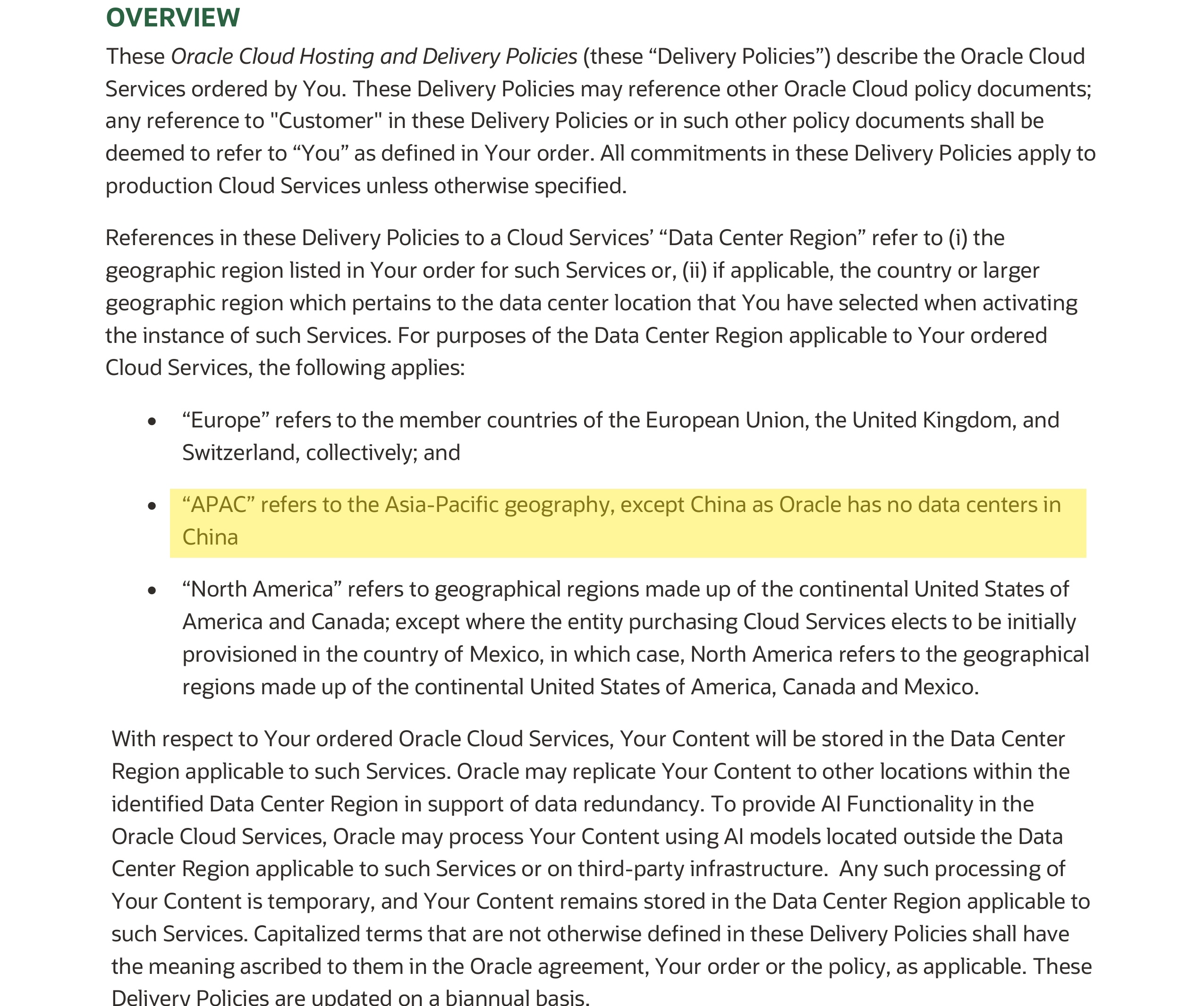
| Oracle states plainly that it has no data centers in China. Oracle's own Cloud Hosting and Delivery Policies define the hosting geography for its cloud services and say that “APAC” refers to “the Asia-Pacific geography, except China as Oracle has no data centers in China,” and that “Your Content will be stored in the Data Center Region applicable to such Services.” Oracle Fusion Cloud EPM is delivered from this same Oracle Cloud Infrastructure footprint, so there is no mainland-China region to host your China EPM data in. | Oracle, “Oracle Cloud Hosting and Delivery Policies” (Effective September 2026; Version 3.13), OVERVIEW section, page 4 — retrieved 2026-10-10 |
| Oracle's own EPM Cloud region list contains no mainland-China region. Oracle's Fusion Cloud EPM regions documentation introduces its table with “The following table lists the Oracle Fusion Cloud Enterprise Performance Management geographical regions,” and its Asia-Pacific entries sit only in Australia, India, Japan, Singapore and South Korea — the nearest to the mainland being Tokyo, Osaka, Seoul, Singapore, Mumbai and Sydney, none inside China. Its dedicated and air-gapped region realms likewise name no China location, so an in-country Oracle build is a customer-sited project, not a region you select from a standard EPM subscription. | Oracle Fusion Cloud EPM — Geographical Regions and Identifiers (docs.oracle.com), retrieved 2026-10-10 |
| Holding China EPM data in an offshore region is a PIPL cross-border transfer — and some of it is sensitive. The financial and personal records a China entity feeds into an offshore Oracle region are a cross-border transfer under PIPL Articles 38–40: notice, a separate consent, and one transfer mechanism — a CAC security assessment, the CAC standard contract, or certification. Where employee pay or bank and tax identifiers travel with the close, that is financial information treated as sensitive personal information (Article 28), which adds a specific purpose, a separate consent and a prior personal-information protection impact assessment (Article 55). | Personal Information Protection Law of the PRC, Articles 28, 38–40 and 55 (cac.gov.cn), retrieved 2026-10-10 |
| For some handlers the data must stay in China — and consolidated financials can trigger the export assessment on their own. Where the handler is a critical information infrastructure operator, data generated in China must be stored in the mainland (PIPL Article 40; Cybersecurity Law Article 39 (formerly Article 37)) — a duty an offshore EPM region cannot meet — and consolidated group financials may be treated as “important data,” carrying China's data-export security assessment irrespective of headcount. Any China-facing EPM reporting or data-collection surface served from inside the mainland must carry an ICP filing (State Council Order No. 292; MIIT Order No. 33). | PIPL Article 40; Cybersecurity Law Article 39 (formerly Article 37); Measures for the Security Assessment of Data Exports; State Council Order No. 292; MIIT Order No. 33 (npc.gov.cn), retrieved 2026-10-10 |
Sources verified by the 21YunBox compliance team on 2026-10-10.
Asked whether Oracle EPM Cloud “works” in mainland China, a finance team’s first instinct is to check whether planners in Shanghai can open the application — and they can: Oracle Fusion Cloud EPM (the cloud successor to the on-premises Oracle Hyperion suite Oracle acquired in 2007) is browser-based SaaS and not blocked at the border. So reachability is not where the China decision is made. What settles it is data residency — where the numbers EPM holds come to rest, and whether moving them there was lawful. And EPM holds the most sensitive numbers a company has: budgets and forecasts, the general-ledger close, reconciliations, consolidated group results, and tax and statutory reporting — un-released results that are material non-public information, bound up with the personal data of the employees, approvers and counterparties attached to them. Oracle runs that platform on Oracle Cloud Infrastructure, and answers the geography half of the question in its own contract.
Oracle EPM Cloud in China at a glance
| What decides it | In Oracle's own terms — and China's law |
|---|---|
| Where do the EPM records live? | Offshore. Oracle's own Cloud Hosting and Delivery Policies state it has “no data centers in China,” and that “Your Content will be stored in the Data Center Region applicable to such Services.” Oracle's EPM Cloud regions list names only offshore geographies — the nearest to the mainland are Tokyo, Osaka, Seoul, Singapore, Mumbai and Sydney — so a standard EPM instance for your China entity sits abroad. |
| What it holds — and why it's personal and material | EPM is the system of record for the money: budgets and forecasts, the ledger close, reconciliations and journal entries, consolidated group results, and tax and statutory reporting. Much of that is material non-public information, and it carries personal information — workforce-planning employee and compensation data, preparer and approver identities, vendor and counterparty contacts. Where employee pay or bank and tax identifiers travel with it, that is financial information that can be sensitive personal information (PIPL Article 28); consolidated group financials at scale may be treated as “important data.” |
| Putting China data into it = a cross-border transfer | Holding China-sourced financial and personal records in an offshore EPM region is a cross-border transfer (数据出境) under PIPL (Articles 38–40): notice, a separate consent, and one transfer mechanism — a CAC security assessment, the CAC standard contract, or certification. The duty sits on the handler — your China entity — not on Oracle the processor. |
| In-country storage duty | At volume, or where consolidated financials are “important data,” a CAC data-export security assessment (数据出境安全评估) may apply before anything leaves. For a critical information infrastructure operator, data generated in China must be stored in the mainland — PIPL Article 40 and Cybersecurity Law Article 39 (formerly Article 37); the 2025 Cybersecurity Law amendment, in force January 1, 2026, renumbered the data-localization article from 37 to 39, substance unchanged — a duty an offshore EPM region cannot meet. |
| Reachability is not the axis | EPM is browser-accessed SaaS served from OCI regions and is not blocked at the border; cross-border access from the mainland can be inconsistent, but that is operational, not the China decision. Any China-facing EPM surface actually served in the mainland — a reporting or data-collection portal, a planning input form — is a public service there and carries an ICP filing (备案) duty bound to a mainland hosting resource. |
No mainland Oracle region — so your EPM numbers rest offshore
Oracle Fusion Cloud EPM is delivered from Oracle Cloud Infrastructure, and your data lives in whichever OCI region your service was provisioned in. Oracle’s own Cloud Hosting and Delivery Policies are explicit about that geography: “With respect to Your ordered Oracle Cloud Services, Your Content will be stored in the Data Center Region applicable to such Services,” and, defining that region, “‘APAC’ refers to the Asia-Pacific geography, except China as Oracle has no data centers in China.” Oracle’s EPM-specific regions documentation bears it out — it introduces its list with “The following table lists the Oracle Fusion Cloud Enterprise Performance Management geographical regions,” and across the Asia-Pacific rows that follow — in Australia, India, Japan, Singapore and South Korea — none is in mainland China; the nearest to the mainland are Tokyo, Osaka, Seoul, Singapore, Mumbai and Sydney.
So the conclusion is structural, not a tuning problem: an EPM instance serving your China entity is hosted offshore because Oracle offers nowhere in the mainland to host it. The budgets and forecasts, the close and reconciliations, and the consolidated results your China operations feed into EPM all come to rest in another country. That is the fact every China compliance question about EPM starts from — and it is settled before performance is ever discussed. The same offshore OCI footing drives our read of EPM’s Fusion-suite siblings, Oracle Fusion Cloud ERP and Oracle HCM Cloud.
What EPM holds is material — and personal — information
Once the data is offshore, a different body of law decides whether it was allowed to go there. The records a China entity feeds into EPM — the local trial balance and close, the entity’s budgets and forecasts, the figures that roll up into consolidated group results — are personal information under China’s Personal Information Protection Law to the extent they carry the identities of employees, preparers, approvers, vendors and counterparties, and loading them into an EPM instance hosted in Japan, Singapore or the US is a cross-border transfer (数据出境). PIPL puts the duty on the handler — your China entity, not Oracle the processor: Articles 38–40 require notice, a separate consent for the overseas transfer, and one transfer mechanism — a CAC security assessment, the CAC standard contract, or certification.
EPM raises the stakes in a way most applications do not, because of what the numbers are. Un-released results, forecasts and close data are material non-public information: commercially sensitive before disclosure, and the kind of data whose premature or uncontrolled movement a listed group’s own disclosure controls are built to prevent. On volume and classification, consolidated financial data for a sizeable China operation can itself be treated as “important data,” which carries China’s data-export security assessment (数据出境安全评估) irrespective of how many individuals are involved. And on sensitivity: to the extent workforce planning ingests employee-level compensation, or bank and tax identifiers travel with the close and reconciliations, that is financial information treated as sensitive personal information under PIPL Article 28, raising the bar to a specific purpose, a separate consent, and a personal-information protection impact assessment (Article 55). Which of these bite your specific deployment turns on your sector, your data volumes and your role under Chinese law — not a verdict that EPM is “blocked” or “illegal.”
Narrowing the exposure doesn’t close the door
It is tempting to treat the residency problem as something you can engineer away inside EPM, and the levers that look like fixes mostly change what crosses the border, not that it crosses. You can push only aggregated balances up to group consolidation, redact identifiers before they travel, or provision a nearer OCI region — all sound data-minimization, and all worth doing — but the records your China entity keeps in EPM still come to rest abroad, so the residency position is unchanged. EPM’s functional China localizations are the same story: Chinese statutory and tax configurations change how the software behaves, not where the data sits.
Oracle’s in-country infrastructure deserves an honest hearing on the same point. Oracle does operate Dedicated Region and Cloud@Customer models that place Oracle-managed infrastructure inside a customer’s own facility — but Oracle’s published EPM dedicated and air-gapped region realms name no mainland-China location, and such a deployment is a customer-sited infrastructure project, not a region you select from a standard EPM subscription. More to the point for a compliance page: even where an organization does stand up an in-country Oracle footing, that settles where the bytes sit — not whether the processing is lawful. If any China data still flows from that system to a global, offshore EPM for group consolidation, that flow is a cross-border transfer in its own right; the consent and in-country-storage duties — Cybersecurity Law Article 39 (formerly Article 37) and PIPL Article 40 — attach to the data regardless of the rack it lives on; and the ICP filing (备案) for any China-facing EPM reporting or data-collection surface does not disappear. In-country hardware is a necessary condition for residency; it is never a sufficient one for compliance. None of this is a ruling — it is a risk map: which obligations actually bite your EPM footprint turns on your entity, your data volumes and who your users are, and the specifics are worth settling with your own counsel against what your EPM instance really holds.
The lawful path — map, localize, deliver
There is a compliant way to run EPM for a China operation, and it has a shape. First, map: our China team works through the residency and cross-border exposure your EPM deployment carries — which financial and personal records your China entity generates must stay in the country, what may lawfully leave for global planning and consolidation, where a data-export security assessment or an Article 39 (formerly Article 37) storage duty applies, and what your notice, consent and impact-assessment flow has to cover. The legal conclusions are settled with counsel; we build the technical picture that feeds them.
Then localize: we help you put the China EPM data that has to stay on a China-resident footing — a consented, in-country home for the records your mainland entity is obliged to keep in the country — while EPM stays your global system of record for planning and consolidation everywhere else, receiving only what may lawfully cross the border. Where an in-country Oracle deployment is the right fit, we help you weigh it for what it is: a residency footing, not a compliance shortcut.
Then deliver: the China-facing surfaces of that stack — the reporting dashboards, the planning and data-collection forms your mainland finance users actually open — need compliant, in-country delivery, and a public-facing service in the mainland carries an ICP filing duty. The 21YunBox Optimizer delivers them in-country, in front of what you already run, with no rebuild and no re-platform. The result is an EPM footprint that runs legally and compliantly for your users in China. 21YunBox is a compliant overlay, not a migration, and a partner to the platform you already run, not a competitor to it — we keep in-country what the law says must stay, deliver the rest compliantly from inside the mainland, and map, localize and deliver over lawful, ICP-filed infrastructure. 21YunBox never uses or suggests circumvention of any kind.
Related reading:
- Cross-border data transfers under PIPL
- China’s data-export security assessment
- China’s Cybersecurity Law (data localization, Article 39)
- How to get an ICP filing for China