Does OneStream Work in China? Financial Consolidation Data, PIPL & Data Residency
OneStream is a hosted corporate performance management platform — consolidation, close, planning and reporting — so whether it 'works' in mainland China is a data-residency question, not a speed one. Its own documentation lists data centers across the Americas, Europe and Asia-Pacific, none in mainland China, which makes the China records it holds a PIPL cross-border transfer. A compliance-first look at the residency and cross-border exposure — and the lawful in-country path.
Does OneStream work in China?
OneStream opens from China, but it runs no mainland-China region — so the real question is where its records are allowed to rest, not whether the dashboard loads.
OneStream is a hosted corporate performance management platform holding your consolidated results, the general-ledger close, journals and reconciliations, budgets and forecasts, and the employee and legal-entity data attached to them. Its own Service Description Guide lists data centers across the Americas, Europe and Asia-Pacific — none in mainland China — so the records your China entity feeds in come to rest offshore, a cross-border transfer of personal information under PIPL, with bank and tax identifiers raising a sensitive-PI bar and a Cybersecurity Law Article 39 (formerly Article 37) in-country storage duty for critical information infrastructure operators.
Which obligations bite depends on your entity, data volumes and users — a risk map to settle with counsel. Our China team can map your exposure →
What OneStream's own documentation says about China
| Fact | Primary source |
|---|---|
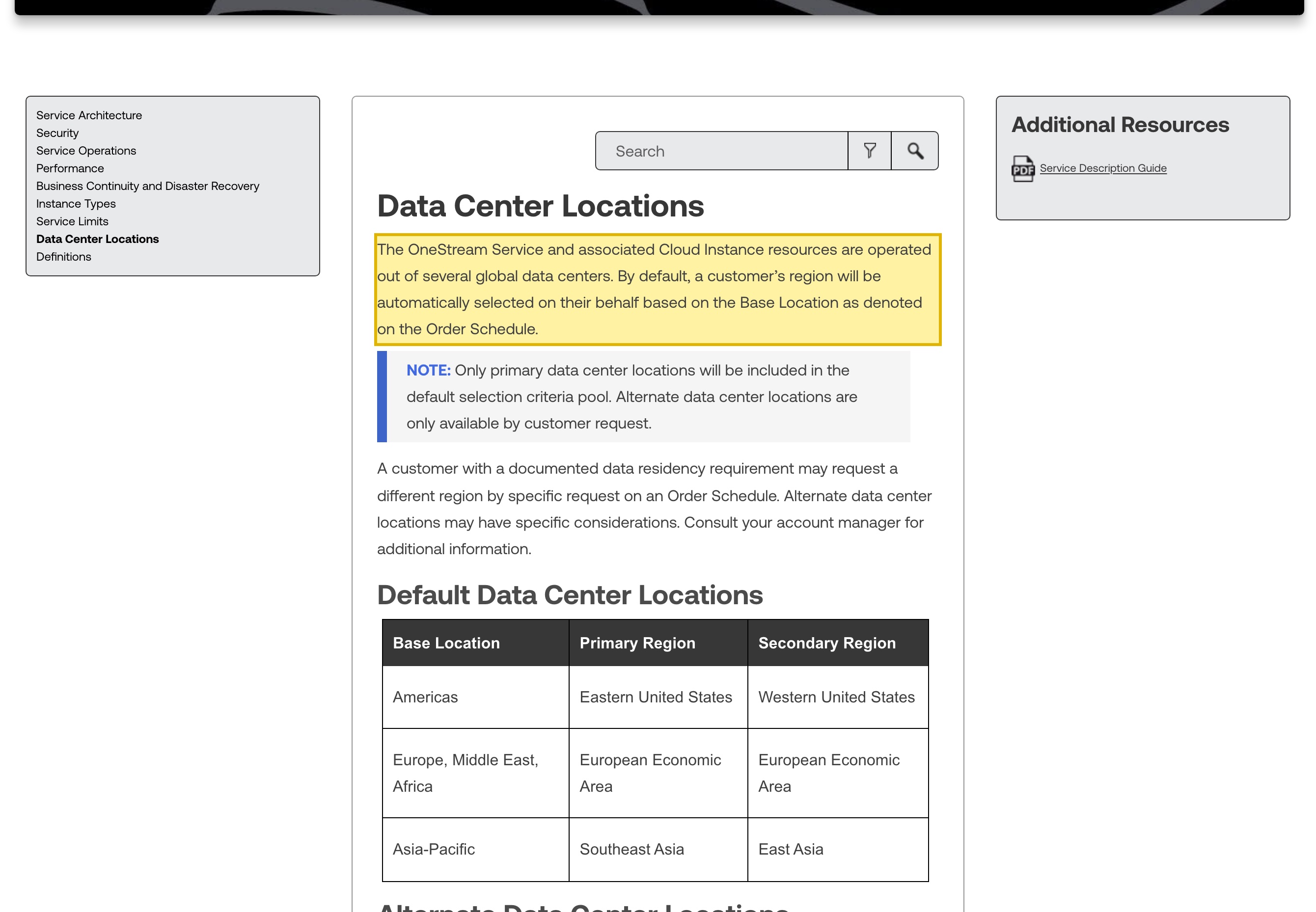
| OneStream hosts its Service from offshore cloud regions, none in mainland China. Its Service Description Guide states the Service is "operated out of several global data centers," with Default regions in the Americas (Eastern and Western United States), Europe and Asia-Pacific (Southeast Asia and East Asia), and an Alternate list adding Canada, the United Kingdom and Australia — neither list contains a mainland-China region. | OneStream Service Description Guide — Data Center Locations (retrieved 2026-10-10) |
| A documented residency requirement only unlocks OneStream's Alternate regions — all still offshore. The Guide says a customer's region is "automatically selected on their behalf based on the Base Location" on the Order Schedule, and that "a customer with a documented data residency requirement may request a different region" — but only from the Alternate list, and that list has no mainland-China region either, so the China entity's records still come to rest abroad. | OneStream Service Description Guide — Data Center Locations (retrieved 2026-10-10) |
| Feeding China-collected financial and employee data into an offshore OneStream region is a cross-border transfer under PIPL. Articles 38–40 of the Personal Information Protection Law require notice, a separate consent and a transfer mechanism (a CAC security assessment, the CAC standard contract, or certification); vendor and employee bank-account and tax identifiers are sensitive personal information under Article 28, adding a necessity test and an impact assessment. | PIPL Articles 28 and 38–40 (retrieved 2026-10-10) |
| A critical information infrastructure operator owes an in-country storage duty an offshore region cannot meet. Cybersecurity Law Article 39 (formerly Article 37 — the 2025 amendment, in force January 1, 2026, renumbered the data-localization article from 37 to 39, substance unchanged) requires personal information generated in China to be stored in China, and above the regulated thresholds a data-export security assessment may be required first. | China Cybersecurity Law Article 39 (formerly Article 37); PIPL Article 40 (retrieved 2026-10-10) |
Sources verified by the 21YunBox compliance team on 2026-10-10.
If your finance team runs the group close, consolidation, planning and reporting on OneStream for a China subsidiary, the first instinct is to ask whether the platform opens quickly, or even opens at all, from the mainland. That is the wrong starting point. OneStream is a hosted corporate performance management platform, and what actually decides whether you can use it in China is where the records it holds — consolidated results, the general-ledger close, journals and reconciliations, budgets, forecasts and models, and the employee and legal-entity data attached to them — are allowed to come to rest, and whether that personal information had a lawful basis to leave the country at all. That is a data-residency and cross-border question under China’s law, and OneStream settles the factual half of it in its own Service Description Guide: the Service is “operated out of several global data centers,” none in mainland China.
OneStream in China at a glance
| What decides it | In OneStream's own terms — and China's law |
|---|---|
| Where the records live | Offshore. OneStream's Service Description Guide says the Service is "operated out of several global data centers"; its Default regions are the Americas (Eastern and Western United States), Europe, and Asia-Pacific (Southeast Asia and East Asia), and its Alternate list adds Canada, the United Kingdom and Australia. There is no mainland-China region in either list, and the region is set from the Base Location on your Order Schedule. |
| What it holds, and why it's personal (and sensitive) information | OneStream is a corporate performance management platform: financial consolidation, the general-ledger close, journals and reconciliations, planning, budgeting, forecasting and reporting. It holds consolidated results and un-released filings (material non-public information), plus employee and legal-entity data and vendor/counterparty bank-account and tax identifiers — the last of which are sensitive personal information under PIPL Article 28. |
| Your China entity's and employees' data = a cross-border transfer | The moment data collected in China lands in an offshore OneStream region, you have made a cross-border transfer (数据出境) under the Personal Information Protection Law. PIPL Articles 38–40 put the duty on you, the handler — notice, a separate consent, and one transfer mechanism (a CAC security assessment, the CAC standard contract, or certification). |
| In-country storage duty | A critical information infrastructure operator, or a handler above the regulated volume thresholds, owes an in-country storage duty under PIPL Article 40 and Cybersecurity Law Article 39 (formerly Article 37) that an offshore OneStream region cannot meet; above threshold, a data-export security assessment may be required before anything leaves. |
| Reachability is not the axis | OneStream may open perfectly well from Shanghai — that is not the question, and this page publishes no China latency figure for it. What decides the matter is where the records rest and whether their export was lawful. Any China-facing surface you stand up around the stack — a reporting portal or intake form — is a public service in the mainland and carries an ICP filing (备案) duty. |
No mainland region, so the consolidations and the close leave the country
OneStream’s own Service Description Guide settles where the data sits. The Service is “operated out of several global data centers,” and “by default, a customer’s region will be automatically selected on their behalf based on the Base Location” named on the Order Schedule. The Default regions are the Americas (Eastern and Western United States), Europe, and Asia-Pacific — whose pair, Southeast Asia and East Asia, are Azure’s Singapore and Hong Kong regions, neither of which is in mainland China. Even “a customer with a documented data residency requirement may request a different region,” but only from the Alternate list — Canada, the United Kingdom and Australia — and “alternate data center locations are only available by customer request.” None of these, Default or Alternate, is in mainland China.
OneStream delivers the Service from third-party cloud data centers; its region names match Microsoft Azure’s, and Microsoft Azure is listed among the Guide’s trademark notices. Microsoft does operate a separate, sovereign Azure China cloud through a licensed local partner (21Vianet), but that is a legally and physically distinct environment a tenant has to be provisioned into deliberately, and it appears nowhere in OneStream’s region lists. So the consolidated results, the close, the journals and the budgets your China entity feeds in come to rest outside the mainland. The moment that China-collected personal information lands in a Singapore, European or US region, you have made a cross-border transfer under the Personal Information Protection Law. And if your organization is a critical information infrastructure operator, the Cybersecurity Law’s Article 39 (formerly Article 37 — the 2025 Cybersecurity Law amendment, in force January 1, 2026, renumbered the data-localization article from 37 to 39, with its substance unchanged) requires that personal information generated in China be stored in China, a duty an offshore region cannot meet.
What OneStream holds is personal information — and some of it is sensitive
A consolidation platform is not neutral traffic. OneStream is the system of record for the group’s money: it ingests trial balances and journals from every subsidiary, runs the close and the reconciliations, consolidates the results, and produces the budgets, forecasts and the figures that feed regulatory and investor filings. Much of that is personal information — the employees who own the journals and approvals, the legal-entity and director data, and the vendor and counterparty records that ride along with intercompany and payables detail. Vendor and employee bank-account numbers and tax identifiers are financial-account information, which PIPL treats as sensitive personal information (敏感个人信息): processing it requires a specific purpose and a showing of necessity, a separate consent, and a personal-information protection impact assessment beforehand — obligations that stack on top of the cross-border duties, not in place of them.
There is a second kind of sensitivity here that is commercial rather than personal: an un-released consolidation is material non-public information. Where those numbers rest, who can reach them, and under which country’s legal process they can be compelled are board-level questions in their own right. OneStream’s security controls — encryption, tenant isolation, and its providers’ ISO 27001, SOC 1 and SOC 2 audits — genuinely reduce security risk, but they do not discharge the consent, necessity and residency duties, which sit with you as the personal-information handler.
Narrowing what crosses doesn’t close the door
The instinct is to reduce the exposure with levers inside OneStream: choose the nearest region, push fewer fields offshore, mask or aggregate before data leaves, or — where OneStream supports a self-managed deployment — run the application on infrastructure you control. Each of these changes what and how much crosses the border, and that is worth doing. What none of them changes is that China-collected records still come to rest outside the mainland: Singapore and Hong Kong are as offshore as Frankfurt or Virginia, so provisioning a “nearer” Asia-Pacific region relocates the transfer rather than resolving it, and in-country infrastructure is not the same as compliance unless the China-resident footing is chosen deliberately and the lawful basis is in place.
Keeping China-collected consolidation, close and employee data in-country means standing up a China-resident footing for the records that must stay, and sending to offshore OneStream only what may lawfully leave — above the regulated thresholds, after a data-export security assessment where one is required. Any China-facing surface you expose around the stack also carries an ICP filing duty. Which obligations actually bite your deployment — which transfer mechanism, whether you are a critical information infrastructure operator, which fields are sensitive, what your consent and notice must say — is a risk to settle with your counsel against what you collect and where your entities and people sit; this page maps the exposure, it does not deliver a ruling.
The lawful path — map, localize, deliver
There is a compliant way to run corporate performance management for a China operation, and it has three moves. First, map: our China team works through your PIPL exposure end to end — which consolidation, close, planning and employee data collected in China must stay in the country, what may lawfully cross to OneStream, where a data-export security assessment or an Article 39 storage duty applies, which fields are sensitive, and what your consent and notice have to cover. The legal conclusions are settled with your counsel; we build the technical picture that feeds them.
Then localize: we help stand up and integrate a consented, China-resident footing for the China records that must stay on mainland soil — including a self-managed, in-country deployment pattern where OneStream supports one — so those records stop leaving the country by default, while you keep OneStream for the entities and markets where it already serves you.
Then deliver: the China-facing surfaces around your finance stack — a reporting or disclosure portal, an approval or intake workflow, the integration edge your mainland users reach — are public services in the mainland and need compliant, in-country delivery on ICP-filed infrastructure. 21YunBox delivers them in-country — the 21YunBox Optimizer — in front of what you already run, with no rebuild and no second codebase. 21YunBox is a compliant overlay, not a migration, and a partner to the platforms you already license, not a competitor to them. 21YunBox never uses or suggests circumvention of any kind. The result is a finance stack that runs legally and compliantly for your users in China.
Related reading:
- Cross-border data transfers under PIPL
- China’s data-export security assessment
- China’s Cybersecurity Law (data localization, Article 39)
- How to get an ICP filing for China