Does Mapbox Work in China? Map-Data Approval, PIPL & Offshore Delivery
Mapbox serves China from offshore with no mainland region, and its own data reference marks its China map “not officially approved for use in the PRC.” Add China's licensed-provider rule for map data and PIPL's cross-border transfer of location, and whether Mapbox works in China is a compliance question before a performance one.
Does Mapbox work in China?
Mapbox loads in mainland China from offshore — and that reachability is the easy half. The half that decides whether you may use it is the map data itself: Mapbox's own reference marks its China map “not officially approved for use in the PRC,” and China reserves compliant public map data to licensed local providers.
In the Mapbox Streets reference the CN worldview is defined as “Features for a mainland Chinese audience/worldview, but not officially approved for use in the PRC,” and Mapbox's glossary says a worldview “most commonly affects how and whether disputed boundaries and labels are displayed.” Separately, every map request carries your visitor's precise location out to Mapbox's offshore APIs — personal information China's Personal Information Protection Law treats as a cross-border transfer. The table below is Mapbox's own wording and the rule each row triggers.
This is a risk map, not a verdict — whether map-data approval, the cross-border transfer of location, or your host site's ICP filing is the binding constraint turns on what you build and who your users are. Our China team can map your exposure with you →
Compliance snapshot
- ! Mapbox serves China from offshore — no mainland region of its own
- ✕ Mapbox's own reference marks its China map “not approved for use in the PRC”
- ! China reserves compliant public map data to licensed local providers
- ! Visitors' location is personal data — sending it to Mapbox crosses the border
- ! A public China site built on it still needs its own ICP filing
What Mapbox's own documentation says about China
| Fact | Primary source |
|---|---|
Mapbox's own data reference flags its China map as unapproved for use in China. In the Mapbox Streets v8 tileset reference, the CN worldview is defined as “Features for a mainland Chinese audience/worldview, but not officially approved for use in the PRC.” Mapbox builds a China-specific depiction and, in the same line, labels it as not approved for use inside the mainland — a map-compliance flag in the vendor's own words. | Mapbox — Mapbox Streets v8 tileset reference (docs.mapbox.com), retrieved 2026-10-07 |
Mapbox treats China as a distinct political “worldview.” Mapbox's glossary defines worldview as a field that “identifies geographic features whose characteristics are defined differently by audiences belonging to various regional, cultural, or political groups,” and notes it “most commonly affects how and whether disputed boundaries and labels are displayed.” China's state-mandated depiction of borders — the South China Sea line, Aksai Chin, South Tibet, Taiwan — is exactly this kind of requirement, and a foreign tile source cannot self-certify that it is met. | Mapbox — worldview glossary (docs.mapbox.com), retrieved 2026-10-07 |
| China reserves compliant public map data to qualified, licensed providers — and keeps the servers in-country. Under the Surveying and Mapping Law of the People's Republic of China and the Map Management Regulations (State Council Order No. 664, in force since 2016), providing internet-map, geolocation and mapping-database services requires a surveying-and-mapping qualification, public maps must use the approved GCJ-02 coordinate system, and the servers that store map data must sit inside mainland China. Foreign companies cannot hold that qualification independently; in practice a compliant China map is served through a licensed Chinese provider (for example Amap/AutoNavi, Baidu or Tianditu). Treat this as a regulatory layer to confirm with counsel, separate from where your site is hosted. | Map Management Regulations, State Council Order No. 664 (gov.cn), retrieved 2026-10-07; Surveying and Mapping Law of the PRC (2017 revision) |
| Your visitors' location is personal information leaving the mainland. A Mapbox map, geocode or directions call carries the user's precise coordinates to Mapbox's offshore APIs. Under China's Personal Information Protection Law a person's location is personal information, and sending it abroad is a cross-border transfer requiring notice, separate consent and a transfer mechanism (Articles 38–43); for a critical-information-infrastructure operator or a large-volume handler, such data must be stored in the mainland (PIPL Article 40; Cybersecurity Law Article 39 (formerly Article 37)). | Mapbox Geocoding API documentation (docs.mapbox.com), retrieved 2026-10-07; PIPL Articles 38–43 & 40; Cybersecurity Law Article 39 (formerly Article 37) |
| Reaching Mapbox is the easy half; approval and hosting are the hard half. Mapbox serves tiles, styles and APIs from its global infrastructure and documents no mainland-China region of its own (inference: no mainland region or point of presence is listed), so China is reached from offshore — delivery is distance-bound and uneven, not a clean block. But reachability never settles the map-data approval above, and a public website that embeds Mapbox still needs its own ICP filing to operate in the mainland (State Council Order No. 292; MIIT Order No. 33). | Mapbox platform documentation (docs.mapbox.com), retrieved 2026-10-07; State Council Order No. 292; MIIT Order No. 33 |
Sources verified by the 21YunBox compliance team on 2026-10-07.
For a mainland-China audience, the real question about Mapbox is not whether the tiles eventually paint — it is whether you are allowed to serve that map at all, and what happens to the location your users hand over to draw it. Mapbox answers the first part itself: it serves China from offshore, with no mainland region, and in its own data reference it marks its China map as “not officially approved for use in the PRC.” China, in turn, reserves compliant public map data to licensed local providers and treats a user’s location as personal information. The map usually loads; the approval and the data are the exposure.
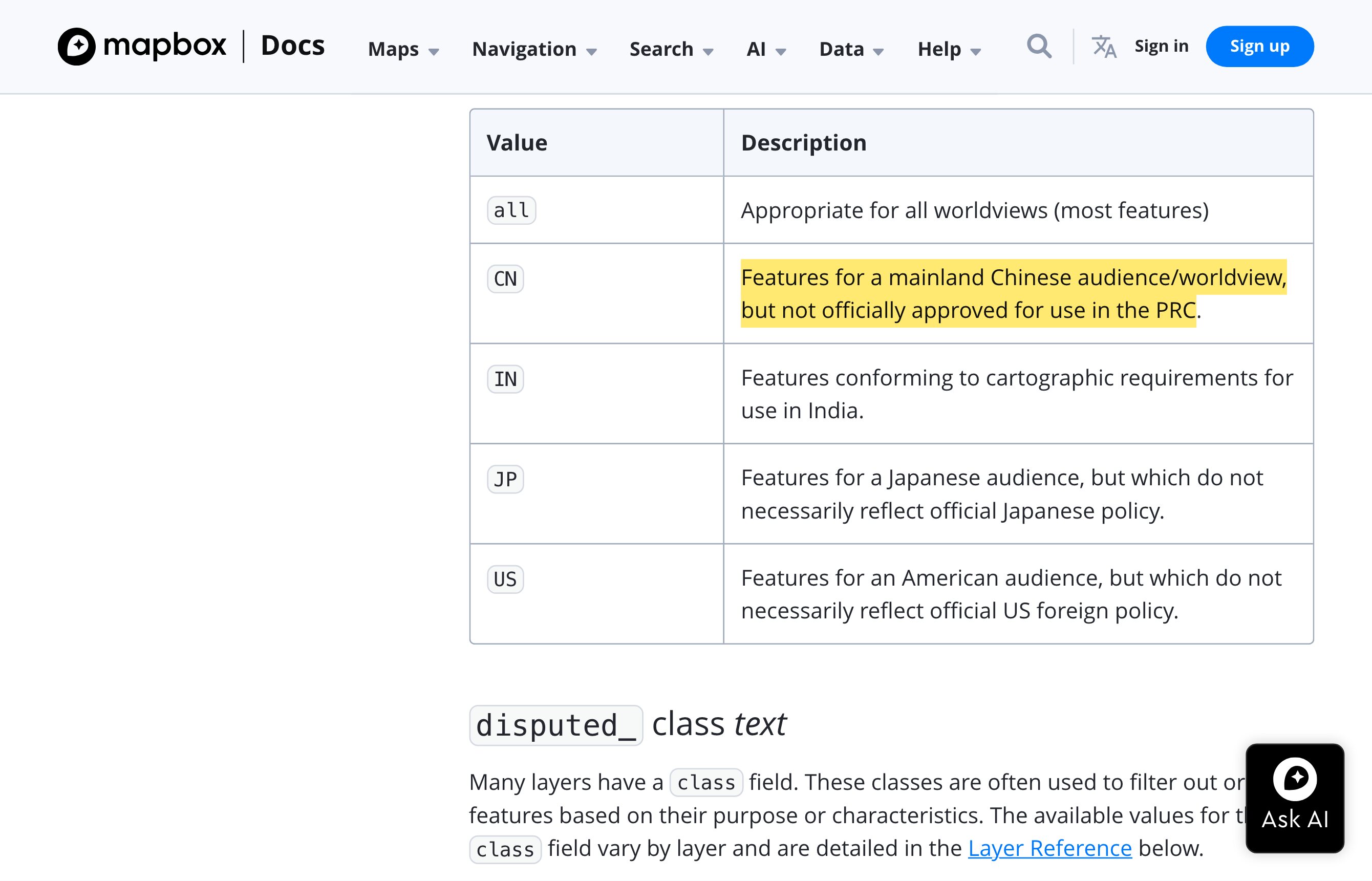
CN worldview is “Features for a mainland Chinese audience/worldview, but not officially approved for use in the PRC.” Source: docs.mapbox.com/data/tilesets/reference/mapbox-streets-v8Mapbox in China at a glance
| What decides it | In Mapbox's own terms |
|---|---|
| Where the maps come from | Tiles, styles and APIs load from Mapbox's global infrastructure. Mapbox documents no mainland-China region of its own, so China is served from offshore. |
| The China map itself | The CN worldview is defined as “Features for a mainland Chinese audience/worldview, but not officially approved for use in the PRC” — Mapbox's own words. |
| Disputed borders | A worldview “most commonly affects how and whether disputed boundaries and labels are displayed”; China's depiction has to be rendered a specific, state-approved way. |
| Who may serve map data | China's Surveying and Mapping Law and the Map Management Regulations (Order No. 664) reserve public map data to qualified providers and require map-data servers inside the mainland — a foreign source cannot self-certify. |
| Your visitors' location | A map, geocode or directions call sends the user's precise coordinates to Mapbox's offshore APIs — personal information leaving the mainland, which PIPL governs as a cross-border transfer. |
Reachable from offshore — but that is the half that doesn’t decide it
Mapbox is not generally walled off in mainland China the way some services are; its tiles, styles and APIs are simply served from its global infrastructure, with no mainland region of its own. Reached from inside China, a Mapbox map travels a long, uneven path — so what users notice is a map that paints slowly or in pieces, not a hard block. But reaching a service is not the same as being cleared to serve it. The moment the map is for a mainland audience, two questions open that distance has nothing to do with: whether the map data itself is approved for use in China, and what law governs the location your users send to fetch it. Tuning the network changes neither.
Mapbox’s own reference calls its China map “not approved for use in the PRC”
Mapbox builds China as a distinct case in its data. Its glossary defines a worldview as a field that “identifies geographic features whose characteristics are defined differently by audiences belonging to various regional, cultural, or political groups,” and notes it “most commonly affects how and whether disputed boundaries and labels are displayed.” For the Chinese worldview the Mapbox Streets reference is blunt: the CN value is “Features for a mainland Chinese audience/worldview, but not officially approved for use in the PRC.” So Mapbox tailors a China depiction and, in the same line, tells you it is not approved for use inside China.
That squares with how China regulates maps. Under the Surveying and Mapping Law of the People’s Republic of China and the Map Management Regulations (State Council Order No. 664, in force since 2016), public map data, internet-map services and geolocation services require a surveying-and-mapping qualification; public maps must use the approved GCJ-02 coordinate system; and the servers that store map data must sit inside the mainland. Foreign companies cannot hold that qualification on their own — which is why a compliant China map is normally served through a licensed Chinese provider. A public website that embeds Mapbox has a second, separate door as well: it still needs its own ICP filing to operate in the mainland. None of these are performance settings — they are approvals.
Your visitors’ location is personal data crossing the border
Every Mapbox map, geocode or directions request carries the user’s precise coordinates out to Mapbox’s APIs. For a Chinese user, those coordinates are personal information, and the request sends them offshore. Under China’s Personal Information Protection Law that is a cross-border transfer: the handler — you, not Mapbox — must give notice, obtain separate consent, and satisfy one transfer mechanism (a CAC security assessment, the CAC standard contract, or certification) under Articles 38–43. If you are a critical information infrastructure operator or a large-volume handler, location data collected in China must be stored in the mainland (PIPL Article 40; Cybersecurity Law Article 39 (formerly Article 37)) — which an offshore map API cannot do. So even when the map paints perfectly, the data path behind it is its own compliance question.
This is a risk map, not a verdict: whether the binding constraint is map-data approval, the cross-border transfer of location, or the ICP filing your host site needs depends on what you build, how much personal data you hold, and who your users are — worth settling with counsel before you ship.
Where 21YunBox fits — a compliant overlay, not a migration
Mapbox stays your map engine. What an offshore map service cannot give a mainland audience, we add alongside it: compliant, ICP-filed delivery from inside the mainland, set in front of the origin you already run — no rebuild, no second codebase, and no move off Mapbox. Our China team works out which constraint actually binds you — map-data approval, the PIPL cross-border transfer of location, or the ICP filing your host site carries — weighs it against your entity and data volumes, and stands up the in-country delivery, and the licensed local map-data path where one is required, that a lawful China presence needs. Your integration does not move.
Related reading:
Frequently Asked Questions
Why do Mapbox maps load unreliably or show unexpected borders in mainland China?
Two separate reasons. First, Mapbox serves tiles, styles and APIs from offshore infrastructure with no mainland region, so from inside China the maps are reached over a long, uneven path rather than from in-country. Second, Mapbox renders China through a dedicated “worldview” because disputed borders and labels must be shown a particular way — and Mapbox's own reference marks that China depiction as “not officially approved for use in the PRC.” The slow or partial loading is the visible symptom; the map-data approval is the compliance issue underneath it.
Is it legal to use Mapbox for a China-facing site or app?
Treat it as a risk to assess with counsel, not a flat yes or no. Two things follow from using an offshore map service for China: compliant public map data is reserved to licensed, qualified Chinese providers with map-data servers kept in-country (the Surveying and Mapping Law and the Map Management Regulations), and your users' precise location is personal information that leaves the mainland when it is sent to Mapbox's APIs — a cross-border transfer under PIPL. Whether a data-localization duty also applies turns on your role (for example CIIO) and your data volumes.
Can 21YunBox help make our Mapbox setup work in China?
Yes. Our China team can map your exposure — the map-data approval, the PIPL cross-border transfer of location data, and the ICP filing your host site needs — and stand up compliant, ICP-filed in-country delivery in front of the origin you already run, with a licensed local map-data path where one is required, and no rebuild. Get in touch to work through your specific case.


