Does Google Maps Work in China? Reachability, Mapping Law & Location Data
Google's own terms list China as a Prohibited Territory for Google Maps Platform, its maps load from offshore and unreliably in the mainland, and China regulates map data as a licensed, GCJ-02 activity Google's standard maps don't meet — while a visitor's precise location is personal data under PIPL. A compliance-first look.
Does Google Maps work in China?
Not cleanly. Google's own terms list China as a Prohibited Territory for Google Maps Platform, Google's maps load unreliably or not at all for mainland visitors, and serving map data in China is a licensed activity that Google's standard maps do not meet.
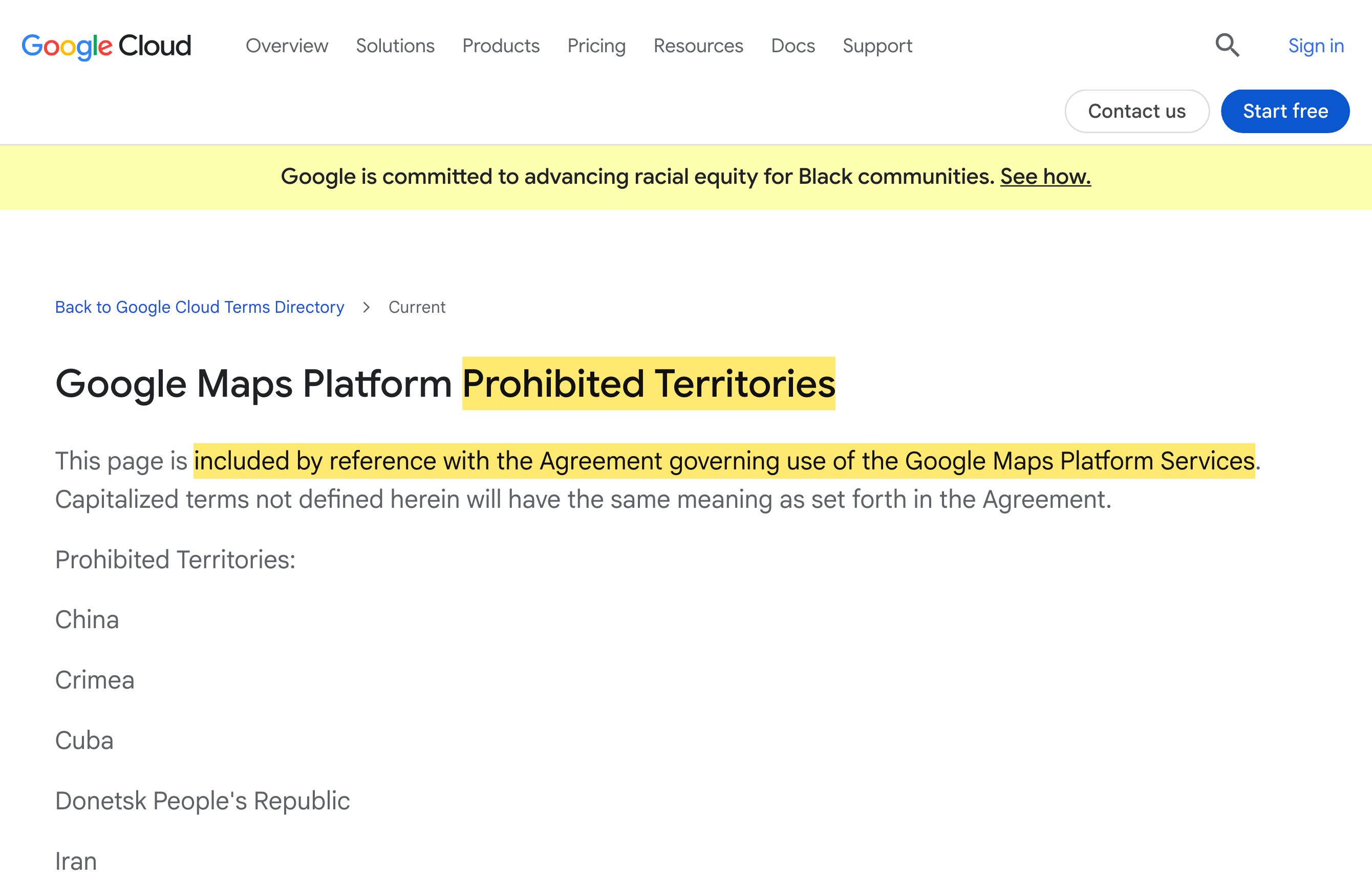
On its Maps Platform terms page Google names its "Prohibited Territories," and the first entry is "China" — so you are not licensed to use the JavaScript API, tiles or geocoding to serve the mainland. Reaching it is a separate problem: those services load from Google's offshore infrastructure, and Google's consumer and developer endpoints are routinely blocked or throttled inside China. China also regulates the map itself — under the Map Management Regulations (State Council Order No. 664) approved map data must use the GCJ-02 coordinate system and come from a licensed provider, so Google's WGS-84 maps show visibly offset and Google is not a licensed Chinese map operator. And a visitor's precise location is personal information; an embed hands it to Google's offshore servers, a cross-border transfer PIPL governs. The table below is Google's own wording and the rule each door triggers.
This is a risk map, not a verdict — which obligations bite turns on what you display, how precise it is, and who your users are. Our China team can map your exposure with you →
Compliance snapshot
- ✕ Google's own terms list China as a Prohibited Territory for Maps Platform
- ! The JS API, tiles and geocoding load from offshore — unreliable or unreachable in the mainland
- ! China requires licensed, GCJ-02 map data; Google's WGS-84 maps show offset and aren't approved
- ! A visitor's precise location is personal data sent to Google offshore — PIPL applies
- ✓ A lawful route exists: a licensed in-China map provider — the pattern Google itself uses
What Google Maps's own documentation says about China
| Fact | Primary source |
|---|---|
| Google's own terms bar using Google Maps Platform to serve China. Google publishes a "Prohibited Territories" page "included by reference with the Agreement governing use of the Google Maps Platform Services," and the first territory it lists is "China." Serving the mainland with the Maps JavaScript API, map tiles or geocoding is therefore a breach of Google's own licence — before reachability is even considered. | Google Maps Platform — Prohibited Territories (cloud.google.com), retrieved 2026-10-07 |
| Google's maps load from offshore and are unreliable or blocked inside the mainland. The Maps JavaScript API, tiles and geocoding are served from Google's infrastructure outside mainland China, and Google wound down its China-based operations in 2010; its consumer and developer endpoints are routinely blocked or throttled for mainland visitors, so a standard embed frequently fails to paint or renders only partially. This is the delivery half of the question — it sits on top of the licensing one, it does not replace it. | Google Maps Platform coverage details (developers.google.com); Google's 2010 withdrawal from mainland China — public record; retrieved 2026-10-07 |
| China regulates the map itself — it must be licensed and use GCJ-02. Under the Map Management Regulations (State Council Order No. 664, in force 1 January 2016) and the Surveying and Mapping Law, public map data served in China must come from a provider holding a surveying-and-mapping qualification and use the state-mandated GCJ-02 coordinate system, and internet map data must be stored on servers inside China. Google's standard maps use WGS-84 — visibly offset against GCJ-02 — and Google holds no such Chinese licence; where it shows the mainland, the data comes from a licensed Chinese partner. | Map Management Regulations, State Council Order No. 664 (gov.cn), effective 2016-01-01; Surveying and Mapping Law of the PRC; retrieved 2026-10-07 |
| A visitor's precise location is personal information leaving the country. A latitude and longitude tied to a person is personal information under PIPL, and an embedded Google Map resolves tiles, geocodes and — with the browser's permission — the user's position against Google's offshore servers: a cross-border transfer of personal information under PIPL (notice, separate consent and a transfer mechanism, Articles 38–43). For a CIIO or large-volume handler, data collected in China must be stored in the mainland (PIPL Article 40; Cybersecurity Law Article 39 (formerly Article 37)), and the site embedding the map still needs its own ICP filing to be served from inside China. | PIPL Articles 38–43 & 40 (cac.gov.cn); Cybersecurity Law Article 39 (formerly Article 37); retrieved 2026-10-07 |
Sources verified by the 21YunBox compliance team on 2026-10-07.
For a mainland-China audience, whether Google Maps “works” is a compliance question before it is a loading one. Google settles the first part itself: its Maps Platform terms publish a list of “Prohibited Territories,” and China is on it — so serving the mainland with the Maps JavaScript API, tiles or geocoding runs against Google’s own licence. On top of that, those services are delivered from Google’s offshore infrastructure and are routinely unreachable inside China; the map data itself is a licensed, GCJ-02 activity Google’s standard maps do not meet; and every pin a visitor drops is personal data that leaves the country. The reachability is real and uneven — the licensing, the mapping law and the location data are the exposure.
Google Maps in China at a glance
| What decides it | In Google's words — and China's law |
|---|---|
| Permitted to use it there? | Google's Maps Platform terms list a set of “Prohibited Territories,” and the first is “China” — using the JavaScript API, tiles or geocoding to serve the mainland breaches Google's own agreement. |
| Reachable? | The API, tiles and geocoding load from Google's offshore infrastructure; Google wound down its China operations in 2010, and its endpoints are routinely blocked or throttled inside the mainland, so a standard embed often fails to paint. |
| The map data | China's Map Management Regulations (State Council Order No. 664) require approved maps to use the GCJ-02 coordinate system and come from a licensed provider; Google's WGS-84 maps show visibly offset, and Google holds no such Chinese licence. |
| Where map data must live | The same regulations require internet map data to be stored on servers inside China — a residency rule an offshore map backend cannot satisfy. |
| Your visitors' location | A precise position tied to a person is personal information; an embed sends it to Google's offshore servers — a cross-border transfer PIPL governs. |
Permitted, and reachable? Two separate noes
Start with Google’s own paperwork. Its Maps Platform terms publish a list of “Prohibited Territories” that is “included by reference with the Agreement governing use of the Google Maps Platform Services,” and the very first entry is “China.” So before any network question, using the Maps JavaScript API, map tiles or geocoding to serve mainland users runs against the licence you agreed to.
Reachability is the second, separate no. Those services are delivered from Google’s infrastructure outside the mainland, and since Google wound down its China-based operations in 2010 its consumer and developer endpoints have been blocked or throttled for users inside China. The practical result is familiar: a standard Google Maps embed frequently fails to load, or paints only partially, for a visitor in Shanghai or Shenzhen. Tuning the page changes neither fact — you are neither licensed to use it there nor able to reach it reliably.
China regulates the map itself, not just the server
Even where a map does paint, China treats cartography as a licensed activity. Under the Map Management Regulations (State Council Order No. 664, in force since 1 January 2016) and the Surveying and Mapping Law, public map data served in China must come from a provider holding a surveying-and-mapping qualification and must use the state-mandated GCJ-02 coordinate system — a deliberately offset datum. Google’s standard maps use the global WGS-84 system, so they render visibly displaced against GCJ-02, and Google is not itself a licensed Chinese map operator. Tellingly, where Google does show mainland China on its consumer map, the data is supplied by a licensed Chinese partner rather than by Google directly. The same regulations also require internet map data to be stored on servers inside China — a residency rule an offshore map backend cannot meet.
Your visitors’ location is personal data
A map is also a personal-data surface. A precise latitude and longitude tied to an individual is personal information under China’s Personal Information Protection Law, and an embedded Google Map resolves tiles, geocodes addresses and — with the browser’s permission — reads the visitor’s position against Google’s servers abroad. That hand-off is a cross-border transfer of personal information: the handler (you, not Google) must give notice, obtain separate consent and satisfy one transfer mechanism under Articles 38–43. For a critical information infrastructure operator or a large-volume handler, personal information collected in China must be stored in the mainland (PIPL Article 40; Cybersecurity Law Article 39 (formerly Article 37)), and the website carrying the map still needs its own ICP filing to be served lawfully from inside China.
This is a risk map, not a verdict: whether the GCJ-02 licensing rules, the map-data residency duty, or a PIPL obligation over location bites depends on what you display, how precise it is, and who your users are — worth settling with counsel before you ship.
Where 21YunBox fits — a compliant overlay, not a migration
You keep the stack you already run. For your own origin and application, we add compliant, ICP-filed delivery from inside the mainland, placed in front of what you have — no rebuild, no second codebase, no move off your platform. The map layer is the piece that cannot simply be optimized into compliance: Google itself routes mainland map data through a licensed Chinese provider, so for your China audience the lawful path is a licensed in-China map source wired in behind that same in-country delivery. Our China team maps the whole exposure — the reachability of Google’s endpoints, the GCJ-02 licensing rules, and the PIPL treatment of your visitors’ location — and stands up the compliant delivery and the mapping route a lawful China presence needs, while your application stays exactly where it is.
Related reading:
Frequently Asked Questions
Can we use the Google Maps API on a site we serve to mainland China?
Treat it as a licence and compliance question, not just a technical one. Google's Maps Platform terms list China among its "Prohibited Territories," so using the JavaScript API, tiles or geocoding to serve the mainland runs against Google's own agreement — and separately, those endpoints load from offshore and are routinely unreachable inside China. Even where a map paints, China's mapping rules expect licensed, GCJ-02 map data, which Google's standard WGS-84 maps are not. Confirm the specifics with counsel for your use case.
Why does Google Maps show China offset or "wrong"?
China mandates a confidential coordinate system, GCJ-02, for approved maps, while Google's standard maps use the global WGS-84 datum. Plotted against each other the two are displaced, so satellite imagery and road layers can appear shifted enough to put a pin on the wrong block. It is not a bug — it is the gap between an unlicensed WGS-84 map and the GCJ-02 system Chinese law requires, which licensed local providers are built on.
Can 21YunBox help us handle maps and location for China?
Yes. Our China team can map your exposure — the reachability of Google's endpoints, the GCJ-02 licensing rules, and the PIPL treatment of your visitors' location data — and stand up ICP-filed, in-country delivery in front of the origin you already run, with no rebuild. For the map layer itself, the compliant route for mainland visitors is a licensed in-China map source wired in behind that delivery, which we help you put in place. Get in touch to work through your specific case.


