Does ManageEngine ServiceDesk Plus Work in China? Data Residency, ICP & Cross-Border Rules
ManageEngine ServiceDesk Plus is a self-hostable ITSM (on-premises, plus a cloud edition for which ManageEngine lists a China data centre), so whether it works in mainland China turns on data residency, ICP filing and cross-border rules — not load speed. It holds your China IT staff and requester PII and your CMDB; a compliance-first look at keeping that in-country, ICP-filing any self-service portal, and the data-security duties the IT-estate record carries.
Does ManageEngine ServiceDesk Plus work in China?
Whether you can run ManageEngine ServiceDesk Plus in China is a data-governance question, not a speed one. As your IT system of record it holds your China IT staff and ticket requesters' personal information and your CMDB — the configuration, topology and operational secrets of your China IT estate.
Because ServiceDesk Plus is self-hostable on-premises (you run it on your own Windows or Linux servers) and ManageEngine also lists a China cloud data centre, an in-country, data-resident deployment is achievable and the compliance path is open. What decides it is where that PII and CMDB live, whether a China-facing self-service portal is ICP-filed, the PIPL cross-border rules if anything rests offshore, and the data-security duties around that concentrated IT-estate record — not whether the console loads from Shanghai.
This is a risk map, not a verdict — your duties turn on your entity, data volumes and role. Our China team can map your ServiceDesk Plus exposure with you →
What ManageEngine ServiceDesk Plus's own documentation says about China
| Fact | Primary source |
|---|---|
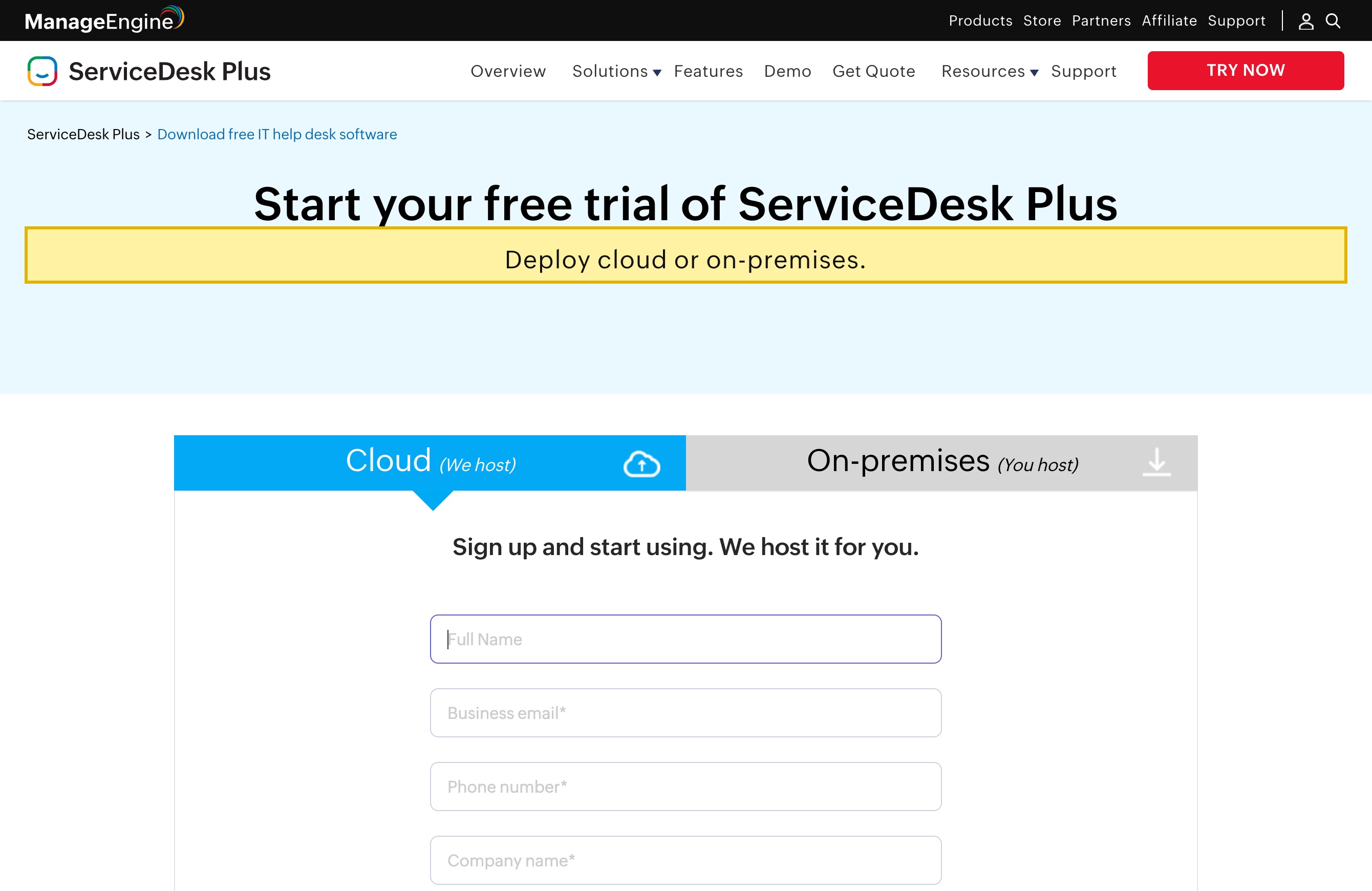
| ManageEngine ServiceDesk Plus is self-hostable. Its own download page presents the choice to “Deploy cloud or on-premises” and offers the on-premises edition as an installer that “can be installed on Windows or Linux machines” — so you run the ITSM on servers you control. That self-hostable design is the residency lever: you can deploy it inside the mainland and keep employee PII and the CMDB in-country. | ManageEngine — Download ServiceDesk Plus, retrieved 2026-10-11 |
| ServiceDesk Plus Cloud runs in Zoho-owned data centres, and ManageEngine lists a China data centre (servicedeskplus.cn) among its cloud regions — alongside the US, EU, India, Australia, Japan, Canada, UK and Saudi Arabia. A China region is an option, not a finished compliance answer: ManageEngine's own comparison page notes “some ServiceDesk Plus features and functionalities may not be available” uniformly across data centres, and ICP, consent and cross-border duties still apply. | ManageEngine — ServiceDesk Plus Cloud data centres, retrieved 2026-10-11 |
| The directory of your China IT staff and every requester who files a ticket is personal information. Held on an offshore cloud, that is a cross-border transfer under PIPL Articles 38–40, layered on the notice and separate consent of PIPL Articles 13 and 23; for a critical information infrastructure operator or a high-volume handler, personal information collected in China must be stored in the mainland under Cybersecurity Law Article 39 (formerly Article 37). | PIPL Articles 38–40, 13 & 23; Cybersecurity Law Article 39 (formerly Article 37) |
| A China-facing self-service ticket portal is an internet information service, so it needs an ICP filing (备案) bound to mainland hosting. And because the CMDB and tickets concentrate your China IT estate's configuration, topology and operational secrets, holding that record offshore is both a cross-border data issue and, for sensitive operations, may implicate “important data” (重要数据) and data-security duties — a risk to confirm with counsel, not a fixed classification. | ICP filing (ICP 备案) requirement for internet information services; Data Security Law 'important data' (重要数据) duties |
Sources verified by the 21YunBox compliance team on 2026-10-11.
For a team running ManageEngine ServiceDesk Plus for a China operation, the first instinct is to treat this as a speed question — will the service desk and its dashboards answer quickly from Shanghai. That is not where it is decided. An ITSM platform is the system of record for your entire China IT estate: it holds the personal information of your China IT staff and of every employee who files a ticket, and it holds your CMDB and your incident and change tickets — the hostnames, network topology, asset inventory and service maps of your China operation, and the configurations and sometimes embedded credentials inside those records. Where that data lives, and under what consent and filing, is the question — not latency.
The encouraging part is that ServiceDesk Plus is self-hostable. ManageEngine ships it as an on-premises edition you install and run on your own Windows or Linux servers, and it also offers a cloud edition for which it lists a China data centre among its regions. Because you can choose where it runs, an in-country, data-resident deployment is achievable — the compliance path is open. Four prongs then decide it: the residency and cross-border status of the employee and requester personal information; the concentrated security-governance exposure of the CMDB and tickets; automated triage or AI that profiles requesters; and an ICP filing for any China-facing self-service portal. ManageEngine states the on-premises deployment model plainly on its own download page.
ManageEngine ServiceDesk Plus in China at a glance
| What decides it | In ManageEngine's own terms — and China's law |
|---|---|
| What it holds | Two things China's law treats differently: the personal information of your China IT staff and of every employee who files a ticket (names, work emails, phone, department, sometimes device or location), and your CMDB and tickets — hostnames, network topology, asset inventory, service maps, and the configurations and sometimes embedded credentials inside incident and change records. |
| Deployment — you choose where it runs (the lever) | ServiceDesk Plus is self-hostable: in its own words you “Deploy cloud or on-premises,” with the on-premises edition one you install on your own Windows or Linux servers. ManageEngine also offers a cloud edition for which it lists a China data centre. Either way you can keep the data in-country — something a managed SaaS with “no China region” cannot offer. |
| The half a speed test misses — your IT-estate record | The CMDB and tickets are the concentrated, security-sensitive map of how your China operation is built and run. Held offshore, that is both a cross-border data issue and, for sensitive operations, may implicate “important data” (重要数据) and data-security duties — a risk to confirm with counsel, not a fixed classification. |
| Employee & requester PII — residency and cross-border | Hold the staff and requester personal information on an offshore cloud and it rests abroad — a cross-border transfer under PIPL Articles 38–40, with Articles 13/23 notice-and-consent. For a CIIO or high-volume handler, Cybersecurity Law Article 39 (formerly Article 37) requires in-country storage. |
| Automated triage and AI | Auto-routing, prioritization or AI that profiles or makes decisions about individual requesters is automated decision-making under PIPL Article 24, which carries transparency and opt-out duties. |
| ICP filing for a China-facing portal | A public self-service ticket portal served to mainland users is an internet information service, so it needs an ICP filing (备案) bound to a mainland hosting resource. You cannot file a portal that is hosted offshore. |
| Reachability is not the axis | Whether the console paints quickly from Shanghai settles nothing. What decides it is where the PII and CMDB live, the ICP filing, and the data-security governance — with compliant in-country delivery (the 21YunBox Optimizer) in front of the ServiceDesk Plus you already run. |
What it actually holds — your IT staff’s data and your IT-estate record
It is easy to file an ITSM tool under “just the internal help desk” and stop there, but a live ServiceDesk Plus install holds two different things China’s law treats differently. The first is personal information: the directory of your China IT staff and the record of every employee who files a ticket — names, work emails, phone numbers, department, and sometimes the device or location attached to a request. The second, and the one that makes this different from an ordinary web app, is your CMDB and your tickets: the hostnames, network topology, asset inventory and service maps of your China operation, and the incident and change records that routinely carry internal system details, configurations and sometimes embedded credentials or secrets. Wherever your ServiceDesk Plus instance runs, all of that runs there too — and because ServiceDesk Plus is self-hostable, where it runs is a choice you control.
The half a reachability check never sees — your CMDB and tickets
This is where a speed test and a compliance review part ways. A reachability check can tell you the service desk answers from Shanghai; it cannot see that your CMDB and ticket history — the concentrated, security-sensitive map of how your entire China IT estate is built, connected and operated — are sitting on an offshore cloud. That record is both a cross-border data matter and, for sensitive operations, something that may implicate “important data” (重要数据) handling and the data-security duties that attach to it. We frame that as a risk to confirm with counsel rather than a fixed classification — but it is exactly the exposure a latency measurement is blind to, and it is why “it loads fine” is the wrong axis for an IT system of record.
The doors: residency, cross-border, automated handling, and ICP
The first door is the personal information. The staff directory and requester records ServiceDesk Plus holds are personal information under China’s Personal Information Protection Law; hold them on an offshore cloud and that is a cross-border transfer (数据出境). The duty lands on you, the handler, not on ManageEngine: Articles 13 and 23 require notice and a basis to collect, and Articles 38–40 require a transfer mechanism to send it abroad — a CAC security assessment, the CAC standard contract, or certification — with separate consent for the overseas transfer. For a critical information infrastructure operator or a high-volume handler, the Cybersecurity Law’s Article 39 (formerly Article 37 — the 2025 amendment, in force January 1, 2026, renumbered the data-localization article from 37 to 39 with its substance unchanged), together with PIPL Article 40, requires personal information generated in China to be stored in the mainland.
The second door is automated handling. If you lean on auto-triage, predictive routing or agentic/AI workflows that profile or make decisions about individual requesters, that is automated decision-making under PIPL Article 24, which carries transparency and opt-out obligations on top of the residency analysis.
The third door is the ICP filing. A public, China-facing self-service ticket portal is an internet information service, so it carries an ICP filing (备案) duty bound to a mainland hosting resource — and you cannot file a portal that is hosted offshore.
Here is where ServiceDesk Plus’s deployment model earns its keep: because it is self-hostable on-premises — and because ManageEngine also offers a China cloud data centre — you have a path to keep the staff and requester PII and the CMDB inside the mainland by design, give any portal a mainland resource to file against, and do the governance on top. The risk is the default (teams run it on an offshore cloud region or VM out of habit), not a ceiling the vendor imposed. A China region or an in-country self-host is necessary, not sufficient: ManageEngine’s own documentation notes some features are not uniformly available across its data centres, and ICP, consent and the data-security duties still have to be met.
Loading isn’t the question — a data-resident, ICP-filed operation is
So the productive question is not whether ServiceDesk Plus paints quickly from the mainland. It is where the staff and requester personal information and the CMDB live, whether a China-facing self-service portal carries its ICP filing, whether automated triage meets its Article 24 duties, and how the concentrated IT-estate record is governed. Get those right and “does it load” takes care of itself; get them wrong and a fast console is still a non-compliant one. The lawful pattern is to keep the data in-country — self-hosted inside the mainland or on a China-resident path — file the ICP on the mainland hosting resource, and deliver the portal compliantly, never routing the data back out. None of this is a verdict that ManageEngine ServiceDesk Plus is “blocked” or “illegal” in China; it is self-hostable software with an in-country option, and much of the exposure dissolves the moment you choose a data-resident deployment. It is a risk map — whether you owe a separate consent, a transfer mechanism, in-country storage, an Article 24 opt-out, an ICP filing, or some combination turns on your entity, your data volumes, your role as handler and who your users are, so settle the specifics with counsel before your China IT operation depends on them.
The lawful path — map, localize, deliver
There is a compliant way to run ManageEngine ServiceDesk Plus for a China operation, and because the platform is self-hostable, its middle step is unusually clean — one that sits in front of the install you already run, with no rebuild and no re-platform.
First, map: our China team inventories what your ServiceDesk Plus holds — the staff and requester personal information, the CMDB and asset data, the content of incident and change tickets, and any China-facing self-service portal — establishes where it is hosted today (often an offshore cloud region or VM), the ICP status of any public portal, and the consent and residency basis each flow relies on. We build the technical picture; the legal conclusions are settled with counsel.
Then localize: this is where the self-hostable design pays off. We help you keep the employee PII and the CMDB and ticket data inside the mainland — self-hosted on a China-resident path or on a China-resident option — put the Article 13/23 notice-and-consent in place, honor the Article 24 opt-out for any automated handling, handle any CIIO or high-volume storage duty, and protect the security-sensitive IT-estate record. Localize means keeping the data on an in-country path — never a route that ships it offshore anyway.
Then deliver: a public China-facing self-service portal is an internet information service, so it carries an ICP filing duty bound to a mainland hosting resource and needs compliant, in-country delivery. 21YunBox delivers it in-country — the 21YunBox Optimizer — set in front of the ServiceDesk Plus you already run, so it runs legally and compliantly for your users in China. Making an offshore ITSM merely reachable from the mainland is not the answer — the data would still be offshore and the portal still unfiled; keeping the data in-country, filing the ICP, and governing the IT-estate record is. 21YunBox never uses or suggests circumvention of any kind — we keep in-country what the law says must stay, deliver the rest compliantly from inside the mainland, and never move personal information across the border by stealth. 21YunBox is a compliance overlay and partner to the ITSM you already run, not a competitor to it.
Related reading:
- How to get an ICP filing for China
- Cross-border data transfers under PIPL
- China’s Personal Information Protection Law (PIPL)
- China’s Cybersecurity Law (data localization, Article 39)