Does BMC Helix Work in China? Data Residency, ICP & Cross-Border Rules
BMC Helix is the system of record for your China IT estate. As BMC-hosted SaaS it has no mainland-China region, so your China IT staff's and requesters' personal information and your CMDB sit offshore — a PIPL cross-border and data-residency matter; but BMC Helix Service Management also ships on-premises, so it can run in-country. A compliance-first look at residency, ICP and the IT-estate record.
Does BMC Helix work in China?
Reachability isn't the question — residency is. BMC Helix is the system of record for your whole China IT estate, and as BMC-hosted SaaS it has no mainland-China region, so your China employees' personal information and your CMDB, asset maps and tickets are held offshore.
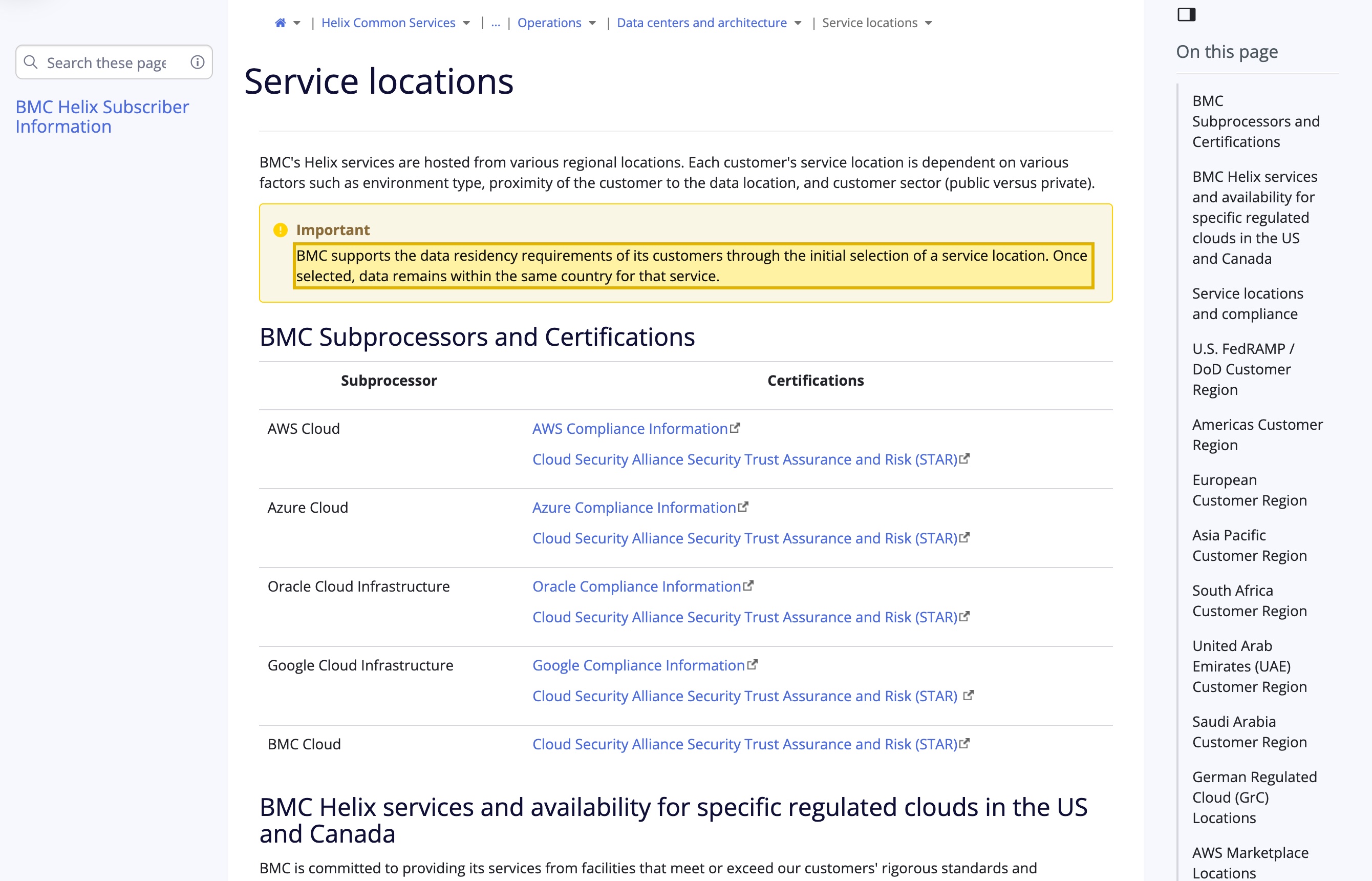
BMC's own Service locations documentation lists SaaS regions across the Americas, Europe, the UK, Asia Pacific (Singapore, Australia, India), South Africa, the UAE and Saudi Arabia — none in mainland China. Holding employees' and requesters' personal information offshore is a PIPL cross-border transfer (notice and separate consent, Articles 38–40), and the CMDB and tickets concentrate the configuration, topology and operational detail of your China operation in one offshore record. But BMC also offers BMC Helix Service Management as an on-premises, self-managed deployment, so you can run it in-country and keep that data in the mainland — the compliance path is open.
This is a risk map to confirm with counsel, not a verdict. Our China compliance team can map your exposure and the in-country path with you →
What BMC Helix's own documentation says about China
| Fact | Primary source |
|---|---|
| BMC Helix SaaS has no mainland-China region. BMC's own Service locations documentation lists its hosting regions across the Americas, Europe, the UK, Asia Pacific (Singapore, Australia and India), South Africa, the UAE and Saudi Arabia, and states “Once selected, data remains within the same country for that service” — but no mainland-China region exists to select, so a China operation's employee data and CMDB are held offshore. | BMC Helix Documentation — Service locations (docs.helixops.ai), retrieved 2026-10-11 |
| BMC Helix Service Management can be self-hosted on-premises. BMC's deployment documentation describes an on-premises install that “installs BMC Helix Innovation Suite and Service Management applications in your on-premises environment” — a containerized Kubernetes deployment that includes the CMDB and the ITSM applications, which you can run on China-resident infrastructure to keep employee PII and the CMDB in the mainland. | BMC Helix Service Management Deployment — Deployment overview (docs.helixops.ai), v26.3.01, retrieved 2026-10-11 |
| Employee and requester PII held offshore is a cross-border transfer under PIPL. Sending the personal information of your China IT staff and ticket requesters abroad requires notice, separate consent and a transfer mechanism (PIPL Articles 13/23 and 38–40); for a critical information infrastructure operator or a high-volume handler, personal information collected in China must be stored in the mainland (PIPL Article 40; Cybersecurity Law Article 39 (formerly Article 37)). | PIPL Articles 13, 23, 38–40 and 40; Cybersecurity Law Article 39 (formerly Article 37) |
| A China-facing self-service portal needs its own ICP filing. A public ticket or self-service portal served to mainland visitors is an internet information service and requires an ICP filing bound to mainland hosting (State Council Order No. 292; MIIT Order No. 33) — making the offshore suite merely reachable does not satisfy this, and neither does it resolve where the data lives. | State Council Order No. 292; MIIT Order No. 33 |
Sources verified by the 21YunBox compliance team on 2026-10-11.
Whether BMC Helix loads quickly from Shanghai is an operations question, not the one that decides whether it works in China. BMC Helix is the system of record for your entire China IT estate — the service desk, the CMDB, the asset inventory, and every incident and change ticket. What decides it is a compliance-risk question: where your China employees’ personal information and your IT-estate’s configuration record are stored, under what consent, and whether any China-facing portal is ICP-filed.
BMC Helix can run two ways, and under Chinese law they land in very different places. As BMC-hosted SaaS it has no mainland-China region — BMC’s own Service locations documentation lists hosting regions across the Americas, Europe, the UK, Asia Pacific (Singapore, Australia, India), South Africa, the UAE and Saudi Arabia, but none in mainland China — so a China operation’s employee data and CMDB are held and processed offshore. BMC also offers BMC Helix Service Management as an on-premises, self-managed deployment you run in your own environment, and that is the lever that opens a lawful in-country path. So the honest answer is not a flat “no”: it is offshore SaaS is the exposure; in-country self-host is the fix.
What BMC Helix actually holds — your people’s data and your IT-estate map
Two kinds of sensitive data concentrate in an ITSM/ITOM platform, and both matter here. The first is personal information: the directory of your China IT staff and every requester who files a ticket — names, emails, phone numbers, org, and sometimes device or location. The second is the CMDB and the tickets: your configuration management database (hostnames, network topology, asset inventory, service maps) together with incident and change records that routinely carry internal system detail, configurations, and sometimes embedded credentials or secrets. Held offshore, that is the concentrated, security-sensitive map of how your China operation is built and run.
The doors: residency, the CMDB second half, automated handling, and ICP
Employee and requester personal information, offshore. Running the SaaS for a China operation puts your staff’s and requesters’ personal information on an offshore cloud. Collecting it needs the PIPL Article 13/23 notice and separate consent; sending it abroad is a cross-border transfer under Articles 38–40, which needs a transfer mechanism. For a critical information infrastructure operator or a high-volume handler, the Cybersecurity Law’s Article 39 (formerly Article 37 — the 2025 Cybersecurity Law amendment, in force January 1, 2026, renumbered the data-localization article from 37 to 39, with its substance unchanged) requires personal information generated in China to be stored in the mainland — which an offshore-only region list cannot do.
The CMDB and tickets are a concentrated security-governance exposure — the half a reachability check never sees. This is not only a privacy matter. Your whole China IT estate’s configuration, topology, asset inventory and operational secrets, sitting in one offshore record, is both a cross-border data issue and, for a sensitive operation, may raise the “important data” (重要数据) question and the data-security duties that come with it. Treat that as a risk to confirm with counsel rather than a settled classification — but it is exactly the risk that “does it load?” testing is blind to.
Automated triage and AI workflows. BMC Helix’s auto-routing, predictive and agentic workflows and AI triage act on the data above, and where they profile or decide about individuals they engage PIPL Article 24 on automated decision-making — the individual may refuse a decision made solely by automation, and profiling must offer an option not targeted at their personal characteristics.
ICP filing for any China-facing portal. A public self-service or ticket portal served to mainland visitors is an internet information service and needs an ICP filing bound to mainland hosting (State Council Order No. 292; MIIT Order No. 33). Making the offshore suite merely reachable does not satisfy this.
BMC Helix in China at a glance
| What decides it | In BMC Helix's own terms — and China's law |
|---|---|
| Where it runs | As BMC-hosted SaaS, BMC Helix has no mainland-China region — BMC's Service locations documentation lists the Americas, Europe, the UK, Asia Pacific (Singapore, Australia, India), South Africa, the UAE and Saudi Arabia, and states that once a location is selected, data remains within that country. For a China operation that country is offshore. BMC also offers an on-premises, self-managed deployment, which is the in-country alternative. |
| What it holds | The directory of your China IT staff and every ticket requester (names, emails, phone, org), plus the CMDB — hostnames, topology, asset inventory and service maps — and incident/change tickets that can carry internal configs and secrets. Personal information plus the security-sensitive map of your China IT estate. |
| The security-governance second half | Held offshore, the CMDB and tickets concentrate how your China operation is built and run into one record abroad. That is both a cross-border data issue and, for a sensitive operation, may raise the "important data" (重要数据) question — a risk to confirm with counsel, and the half a reachability review never sees. |
| Automated handling | Auto-routing, predictive/agentic workflows and AI triage that profile or decide about individuals engage PIPL Article 24 — the right to refuse decisions made solely by automation, and profiling that offers an option not targeted at personal characteristics. |
| Residency, consent & ICP | Employee/requester PII offshore is a cross-border transfer (PIPL Articles 13/23 and 38–40); for a CIIO or high-volume handler, personal information generated in China must be stored in the mainland (PIPL Article 40; Cybersecurity Law Article 39 (formerly Article 37)). A China-facing self-service portal needs an ICP filing. |
| The in-country lever | Because BMC Helix Service Management can be self-hosted on-premises, you can run it on China-resident infrastructure and keep employee PII and the CMDB in the mainland — the lawful path, not a delivery workaround. |
| Reachability is not the axis | Whether BMC Helix loads quickly from the mainland is operational, not the compliance question. What decides it is where your employees' data and your IT-estate record live, and that the suite profiles your people. 21YunBox keeps the data in-country, helps with the Article 24 duty, and ICP-files any China-facing portal — in front of what you already run. |
Loading fast isn’t the answer — in-country data is
A reachability check confirms one thing: that the login screen renders from the mainland. It cannot see where your employees’ personal information lives, it cannot see that your CMDB — the blueprint of your China network and assets — is sitting offshore, and it cannot see whether a public portal is ICP-filed. Making an offshore BMC Helix instance merely reachable leaves the data offshore and the portal unfiled; it changes the latency, not the compliance position. That is why the answer is not delivery tricks but residency: keep the data in-country.
The lawful path — map, localize, deliver
Map. Inventory what your BMC Helix estate holds — employee and requester PII, the CMDB and asset maps, ticket content, and any China-facing self-service portal — where each of those runs today, your ICP status, and the consent basis you rely on.
Localize and govern. Keep employee PII and the CMDB and ticket data in-country. Because BMC Helix Service Management can be deployed on-premises, you can run it on China-resident infrastructure and keep that data in the mainland; pair it with the Article 13/23 notice and consent, an Article 24 opt-out for automated handling, and the controls the security-sensitive IT-estate record warrants.
Deliver. ICP-file any China-facing portal, and put compliant, in-country delivery in front of what you already run. 21YunBox stands this up in front of your existing BMC Helix deployment — no rebuild, and no migration of the product itself.
21YunBox never uses or suggests circumvention of any kind — we keep in-country what the law says must stay, deliver the rest compliantly from inside the mainland, and never move employee personal information across the border by stealth.
To scope your BMC Helix China setup and get a quote for the in-country path, reach out to our China compliance team.
Related reading:
- Cross-border data transfers under PIPL
- China’s Cybersecurity Law (data localization, Article 39 / formerly 37)
- China’s Personal Information Protection Law (PIPL)
- How to get an ICP filing for China