Does JumpCloud Work in China? Directory & Device-Data Residency, PIPL Cross-Border & ICP
JumpCloud is a cloud directory and device-management platform, so the mainland-China question isn't sign-in speed — it's residency. JumpCloud's own support docs name three data-center regions — the United States, the European Union (Frankfurt) and India (Mumbai) — and none is in mainland China, so the workforce identity and device records it holds for your China users and endpoints rest offshore, making their collection a cross-border transfer under PIPL, with a Cybersecurity Law Article 39 (formerly Article 37) in-country storage duty for a CIIO or large-volume handler. A compliance-first look at the regions, the data-residency and consent questions, and the lawful in-country path.
Does JumpCloud work in China?
The honest answer is that reaching JumpCloud isn't the China question — where it keeps your China users' identity and device data is. JumpCloud is a cloud directory and device-management platform, and the decision turns on data residency and consent, not sign-in speed.
JumpCloud's own support docs name three data-center regions — the United States, the European Union (an AWS instance in Frankfurt) and India (Mumbai) — and none is in mainland China; a region is chosen once at signup and an organization can't span regions. So the account records, authentication logs, device identifiers and endpoint telemetry it holds for your people and machines in China come to rest offshore, which makes their collection a cross-border transfer (数据出境) under PIPL — notice, a separate consent, and one transfer mechanism — and it may trigger China's data-export security assessment. Enrolling and tracking identifiable users carries its own PIPL consent duty on top. For a critical information infrastructure operator, the Cybersecurity Law's Article 39 (formerly Article 37) requires that data to be stored in China, which no JumpCloud region can satisfy.
21YunBox maps your cross-border, residency and consent exposure, localizes the China directory and device data onto a China-resident footing, and delivers your China-facing surfaces in-country on ICP-filed infrastructure — with no rebuild, and never any form of circumvention. Treat the specifics as a risk to confirm with counsel.
What JumpCloud's own documentation says about China
| Fact | Primary source |
|---|---|
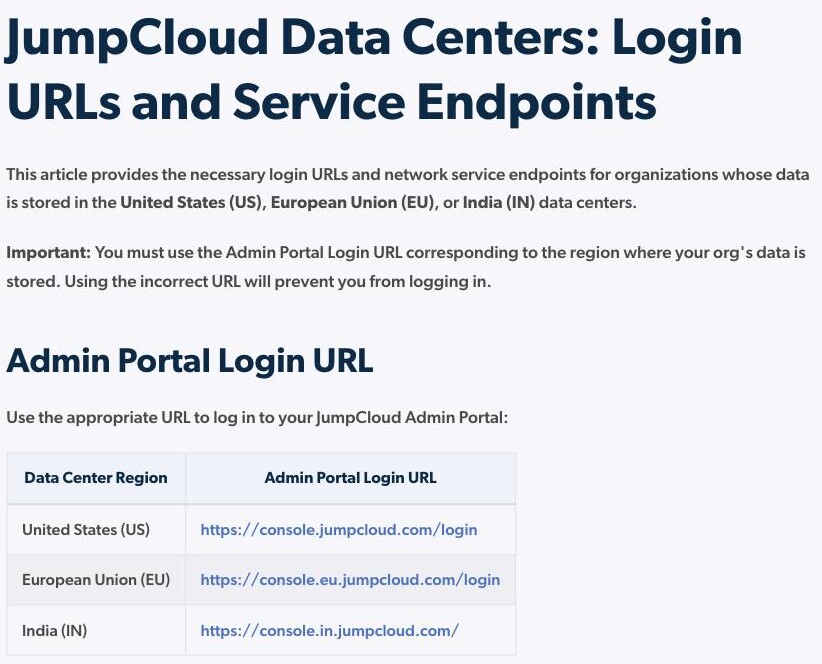
| JumpCloud names three data-center regions — the US, the EU and India — and none is in mainland China. Its data-center documentation provides “the necessary login URLs and network service endpoints for organizations whose data is stored in the United States (US), European Union (EU), or India (IN) data centers,” and warns that you “must use the Admin Portal Login URL corresponding to the region where your org's data is stored.” There is no mainland-China region, so there is no in-country resting place for the identity and device data it holds, and none to attach an ICP filing to. | JumpCloud Support — JumpCloud Data Centers: Login URLs and Service Endpoints (jumpcloud.com), retrieved 2026-10-09 |
| The EU region is an AWS instance in Frankfurt; the US and India (Mumbai) are the other two — all offshore to China. JumpCloud's EU FAQ states that the “JumpCloud EU data center (AWS instance) is hosted in Frankfurt, Germany,” and that it offers “Customer Personal Data storage at rest in the EU by maintaining a dedicated site within the continental European Union region.” Its India FAQ places that region in Mumbai. Every region it documents sits outside the mainland. | JumpCloud Support — FAQ: JumpCloud Data Center (EU) (jumpcloud.com), retrieved 2026-10-09 |
| A region is locked in at signup and an organization can't span regions, so there is no China region to switch to. JumpCloud's India FAQ states that “JumpCloud environments are deployed within a single selected region at the time of signup,” that “Each organization operates independently within its chosen region,” and that “Multi-region deployments for a single organization are not supported at this time.” Moving between the US, EU and India relocates a cross-border transfer; it does not create an in-country one. | JumpCloud Support — FAQ: JumpCloud Data Center (India) (jumpcloud.com), retrieved 2026-10-09 |
| China-collected identity and device data sent to an offshore region is a PIPL cross-border transfer. Moving personal information collected from users and devices in mainland China into a JumpCloud account hosted in the US, EU or India triggers PIPL Articles 38–40: notice, a separate consent, and one transfer mechanism — a CAC security assessment, the CAC standard contract, or certification. For a critical information infrastructure operator, Cybersecurity Law Article 39 (formerly Article 37) adds an in-country storage duty no offshore region can meet. | Personal Information Protection Law of the PRC, Articles 38–40 (cac.gov.cn); Cybersecurity Law Article 39 (formerly Article 37), retrieved 2026-10-09 |
Sources verified by the 21YunBox compliance team on 2026-10-09.
For an organization running people and devices in mainland China, the first question about JumpCloud is easy to aim at the wrong target. JumpCloud is a cloud directory platform — one place for workforce identity, single sign-on and multi-factor authentication, and the management of the Windows, Apple, Linux and Android machines your staff sign in from. The reflex is to ask whether its agents and admin consoles reach the mainland. But that is not where the China decision is settled. A directory and a managed device fleet are both stores of personal information, and JumpCloud keeps them in whichever regional data center your account was provisioned in — and by JumpCloud’s own documentation, none of those regions sits inside mainland China. So this turns on residency and cross-border transfer long before it turns on load time.
JumpCloud documents exactly three data-center regions: the United States, the European Union (an AWS instance in Frankfurt), and India (Mumbai). A region is chosen once, at signup, and an organization cannot span regions — there is no mainland-China region to pick. The moment the account records, group and role data, authentication logs, and the device identifiers and endpoint telemetry JumpCloud holds about your people and machines in China come to rest in a US, EU or India environment, you have made a cross-border transfer (数据出境) of personal information — and a separate body of law decides whether that was allowed.
JumpCloud in China at a glance
| What decides it | In JumpCloud's own terms — and China's law |
|---|---|
| What it is | A cloud directory and device-management platform: workforce identity, single sign-on, multi-factor authentication, and management of Windows, Apple, Linux and Android devices. It holds two kinds of personal information at once — a directory of your people and an inventory of their endpoints, with device identifiers and telemetry. |
| Where the data lives | JumpCloud documents three data-center regions — the United States, the European Union (an AWS instance in Frankfurt) and India (Mumbai). Your organization's data rests in the one region it was provisioned in. None of the three is inside mainland China. |
| Can you choose a China region? | No. A region is selected once at signup and “Multi-region deployments for a single organization are not supported.” There is no mainland-China region on the list, so switching between the US, EU and India only relocates the transfer — it does not end it. |
| Collecting China identity & device data into it | Account records, group and role data, authentication logs, device identifiers and endpoint telemetry are personal information. Holding them in a US, EU or India environment is a cross-border transfer (数据出境) under PIPL (Articles 38–40): notice, a separate consent, and one transfer mechanism. For a critical information infrastructure operator or large-volume handler, the Cybersecurity Law's Article 39 (formerly Article 37) sets an in-country storage duty an offshore region cannot meet, and larger or sensitive transfers can add a CAC data-export security assessment. |
| The lawful path | Keep the China directory and device data on a China-resident footing — a China-resident directory for the China entity, or consented in-country processing and storage — send offshore only what may lawfully leave, and deliver the China-facing admin and app surfaces in-country on ICP-filed infrastructure. 21YunBox maps, localizes and delivers; it never uses or suggests circumvention of any kind. |
Availability: three documented regions, and none is in the mainland
JumpCloud’s presence is fixed by its own documentation, not by a load-time test. Its data-center article states that it serves “organizations whose data is stored in the United States (US), European Union (EU), or India (IN) data centers,” and warns that you “must use the Admin Portal Login URL corresponding to the region where your org’s data is stored.” Its EU FAQ adds that the “JumpCloud EU data center (AWS instance) is hosted in Frankfurt, Germany,” and its India FAQ that “the India region is hosted in Mumbai.” Three regions, three places the data can rest — and the mainland is not one of them.
That settles the shape of the question. Whether JumpCloud’s agents and consoles resolve consistently from inside China is an operational matter, not the decision — and it is never one to answer with a network workaround. The decision is where your China-collected identity and device data comes to rest, and whether it had a lawful basis to leave the country at all. For that reason this page publishes no first-party China latency figure for JumpCloud: speed is not the axis a residency question turns on.
The residency question: your directory — and your device inventory — is personal information
Here is the gate most teams miss. A JumpCloud organization provisioned in the US, EU or India region is, by definition, outside the mainland. The account records, display names, email addresses, phone numbers used for MFA, group and role membership, and the sign-in and audit logs it keeps for your users in China are personal information — and so is the second store JumpCloud holds: the managed-device inventory, with hardware and OS identifiers, posture and patch state, and the endpoint telemetry its agent reports. Loading any of it into an offshore JumpCloud is a cross-border transfer under China’s Personal Information Protection Law. PIPL puts the duty on the handler — you, not JumpCloud the processor: Articles 38–40 require notice, a separate consent distinct from a user’s agreement to sign in or to enroll a device, and one transfer mechanism — a CAC security assessment, the CAC standard contract, or certification.
Beneath that sits residency. A critical information infrastructure operator or a large-volume handler must store personal information collected in China inside the mainland under PIPL Article 40 and the Cybersecurity Law’s Article 39 (formerly Article 37 — the data-localization provision was renumbered by the 2025 amendment that took effect on January 1, 2026, with its substance unchanged). An account that lives in Frankfurt, Mumbai or a US region structurally cannot meet that duty. And where volumes or data sensitivity cross the thresholds, the transfer itself may need a CAC data-export security assessment before anything leaves. Which of these bind your specific deployment depends on your entity, your data volumes and your role under Chinese law — a risk to confirm with counsel against what you actually collect, not a default to assume.
No China region to choose — and switching regions only moves the transfer
The tempting fix is to flip a setting and keep the data in-region. But JumpCloud’s regions are the US, the EU and India, and a region is locked in once: its India FAQ states that “JumpCloud environments are deployed within a single selected region at the time of signup,” that “Each organization operates independently within its chosen region,” and that “Multi-region deployments for a single organization are not supported at this time.” None of the three is mainland China, so none resolves a China residency duty — moving an organization from a US region to the EU, or to Mumbai, simply relocates the cross-border transfer; it never ends it. Keeping China-collected identity and device data in-country means standing it up on a China-resident footing in the first place, and sending offshore only what may lawfully leave. That split — what must stay, what may go — is a legal question before it is a technical one.
Consent and device telemetry: a second PIPL duty on top of the transfer
Residency is only half of it. Enrolling an employee’s device and streaming its telemetry is, under PIPL, processing of that identifiable person’s information, and it needs its own lawful basis — in practice informed consent and clear notice before the agent begins collecting, covering what is gathered from the endpoint and why. The cross-border move of that same data to an offshore JumpCloud then needs a further, separate consent on top. A directory that authenticates staff and a management agent that inventories their laptops are exactly the kind of continuous, identity-linked collection Chinese regulators treat as sensitive, so the consent and notice flow is not a formality to bolt on later. What each identifier counts as, and what your notice must say, are questions to settle with counsel.
The lawful path — map, localize, deliver
There is a compliant way to run identity and device management for a China workforce, and it has a definite shape. First we map: our China team works through your PIPL exposure on both fronts at once — the directory and the device fleet — marking which account, authentication, device-identifier and telemetry data collected in China must stay in the country, what may lawfully cross the border, where Article 39 in-country storage or a data-export security assessment bites, and what your enrollment and sign-in consent has to cover. The legal conclusions are settled with counsel; we build the technical picture that feeds them.
Then we localize: because JumpCloud offers no mainland region and no in-country sovereign instance, the work is to put the China directory and device data on a China-resident footing — a China-resident directory for the China entity, or consented in-country processing and storage — in place of an offshore account that cannot carry the residency duty, while you keep JumpCloud for the markets where it already serves you. Only what may lawfully leave is sent out.
Then we deliver: the China-facing surfaces that hang off all this — the admin portals, intranets and customer apps that authenticate against the directory — are themselves public services in the mainland, so each carries an ICP filing (备案) duty and needs compliant in-country delivery. 21YunBox delivers them in-country — the 21YunBox Optimizer — set in front of what you already run, with no rebuild and no re-platform. The result is identity and device management that runs legally and compliantly for your users in China. What we never do — and what no one lawfully can — is route anyone around China’s data-export rules or any network control: we localize what must stay, deliver in-country, and never move personal information out of the mainland by stealth.
Related reading:
- Cross-border data transfers under PIPL
- China’s Cybersecurity Law — Article 39 (formerly Article 37) and data localization
- China’s data-export security assessment measures
- How to get an ICP filing for China