Does Google Meet Work in China? Data Residency, ICP & Cross-Border Rules
Google Meet keeps meeting content, chat, participant PII and recordings — speaker voiceprints and faces — on Google's cloud, which stores data only in the US or Europe, with no mainland-China region. A China team's meetings are a PIPL cross-border transfer; the recordings are sensitive personal information. The lawful path is China-resident, never circumvention.
Does Google Meet work in China?
Whether Google Meet works for a mainland-China team is first a data-residency and consent question under PIPL — not whether the call connects from Shanghai. Meet holds your meeting content, in-call chat, participant identities and recordings, and Google Workspace keeps that data only in the United States or Europe, with no mainland-China region — so a China team's meetings sit offshore.
The part a reachability check never sees: a Meet recording is the speaker's voiceprint and the participants' faces, which is sensitive personal information under PIPL (Articles 28–29) that cannot be de-identified — the biometric is the recording — and every China participant's meeting data placed in Meet is a cross-border transfer of personal information (notice, separate consent and a transfer mechanism, Articles 38–40). Google runs no mainland-China region or operating entity, so the lawful answer is a China-resident meeting path, never circumvention of any kind.
This is a risk map, not a verdict — what you owe turns on your data volumes, your role as handler and who joins your calls, and it's worth settling with counsel. Our China team can map your exposure with you →
What Google Meet's own documentation says about China
| Fact | Primary source |
|---|---|
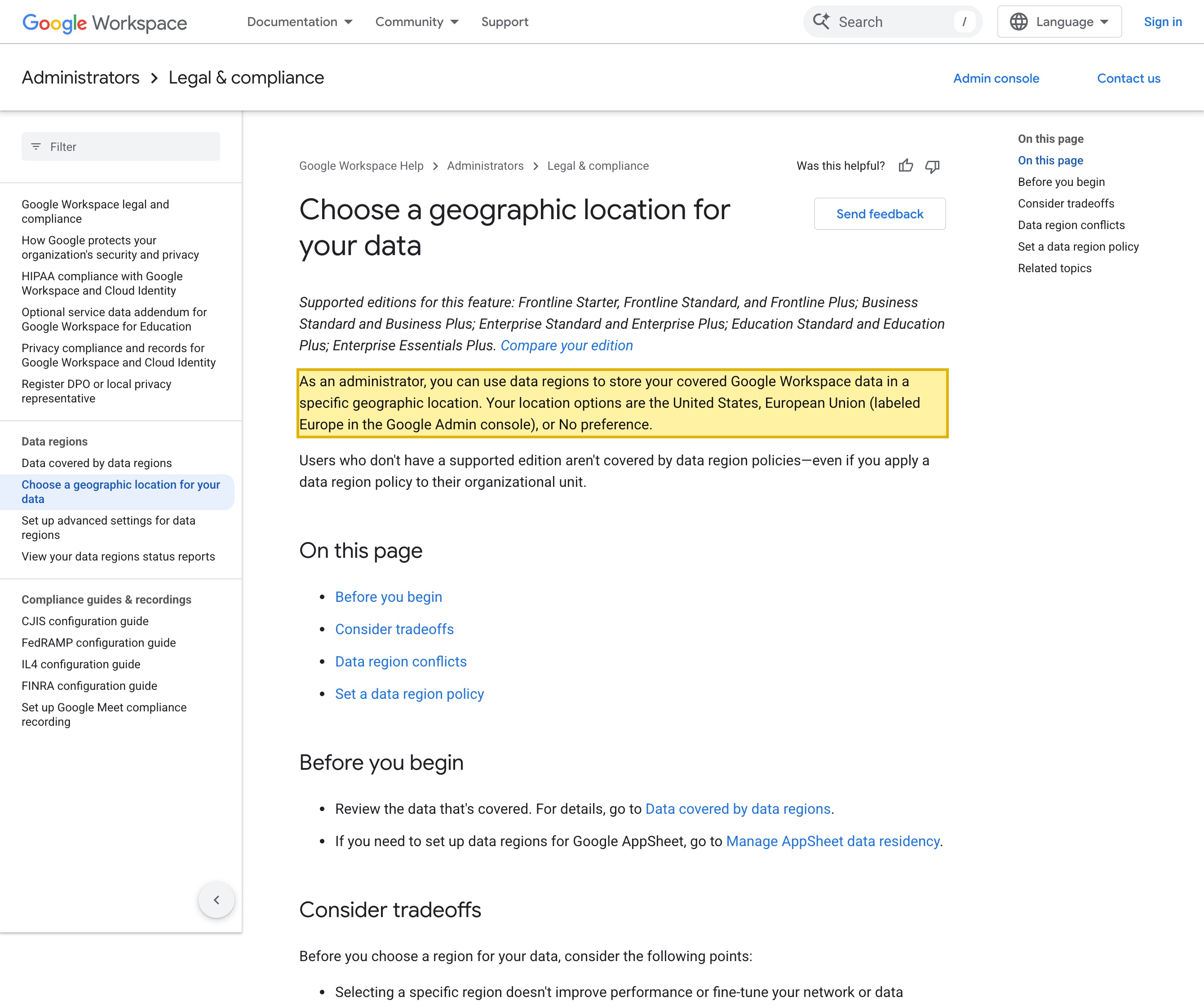
| Google Workspace stores customer data at rest only in the United States or Europe — there is no mainland-China region. Google's admin guidance for choosing a data location states: "Your location options are the United States, European Union (labeled Europe in the Google Admin console), or No preference." Mainland China is not on that list and there is no China data region to select, so a China team's Meet content, in-call chat, participant identities and recordings are held offshore — a cross-border transfer of personal information under PIPL (Articles 38–40). | Google Workspace Admin Help — Choose a geographic location for your data (retrieved 2026-10-12) |
| Google Meet recordings and transcripts are themselves confined to the United States or Europe — never the mainland. Google's Data Regions documentation lists the covered Meet data as "Meet recordings (including chats in Google Drive), attendance reports, polling results, transcripts, and questions," and says the service can only "process that data in a specific geographic location (the United States or Europe)." Meet recordings save to the organizer's Google Drive, so the voiceprints and faces captured in a China meeting land on US or EU storage, with no China option. | Google Workspace Admin Help — Data covered by data regions (retrieved 2026-10-12) |
| A meeting recording is biometric sensitive personal information, and a China team's meeting data placed in Meet is a cross-border transfer. A recording captures the speaker's voiceprint and participants' faces — sensitive personal information under PIPL Articles 28–29, which requires a specific purpose, necessity, a separate consent and a protection-impact assessment, and cannot be de-identified because the biometric is the recording. Collecting China participants' meeting content and identities into an offshore workspace is a cross-border transfer under Articles 38–40, with notice and a separate consent under Articles 13 and 23. | PIPL Articles 13, 23, 28–29, 38–40 (retrieved 2026-10-12) |
| Some handlers must keep the data in China, and any public China-facing surface needs an ICP filing. Where the handler is a critical information infrastructure operator or moves personal information at volume, personal information collected in the mainland must be stored there (PIPL Article 40; Cybersecurity Law Article 39 (formerly Article 37)) — a duty Google's US and EU regions cannot meet. And any public China-facing surface served from inside the mainland carries an ICP filing duty (State Council Order No. 292; MIIT Order No. 33) bound to mainland hosting, which Google does not provide. | PIPL Article 40; Cybersecurity Law Article 39 (formerly Article 37); State Council Order No. 292; MIIT Order No. 33 (retrieved 2026-10-12) |
Sources verified by the 21YunBox compliance team on 2026-10-12.
The first instinct with a tool like Google Meet is to ask whether a call even connects from Shanghai or Shenzhen. For a China-facing team that is the wrong first question. What decides whether you can run Meet for a China team is where your meetings actually live: the spoken content, the in-call chat, the identities of the people on the call, and — the part that is easy to forget — the recordings. Google keeps all of that offshore, and the moment a meeting involves people in China, a different body of law decides whether that was lawful. Even if every call connected flawlessly, that question would still stand — which is why this is a compliance decision, not a performance one. And to be unambiguous from the outset: Google operates no data region or entity inside the mainland, and the only ways to force a connection to a service that will not open are forms of circumvention, which are themselves non-compliant and which 21YunBox never uses or suggests. The lawful answer to a tool Google does not serve in the mainland is a China-resident alternative, not a way around a block.
Google Meet in China at a glance
| What decides it | In Google's own terms — and China's law |
|---|---|
| What it is | Google Meet is a video-meeting service inside Google Workspace: the spoken content of a call, in-call chat, the identities of participants, and recordings, transcripts and attendance reports. There is no Meet data region or Google operating entity inside mainland China. |
| Is it reachable from the mainland? | Mainland China is not on Google Workspace's published list of restricted countries (that list covers sanctioned places such as Crimea, Cuba, Iran, North Korea and Syria), but Google runs no mainland region or entity, and its services have a long-documented history of being unreachable behind China's network controls. Either way, reachability is not the China question — and the only ways to force a connection to a service that will not open are circumvention, which 21YunBox never uses or suggests. |
| Where do your meetings actually sit? | Offshore. Google Workspace's data-location options are the United States or Europe (or "No preference"), and its Data Regions documentation confines Meet recordings, transcripts and attendance reports to processing "in a specific geographic location (the United States or Europe)." China is not a region, and there is no China data instance to select. |
| Recordings are a special category | A Meet recording captures the speaker's voiceprint and participants' faces — biometric sensitive personal information under PIPL Articles 28–29. It cannot be de-identified, because the biometric is the recording; it requires a specific purpose, necessity, a separate consent and a protection-impact assessment. |
| Putting China-collected meetings in Meet | A cross-border transfer (数据出境) of personal information under PIPL (Articles 38–40): notice, a separate consent (Articles 13 and 23), and one transfer mechanism. For a critical information infrastructure operator or a large-volume handler, the Cybersecurity Law's Article 39 (formerly Article 37) sets an in-country storage duty an offshore workspace cannot meet. |
| The lawful path | Keep the regulated recordings and participant data in-country on a consented store or in a China-resident meeting alternative, move only what may lawfully leave, and deliver any China-facing surface in-country on ICP-filed infrastructure. 21YunBox maps, localizes and delivers; it never uses or suggests circumvention. |
The data-residency question: your meetings sit offshore
Here is the gate most teams miss. Everything a call puts into Meet — the spoken content, the in-call chat, the identities of the attendees, and any recording, transcript or attendance report — is stored on Google’s infrastructure, and by Google’s own account that infrastructure sits outside mainland China. Google’s Workspace admin guidance for choosing a data location puts it plainly: “Your location options are the United States, European Union (labeled Europe in the Google Admin console), or No preference.” Its Data Regions documentation lists the covered Meet data as “Meet recordings (including chats in Google Drive), attendance reports, polling results, transcripts, and questions,” and says the service can only “process that data in a specific geographic location (the United States or Europe).” None of those regions is China. So the ordinary act of a Shanghai-based colleague joining a call — and especially of recording it — places personal information collected in China onto storage outside the country. That is a cross-border transfer of personal information under China’s Personal Information Protection Law.
PIPL puts the duty on the handler — you, Google’s customer, not the vendor. Articles 38–40 require notice, a separate consent distinct from a user’s agreement to use the product (Articles 13 and 23), and one transfer mechanism — a CAC security assessment, the CAC standard contract, or certification. Above certain thresholds, or where the records include “important data,” that transfer may also require China’s data-export security assessment (数据出境安全评估) before anything leaves.
And if your organization is a critical information infrastructure operator, the Cybersecurity Law adds a harder duty. Its Article 39 — renumbered from Article 37 in the 2016 text by the amendment in force January 1, 2026, the obligation unchanged — requires that personal information and important data collected and generated in the mainland be stored in the mainland. An offshore Meet workspace cannot satisfy that, whichever data location you pick, because neither of Google’s regions is in China. Which of these obligations actually bites on your data is a risk to confirm with counsel against what your team collects, records and stores.
The recording is biometric sensitive personal information
This is the half a reachability test can never see, and it is specific to meetings. When a Meet call is recorded, the file is not an abstract log — it is the speaker’s voiceprint and the participants’ faces. Under PIPL, biometric characteristics are sensitive personal information (Articles 28–29): information whose leakage or misuse could readily harm a person’s dignity or safety. A handler may process it only for a specific purpose with sufficient necessity, must obtain a separate consent, and must carry out a personal-information protection impact assessment beforehand.
The sharp edge is that this data cannot be minimized or de-identified the way a name or an email sometimes can — because the biometric is the recording. You cannot “anonymize” a face or a voice out of the video and still have the video. So a recorded China meeting stored in a US or EU Google region is a continuous export of sensitive personal information, governed by the strictest tier of PIPL, and the only durable fix is to keep that recording in-country in the first place. Whether your meetings need recording at all, and under what consent, is exactly the kind of question worth settling with counsel before the first call.
Why there is no Google Meet “China region” to switch on
With some vendors the fix is to move onto a mainland instance the vendor itself runs. Google is not one of them. Its data-location choices — the United States or Europe, or “No preference” — are the whole menu; there is no China setting to enable, no in-China operating partner for Workspace, and Google maintains no data region in the mainland. So localizing for China is not a toggle inside Meet — it is a decision about where the regulated meeting data lives.
The work, then, is to keep the China-collected records that must stay — above all the recordings and the participant data — inside the mainland on a consented, in-country store, or to run the meetings themselves on a China-resident alternative, and let only what may lawfully leave reach the Google services your team already uses. Because Google does not serve Meet from the mainland, the compliant pattern here leans on a China-resident meeting option rather than on making an offshore workspace reachable — and that pattern, not a way around a block, is the heart of the fix.
Serving a China-facing surface adds an ICP duty
If your use of Meet is purely an internal team tool, the residency, recording and cross-border questions above are the whole story. But the moment any China-facing surface built around it is served to the public from inside the mainland — a public booking or join page, a recorded-session library, an embedded webinar view — that surface is a public internet service in China and carries an ICP filing (备案) duty under State Council Order No. 292 and MIIT Order No. 33, bound to a hosting resource physically in the mainland. Google names no mainland region, so there is nothing of its own to file against.
This is a risk map, not a verdict: whether you owe separate consent, a transfer mechanism, in-country storage, an ICP filing, or some combination turns on your data volumes, your role as handler and who joins your calls — worth settling with counsel before you rely on it.
The lawful path — map, localize, deliver
There is a lawful way to run meetings for a China-facing team, and it has a clear shape — three moves, in order.
Map. Our China team works through the PIPL cross-border exposure, the consent basis, and the data-residency duties that attach to what you keep in Meet — sorting which China-collected records carry personal, sensitive or important information that must stay in-country (recordings first), which may lawfully be transferred, and where a data-export security assessment or an Article 39 storage duty applies. The legal conclusions are settled with counsel; we supply the technical picture that feeds them.
Localize. Keep the China-collected records that must stay — the recordings, transcripts and participant data — on a consented, in-country store inside the mainland, or run the meetings on a China-resident alternative, and let only what may lawfully leave reach your global Google workspace. The meetings your team depends on keep running, without the workspace becoming the thing that carries sensitive biometric data out of China unlawfully. 21YunBox stands up and integrates that in-country option in place of what cannot run compliantly in the mainland.
Deliver. Any China-facing surface that serves or receives that meeting data is itself a public service in the mainland, so it needs compliant, ICP-filed, in-country delivery — the 21YunBox Optimizer, set in front of what you already run, with no rebuild and no re-platform. The result is meetings and a China-facing surface that run legally and compliantly for your users in China. What we never do — and what no one lawfully can — is hand you a way around a block: we keep what must stay in-country and deliver in-country, and circumvention is never on the table.
Related reading:
- China’s Personal Information Protection Law (PIPL)
- Cross-border data transfers under PIPL
- China’s Cybersecurity Law (data localization, Article 39)
- How to get an ICP filing for China


