Does Canva Work in China? Data Residency, ICP & Cross-Border Rules
Canva holds your design files, brand assets and prototypes — IP plus embedded personal data. Global canva.com stores that corpus offshore (residency US/EU only, no mainland-China region), so a China team's corpus is a PIPL cross-border transfer; a separate canva.cn platform shares no data.
Does Canva work in China?
Whether you can use Canva for a mainland-China team is first a data-residency and cross-border question under PIPL — not whether the editor loads in Shanghai. Canva holds your design files, brand assets and prototypes: business IP, plus the personal data embedded in mockups and screenshots and your collaborators' identities.
The global canva.com product stores that corpus offshore — its own Help Center offers data residency only for the US and the EU, with no mainland-China region — so a China team's designs and collaborator PII are a cross-border transfer of personal information under PIPL (notice, a separate consent and a transfer mechanism, Articles 38–40), with sensitive-PI duties for embedded faces and IDs (Articles 28–29) and an ICP filing for any China-facing published design or site. Canva does run a separate, independent China platform (canva.cn), and its developer docs state Chinese users' personal data must be stored on servers in China — but that is a separate region, not a toggle in your global org, so your global-Canva corpus still sits offshore until it is localized.
This is a risk map, not a verdict — what you owe turns on your data volumes, your role as handler and who your users are, and it's worth settling with counsel. Our China team can map your exposure with you →
What Canva's own documentation says about China
| Fact | Primary source |
|---|---|
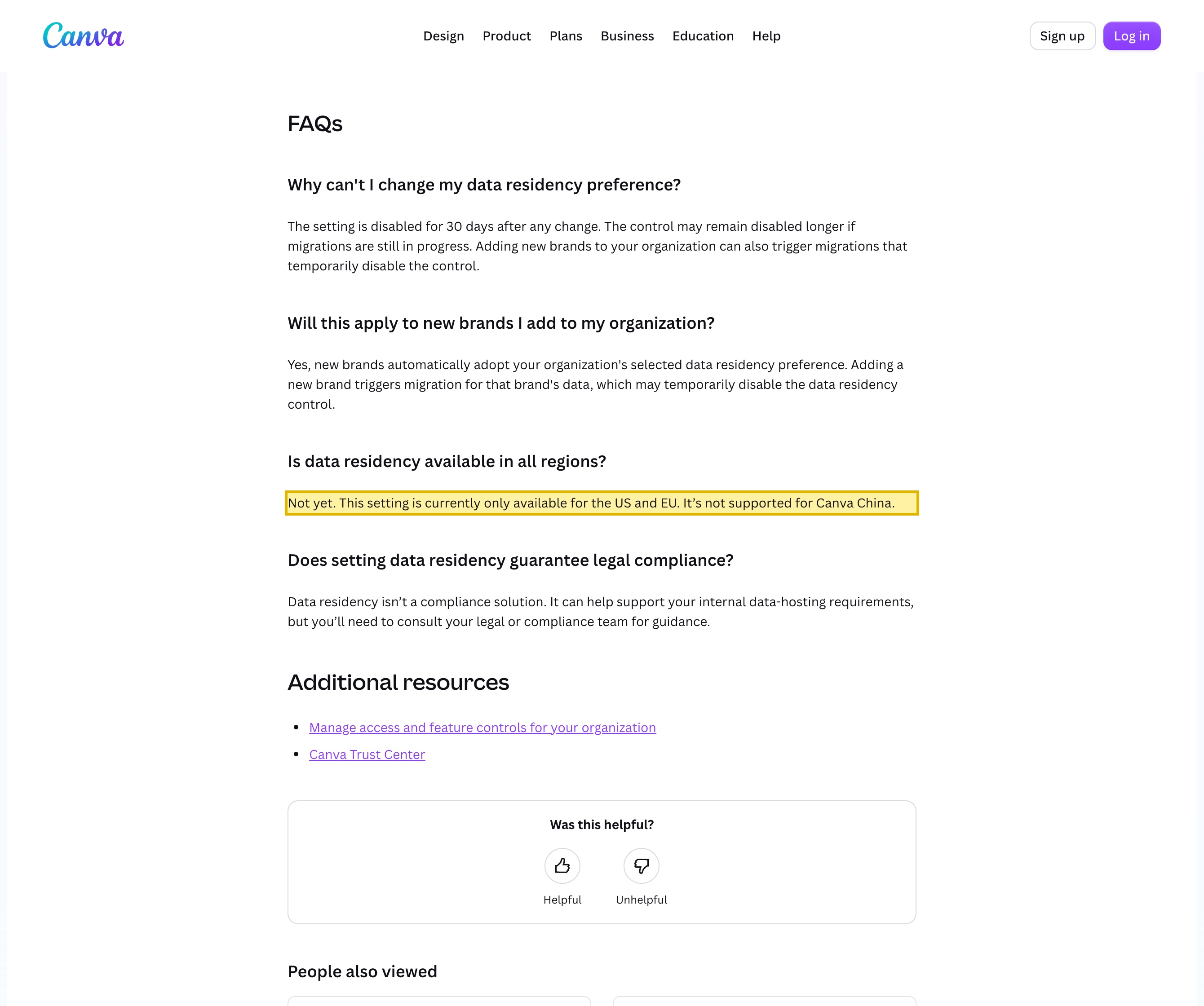
| Canva's own Help Center offers data residency only for the US and the EU — not mainland China. Its article on setting an organization's data-residency preference lists the dropdown regions as "No Preference," "United States" and "European Union" (Enterprise, Campus or District plans), and its FAQ states the setting "is currently only available for the US and EU" and "is not supported for Canva China." So the design corpus and collaborator identities a China team keeps in the global canva.com product are held offshore — a cross-border transfer of personal information under PIPL (Articles 38–40). Canva also notes data residency "isn't a compliance solution." | Canva Help Center — Set your organization's data residency preference (retrieved 2026-10-12) |
| Canva's developer documentation states it "exists in two regions" — a Global platform (canva.com) and a separate China platform (canva.cn) — that "no data is shared between these regions," and that "personal data of Chinese users must be stored on servers within Chinese territories." The China region is independent by design: apps and data do not cross between it and the global product, and the same docs require China-region apps to follow the "Cybersecurity Law of the People's Republic of China" and the "Administration of Internet Information Services Procedures" — so adopting it is a localization decision, not a setting inside your existing global organization. | Canva Developers — Regions (canva.dev) (retrieved 2026-10-12) |
| Collecting China users' designs and the personal data inside them into an offshore product is what PIPL governs as a cross-border transfer. The personal-information handler (you, Canva's customer — not Canva) must give notice, obtain a separate consent, and satisfy one transfer mechanism — a CAC security assessment, the CAC standard contract, or certification (Articles 38–40) — on top of the Article 13 lawful basis and the Article 23 rule for sharing. Faces and ID images embedded in designs are sensitive personal information (Articles 28–29), which requires its own specific consent and a necessity test. | PIPL Articles 13, 23, 28–29 and 38–40 |
| For some handlers the data must stay in China — and a public China-facing surface served from inside the mainland needs an ICP filing. Where the handler is a critical information infrastructure operator or moves personal information at volume, data collected in China must be stored in the mainland (Cybersecurity Law Article 39 (formerly Article 37)) — a duty the global canva.com product's US/EU regions cannot meet. And any design, Canva-built site or embedded view actually published to the mainland public carries an ICP filing (State Council Order No. 292; MIIT Order No. 33), bound to a mainland hosting resource the global product does not provide. | Cybersecurity Law Article 39 (formerly Article 37); State Council Order No. 292; MIIT Order No. 33 |
Sources verified by the 21YunBox compliance team on 2026-10-12.
The first instinct with a tool like Canva is to ask whether the editor even opens from Shanghai or Shenzhen. For a China-facing team that is the wrong first question. What decides whether you can use Canva is not where it loads from but where your work lives — the design files, brand assets, templates and prototypes, the identities of the collaborators who build them, and the personal data that quietly rides along inside mockups and screenshots: a face in a photo, a name on a sample business card, a customer logo on a pitch deck. Canva keeps that corpus on its infrastructure, and the moment any of it is collected from people in China, a different body of law decides whether that was lawful. Even if every design loaded instantly, that question would still stand — which is why this is a compliance decision, not a performance one. And to be unambiguous from the outset: the only ways to force a connection to a service that will not open are forms of circumvention, which are themselves non-compliant and which 21YunBox never uses or suggests.
Canva in China at a glance
| What decides it | In Canva's own terms — and China's law |
|---|---|
| What it is | Canva is an online visual-design platform: design files, brand assets, templates and prototypes, the identities of the collaborators who make them, and whatever personal data is embedded in the images — faces, names, ID cards, customer artwork. Canva's developer documentation states it “exists in two regions,” a Global one served from canva.com and a separate China one served from canva.cn. |
| Is it reachable from the mainland? | The global canva.com editor is generally reachable, though connectivity can be uneven, and a distinct canva.cn platform operates inside China. But reachability is not the China question, and the only ways to force a connection to a service that will not open are circumvention, which 21YunBox never uses or suggests. |
| Where does your design corpus sit? | On the global product, offshore. Canva's Help Center offers data residency only for the United States and the European Union — “No Preference,” “United States,” “European Union” — on an Enterprise, Campus or District plan, with no mainland-China region to select. Canva's developer docs add that the Global and China regions share no data. |
| Putting China-collected designs there | A cross-border transfer (数据出境) of personal information under PIPL (Articles 38–40): notice, a separate consent and one transfer mechanism, plus the Article 13/23 basis for collecting and sharing it. Faces and ID images embedded in designs are sensitive personal information (Articles 28–29). For a critical information infrastructure operator or a high-volume handler, Cybersecurity Law Article 39 (formerly Article 37) sets an in-country storage duty the offshore product cannot meet. |
| Serving a public China-facing surface | A published design, a Canva-built website or an embedded view served to the mainland public is a public internet service and needs an ICP filing (备案) bound to a mainland hosting resource. The global canva.com product provides no mainland region to file against. |
| Is the separate China platform the fix? | Canva runs an independent China platform (canva.cn), and its own docs say “personal data of Chinese users must be stored on servers within Chinese territories.” But it is a separate region, not a setting in your global org; your existing canva.com corpus does not move there on its own; and Canva states data residency “isn't a compliance solution.” Whether it fits your entity, workloads and users is a decision to confirm with counsel. |
| The lawful path | Keep the China-collected designs and personal data that must stay in-country on a consented, China-resident store, move only what may lawfully leave, and deliver any China-facing published surface in-country on ICP-filed infrastructure. 21YunBox maps, localizes and delivers; it never uses or suggests circumvention. |
The data-residency question: the global Canva product keeps your corpus offshore
Here is the gate most teams miss. Everything your team builds in the global canva.com product — every design, brand asset, uploaded photo and the profile of each collaborator — is stored on Canva’s infrastructure, and by Canva’s own account that infrastructure sits outside mainland China. Its Help Center article on setting an organization’s data residency offers exactly three choices from the dropdown — “No Preference,” “United States,” “European Union” — available only on Enterprise, Campus or District plans, and its own FAQ is blunt that the control “is currently only available for the US and EU” and “is not supported for Canva China.” None of those regions is the mainland. So the ordinary act of a Shenzhen-based designer uploading a client photo or sharing a brand kit places personal information collected in China onto storage outside the country. That is a cross-border transfer of personal information under China’s Personal Information Protection Law.
PIPL puts the duty on the handler — you, Canva’s customer, not the vendor. Articles 38–40 govern the transfer: notice, a separate consent distinct from a user’s agreement to use the product, and one transfer mechanism — a CAC security assessment, the CAC standard contract, or certification — on top of the Article 13 lawful basis and the Article 23 rule for sharing personal information with a third party. And because a design corpus is full of images, the exposure is not just names and emails: a face in an uploaded photo or an ID document in a mockup is sensitive personal information under Articles 28–29, which demands its own specific consent and a necessity test. If your organization is a critical information infrastructure operator or moves personal information at volume, the Cybersecurity Law adds a harder duty: its Article 39 — renumbered from Article 37 in the 2016 text by the amendment in force January 1, 2026, the obligation unchanged — requires personal information and important data collected in the mainland to be stored in the mainland. The global canva.com product, offering only US and EU residency, cannot satisfy that. Which of these obligations actually bite on your data is a risk to confirm with counsel against what your team collects and stores.
There is a separate China platform — but it is a localization, not a switch
Canva is not a pure offshore-only service, and it would be wrong to pretend otherwise. Its developer documentation states that Canva “exists in two regions” — a Global platform served from canva.com and a separate China platform served from canva.cn — that “apps created via canva.com are independent of apps created via canva.cn,” and that “no data is shared between these regions.” The same documentation notes that “personal data of Chinese users must be stored on servers within Chinese territories.” In other words, Canva itself localized for China by standing up a distinct, China-resident region rather than adding a mainland option to the global product.
That is genuinely good news — but it is a localization decision, not a toggle inside your existing global organization. The two regions are independent by design, so the corpus your team already keeps in canva.com does not migrate to canva.cn on its own, the accounts and apps do not carry across, and Canva is explicit that data residency “isn’t a compliance solution” on its own. There are also facts this page does not assert because they were not verified from a primary source: the current legal and ICP status of the China platform’s operating entity, and whether it fits your specific entity, enterprise workloads and user base. Those are precisely the questions to settle with counsel before relying on it. What the separation does establish is the shape of the lawful answer — regulated Chinese data lives in-country — which is exactly the pattern a compliant setup follows.
Serving a China-facing surface adds an ICP duty
If your use of Canva is purely an internal design tool, the residency and cross-border questions above are the whole story. But the moment a design is published to the mainland public — a Canva-built website on a custom domain, a shared public link promoted inside China, an embedded design on a China-facing page — that surface is a public internet service in China and carries an ICP filing (备案) duty under State Council Order No. 292 and MIIT Order No. 33, bound to a hosting resource physically in the mainland. Canva’s own developer rules for its China region point the same way, requiring apps there to follow the “Cybersecurity Law of the People’s Republic of China” and the “Administration of Internet Information Services Procedures.” The global canva.com product provides no mainland hosting of its own to file against, so a compliant China-facing surface needs in-country, ICP-filed delivery in front of it.
This is a risk map, not a verdict: whether you owe separate consent, a transfer mechanism, in-country storage, an ICP filing, or some combination turns on your data volumes, your role as handler and who your users are — worth settling with counsel before you rely on it.
Why a reachability check misses all of this
Open canva.com from a mainland connection and it may well load, and a shallow “does it work in China” test would stop there and call it fine. That test sees none of what actually governs the decision. It cannot see that your entire design corpus — the brand IP and the personal data baked into every mockup — is sitting in a US or EU region with no mainland option. It cannot see that collecting it from people in China is a cross-border transfer that owes notice, a separate consent and a transfer mechanism. It cannot see that a published design is a public internet service with an ICP duty, or that there is a separate, independent China platform that your global org does not automatically use. Reachability is a network fact; compliance is a data fact, and they are decided in different places.
The lawful path — map, localize, deliver
There is a lawful way to run visual design for a China-facing team, and it has a clear shape — three moves, in order.
Map. Our China team inventories what you keep in Canva — which designs, uploads and collaborator records carry personal or sensitive information (including faces and IDs embedded in images), where that corpus is hosted, the Article 13/23 consent and the cross-border basis behind it, and the ICP status of any China-facing published surface. The legal conclusions are settled with counsel; we supply the technical picture that feeds them.
Localize. Keep the China-collected designs and personal data that must stay in-country on a consented, China-resident store, and let only what may lawfully leave reach your global Canva — so the brand assets and workflows your team depends on keep running, without the design corpus becoming the thing that carries regulated data out of China unlawfully. Where Canva’s own China region is the right home for that data, we help you adopt it on a sound footing rather than treating it as a quick switch; where it is not, we stand up and integrate a China-resident option in front of what you run.
Deliver. Any China-facing surface that serves a published design is itself a public service in the mainland, so it needs compliant, ICP-filed, in-country delivery — the 21YunBox Optimizer, set in front of what you already run, with no rebuild and no re-platform. The result is visual design and a China-facing surface that run legally and compliantly for your users in China. What we never do — and what no one lawfully can — is hand you a way around a block: we localize what must stay and deliver in-country, and circumvention is never on the table.
Related reading:
- China’s Personal Information Protection Law (PIPL)
- Cross-border data transfers under PIPL
- China’s Cybersecurity Law (data localization, Article 39)
- How to get an ICP filing for China


