Does Cisco Duo Work in China? Data Residency, ICP & Cross-Border Rules
Cisco Duo is cloud-only MFA and device trust: your China users' second factors — phone numbers, biometric and push tokens, device posture — and every login's access log rest in Duo's offshore data centers, none in mainland China. A compliance-first look at the residency, cross-border and ICP doors.
Does Cisco Duo work in China?
The question isn't whether the Duo prompt loads from Shanghai — it's that Cisco Duo is the single access gate in front of your whole China estate, and it holds that gate's most sensitive data offshore.
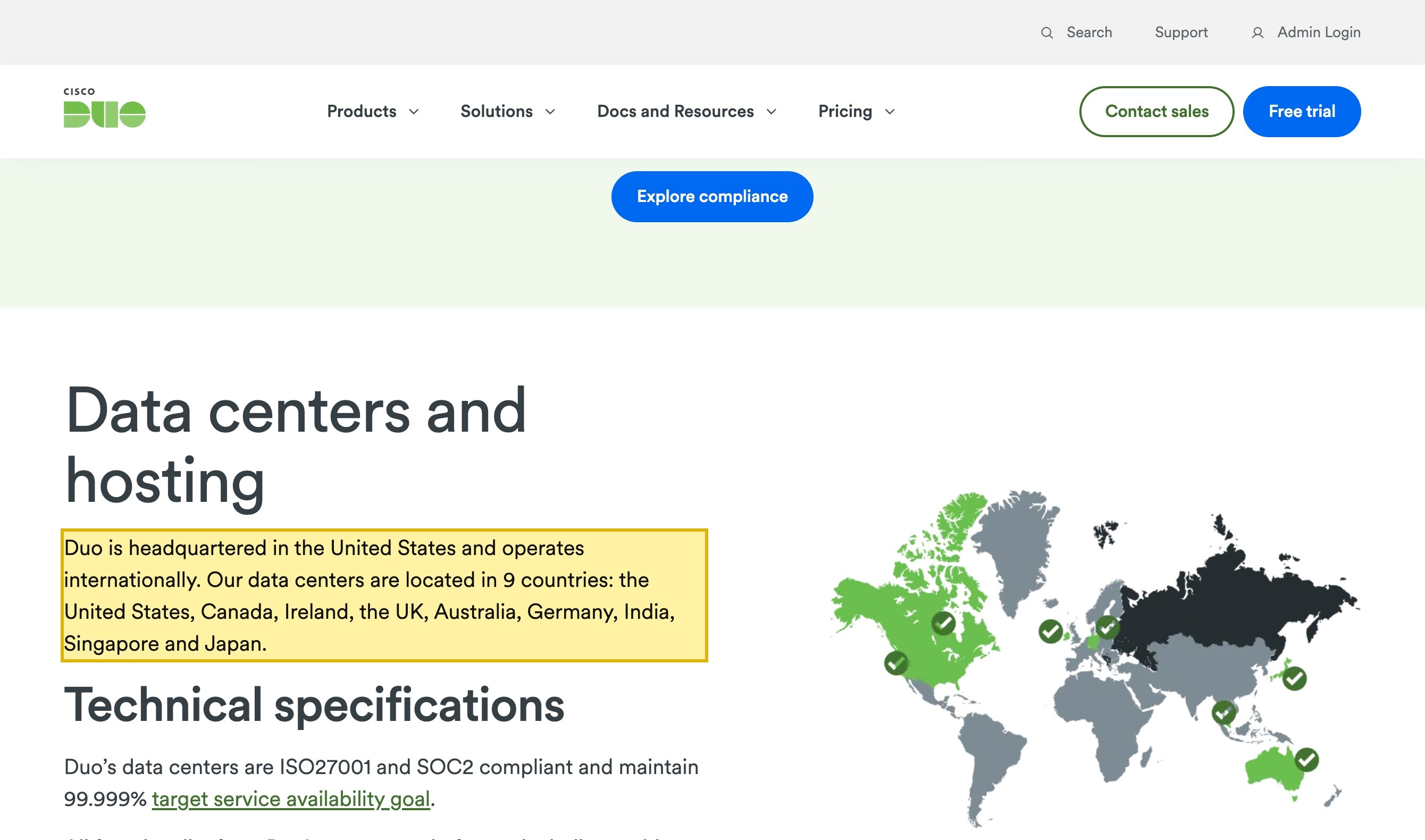
Duo's second factors — phone numbers, push and biometric enrollment tokens and device posture — are sensitive personal information (PIPL Articles 28–29), and holding them in Duo's offshore data centers is a cross-border transfer under Articles 38–40. Duo's own security page lists data centers in nine countries, none in mainland China.
The distinctive exposure a reachability test never sees: the identity and device-posture graph plus the access log of who entered which system concentrate, offshore, the control plane that guards everything — a security-governance and MLPS (等级保护) question, not a latency one.
What Cisco Duo's own documentation says about China
| Fact | Primary source |
|---|---|
| In Cisco Duo's own words: “Our data centers are located in 9 countries: the United States, Canada, Ireland, the UK, Australia, Germany, India, Singapore and Japan.” None is in mainland China. | Cisco Duo — Security and reliability (Data centers and hosting), retrieved 2026-10-12 |
| Duo groups customers into three locations — Americas; Europe, Middle East, Africa; and Asia Pacific — each served only by those offshore data centers (Asia Pacific from Australia, Japan, Singapore, Ireland, the UK and India). There is no mainland-China data region to assign a tenant to. | Cisco Duo — Security and reliability (Where is my data center?), retrieved 2026-10-12 |
| Biometric and phone-based second factors are sensitive personal information: PIPL Articles 28–29 require a specific purpose, necessity and separate consent, and Articles 38–40 require a lawful transfer mechanism (a CAC security assessment, the CAC standard contract, or certification) to send them abroad. | Personal Information Protection Law (PIPL), Articles 28–29 and 38–40 |
| For a critical information infrastructure operator or high-volume handler, the Cybersecurity Law's Article 39 (formerly Article 37) requires personal information generated in China to be stored in the mainland — which an offshore MFA tenant cannot satisfy — and the authentication control plane can draw MLPS (等级保护) and important-data (重要数据) duties. | Cybersecurity Law of the PRC, Article 39 (formerly Article 37) |
Sources verified by the 21YunBox compliance team on 2026-10-12.
For a company that leans on Cisco Duo to protect a mainland-China operation, the deciding question is not how quickly the Duo prompt appears on a phone in Shanghai. It is where the data behind that prompt is allowed to live — because Duo is not just a page that loads, it is the single gate in front of everything else. Multi-factor authentication and device trust sit at the front of every login to your China estate, and to do that job Duo holds the most access-sensitive data you have: the phone numbers, push and biometric enrollment tokens and device posture of the people you authenticate, and the access logs that record who entered which system, from which device, and when. Cisco Duo is a cloud-only service; its own security page lists data centers in nine countries, none inside mainland China — so those second factors and that access log are held and processed abroad. That makes this a compliance-risk question first, not a performance one.
Cisco Duo in China at a glance
| What decides it | In Duo's own terms — and China's law |
|---|---|
| What it holds | The data behind the gate to your China estate: the second factors of everyone you authenticate — phone numbers, push and biometric enrollment tokens; the device-trust posture (device IDs, OS, health, location signals); and the access logs that record who logged in to which system, from which device, and when. |
| Where it runs | Duo is a cloud-only service. Its own page lists data centers in nine countries — the US, Canada, Ireland, the UK, Australia, Germany, India, Singapore and Japan — with customers grouped into Americas, Europe/Middle East/Africa and Asia Pacific. None is inside mainland China, and there is no in-country data region to assign a tenant to. |
| Sensitive second factors | Phone numbers, biometric and push tokens and device IDs collected from people in China are sensitive personal information under PIPL Articles 28–29 (specific purpose, necessity, separate consent), and holding them offshore is a cross-border transfer under Articles 38–40, layered on the Article 13/23 notice-and-consent. |
| The gate — a security exposure | This is the half a reachability check never sees. Duo is the single access gate in front of your China systems, so its identity/device graph and access logs are a concentrated, security-sensitive record of who can reach what. Offshore, that is a governance exposure that may implicate “important data” (重要数据) handling and MLPS / 等级保护 duties on the authentication control plane — not a latency issue. |
| A China-facing login surface | A login or registration page served to mainland users is an internet information service, so it carries an ICP filing (备案) duty bound to a mainland hosting resource. A Duo-backed login running on offshore infrastructure offers no ICP-filing path of its own. |
| Reachability is not the axis | Whether the Duo prompt paints quickly from the mainland is operational, not the compliance question. What decides it is where the sensitive factors and access logs live, and whether the gate is governed. 21YunBox helps you keep the regulated identity data in-country, ICP-file any public login surface, and deliver it compliantly — the 21YunBox Optimizer — in front of the Duo you already run. |
What it actually holds — the keys to your China estate
Duo is not a static asset like a font or a script; it is the authentication control plane for your China operation, and it concentrates exactly the data China’s law treats most carefully. The first kind is sensitive personal information: the phone numbers people register, the push and biometric enrollment tokens that bind a login to a specific human, and the device-trust posture — device identifiers, operating system, health and location signals — gathered from each person you authenticate. The second kind — the half a reachability check never sees — is the access record: the logs of who authenticated into which system, from which device, and when. Because Duo sits at the front of every login, these are collected continuously and at scale across your whole China estate. And because Cisco Duo is a cloud-only service hosted in offshore data centers, with no mainland-China region, all of it — the factors, the device graph and the access log — is held and processed abroad by default.
The doors: sensitive-factor residency, the gate as a security exposure, biometric consent, and ICP
The first door is personal-information residency. The phone numbers, tokens and device data Duo collects from people in China are personal information under China’s Personal Information Protection Law, and holding them in an offshore region is a cross-border transfer (数据出境). The duty lands on you, the handler, not on Cisco: Articles 13 and 23 require notice and a basis to collect the data, and Articles 38–40 require a transfer mechanism to send it abroad — a CAC security assessment, the CAC standard contract, or certification. Because Duo’s second factors include biometric data and phone numbers, PIPL Articles 28–29 raise the bar: sensitive personal information demands a specific purpose, a necessity test and separate consent, not a buried checkbox. And for a critical information infrastructure operator or a high-volume handler, the Cybersecurity Law’s Article 39 (formerly Article 37 — the 2025 Cybersecurity Law amendment, in force January 1, 2026, renumbered the data-localization article from 37 to 39, with its substance unchanged) requires personal information generated in China to be stored in the mainland, which an offshore MFA tenant cannot satisfy.
The second door is the one that makes an identity gate different from an ordinary SaaS. Duo is not just another store of personal data — it is the single access gate in front of your China systems, so its identity and device-posture graph and its access logs are a concentrated, security-sensitive record of who can reach what, from where. Held offshore, that record is both a cross-border data issue and, for sensitive operations, may implicate “important data” (重要数据) handling and the data-security duties that attach to the systems that guard critical infrastructure. China’s Multi-Level Protection Scheme (MLPS, 等级保护) grades information systems by their security impact and imposes graded protection obligations; an authentication control plane that gates an entire China estate is precisely the kind of system that draws attention under it. Treat the classification as a risk to confirm with counsel rather than a label to claim — the point is that the keys to your operation, sitting abroad, are a governance question a speed test will never surface.
The third door is the China-facing login surface. If you publish a login or registration page to mainland users, you are running a public internet information service, and that turns on an ICP filing (ICP 备案) duty bound to a hosting resource physically inside the mainland. A login flow backed by an offshore service runs on infrastructure abroad, so there is nothing on it to file against — tuning the stack does not create the mainland footing a filing needs.
A reachability check never sees this
Duo is not the kind of service whose compliance you can judge by whether the prompt appears — the exposure is quieter and more durable than a slow paint. Even if the Duo prompt opened instantly on every phone in China, using it would still place your users’ sensitive second factors, their device posture and the full access log of who entered your China estate outside the country, in the one service that gates everything else. A reachability test answers “did the prompt come back?”; it is blind to where the biometric tokens, phone numbers and access logs come to rest, to whether the authentication control plane is governed, and to who is lawfully allowed to hold them. Where the data lives and whether the gate is governed, not how fast the prompt arrives, is what China’s law responds to.
This is a risk map, not a verdict that Cisco Duo is “blocked” or “illegal” in China. Which duties bite your case turns on your entity, which factors you collect and from whom, your role under Chinese law, and whether you are a critical information infrastructure operator — worth settling the specifics with counsel before your China logins depend on it.
The lawful path — map, localize, deliver
There is a compliant way to run identity and access for a China operation, and it sits in front of the Duo your team already uses — no rebuild, no second tool, no migration.
First, map: our China team inventories what your Duo tenant holds — the registered factors and biometric tokens, the device-trust posture, the access logs, and any China-facing login or registration surface — establishes where it is hosted (an offshore Duo data center), the ICP status of any public login page, whether the authentication control plane is MLPS-relevant, and the consent and residency basis each flow relies on. We build the technical picture; the legal conclusions are settled with counsel.
Then localize/govern: we help you keep the regulated identity data — the sensitive second factors and the access logs — on a lawful in-country path, obtain the Article 13/23 notice-and-consent, treat the biometric and phone factors as sensitive personal information under Articles 28–29, and honor the MLPS and important-data duties that attach to the gate guarding your China estate. Where localization is mandatory and an offshore MFA service cannot meet it, that may mean a resident authentication design for the China operation rather than leaving the keys abroad. Localize means keeping the data on an in-country path — never a route that ships it offshore anyway.
Then deliver: any public China-facing login or registration surface is an internet information service, so it carries an ICP filing duty bound to mainland hosting and needs compliant, in-country delivery. 21YunBox stands that up — the 21YunBox Optimizer — in front of what you already run, so it serves your users in China legally and compliantly. 21YunBox never uses or suggests circumvention of any kind — we keep in-country what the law says must stay, deliver the rest compliantly from inside the mainland, and never move personal information across the border by stealth. Making an offshore gate merely reachable is not the answer; keeping the regulated identity data in-country, governing the authentication control plane, ICP-filing the login surface and delivering it compliantly is. 21YunBox is a compliance overlay and partner to the identity stack you already run, not a competitor to it.
Related reading:
- How to get an ICP filing for China
- Cross-border data transfers under PIPL
- China’s Personal Information Protection Law (PIPL)
- China’s Cybersecurity Law


