Does Delinea Work in China? Data Residency, ICP & Cross-Border Rules
Delinea's Secret Server Cloud and Delinea Platform hold the privileged-access vault — credentials, secrets and recorded sessions for your China systems — in offshore Azure regions, none in mainland China. For the mainland that is a cross-border transfer under PIPL, sharpened where the vault and access logs implicate important data and MLPS. The compliance-first view, plus the in-country path: Secret Server On-Premises.
Does Delinea work in China?
The question that decides Delinea in China is not whether the console loads from Shanghai — it is where the privileged-access vault comes to rest and whether moving it there was lawful.
Run as Secret Server Cloud or the Delinea Platform, the encrypted vault of privileged credentials and the recordings of every privileged session on your China systems sit in offshore Azure regions — Delinea's own hosting list reaches Hong Kong and Singapore but names no mainland-China region — so their collection is a cross-border transfer of personal information under PIPL Articles 38–40, with notice and a separate consent under Articles 13 and 23.
The sharper exposure a reachability check never sees: that vault and the log of who-can-touch your China estate are exactly the concentrated security data that can implicate “important data” (重要数据) and Multi-Level Protection Scheme (MLPS / 等级保护) duties on the control plane itself. Because Delinea also ships Secret Server On-Premises, the lawful path is a deployment choice you control — keep the vault and access logs in-country.
What Delinea's own documentation says about China
| Fact | Primary source |
|---|---|
| Delinea's documentation names Secret Server On-Premises alongside Secret Server Cloud as a way to run the product, so the privileged-access vault can be self-managed on China-resident infrastructure you control rather than only in the offshore cloud. | Delinea Documentation — Secret Server (Delinea Platform), retrieved 2026-10-12 |
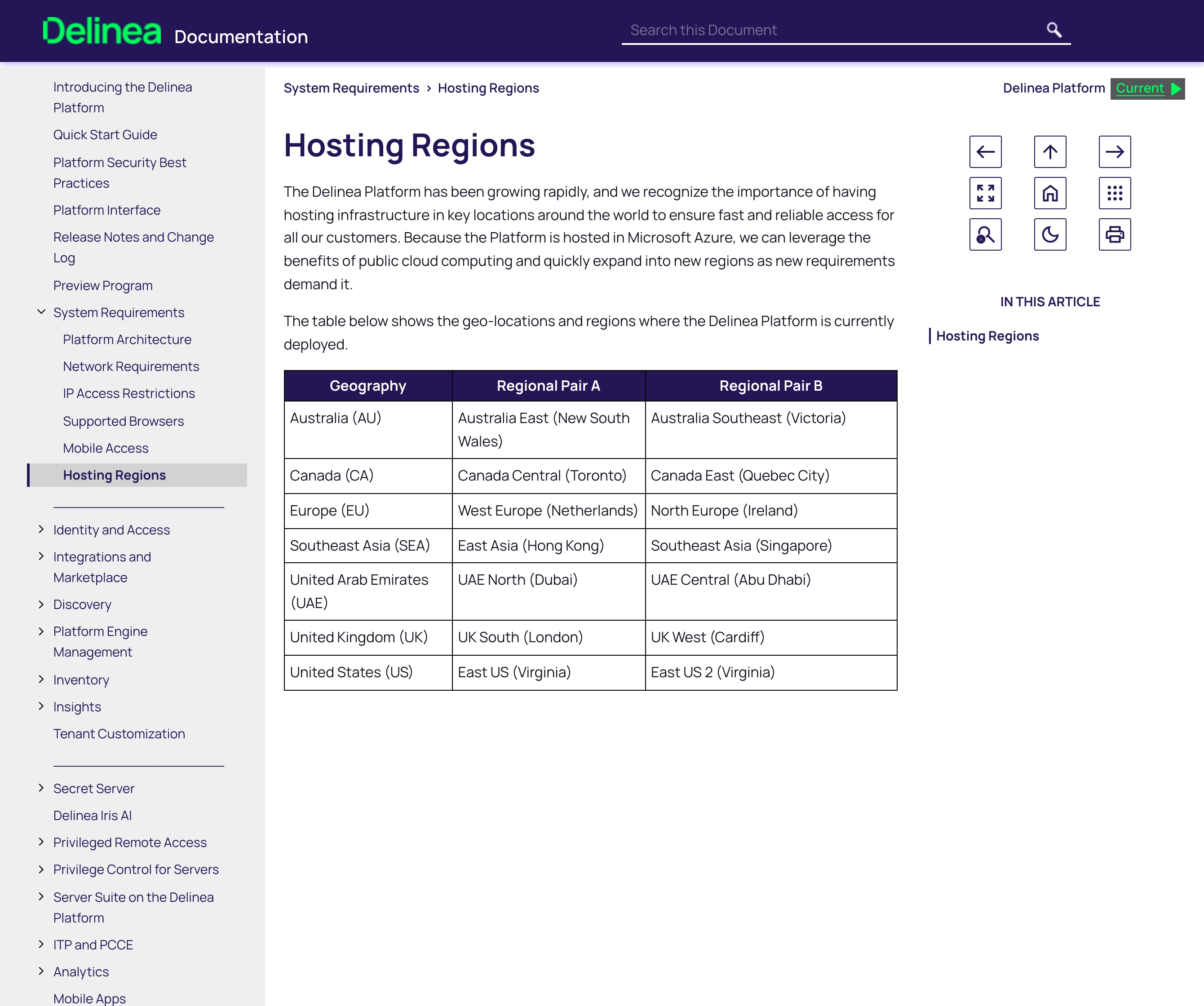
| Delinea's Platform hosting page states, “The table below shows the geo-locations and regions where the Delinea Platform is currently deployed,” listing the US, Canada, Europe (Netherlands and Ireland), the UK, the UAE, Australia and Southeast Asia (Hong Kong and Singapore) — with no mainland-China region. | Delinea Documentation — Delinea Platform Hosting Regions, retrieved 2026-10-12 |
| Holding privileged credentials, secrets and session records tied to identifiable China administrators in an offshore region is a cross-border transfer of personal information under PIPL Articles 38–40, requiring notice, a separate consent (Articles 13 and 23) and a transfer mechanism (CAC security assessment, CAC standard contract, or certification). | PIPL — cross-border transfer rules (21YunBox gov-doc), retrieved 2026-10-12 |
| For a critical information infrastructure operator, the Cybersecurity Law's Article 39 (formerly Article 37) requires personal information generated in China to be stored in China — an in-country-storage duty an offshore vault region cannot meet; where the vault governs critical systems it may also engage important-data and MLPS obligations. | Cybersecurity Law of the PRC — data localization, Article 39 (21YunBox gov-doc), retrieved 2026-10-12 |
Sources verified by the 21YunBox compliance team on 2026-10-12.
For a security team running privileged access management across its China systems, the instinct is to ask whether the Delinea console answers from inside the mainland. It does — and that is not the question that decides anything. Delinea pulls the single most dangerous dataset you hold into one control plane: the encrypted vault of privileged credentials and secrets, the inventory of privileged accounts, and the recording and audit trail of every privileged session. Whether you can run it for China turns on where that vault comes to rest, and whether placing it there was lawful. That is a data-residency and cross-border question, not a performance one — and Delinea’s own documentation answers the first half.
Delinea offers the vault two ways. Secret Server Cloud and the Delinea Platform are the managed, Azure-hosted editions; Secret Server On-Premises is the self-managed edition you run on infrastructure you control. The cloud editions are where the China question bites, because Delinea publishes exactly where they run — and none of it is the mainland.
Delinea in China at a glance
| What decides it | In Delinea's own terms — and China's law |
|---|---|
| The platform | Delinea is a privileged access management (PAM) suite built from Thycotic and Centrify. Its Secret Server vault holds privileged account credentials and secrets, and it records and audits every privileged session on the systems it protects. |
| What it concentrates for China | The keys to your China estate in one place: the credential-and-secret vault, the inventory of privileged accounts, and the session recordings and access logs of who touched which China system, when. |
| The axis that decides it | Not latency. Even where the console loads from the mainland, the decision is where the vault's data comes to rest and whether moving it there was lawful. This page publishes no China speed figure — speed is not the axis. |
| Where the managed vault runs | Offshore. Delinea's Platform hosting page lists the US, Canada, Europe, UK, UAE, Australia and Southeast Asia (Hong Kong and Singapore). There is no mainland-China region; the nearest, Hong Kong, is outside the mainland and does not satisfy mainland residency. |
| The cross-border trigger | Credentials, secrets and session records tied to identifiable China administrators are personal information. Holding them offshore is a cross-border transfer (数据出境) under PIPL Articles 38–40 — notice, a separate consent (Articles 13 and 23) and one transfer mechanism. |
| The sharper edge | The vault and the record of who-can-access your China systems are concentrated security data that can count as “important data” (重要数据), and the control plane guarding your estate carries Multi-Level Protection Scheme (MLPS / 等级保护) duties. A reachability check sees none of this. |
| The in-country option | Delinea ships the lawful shape in the box: Secret Server On-Premises, deployed on China-resident infrastructure, keeps the vault, secrets and session logs in-country. 21YunBox maps, localizes and delivers; it never uses or suggests circumvention of any kind. |
The vault is the control plane for your China estate
Delinea’s purpose is to pull the most dangerous data in your environment into one hardened place: the privileged credentials and secrets that unlock your systems, and the recording and audit trail of what every administrator did in each privileged session. For your China systems, that store is not just another SaaS dataset — it is the control plane, the single thing an attacker or an auditor would care about most. Two consequences follow, and only the first is obvious.
The obvious one is cross-border transfer. The credentials, secrets and session recordings Delinea holds for identifiable administrators and systems in China are personal information, and keeping them in an Azure region outside the mainland is a cross-border transfer (数据出境) of personal information under China’s Personal Information Protection Law. PIPL puts the duty on the handler — you, not Delinea the processor: Articles 38–40 require a transfer mechanism (a CAC security assessment, the CAC standard contract, or certification), and Articles 13 and 23 require a lawful basis, notice, and a separate consent for the transfer distinct from any general use agreement. The detail of the cross-border mechanics is set out in our note on cross-border data transfers.
The exposure a reachability check never sees
The less obvious consequence is the one that makes a PAM vault different from an ordinary offshore app, and it is invisible to any test that only asks whether the console loads. The vault is a concentrated inventory of the privileged accounts, secrets and access paths into your China estate, and the session logs are the record of exactly who can touch what, and who did. Concentrated security data of that kind can rise to “important data” (重要数据) under China’s data rules — a category whose export faces a heightened security-assessment bar — and the authentication-and-vaulting system that guards critical China systems is the sort of control plane that falls within the Multi-Level Protection Scheme (MLPS / 等级保护), China’s graded cyber-security protection regime. A latency probe, a ping, a “does the page open from Shanghai” check — none of these can see a residency obligation, a cross-border consent gap, an important-data classification, or an MLPS grading. Those are governance facts about where the data lives and what it is, not network facts about whether a packet arrives. Which of them bite your specific deployment is a question to settle with counsel against what you actually vault, record and secure.
Hong Kong is on the list; the mainland is not
The tempting move is to pick the nearest region and call residency solved. Delinea’s hosting list reaches East Asia (Hong Kong) and Southeast Asia (Singapore), and either looks close enough. Neither is in mainland China. Hong Kong operates under its own legal system, and for the mainland’s PIPL and data-localization rules, data held there is still outside the country — so placing a China tenant in Hong Kong relocates the cross-border transfer; it does not end it. Proximity is not residency, and a nearer Azure region is still not a China region.
The deployment choice is a compliance choice
Here is where Delinea differs from a cloud-only vault, and it is the lawful path rather than a workaround. Delinea does not force the managed cloud: Secret Server On-Premises is the self-managed edition — the vault you run on infrastructure you control. Deployed on China-resident infrastructure for your China estate, it keeps the credential-and-secret vault, the privileged-account inventory and the session recordings inside the country, with consented in-country processing — while you keep Secret Server Cloud or the Delinea Platform for the regions where they already serve you. Keeping the China vault in China is therefore a deployment-model decision you are entitled to make with the product as sold; it is a legal design choice before it is a technical one. And for a critical information infrastructure operator, the Cybersecurity Law’s Article 39 (formerly Article 37 — the data-localization provision renumbered by the 2025 amendment that took effect on January 1, 2026, its substance unchanged) makes in-country storage of China-generated personal information a duty an offshore region cannot satisfy in any case.
None of this makes Delinea “blocked” or “illegal” in China — it is reachable and widely used. It is a risk-and-residency map: which obligations bite turns on your entity, the systems you secure, what you vault and record, and who your administrators are — worth settling with counsel before your privileged-access data depends on it.
The lawful path — map, localize, deliver
There is a lawful shape to running privileged access management for a China estate, and it starts with the data, not the network.
First, map. Our China team inventories what Delinea holds for your China systems — which privileged credentials, secrets, vault entries, account records and session recordings were collected or generated in the mainland and must stay there, what (if anything) may lawfully leave, whether what you secure makes that data “important data” or brings a critical-information-infrastructure duty and an MLPS grading into play, and what your notice and separate-consent flow has to cover. The legal conclusions are settled with your counsel; we build the technical picture that feeds them.
Then localize. For the China estate we stand up and integrate Secret Server On-Premises — Delinea’s self-managed vault — on China-resident infrastructure, with consented in-country processing and storage, so the privileged-access data stops leaving the country by default. You keep the Delinea cloud editions for the regions where they already serve you; what changes is that the mainland’s crown-jewels data stays in the mainland, and the control plane that guards it is governed under the rules that apply to it.
Then deliver. Any China-facing console, portal or administrative surface that must be reachable from inside the mainland is itself a service delivered in China, so it carries an ICP filing duty and needs compliant, in-country delivery. 21YunBox delivers it in-country — the 21YunBox Optimizer — in front of what you already run, with no rebuild and no re-platform, so privileged access management runs legally and reliably for your users in China. What we never do — and what no one lawfully can — is hand you a way around China’s data-export rules or any network restriction; we localize what must stay and deliver in-country, and we never move personal information out of China by stealth.
Related reading:
- Cross-border data transfers under PIPL
- China’s Personal Information Protection Law
- China’s Cybersecurity Law (data localization, Article 39)
- How to get an ICP filing for China


