Does BeyondTrust Work in China? Data Residency, ICP & Cross-Border Rules
BeyondTrust's privileged access management holds the credential vault, secrets and recorded admin sessions for your China systems — the keys to your China estate. BeyondTrust Cloud lists no mainland-China region, so on the cloud edition that security-sensitive data sits offshore: a PIPL cross-border and data-residency matter, and an MLPS / 重要数据 exposure on the access control plane. Because Password Safe is self-hostable on-premises via a U-Series appliance, it can run in-country. A compliance-first look at residency, ICP and cross-border rules.
Does BeyondTrust work in China?
BeyondTrust's console loads from mainland China — but that was never the compliance question. Its privileged access management is the vault that holds the admin credentials, secrets and recorded privileged sessions for your China systems, the keys to your China estate, and BeyondTrust Cloud lists no mainland-China region, so that most security-sensitive dataset sits offshore.
The exposure a reachability check never sees is the distinctive one: a credential vault plus session recordings of who-can-touch your China systems is concentrated security data that can implicate "important data" (重要数据) handling and Multi-Level Protection Scheme (MLPS / 等级保护) duties on the very control plane that guards your estate — and any personal data it holds, kept abroad, is a cross-border transfer under PIPL Articles 38–40, with Article 13/23 notice and separate consent. Because BeyondTrust Password Safe is also self-hostable on-premises via its U-Series appliance, there is an in-country path: run it on China-resident infrastructure and the identity data can stay in the mainland.
This is a risk map, not a verdict — which duties bite turns on your entity, your role and your data volumes. Our China team can map your exposure with you →
What BeyondTrust's own documentation says about China
| Fact | Primary source |
|---|---|
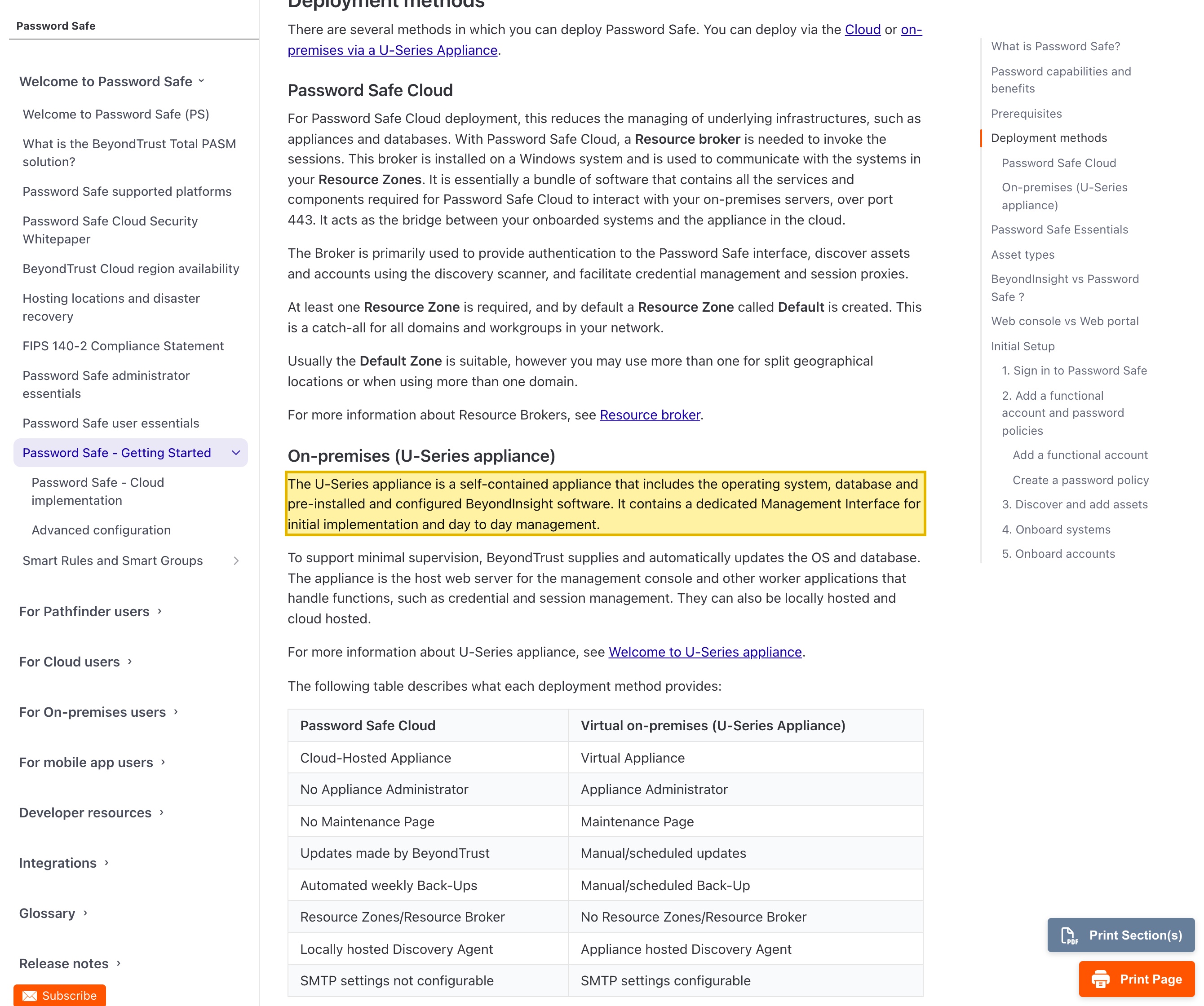
| BeyondTrust Password Safe is self-hostable on-premises, not cloud-only. In BeyondTrust's own documentation, "There are several methods in which you can deploy Password Safe" and "you can deploy via the Cloud or on-premises via a U-Series Appliance" — "a self-contained appliance that includes the operating system, database and pre-installed and configured BeyondInsight software." Because you install and run that appliance yourself, a company can keep the whole PAM — the credential vault and privileged-session management — on China-resident infrastructure, so the identity data stays in the mainland. | BeyondTrust Docs — Password Safe Getting Started (docs.beyondtrust.com), retrieved 2026-10-12 |
| BeyondTrust's cloud edition publishes no mainland-China region. BeyondTrust states it "offers our Cloud Solutions delivered on the unified Pathfinder platform, available in the following regions," and the Password Safe list names Australia (East), South America (East – Brazil), North America (Canada – Central), Europe (Germany), Asia (India – Central), Asia (Southeast), Africa (South Africa – North), UAE (UAE North), Europe (United Kingdom – South) and US Central — none inside mainland China. On BeyondTrust Cloud, the vault, secrets and session recordings for your China systems therefore rest offshore. | BeyondTrust Docs — BeyondTrust Cloud region availability, Password Safe (docs.beyondtrust.com), retrieved 2026-10-12 |
| Privileged credentials and recorded sessions tied to your China admins are personal information; held abroad, that is a cross-border transfer. Run Password Safe on BeyondTrust's offshore cloud and the admin identities, vaulted secrets and recorded sessions rest outside the mainland — a cross-border transfer (数据出境) under PIPL Articles 38–40, on top of the Article 13/23 notice and separate consent. The duty falls on you, the handler, not on BeyondTrust, which is why making an offshore vault merely reachable from China does not resolve it. | PIPL Articles 13, 23 and 38–40 (cross-border transfer of personal information), retrieved 2026-10-12 |
| The vault and session logs of who-can-touch your China estate are a security-governance exposure, not a latency one. A concentrated record of privileged access to your China systems can implicate "important data" (重要数据) handling and Multi-Level Protection Scheme (MLPS / 等级保护) obligations on the control plane itself — treat the classification as a risk to confirm with counsel, not a settled label. For a critical information infrastructure operator or high-volume handler, Cybersecurity Law Article 39 (formerly Article 37) also requires personal information generated in China to be stored in the mainland — which an offshore cloud cannot satisfy and an in-country self-host can. | Cybersecurity Law Article 39 (formerly Article 37); MLPS (等级保护) and 'important data' (重要数据) data-security duties, retrieved 2026-10-12 |
Sources verified by the 21YunBox compliance team on 2026-10-12.
For an enterprise running BeyondTrust for a mainland-China operation, the question that matters is not whether the admin console paints quickly from Shanghai. A privileged access management platform is the vault and the gatekeeper for your entire China estate: it holds the privileged and administrative credentials, the secrets and passwords that unlock your China systems, and the recorded privileged sessions that show who touched what, and when. Run offshore, the single most security-sensitive dataset you own — and the one gate that stands in front of everything else — lives abroad. BeyondTrust offers its PAM two ways: a cloud edition (BeyondTrust Cloud, whose published regions include none in mainland China) and a self-hostable, on-premises U-Series appliance you install and run yourself — and that deployment choice is the whole story. An offshore-cloud instance puts the vault and the session logs abroad; an on-premises, China-resident instance can keep them in the mainland. Three prongs decide it: the residency and cross-border exposure of the credentials, secrets and recorded sessions (personal information wherever they name people); the security-governance exposure of a concentrated map of who-can-touch your China systems — the half a reachability check never sees; and the governance of the authentication control plane itself.
BeyondTrust in China at a glance
| What decides it | In BeyondTrust's own terms — and China's law |
|---|---|
| What it holds | The most concentrated, security-sensitive data in your estate: the privileged and admin credentials and the secrets vault that unlock your China systems, the recorded privileged sessions of who touched what and when, plus the identities of the administrators themselves. Wherever those name or key to a person, they are personal information; together they are the keys to your China estate. |
| Offshore cloud, or self-host (the lever) | BeyondTrust Password Safe is offered as a cloud edition and as an on-premises, self-contained U-Series appliance you install and run yourself. BeyondTrust's own region list for the cloud names Australia, Brazil, Canada, Germany, India, Southeast Asia, South Africa, the UAE, the UK and the US — none in mainland China. The on-premises appliance is the residency lever: run it on China-resident infrastructure and the vault and session logs stay in the mainland. An offshore cloud instance cannot. |
| The vault & session logs — the distinctive second half | The half a reachability check never sees. A credential vault plus recorded sessions is a concentrated record of exactly who can reach, and what has been done to, your China systems. Held offshore, that is both a cross-border data matter and, for sensitive operations, may implicate “important data” (重要数据) handling and Multi-Level Protection Scheme (MLPS / 等级保护) obligations on the control plane itself. Treat the classification as a risk to confirm with counsel — but the concentration of security-sensitive detail is real. |
| Credentials & PII — residency & cross-border | Run the China estate on the offshore cloud and the admin identities, vaulted secrets and recorded sessions rest abroad — a cross-border transfer (数据出境) under PIPL Articles 38–40, on top of the Article 13/23 notice and separate consent. For a critical information infrastructure operator or a high-volume handler, Cybersecurity Law Article 39 (formerly Article 37) requires China-collected personal information to be stored in the mainland. |
| The control plane, automated access & the ICP door | The authentication and access control plane that guards your China estate is MLPS-relevant in its own right. Where access or certification decisions are made automatically about individuals, PIPL Article 24 on automated decision-making attaches. And any public, China-facing access or self-service portal is an internet information service carrying an ICP filing duty bound to mainland hosting — which an in-country deployment can provide and an offshore one cannot. |
| Reachability is not the axis | Whether the console loads quickly from the mainland is operational, not the compliance question. What decides it is where the vault and session logs live and how the control plane is governed. 21YunBox helps you keep that data in-country, secure the consents, file the ICP for any China-facing access surface, and deliver compliantly — the 21YunBox Optimizer — in front of the BeyondTrust instance you already run. |
What it actually holds — your credentials, secrets and session recordings
BeyondTrust is not a public-facing marketing site; it is the control plane for privileged access to your China estate, and it holds the most security-sensitive data you own. Its Password Safe vault stores the privileged and administrative credentials, passwords and secrets that unlock your China systems. Its privileged-session management records those sessions — a replayable account of who connected to which system and what they did. And it carries the identities of the administrators and operators themselves: names, accounts, and the entitlements that say who may touch what. Wherever those records name or key to a person, they are personal information under China’s Personal Information Protection Law. Taken together, the vault and the session logs are a concentrated map of exactly how privileged access to your China operation is granted and exercised — the keys to the estate, in one place. Whether that record lives in the mainland or offshore is decided entirely by how you deploy BeyondTrust: the cloud edition, or an on-premises U-Series appliance you place where you choose.
The doors: residency, cross-border, the control plane, and ICP
Put the China estate on the offshore cloud and the first door opens. The admin identities, vaulted secrets and recorded sessions in that tenant rest abroad, which makes it a cross-border transfer (数据出境). The duty lands on you, the handler, not on BeyondTrust: PIPL Articles 13 and 23 require notice and a basis to collect the data, and Articles 38–40 require a transfer mechanism to send it offshore — a CAC security assessment, the CAC standard contract, or certification — with separate consent for the overseas transfer. And for a critical information infrastructure operator or a high-volume handler, the Cybersecurity Law’s Article 39 (formerly Article 37 — the 2025 Cybersecurity Law amendment, in force January 1, 2026, renumbered the data-localization article from 37 to 39, its substance unchanged) requires personal information generated in China to be stored in the mainland, which an offshore cloud cannot satisfy.
The vault-and-session record opens a second, quieter door — and it is the one that makes PAM different from an ordinary business app. Beyond the personal information, a concentrated record of who can reach, and what has been done to, your China systems is a data-security exposure in its own right. For sensitive operations it may fall within “important data” (重要数据) handling, with heightened data-security duties, and the authentication control plane that holds it is itself a candidate for Multi-Level Protection Scheme (MLPS / 等级保护) obligations — the graded protection regime China applies to systems whose compromise would harm security or the public interest. This is a risk to map and settle with counsel rather than a classification to assert — but a reachability check will never surface it, because it is about what the control plane holds and how it is governed, not whether it answers.
Two more doors follow from how you run the platform. Where access reviews, certification or policy decisions about individuals are made solely by automation, PIPL Article 24 on automated decision-making attaches — transparency, fairness, and an opt-out from decisions made without human involvement. And the moment you expose a public, China-facing access or self-service portal, that portal is an internet information service and carries an ICP filing (备案) duty bound to a mainland hosting resource — which an on-premises, China-resident deployment can provide and an offshore one cannot. A purely internal admin console may not trigger ICP on its own; a public access surface served to mainland users does.
Why a reachability check misses this
A probe from inside China can watch the BeyondTrust login screen paint and conclude “it works.” That answer is beside the point. The compliance exposure is not on the screen — it is in the data at rest and how it moves: the privileged credentials, the secrets vault, and the recorded sessions that describe who holds the keys to your China estate, all sitting on an offshore control plane. A page-load test measures none of that. It cannot see which region the tenant lives in, whether separate consent was taken, whether a transfer mechanism is in place, or that the one system guarding access to everything else is concentrated abroad and ungoverned for MLPS. That is the competitor-proof second half of the question — and it is exactly why making an offshore PAM merely reachable from the mainland is not the answer. Keeping the vault, the session logs and the control plane in-country and governed is.
The lawful path — map, localize, deliver
There is a compliant way to run BeyondTrust for a mainland-China operation, and because Password Safe is self-hostable its middle step is unusually clean — one that sits in front of the instance you already run, with no rebuild and no migration.
First, map: our China compliance team inventories what your BeyondTrust deployment holds — the credential vault, the secrets, the entitlements, the recorded privileged sessions, the administrator identities, and any China-facing access or self-service portal — establishes where BeyondTrust is deployed today (often the offshore cloud), the ICP status of any portal domain, and the consent and residency basis each flow relies on. We build the technical picture; the legal conclusions are settled with counsel.
Then localize: this is where BeyondTrust’s on-premises option pays off directly. We help you run Password Safe on a China-resident path — the self-contained U-Series appliance on in-country infrastructure — so the vault, the secrets and the session recordings stay in the mainland, obtain the Article 13/23 notice and separate consent, honor the Article 24 opt-out for any automated access decision, and govern the control plane for its MLPS and “important data” duties. Localize means keeping the data on an in-country path — never a route that ships it offshore anyway.
Then deliver: any public, China-facing access or self-service surface is an internet information service, so it carries an ICP filing duty and needs compliant, in-country delivery. 21YunBox delivers it in-country — the 21YunBox Optimizer — in front of the BeyondTrust instance you already run, so it runs legally and compliantly for your users in China. 21YunBox never uses or suggests circumvention of any kind — we keep in-country what the law says must stay, deliver the rest compliantly from inside the mainland, and never move personal information across the border by stealth. 21YunBox is a compliance overlay and partner to the PAM platform you already run, not a competitor to it.
None of this is a verdict that BeyondTrust is “blocked” or “illegal” in China; it is self-hostable software, and much of the exposure dissolves the moment you choose an in-country deployment. It is a risk-and-residency map, and which duties bite your case turns on your entity, your role under Chinese law, your data volumes, and what your vault and session logs actually hold — worth settling the specifics with counsel before the control plane for your China estate depends on it.
Related reading:
- How to get an ICP filing for China
- Cross-border data transfers under PIPL
- China’s Personal Information Protection Law (PIPL)
- China’s Cybersecurity Law (data localization, Article 39)
Frequently Asked Questions
Does BeyondTrust store our privileged credentials in China?
Is running BeyondTrust for our China systems illegal?
Can 21YunBox help us run BeyondTrust compliantly in China?


ARTICLES RELATED TO BEYONDTRUST

