Does AWS Route 53 Work in China? ICP, Data Residency & a Backend DNS Layer
Route 53 is AWS's managed authoritative DNS — a backend layer that resolves your domain, not your host and not where user data lives. So the ICP filing sits on your site, and Route 53 raises no PIPL residency duty of its own — while running it inside AWS China is a separate-account partition, not a toggle. A compliance-first look at where the obligations really land.
Does AWS Route 53 work in China?
Yes — Route 53 works for a China-facing site, because DNS is a backend layer. The compliance weight — the ICP filing and PIPL data-residency — lands on the site Route 53 points to and its mainland host, not on Route 53 itself.
In AWS's own words Route 53 is "a highly available and scalable Domain Name System (DNS) web service" that "connects the browser with your website or web application" — the lookup layer, not your host and not where your users' data lives. So a public site served to mainland visitors needs an ICP filing on an in-country host (State Council Order No. 292; MIIT Order No. 33), and your users' personal data under PIPL sits wherever your app and database run — neither obligation attaches to Route 53. What is a real question is narrower: global Route 53 answers from outside the mainland, and running Route 53 inside AWS China is a separate partition (Beijing operated by Sinnet, Ningxia by NWCD) that needs a separate account and a Chinese business license — not a region toggle. The table below is AWS's own wording and the layer each rule actually lands on.
This is a risk map, not a verdict — whether the real exposure is your host, your data or an in-mainland DNS presence turns on your entity, your data and your users. Our China team can map your exposure with you →
What AWS Route 53's own documentation says about China
| Fact | Primary source |
|---|---|
| Route 53 is a backend DNS layer, not your host. In AWS's own words it is "a highly available and scalable Domain Name System (DNS) web service," and when a user enters your domain "Route 53 connects the browser with your website or web application." It resolves and routes names; it is not the public site and not where your users' personal data lives — so the ICP filing a mainland site needs attaches to that site and its in-country hosting, not to Route 53. | Amazon Route 53 Developer Guide — "What is Amazon Route 53?" (docs.aws.amazon.com), retrieved 2026-10-07; State Council Order No. 292; MIIT Order No. 33 |
| Route 53 stores your DNS records, not your users' personal data. Its hosted zones hold the records that map names to addresses — not the personal information your application collects. So the PIPL cross-border and localization duties — notice, separate consent and a transfer mechanism under Articles 38–43, and in-country storage for a CIIO or large-volume handler under PIPL Article 40 and Cybersecurity Law Article 39 (formerly Article 37) — land on where your user data actually lives: your app, database and host, not the authoritative-DNS layer. | Amazon Route 53 Developer Guide (docs.aws.amazon.com), retrieved 2026-10-07; PIPL Articles 38–43 & 40; Cybersecurity Law Article 39 (formerly Article 37) |
| Route 53 does run in AWS China — but only as a separate partition. AWS offers it in the China Regions — Beijing "operated by Sinnet" and Ningxia "operated by NWCD" — but you reach them through "a separate set of account credentials unique to Amazon Web Services China services," existing global credentials "will not be able to access resources in the Amazon Web Services China Regions, and vice versa," and registering needs "a valid Chinese business license issued by the Bureau of Industry and Commerce." It is not a region you switch on inside your global account. | Amazon Web Services in China — FAQs (amazonaws.cn), retrieved 2026-10-07 |
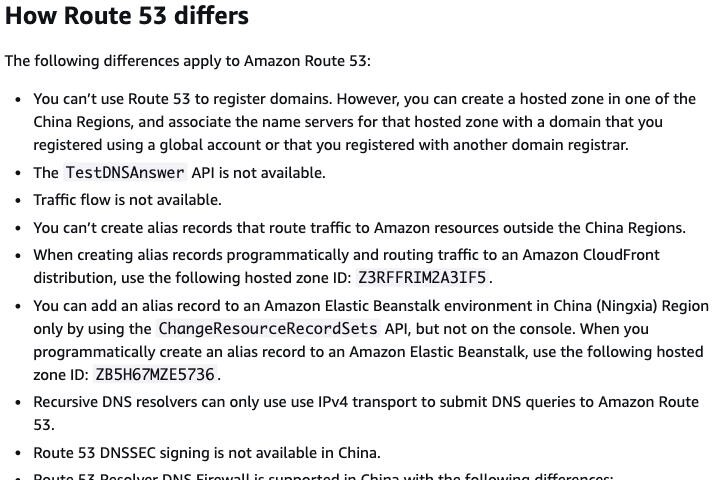
| Route 53 inside China is a reduced service. AWS's own China documentation, under "How Route 53 differs," states "You can't use Route 53 to register domains," "Traffic flow is not available," "Route 53 DNSSEC signing is not available in China," and "You can't create alias records that route traffic to Amazon resources outside the China Regions." Moving your DNS in-country is a separate-partition project with real gaps — bound to the same Chinese-entity-and-ICP path as the rest of AWS China, not a setting change. | Getting Started with Amazon Web Services in China — Amazon Route 53 (docs.amazonaws.cn), retrieved 2026-10-07 |
Sources verified by the 21YunBox compliance team on 2026-10-07.
For a mainland-China audience, the useful question about Route 53 is not how quickly it answers a lookup — it is what, if anything, Route 53 obliges you to file or localize. The answer is reassuring in one direction and easy to misread in the other. Route 53 is a backend DNS layer: in AWS’s own words it is “a highly available and scalable Domain Name System (DNS) web service” that “connects the browser with your website or web application.” It is not your host, and it is not where your users’ personal data lives. So the ICP filing a mainland site needs attaches to the site and its in-country hosting, not to your DNS, and Route 53 raises no PIPL data-residency duty of its own. What is worth looking at closely is narrower: a global Route 53 answers from outside the mainland, and running Route 53 inside AWS’s China partition is a separate-account arrangement, not a region you switch on.
AWS Route 53 in China at a glance
| What decides it | In AWS's own terms |
|---|---|
| What Route 53 is | “A highly available and scalable Domain Name System (DNS) web service” that, when a user enters your domain, “connects the browser with your website or web application.” It resolves and routes names — the lookup layer, not the host. |
| Who needs the ICP filing | The public site served to mainland visitors and its in-country host — not the DNS. You don't ICP-file Route 53; the filing is the site's, under State Council Order No. 292 and MIIT Order No. 33. |
| Your data on Route 53 | Hosted zones hold your DNS records, not the personal information your app collects. The authoritative-DNS layer raises no PIPL residency duty of its own; that question lands on your app, database and host. |
| Route 53 inside the mainland | Available in AWS China — Beijing “operated by Sinnet,” Ningxia “operated by NWCD” — but through “a separate set of account credentials unique to Amazon Web Services China services,” which needs “a valid Chinese business license.” Not a toggle in your global account. |
| What changes in the China partition | A reduced service: “You can't use Route 53 to register domains,” “Traffic flow is not available,” “Route 53 DNSSEC signing is not available in China,” and no alias records to Amazon resources “outside the China Regions.” |
Route 53 is a backend layer — so the ICP lands on your site, not your DNS
Route 53 does three things — in AWS’s words, “domain registration, DNS routing, and health checking” — and all of it is resolution and routing: the lookup that “connects the browser with your website or web application.” None of that is the public-facing service a regulator treats as the operating website. That is your host and your application. The ICP filing (ICP 备案) under State Council Order No. 292 and MIIT Order No. 33 attaches to the site delivered to mainland visitors and to the mainland hosting resource behind it — you do not file an ICP against a DNS service.
The practical consequence cuts both ways. If your site is served from offshore, no choice of DNS provider makes it ICP-eligible; the filing turns on in-country hosting, which is a different layer from Route 53 entirely. But the reverse is just as true: keeping Route 53 as your DNS does not, by itself, put a China-facing site out of compliance. The licensing question is settled by where the site is hosted, not by who answers the lookups.
Route 53 holds your DNS records, not your users’ data
DNS is honest here, so it is worth not inventing a problem. Route 53 stores your hosted zones — the records that map names to addresses — not the personal information your application collects from visitors. So the duties China’s Personal Information Protection Law raises — notice, separate consent and a transfer mechanism for any cross-border transfer (Articles 38–43), and in-country storage for a critical information infrastructure operator or large-volume handler (PIPL Article 40; Cybersecurity Law Article 39 (formerly Article 37)) — land on where your user data actually lives: your app, your database, your host. They do not attach to the authoritative-DNS layer.
One honest caveat is worth raising with counsel rather than waving away: if you turn on Route 53 Resolver query logging, those logs are their own small data question. But the headline holds — Route 53 is not the thing that creates a residency problem, and a DNS decision should not stand in for the hosting and data decisions that do.
Route 53 does run in AWS China — but as a separate partition, not a toggle
AWS does offer Route 53 inside the mainland, in its China partition — Beijing “operated by Sinnet” and Ningxia “operated by NWCD.” But that is not a region you flip on inside the account you already have. You work through “a separate set of account credentials unique to Amazon Web Services China services,” and existing global credentials “will not be able to access resources in the Amazon Web Services China Regions, and vice versa.” Registering that account needs “a valid Chinese business license issued by the Bureau of Industry and Commerce.”
The China Route 53 is also a reduced service. AWS’s own documentation, under “How Route 53 differs,” notes “You can’t use Route 53 to register domains,” “Traffic flow is not available,” “Route 53 DNSSEC signing is not available in China,” and “You can’t create alias records that route traffic to Amazon resources outside the China Regions.” So moving your DNS in-country is a separate-partition project with real gaps, bound to the same Chinese-entity-and-ICP path as the rest of AWS China — a decision to make deliberately, not a setting you change.
Reachable from the mainland — which is the delivery half, not the legal one
When your nameservers are the global Route 53, a visitor’s resolver in China still has to reach Route 53’s authoritative servers, which for the global service sit outside the mainland. Whether those lookups resolve quickly and consistently from inside China is a delivery-and-reachability consideration — real, but separate from the compliance question that decides whether you may operate at all. We keep our in-China measurement work off this page on purpose; the licensing and data layers are what settle whether a China-facing site is lawful, and no DNS tuning changes that.
This is a risk map, not a verdict: whether you need an ICP filing, in-country hosting, or an in-mainland DNS presence depends on what you serve, how much personal data you hold, and who your users are — worth settling with counsel before you build.
Where 21YunBox fits — a compliant overlay, not a migration
You keep Route 53 as your DNS. We add the part DNS was never going to provide: compliant, ICP-filed delivery and hosting from inside the mainland, placed in front of your existing origin — no rebuild, no second codebase, and no move off AWS or Route 53. Our China team maps where the ICP actually lands and assesses your PIPL cross-border and data-residency exposure for your entity, your data volumes and your users, then stands up the in-country presence a lawful China site needs. Route 53 stays exactly where it is — you simply point your records at the compliant path.
Related reading: