Does Adobe Fonts Work in China? Offshore Delivery & Where ICP Really Applies
Adobe Fonts (formerly Typekit) serves font files — not your users' data — from Adobe's offshore CDN, use.typekit.net, with no mainland-China presence, so a China page that loads fonts at runtime can stall into invisible text. Adobe Fonts owes no ICP or PIPL duty of its own; that falls on the site embedding it. An honest, delivery-first look.
Does Adobe Fonts (Typekit) work in China?
Mostly yes — and for an honest reason. Adobe Fonts (formerly Typekit) serves font files, not your users' personal data, so it triggers no PIPL transfer and carries no ICP of its own. The real catch is delivery: it loads only from Adobe's offshore font network, which is unreliable from inside the mainland.
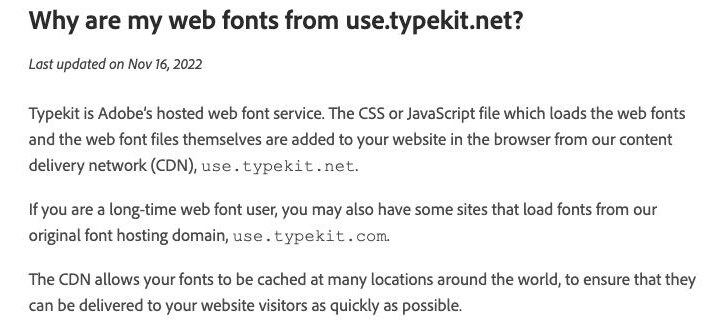
In Adobe's own words, "Typekit is Adobe's hosted web font service," and your fonts are "added to your website in the browser from our content delivery network (CDN), use.typekit.net" — an offshore edge with no point of presence inside mainland China. Because the default embed code means "the rest of the page may not display until after the web font CSS has finished loading," a font request that stalls at the border can leave your text invisible while the page waits. Adobe Fonts itself owes no cross-border-transfer or ICP duty — but the site that embeds it still does, for its own hosting and the user data it collects. The table below is Adobe's own wording and where each duty really lands.
This is a risk map, not a verdict — whether an offshore font dependency merely slows your site or breaks it, and whether the site embedding it is itself filed and in-country, turns on how your front-end is built and what you collect. Our China team can map your exposure with you →
Compliance snapshot
- ✓ Adobe Fonts serves font files, not user data — no PIPL transfer of its own
- ✓ It carries no ICP filing — an offshore font CDN holds none
- ! Served only from Adobe's offshore CDN (use.typekit.net); no mainland-China presence
- ! Fonts load as the page renders, so a stalled request can blank your text in China
- ! The site embedding Adobe Fonts still needs ICP filing and owns its PIPL duties
What Adobe Typekit's own documentation says about China
| Fact | Primary source |
|---|---|
| Adobe Fonts is served from Adobe's own offshore CDN, in the browser, at render time. In Adobe's words, "Typekit is Adobe's hosted web font service," and "the CSS or JavaScript file which loads the web fonts and the web font files themselves are added to your website in the browser from our content delivery network (CDN), use.typekit.net." That CDN caches fonts "at many locations around the world" — none of them inside mainland China. | Adobe Fonts Help — "Why are my web fonts from use.typekit.net?" (helpx.adobe.com), retrieved 2026-10-07 |
| A font request that stalls can leave your text invisible. With the default embed code, Adobe states, "the rest of the page may not display until after the web font CSS has finished loading" — the typeface is fetched from use.typekit.net while the page renders. When that single offshore request is slow or unreachable from inside the mainland, a visitor sees blank or unstyled text and shifting layout, not a clean error. That is a delivery risk, not a legal one. | Adobe Fonts Help — "Embed codes" (helpx.adobe.com), retrieved 2026-10-07 |
| Adobe Fonts holds none of your users' personal data, so no PIPL or ICP duty attaches to it. What leaves use.typekit.net is font files and the CSS or JavaScript that loads them — not personal information about your visitors. Loading a typeface is therefore not a cross-border transfer of personal information under PIPL (Articles 38–43), and a font CDN carries no ICP filing of its own. Inventing a data-residency story for a font service would be dishonest; the real exposure is delivery, and the site that embeds it. | Adobe Fonts Help (helpx.adobe.com), retrieved 2026-10-07; PIPL Articles 38–43; State Council Order No. 292; MIIT Order No. 33 |
| The whole typeface hangs on reaching one offshore host — and the compliance duty sits on the site that embeds it. Adobe documents the failure itself: your site "may report that it cannot connect to use.typekit.net or that it failed to load a resource from that domain." Adobe Fonts owes no ICP or PIPL duty, but the public site shown to mainland visitors still needs an ICP filing tied to in-country hosting (State Council Order No. 292; MIIT Order No. 33), and owes its own cross-border and data-residency duties for whatever it collects (PIPL Article 40; Cybersecurity Law Article 39 (formerly Article 37)). | Adobe Fonts Help — "Site can't connect to use.typekit.net" (helpx.adobe.com), retrieved 2026-10-07; State Council Order No. 292; MIIT Order No. 33; PIPL Article 40; Cybersecurity Law Article 39 (formerly Article 37) |
Sources verified by the 21YunBox compliance team on 2026-10-07.
For a mainland-China audience, the real question about Adobe Fonts — the service formerly called Typekit — is not whether you are allowed to use it, but whether the fonts actually arrive. Adobe Fonts is a hosted web-font service: it ships typefaces, not your users’ personal data, so on its own it triggers no cross-border-transfer duty and carries no ICP filing. The exposure it introduces is a delivery one. Every typeface is fetched at render time from Adobe’s offshore network, use.typekit.net, which keeps no point of presence inside mainland China — and because that fetch can block the page from painting, a request that stalls at the border turns into invisible text rather than a graceful fallback. The compliance line in this picture sits one step away, on the website that embeds the fonts, which still has to be ICP-filed and served in-country.
Adobe Fonts in China at a glance
| What decides it | In Adobe's own terms |
|---|---|
| Where it runs | Adobe's own CDN: fonts are “added to your website in the browser from our content delivery network (CDN), use.typekit.net,” cached “at many locations around the world” — none inside mainland China. |
| What it serves | “Adobe's hosted web font service” — font files plus the CSS or JavaScript that loads them. Typefaces and code, not your users' personal data. |
| Reachable from the mainland? | Only from Adobe's offshore edge. Adobe itself documents a site that “cannot connect to use.typekit.net”; from inside the mainland that offshore host is frequently slow or unreachable — a delivery risk, not a clean block. |
| When it fails, what breaks | Fonts load as the page paints: “the rest of the page may not display until after the web font CSS has finished loading.” A stalled request shows blank or fallback text, then layout shift. |
| ICP & PIPL | Not on Adobe Fonts — a font CDN holds no personal data and carries no filing. Both duties fall on the site that embeds it, which must be ICP-filed and hosted in-country. |
A web-font service, not a data pipe — PIPL and ICP don’t attach to it
Adobe is explicit about what the service is: “Typekit is Adobe’s hosted web font service.” What travels across the wire when a visitor loads your page is font files and the CSS or JavaScript that requests them — not names, contacts, device identifiers or any other personal information about that visitor. That distinction decides the legal question. Loading a typeface from Adobe is not a cross-border transfer of personal information under the Personal Information Protection Law, and an open web-font CDN holds no ICP filing of its own. Dressing a font service up as a data-residency problem would be dishonest; the honest reading is narrower and more useful — the risk is whether the font arrives, and whether the site carrying it is itself compliant.
Served from Adobe’s offshore font network, outside mainland China
Adobe serves your fonts from its own content delivery network: the CSS or JavaScript and the web-font files themselves are, in Adobe’s words, “added to your website in the browser from our content delivery network (CDN), use.typekit.net,” which caches them “at many locations around the world.” None of those locations is inside mainland China, and the fetch happens while the page is rendering. Adobe’s own embed-code documentation spells out the consequence: with the default embed code “the rest of the page may not display until after the web font CSS has finished loading.” So when that single offshore request is slow or cannot complete from inside the mainland — Adobe even keeps a troubleshooting page for the case where a site “cannot connect to use.typekit.net or that it failed to load a resource from that domain” — the visitor does not get a tidy error. They get blank or fallback text, then a jolt of layout shift if the real font eventually lands. It is a dependency you do not control, sitting on the wrong side of the border, wired directly into the moment your page paints.
The compliance door is the site that embeds the fonts, not the fonts
Being precise about where the compliance duty actually lands matters here, because it is easy to point it at the wrong thing. Adobe Fonts needs no ICP filing — but the public website that embeds it does. A site shown to mainland visitors turns on an ICP filing (ICP 备案) under State Council Order No. 292 and MIIT Order No. 33, tied to a hosting resource physically inside the mainland. And if that same site collects personal information from Chinese users, its own cross-border-transfer and data-localization duties apply to that data — notice, separate consent and a transfer mechanism under PIPL Articles 38–43, and in-country storage for a critical information infrastructure operator or large-volume handler under PIPL Article 40 and Cybersecurity Law Article 39 (formerly Article 37). Adobe Fonts sits outside all of it. The trap is subtler: a mainland site that quietly leans on use.typekit.net inherits that offshore delivery weakness while still owing every one of its own compliance duties in full.
This is a risk map, not a verdict: whether an offshore font dependency merely slows your pages or breaks them, and whether the site embedding it is itself filed and in-country, depends on how your front-end is assembled and what you collect — worth settling with counsel and an honest look at your real dependencies.
Where 21YunBox fits — a compliant overlay, not a migration
Your designers keep the typefaces they chose and your front-end stays untouched. What we change is where the fonts come from: the assets your pages currently pull from use.typekit.net are served instead from ICP-filed delivery inside the mainland, set in front of your existing origin — no rebuild, no second codebase, and no swapping Adobe Fonts out of your markup. Alongside that, our China team checks the part a font service never addresses: that the site carrying those fonts is itself ICP-filed, hosted in-country, and sound on PIPL for whatever user data it actually handles. The fonts render the same; what changes is that they now arrive from the right side of the border, every time.
Related reading:
Frequently Asked Questions
Does using Adobe Fonts put my site out of compliance in China?
No — not on its own. Adobe Fonts serves font files, not your users' personal data, so loading a typeface is not a cross-border transfer of personal information, and the font service carries no ICP filing of its own. What it does introduce is a delivery dependency: your fonts load from Adobe's offshore network, use.typekit.net, which has no presence inside mainland China. The compliance questions — ICP filing and PIPL — attach to the site that embeds Adobe Fonts and to whatever data that site collects, not to the font.
Why does my text sometimes disappear in China when I use Adobe Fonts?
Because the fonts are fetched while the page renders. Adobe's own embed-code documentation notes that "the rest of the page may not display until after the web font CSS has finished loading." When the request to use.typekit.net is slow or blocked from inside the mainland — Adobe even keeps a page for when a site "cannot connect to use.typekit.net" — the browser can show blank or fallback text and then shift the layout once the font finally arrives, if it arrives. It is a reachability problem with Adobe's offshore host, not a licensing one.
Can 21YunBox help serve Adobe Fonts reliably in China?
Yes. Our China team can serve the font assets your pages pull from use.typekit.net out of ICP-filed delivery inside the mainland instead, placed in front of your existing origin — your front-end and your font choices do not change. We also check the part Adobe Fonts never touches: that the site embedding those fonts is itself ICP-filed, hosted in-country, and clean on PIPL for the user data it collects. Get in touch to work through your setup.


