
Does Algolia work in China, and what are the alternatives?
Reachable, yes — compliant is the real question. Algolia is a hosted search API that runs only offshore, with no mainland-China region, so a China-facing search index carries your users' queries and IP addresses across the border. The honest "alternative" isn't a faster hosted index; it's search whose data is allowed to live in-country.
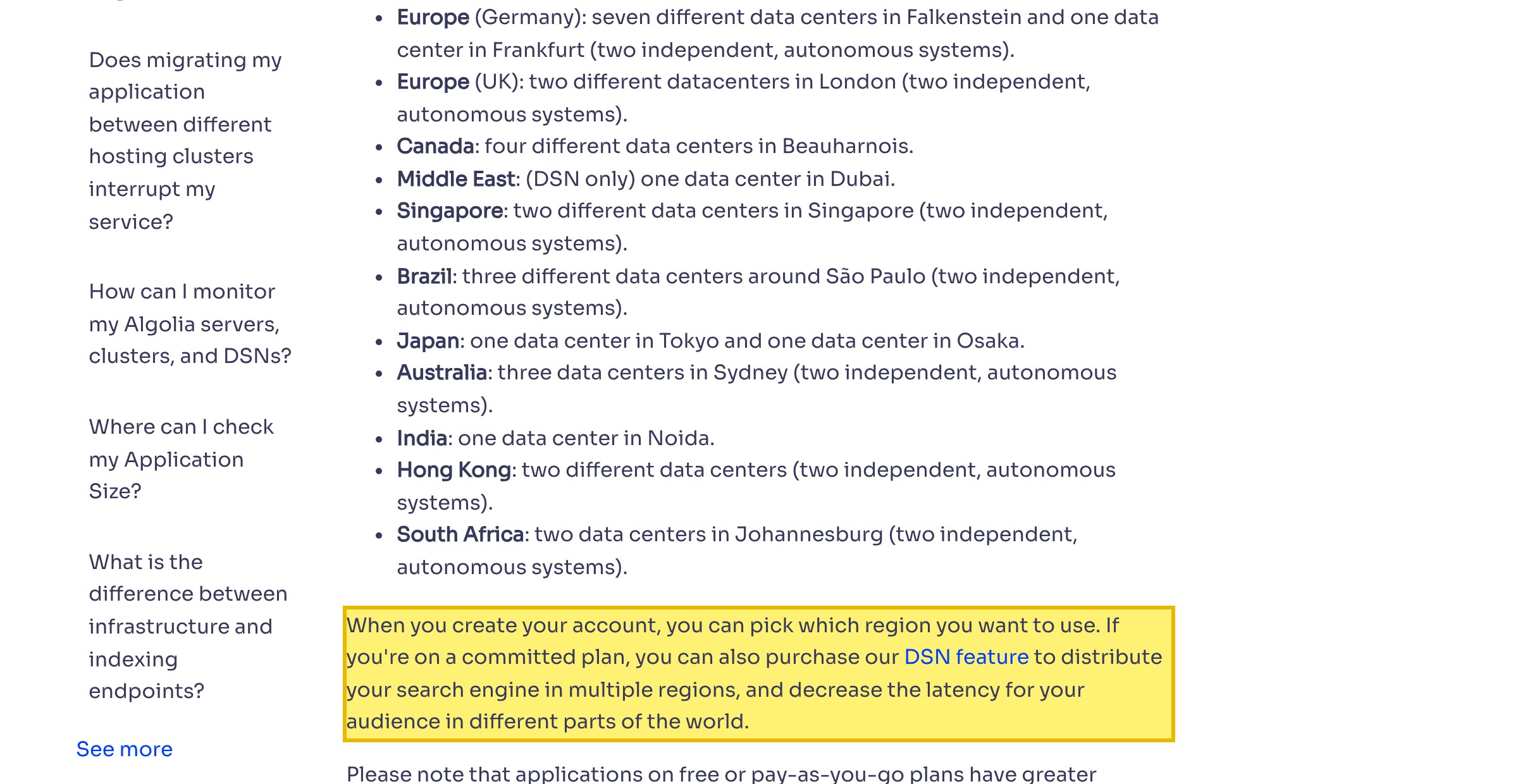
Algolia's own support page on where its clusters sit says "when you create your account, you can pick which region you want to use" — and the nearest to the mainland are Hong Kong, Singapore and Tokyo, none inside it. Its infrastructure policy describes the data its log subprocessor touches as "indexing operations, end-user queries, end-user IP addresses" — the very information that, for Chinese users, becomes a cross-border transfer of personal information under PIPL once it sits in an offshore index (notice, separate consent and a transfer mechanism, Articles 38–43). Separately, the ICP filing rides on the public app that embeds the search, not on Algolia. The table below pairs Algolia's own words with the rule each one triggers.
This is a risk map, not a verdict — what you index, how much personal data it holds and who your users are decide which door fits. Our China team can map your exposure with you →
What actually decides whether Algolia works for a mainland-China audience
| Fact | Primary source |
|---|---|
| Algolia hosts your search index offshore, and there is no mainland-China region to choose. On Algolia's own support page describing where its clusters and servers sit, "when you create your account, you can pick which region you want to use" — but the regions nearest mainland China are Hong Kong, Singapore and Tokyo, every one of them across the border, and even its multi-region distribution draws only from those same offshore sites. A China-facing index is reached from offshore whichever region you select. | Algolia Support — "Where are classic clusters and servers located?", retrieved 2026-10-07 |
| A search index holds personal information — the queries users type and the IPs they arrive from. Algolia's infrastructure policy lists the data its log-management subprocessor can access as "indexing operations, end-user queries, end-user IP addresses," and its CDN subprocessor as holding the website URL the end-user interacts with "(which includes end-user IP address)." For a mainland audience, that data living in an offshore index is a cross-border transfer of personal information under PIPL — requiring notice, separate consent and one transfer mechanism (a CAC security assessment, the CAC standard contract, or certification), Articles 38–43. | Algolia — "Infrastructure & Sub-Processors" (updated 2026-01-12), retrieved 2026-10-07; PIPL Articles 38–43 |
| Your data is handled by an offshore Algolia entity, on worldwide partner infrastructure. Algolia says it "operates worldwide infrastructure in co-location and server hosting facilities of our infrastructure partners," and that where a subscriber is "domiciled in a country located outside of Europe, Algolia, Inc. acts as the data processor" — a United States entity. If you are a critical information infrastructure operator or a large-volume handler, personal information collected in China must be stored in the mainland (PIPL Article 40; Cybersecurity Law Article 39 (formerly Article 37)) — which an offshore-only service cannot satisfy. | Algolia — "Infrastructure & Sub-Processors" (updated 2026-01-12), retrieved 2026-10-07; PIPL Article 40; Cybersecurity Law Article 39 (formerly Article 37) |
| The ICP filing rides on your app, not on the search provider — which reframes the "alternative." A hosted search API is not a website your visitors open; it answers calls from the public app that is the website, so the ICP filing attaches to that app under State Council Order No. 292 and MIIT Order No. 33. The honest alternative to an offshore index is therefore search whose data can live in-country: an open-source engine you self-host on mainland infrastructure keeps the index on the mainland — moving the ICP and PIPL duties onto you, not removing them. | China ICP filing regime — State Council Order No. 292; MIIT Order No. 33 (national filing portal) |
Sources verified by the 21YunBox compliance team on 2026-10-07.
“Algolia alternatives in China” is usually asked as a speed question: the hosted search felt sluggish for mainland users, so what’s faster? That is the wrong half of the problem. Algolia is a hosted search API that runs only on offshore infrastructure, and the moment its index answers a mainland audience, the questions that actually bind are where that index is allowed to live and who holds the filing on the app that calls it. Reaching Algolia from China is the easy part; being allowed to keep your users’ search data in an offshore index is the part that decides whether you have a problem. So the useful “alternative” is not a quicker hosted index — it is search whose data can sit in-country, read here in Algolia’s own words and China’s own law.
Algolia in China at a glance
| What decides it | In Algolia's own terms |
|---|---|
| What Algolia is | A hosted search API, offshore by design. Algolia “operates worldwide infrastructure in co-location and server hosting facilities of our infrastructure partners” — an excellent global search layer, but one with no mainland-China region to select. |
| A mainland-China region? | No. “When you create your account, you can pick which region you want to use” — but the list stops at the border: Hong Kong, Singapore, Tokyo and Sydney are among the nearest, and none sits inside mainland China. |
| What the index holds | The records you index plus, in Algolia's words, “end-user queries, end-user IP addresses” — personal information. For a mainland audience in an offshore index, that is a cross-border transfer PIPL governs (Articles 38–43). |
| Who the ICP filing binds | The public app that embeds the search box — not Algolia — under State Council Order No. 292 and MIIT Order No. 33. A search API is not itself a website, so swapping search vendors does not move this door. |
| The honest alternative | Search whose data can live in-country. An open-source engine self-hosted on mainland infrastructure keeps the index on the mainland; the ICP and PIPL duties then sit with you, or with a compliant in-country layer. |
The offshore index — where your search data actually sits
Algolia is managed, and it is offshore. Its own words are that “when you create your account, you can pick which region you want to use,” yet the menu ends at the border — Hong Kong, Singapore, Tokyo, Sydney and the rest, with nothing inside mainland China, and even the multi-region option spreads only across those same offshore sites. What rides in that index is not anonymous. Algolia’s infrastructure policy describes the data its log subprocessor can see as “indexing operations, end-user queries, end-user IP addresses,” and names a United States entity — where a subscriber is “domiciled in a country located outside of Europe, Algolia, Inc. acts as the data processor.” For a mainland audience, the queries your users type and the records you index are personal information held abroad, which under China’s Personal Information Protection Law is a cross-border transfer: notice, separate consent, and one permitted transfer mechanism — a CAC security assessment, the CAC standard contract, or certification — Articles 38–43. If you are a critical information infrastructure operator or a large-volume handler, that personal data must be stored in the mainland (PIPL Article 40; Cybersecurity Law Article 39 (formerly Article 37)), which an offshore-only service structurally cannot do.
The filing gate rides on the app, not on the search box
A hosted search API is not a page your visitors open in a browser; it answers calls from the application that is the public site — the storefront, the help center, the documentation. So the permission that lets that site be served to people in mainland China — the ICP filing under State Council Order No. 292 and MIIT Order No. 33 — attaches to the app, never to Algolia underneath it. Swapping one offshore search vendor for another changes nothing on this gate: the app still needs its own filing, and a site actually served from inside the mainland needs a licensed in-country host for that filing to attach to. Performance and this filing are two separate gates, failed separately — and search sits on the regulatory one from two directions at once, the residency of the index and the filing on the app in front of it.
So what is the real “alternative”?
Here is where the “alternatives” question finally gets a useful answer. If the problem were only speed, a nearer region would fix it — but every region on offer is offshore, so speed is never the gate that closes. The gate that closes is residency: can the index, and the personal data inside it, lawfully live where your users are? Measured that way, the real alternative to an offshore hosted index is search whose data can sit on the mainland. Open-source engines — Meilisearch among them — are code you can run on your own in-country infrastructure, which keeps the index on the mainland. That does not make compliance vanish; it relocates it onto you, since you now hold the filing on the app and the PIPL duties on the data. The choice is therefore not “which hosted index is fastest” but “who carries the in-country filing and the residency duty” — you, self-hosting, or a compliant in-country layer that carries them for you.
This is a risk map, not a verdict: whether you keep an offshore index behind a compliant boundary, self-host in-country, or need in-country storage at all depends on what you index, how much personal data it holds, and who your users are — worth settling with counsel before you build.
Where 21YunBox fits — a compliant overlay, not a migration
You do not have to rip out Algolia, and you do not have to rebuild your site inside the mainland to serve China. 21YunBox adds the piece an offshore search vendor cannot: compliant, ICP-filed delivery from inside the mainland, placed in front of the app you already run — no rebuild, no second codebase, and no forced migration off the search you use. Our China team maps which door fits, assesses your PIPL cross-border and data-residency exposure for the queries and records your index holds, handles the ICP filing on the public app, and stands up the in-country delivery a lawful China presence needs — while your application and its search layer stay exactly where they are today.
Related reading:
