Does Contentful work in China?
Whether you can use Contentful in mainland China is first a data-residency and reachability question, not a speed one. Contentful is a hosted headless CMS: it stores the content your site is built on — and any personal data your content models hold — and delivers it over its own global CDN. Where that content lives, and whether a visitor in China can reach it reliably, are what China's law and the Great Firewall respond to.
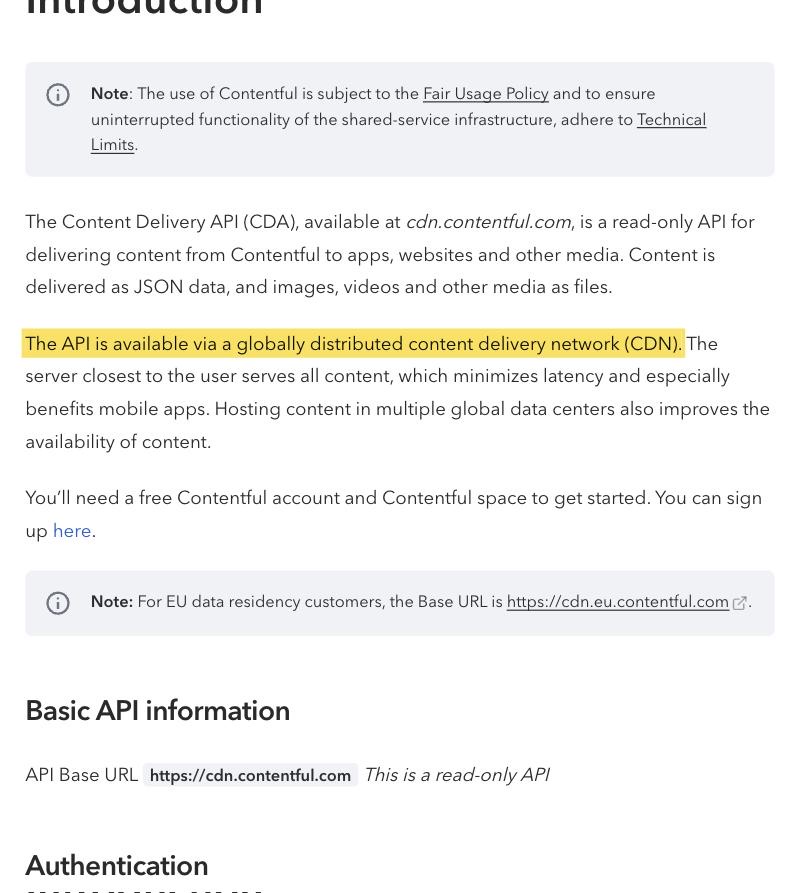
By Contentful's own documentation, the Content Delivery API is “available via a globally distributed content delivery network (CDN)”, it hosts “content in multiple global data centers,” and the one alternate data-residency region it documents beyond the default cdn.contentful.com is the EU (cdn.eu.contentful.com) — neither inside mainland China. So your content, and any personal data modeled into it about people in China, comes to rest offshore: a cross-border transfer of personal information PIPL governs. And because Contentful is a backend behind a frontend you build and host, the ICP filing falls on the public mainland site you run, not on Contentful. The table below sets Contentful's own wording against the rule each line triggers.
This is a risk picture, not a verdict — what applies turns on what your models hold, how much of it is personal, and who your users are. Our China team can map your Contentful exposure with you →
What actually decides whether you can use Contentful in China
| Fact | Primary source |
|---|---|
Contentful delivers your content from an offshore, globally distributed CDN. Its Content Delivery API documentation states the CDA is “available via a globally distributed content delivery network (CDN)”, that “the server closest to the user serves all content,” and that “hosting content in multiple global data centers also improves the availability of content.” The default delivery host is cdn.contentful.com, and none of that footprint is inside mainland China — so a page that fetches Contentful content live from behind the Great Firewall depends on a cross-border round trip, a reachability risk rather than a guaranteed block. | Contentful — Content Delivery API overview (contentful.com), retrieved 2026-10-07 |
Contentful's only data-residency options are offshore. Beyond the default cdn.contentful.com, Contentful documents a single alternate region, for EU data residency: “For EU data residency customers, the Base URL is https://cdn.eu.contentful.com.” Neither the default nor the EU option is inside mainland China, so the content your site is built on is stored and served from outside the country wherever you host, with no way to keep only the China slice of it on the mainland. | Contentful — Content Delivery API overview (contentful.com), retrieved 2026-10-07 |
| If your content models hold personal data, that data is held offshore. A headless CMS does not only carry marketing copy — content models routinely hold author profiles, user-generated content, personalization and form-style entries that can be personal information. Gathered from people in China and kept in an offshore Contentful region, that is a cross-border transfer of personal information under PIPL: the handler — you, Contentful's customer, not Contentful — must give notice, obtain separate consent, and satisfy one transfer mechanism (a CAC security assessment, the CAC standard contract, or certification). | PIPL Chapter III, Articles 38–43 |
| There is no in-product way to keep the content on Chinese soil. For a critical information infrastructure operator or a large-volume handler, personal information collected in China must be stored in the mainland (PIPL Article 40; Cybersecurity Law Article 39 (formerly Article 37)). Because Contentful publishes no mainland-China region — only the default and the EU — meeting that duty means running the storage on infrastructure inside the mainland, a separate arrangement from your Contentful space rather than a region setting. | PIPL Article 40; Cybersecurity Law Article 39 (formerly Article 37) |
The ICP filing attaches to your public site, not to the headless backend. Contentful is a read-only content API a frontend queries at cdn.contentful.com; the ICP filing (State Council Order No. 292; MIIT Order No. 33) attaches to the public mainland website or app you build on top of it and the in-country hosting it runs on — not to the CMS. With no mainland region, Contentful gives that site no footing to file against. | Contentful — Content Delivery API overview (contentful.com), retrieved 2026-10-07; State Council Order No. 292; MIIT Order No. 33 |
Sources verified by the 21YunBox compliance team on 2026-10-07.
Contentful is one of the best-known headless content management systems, and if you are serving a mainland-China audience the question behind “does Contentful work in China” — or “what’s the Contentful alternative for China” — is not really about raw speed. Contentful is a hosted service: it stores the content your site is built on and delivers it over its own global content delivery network. So the honest questions are where that content (and any personal data in it) is allowed to live, whether a visitor in China can reach the content API reliably, and who has to be licensed to run the public site on top — three things no amount of caching or theme work settles on its own.
Those are compliance and delivery questions, and they are the half of “does Contentful work in China” that a benchmark never answers. Below is what Contentful documents about where it hosts and how it delivers content, how China’s Personal Information Protection Law treats the personal data your content models can hold, and where the ICP filing actually lands — in Contentful’s own words and China’s own law, so you can take it to counsel rather than to a speed test.
Contentful in China at a glance
| What decides it | In Contentful's own words — and China's own law |
|---|---|
| Where your content lives | Contentful hosts “content in multiple global data centers,” and the only data-residency choices it documents are the default (cdn.contentful.com) and the EU (cdn.eu.contentful.com). Neither is inside mainland China. |
| How it reaches China | The Content Delivery API is “available via a globally distributed content delivery network (CDN).” Cached public reads can come from a nearby edge, but uncached, preview and personalized reads still resolve against the offshore store — a cross-border round trip, not a guaranteed block. |
| Your China users' data | Personal data you model as content — author profiles, user-generated content, form-style entries — sits in the offshore region. For data gathered in China that is a cross-border transfer PIPL governs, and there is no mainland region to keep it on Chinese soil. |
| Serving the public | The public mainland site you build on Contentful needs an ICP filing tied to an in-country hosting resource (State Council Order 292; MIIT Order 33). As a headless backend with no mainland region, Contentful offers no filing footing of its own — the filing lands on your site. |
| The working design | Keep Contentful exactly as it is; add ICP-filed, in-country delivery in front of your origin — and, where the law requires it, in-country storage for personal data. An overlay, not a migration. |
Where Contentful stores and serves your content — offshore, over a global CDN
Start with Contentful’s own Content Delivery API documentation, because it answers the two questions most “does it work in China” articles skip: where your content sits, and where it is served from. Contentful states the Content Delivery API is “available via a globally distributed content delivery network (CDN)”, that “the server closest to the user serves all content,” and that “hosting content in multiple global data centers also improves the availability of content.” The default delivery host is cdn.contentful.com, and the one alternate region Contentful documents for data residency is the EU: “For EU data residency customers, the Base URL is https://cdn.eu.contentful.com.” Neither is inside mainland China.
That settles the residency question before performance is ever in frame. The content your site is built on — and anything you model into it — lives in an offshore region, with no mainland-China option to choose and no in-product way to keep only the China slice of it on Chinese soil. Whether that is a problem depends less on Contentful than on what your content holds, which is the door after next.
Reaching the content API from inside China
A headless CMS is only half a system: Contentful holds the content, and a frontend you build and host queries its content API. Because that API is a globally distributed CDN, published reads your delivery layer has already cached can be answered from an edge near the visitor. But an edge cache in front of an offshore store does not move the store. A draft or preview, an editor’s change, a personalized response, or any query the cache has not seen resolves against the offshore region — a cross-border round trip through the Great Firewall that can run slow or drop.
How much a China visitor feels this depends on how your frontend renders. Publish a fully static build and most of the per-visitor API crossing disappears; render at request time — server-side rendering, incremental regeneration, or client-side calls to the content API — and each query makes the trip. This is why “just put a CDN on it” under-answers the China question for a Contentful stack: caching the fast public reads leaves the dynamic path crossing the border, and leaves the data-residency and ICP facts below untouched.
Your China users’ data in your content models
Contentful rarely stores only marketing copy. Model author profiles, account records, user-generated content, comments or form-style entries, and for people in China that personal information is written to and kept in your offshore Contentful region. Under China’s Personal Information Protection Law that is a cross-border transfer, and the handler — you, Contentful’s customer, not Contentful — must give notice, obtain separate consent, and clear one transfer mechanism: a CAC security assessment, the CAC standard contract, or certification (PIPL Chapter III, Articles 38–43). If you are a critical information infrastructure operator or a large-volume handler, personal information collected in China must be stored in the mainland (PIPL Article 40; Cybersecurity Law Article 39 (formerly Article 37)) — a residency duty neither Contentful’s default region nor its EU region can meet. The clean line is to keep personal data out of Contentful where you can; where you cannot, treat its location as a question for counsel.
The ICP door lands on your public site, not on Contentful
Because Contentful is a backend reached over an API, the licensing question does not attach to it the way it attaches to a host. It attaches to the public-facing website or app you run on top of it. A site delivered to mainland visitors from inside China turns on an ICP filing (备案) under State Council Order No. 292 and MIIT Order No. 33, and that filing must bind to a hosting resource physically inside the mainland and to a mainland legal entity. Contentful publishes no mainland region, so there is nothing on Contentful to file against — the filing is yours to arrange for the site you build. “We already run on Contentful” does not carry that site into China: calling an offshore content API from Shanghai is not the same as being licensed to operate a public site there.
This is a risk map rather than a verdict: whether you need an ICP filing, in-country storage for the personal data in your content, or both, depends on what you publish, how much personal information you handle, and who your users are — worth settling with counsel before you build.
Looking for a Contentful “alternative” for China?
Teams often search for a Contentful “alternative” for China expecting the answer to be a different CMS. It usually isn’t. Swapping headless platforms moves your content from one offshore region to another and leaves all three doors exactly where they were — the content still sits outside the mainland, the API still answers across the border, and the public site still needs its own ICP filing. The alternative that actually changes the China outcome is not a new editing tool but a compliant, in-country delivery path for the site you already run: it keeps the authoring workflow your team knows and puts the lawful, reachable layer where China requires it.
Where 21YunBox fits — a compliant overlay, not a migration
You keep shipping on Contentful, and your spaces, content models and region settings stay as they are. We supply the one piece a hosted headless CMS with no mainland footprint leaves to you: compliant, ICP-filed delivery from inside the mainland, placed in front of the site you already run — no rebuild, no parallel codebase, and no move off Contentful. Our China team weighs your ICP and PIPL data-residency obligations against your entity and the personal data your content holds, then stands up the in-country delivery — and, where the law demands it, the in-country storage — a lawful China presence requires, while your Contentful space stays exactly where it is.
Related reading:
