Does VMware Horizon Work in China? Data Residency, ICP & Cross-Border Rules
VMware Horizon (now Omnissa) runs your employees' virtual desktops, so the China question isn't whether the login loads — it's where the desktop VMs, the files users open and the management plane live. On-premises Horizon in a mainland data center keeps that data resident; the cloud-managed control plane routes it offshore under PIPL. A compliance-first look at Horizon's residency, PIPL cross-border, MLPS and ICP duties.
Does VMware Horizon work in China?
Whether you can run VMware Horizon in China is a data-residency question, not a speed one. A probe from Shanghai only tells you the login screen loads; it says nothing about where the virtual desktops, the files your staff open, and the management plane are allowed to live.
Horizon (now Omnissa) delivers your employees' virtual desktops and apps, so a Horizon estate concentrates employee personal information and whatever files each user opens — plus the user directory and session data. Where that rests is set by how you deploy. By Omnissa's own documentation, "Horizon 8 can be deployed on-premises or in a private cloud" — even air-gapped or in a sovereign cloud — so an on-premises deployment inside the mainland keeps the desktops and their data resident. The exposure is the cloud-managed side: a SaaS-subscription Horizon Control Plane, Horizon Cloud, or public-cloud regions can route directory, session and telemetry data offshore — a PIPL cross-border transfer a no-mainland-region service cannot cure. Running the platform for mainland users also brings MLPS duties, and a China-facing access portal owes an ICP filing.
This is a risk picture, not a verdict — your duties turn on your role, your data volumes and how you deploy. Our China team can map your Horizon residency exposure with you →
What VMware Horizon's own documentation says about China
| Fact | Primary source |
|---|---|
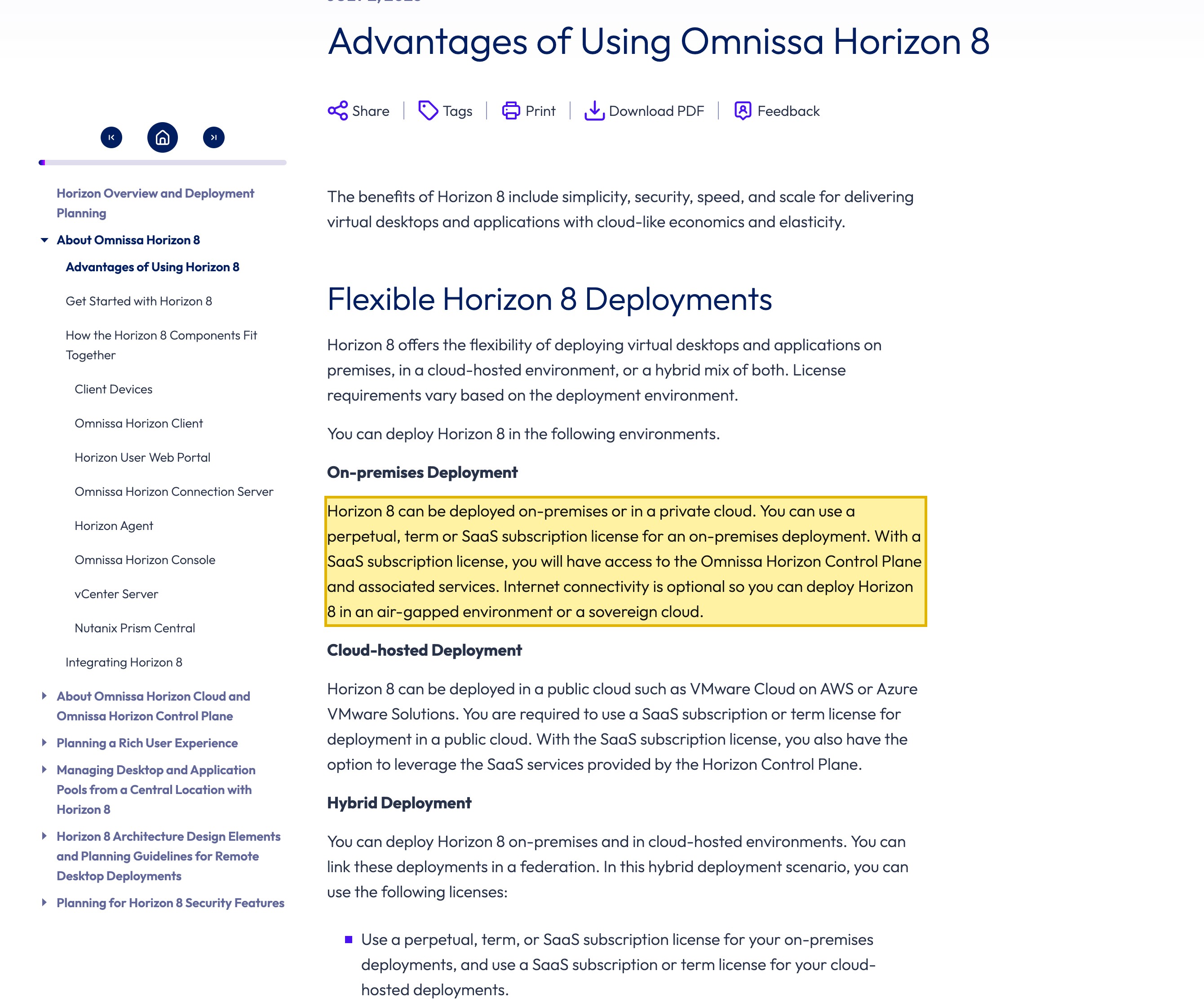
| In Omnissa's own words: "Horizon 8 can be deployed on-premises or in a private cloud," and "you can deploy Horizon 8 in an air-gapped environment or a sovereign cloud." Because you choose the infrastructure, an on-premises Horizon deployment can run inside a mainland-China data center, keeping the virtual desktops and the data they hold in-country. | Omnissa Docs — Advantages of Using Omnissa Horizon 8, retrieved 2026-10-15 |
| Horizon also has cloud-managed shapes. Omnissa's documentation notes that "with a SaaS subscription license, you will have access to the Omnissa Horizon Control Plane and associated services," and that "Horizon 8 can be deployed in a public cloud such as VMware Cloud on AWS or Azure VMware Solutions." Those cloud-managed and public-cloud paths can place management, directory and session data on infrastructure outside the mainland — the routing to govern, not the resident lever. | Omnissa Docs — Advantages of Using Omnissa Horizon 8, retrieved 2026-10-15 |
| When a Horizon estate serving people in China sends directory, session or telemetry data to an offshore control plane or a public-cloud region, holding that personal information abroad is a cross-border transfer under PIPL (Articles 38–40): the handler owes notice, a separate consent, and one transfer mechanism — a CAC security assessment, the CAC standard contract, or certification. | PIPL Articles 38–40 (cross-border transfer of personal information) |
| A critical-information-infrastructure operator or high-volume handler must store China personal information on the mainland — PIPL Article 40 and Cybersecurity Law Article 39 (formerly Article 37) (renumbered by the 2025 amendment, in force January 1, 2026, substance unchanged). Operating the in-country VDI also brings graded cybersecurity-protection (MLPS) duties on whoever runs the system, and a mainland-facing access portal owes an ICP filing. | Cybersecurity Law Article 39 (formerly Article 37); PIPL Article 40 |
Sources verified by the 21YunBox compliance team on 2026-10-15.
For a company serving mainland China, the deciding question about VMware Horizon (now Omnissa) is not whether a login screen renders quickly or whether the connection broker is reachable — both are routine delivery matters. It is where your employees’ virtual desktops, the files they open inside them, and the plane that manages them are allowed to come to rest. Horizon is a VDI and end-user-computing platform: it serves your staff full virtual desktops and published applications, and those sessions concentrate employee personal information together with whatever documents, records and customer data each user opens during the working day. Horizon ships in two shapes that sit on opposite sides of the residency line. On-premises Horizon 8 runs in your own data center or private cloud — infrastructure you control, which can be inside mainland China. The cloud-managed shapes — a SaaS-subscription Horizon Control Plane, Horizon Cloud, and public-cloud deployments — place management, directory and session data on infrastructure Omnissa or a public cloud operates. So “does VMware Horizon work in China?” is really a question about where the desktops and their data live, and it turns on data residency, not milliseconds.
VMware Horizon in China at a glance
| What decides it | In Horizon's own terms — and China's law |
|---|---|
| What it is | A VDI and end-user-computing platform that delivers virtual desktops and published apps. It runs in two shapes: on-premises Horizon 8 in your own data center or private cloud (Omnissa notes it can even run "in an air-gapped environment or a sovereign cloud"), and the cloud-managed shapes — a SaaS-subscription Horizon Control Plane, Horizon Cloud, and public-cloud deployments such as VMware Cloud on AWS or Azure VMware Solutions. |
| What it holds, and why it is personal information | Every virtual desktop is a working environment for one employee: it concentrates that person's account and session data plus whatever files they open — HR records, customer data, contracts, source material. Together with the user directory those are personal information under PIPL, much of it sensitive. Where they rest is a legal question, not a performance one. |
| Where the desktops actually rest | Wherever you deploy the cluster. Omnissa's documentation is explicit that "Horizon 8 can be deployed on-premises or in a private cloud" — so an on-premises deployment inside the mainland keeps the desktops and their data resident. Cloud-managed and public-cloud paths place that estate, or its control plane, on infrastructure outside China. |
| The control plane and cross-border exposure | With a SaaS subscription you "have access to the Omnissa Horizon Control Plane and associated services." If directory, session or telemetry data flows from a China-facing estate to an offshore control plane or public-cloud region, that is a cross-border transfer under PIPL (Articles 38–40): notice, a separate consent, and one transfer mechanism — a CAC security assessment, the CAC standard contract, or certification. |
| The in-country storage duty (CIIO / high-volume handler) | A critical-information-infrastructure operator or high-volume handler must keep China personal information on the mainland (PIPL Article 40; Cybersecurity Law Article 39 (formerly Article 37)). A VDI estate concentrates personal information fast, so it can itself push a handler over the large-volume threshold; an offshore control plane cannot meet the duty. |
| Operator duties in China (MLPS + ICP) | Running the VDI that serves mainland users brings graded cybersecurity-protection (MLPS / 等级保护) obligations on whoever operates the system, and any mainland-facing surface — the access portal your China users open to reach their desktops — owes an ICP filing. |
| The data-resident path | Deploy Horizon on-premises in a mainland data center, keep the desktops, their data and the connection broker resident, govern the control-plane back-haul, and deliver the China-facing access portal in-country on ICP-filed infrastructure. Reachability was never the test; residency is. |
Where the desktops and their data actually rest
Horizon’s residency is set by which shape you run, not by a load-time test from Shanghai. On-premises Horizon 8 runs on infrastructure you control: Omnissa’s documentation states plainly that “Horizon 8 can be deployed on-premises or in a private cloud,” and that “you can deploy Horizon 8 in an air-gapped environment or a sovereign cloud.” Deploy that cluster inside a mainland data center and the virtual desktops, the connection broker and the files inside each session stay in the country. That is the whole point of the on-premises path, and it is a genuine in-country lever — not a reachability trick.
The cloud-managed shapes are the other side of the line. Omnissa notes that “with a SaaS subscription license, you will have access to the Omnissa Horizon Control Plane and associated services,” and that “Horizon 8 can be deployed in a public cloud such as VMware Cloud on AWS or Azure VMware Solutions.” Those paths move management, directory and session data onto infrastructure Omnissa or a public cloud operates — the routing to govern, not the resident lever. Naming them is the honest half of the answer: an on-premises Horizon estate is the compliant footing, and the cloud control plane, Horizon Cloud and offshore public-cloud regions are the parts whose back-haul you have to account for, not the parts you build on for a China-facing deployment.
A virtual desktop is a concentration of employee personal information
A VDI platform is a concentrator of a particular kind. Each virtual desktop is one employee’s whole working environment, and it holds — or opens, over the course of a day — their account and directory record, their session data, and whatever files that person touches: HR and payroll documents, customer and transaction records, contracts, correspondence, source material. Horizon’s own documentation frames the platform as a way to keep that material centralized rather than on endpoints — “Sensitive data can be prevented from being copied onto a remote employee’s home computer,” and “Access to data can easily be restricted.” That centralization is a security advantage, but it also means the data concentrates wherever the cluster sits. Most of it is personal information under PIPL, and some — identity, financial and contact data — is sensitive personal information that draws heightened duties.
That is why residency, not reachability, is the test. When a China-facing Horizon estate sends directory, session or telemetry data to an offshore control plane or a public-cloud region, you are making a cross-border transfer, and PIPL Articles 38–40 govern it: notice, separate consent, and one lawful transfer mechanism — a CAC security assessment, the CAC standard contract, or certification. On top of that sits a harder duty: a critical-information-infrastructure operator or high-volume handler must store China personal information inside the mainland — PIPL Article 40 and the data-localization rule in Cybersecurity Law Article 39 (formerly Article 37) (renumbered by the 2025 Cybersecurity Law amendment, in force January 1, 2026, substance unchanged). And running the VDI itself makes you an operator of an in-country system, which brings graded cybersecurity-protection (MLPS / 等级保护) obligations; the access portal your mainland users open to reach their desktops is a China-facing surface that owes an ICP filing.
Why a reachability check misses this
Point a probe at a Horizon login portal from Shanghai and it may tell you the page loads — and that is exactly why the familiar “does it open from China?” question answers the wrong thing. Reachability is a delivery matter; it says nothing about where the virtual desktops, the files your staff open inside them, and the plane that manages the estate are allowed to live. Two Horizon deployments can look identical from a browser in China and sit on opposite sides of the law: one on-premises in a mainland data center with the desktops and data resident, and one managed from an offshore control plane with directory and session data crossing the border. A speed test cannot see that difference. The residency of the desktops and their data — not the latency of the login — is what decides whether you can lawfully run Horizon for a China-facing workforce, which is why this page publishes no first-party China latency figure for Horizon: a number without the data-residency context would answer the wrong question.
The lawful path — map, localize, deliver
21YunBox is a compliant overlay, not a migration — and a partner to your IT and end-user-computing team, not a competitor to it.
- Map. We read the PIPL cross-border, data-residency, data-localization (CII) and ICP obligations, and the MLPS posture, against your entity, your data volumes, whose personal information actually flows through the desktops, and how your Horizon estate is deployed today — so you know which duties bite before you move anything.
- Localize. We stand up the in-country footing so the personal information stays on mainland soil — typically Horizon deployed on-premises in a mainland data center, with the virtual desktops, their data and the connection broker resident, and the control-plane and telemetry back-haul governed rather than left to route offshore. Localize means an in-country deployment, not reaching back to an offshore endpoint.
- Deliver. The China-facing surface in front of the estate — the access portal your mainland users open to reach their desktops — runs over ICP-filed, in-country delivery (the 21YunBox Optimizer), in front of the stack you already run. No rebuild, no second image.
None of this is a legal ruling. Whether your operation is a critical-information-infrastructure operator, what MLPS grade your system draws, whether what you hold counts as important data, and which transfer mechanism (if any) your flows require are determinations to settle with qualified China counsel against what actually runs on your desktops — this page maps the exposure, it does not resolve it.
The result is a virtual-desktop estate that runs legally and compliantly for your users in China. 21YunBox never uses or suggests circumvention of any kind.
Related reading
- China’s Personal Information Protection Law (PIPL)
- Cross-border data transfers under PIPL
- China’s Cybersecurity Law — data localization at Article 39 (formerly Article 37)
- How to get an ICP license for a website in China


