Does TikTok Pixel Work in China? Data Residency, ICP & Cross-Border Rules
The TikTok Pixel collects a mainland visitor's device, browser, IP and cookie data — third-party cookies on by default — and reports it to TikTok's offshore servers, with no mainland-China region. For a China visitor that is a PIPL cross-border transfer needing its own separate consent, and the default tracking China's rules on apps and SDKs are written to catch.
Does TikTok Pixel work in China?
Whether the TikTok Pixel “works” in mainland China is first a cross-border-data and consent question, not a speed one. The pixel is a piece of code you embed to report your visitors’ actions to TikTok — so the moment it fires for a mainland user, you are collecting that person’s device, browser and behavioral data and sending it to TikTok’s offshore servers.
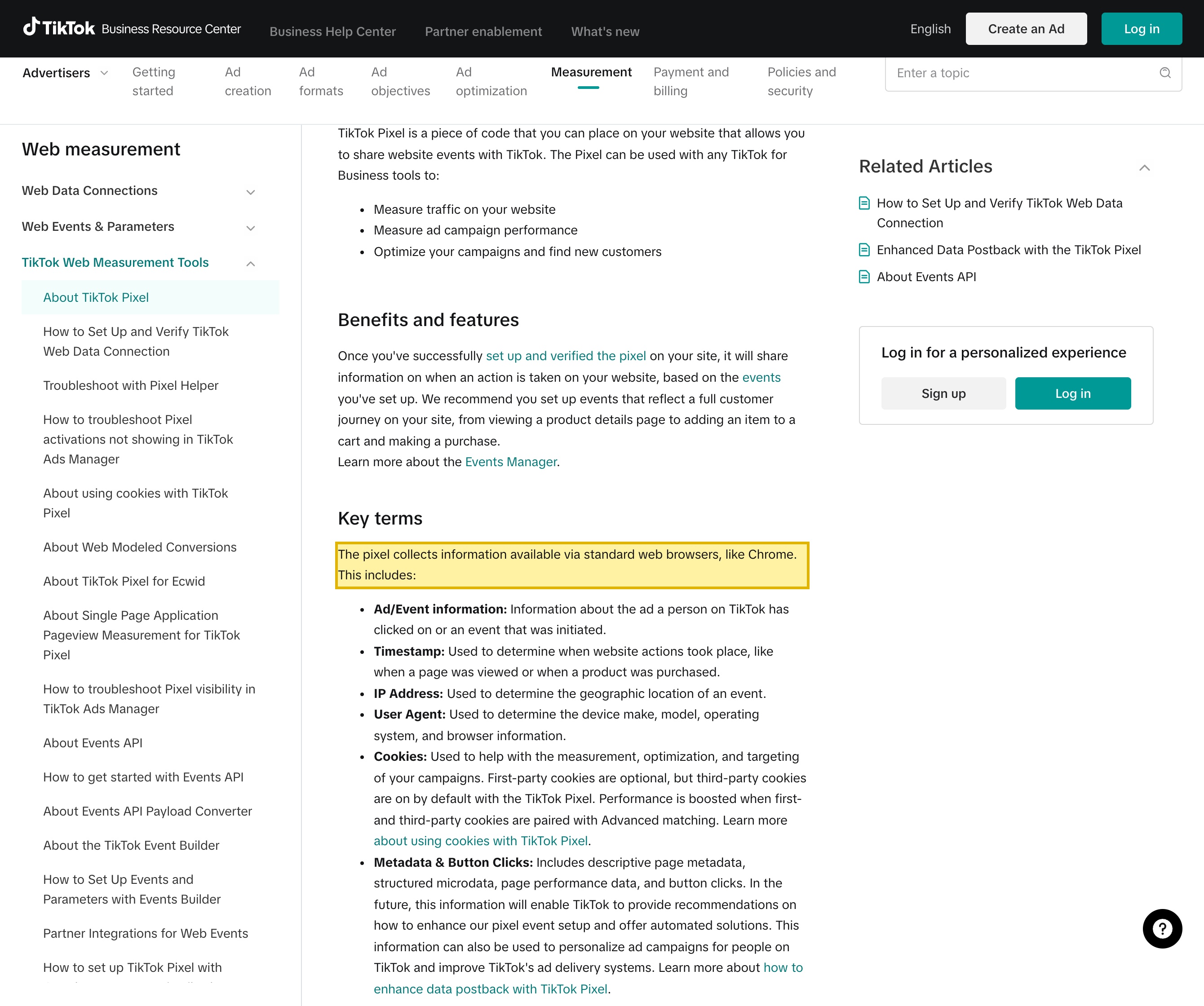
In TikTok’s own documentation the pixel “collects information available via standard web browsers” — the User Agent, “Used to determine the device make, model, operating system, and browser information,” the IP address used for geolocation, page metadata and button clicks — and “third-party cookies are on by default with the TikTok Pixel.” With Advanced Matching it also hashes and sends form-entered email and phone numbers. TikTok stores the data it collects on “servers located in the United States, Singapore, and Malaysia,” with no mainland-China region, so a Chinese visitor’s data is carried offshore — a cross-border transfer of personal information under PIPL needing notice, a separate consent, and a transfer mechanism (Articles 38–40). China separately governs trackers and SDKs that collect personal information: a pixel that collects by default, before any specific consent, is exactly what those rules target — something a “does the tag fire?” check never sees.
This is a risk map, not a verdict — what you owe turns on your data, your volumes and who your visitors are. Our China team can map your exposure with you →
What TikTok Pixel's own documentation says about China
| Fact | Primary source |
|---|---|
| TikTok’s own documentation lists what the pixel collects from each visitor. On its “About TikTok Pixel” page TikTok calls the pixel “a piece of code that you can place on your website that allows you to share website events with TikTok,” and states that “the pixel collects information available via standard web browsers, like Chrome.” Its itemized list includes the IP Address (“Used to determine the geographic location of an event”), the User Agent (“Used to determine the device make, model, operating system, and browser information”), cookies — where “third-party cookies are on by default with the TikTok Pixel” — plus timestamps, page metadata and button clicks. Under PIPL those device identifiers, network identifiers and behavioral events are personal information. | TikTok Ads Manager — About TikTok Pixel (ads.tiktok.com), retrieved 2026-10-12 |
| That data is sent to TikTok and stored offshore — there is no mainland-China region. The pixel’s purpose is to “share website events with TikTok,” and with Advanced Matching TikTok also collects form-entered identifiers — “name, zip, email and phone” — stating that “customer emails and phone numbers will be hashed with SHA256 … before reaching TikTok servers.” TikTok stores the data it collects “in servers located in the United States, Singapore, and Malaysia.” [Inference: TikTok names only offshore storage and operates no mainland-China region — its international platform is not available in the mainland — so a Chinese visitor’s data comes to rest outside China.] | TikTok Ads Manager — About Advanced Matching for Web; TikTok Newsroom — How we secure personal information and store data (Oct 12, 2023), retrieved 2026-10-12 |
| Sending a mainland visitor’s data offshore is a cross-border transfer under PIPL. The device identifiers, IP, cookies and behavioral events the pixel collects are personal information, and exporting them to TikTok’s offshore servers is a cross-border transfer the personal-information handler must justify — you, the site operator, not TikTok. PIPL requires notice, a separate consent for the overseas transfer, and one transfer mechanism (a CAC security assessment, the CAC standard contract, or certification) under Articles 38–40, and does not accept a single bundled “take it or leave it” (一揽子) consent for this tracking. Where a device identifier or behavioral profile is sensitive personal information, Articles 28–29 add further duties. | PIPL Articles 13, 23, 28–29, 38–40 — notice, separate consent and cross-border transfer |
| China specifically governs trackers and SDKs that collect personal information. A tracker must declare what it collects and obtain consent before collecting: the PIPL notice-and-consent rules (Articles 13 and 23), reinforced by the MIIT/CAC framework on apps and third-party SDKs that “illegally collect and use personal information,” target exactly a pixel that collects device and behavioral data by default. For a critical-information-infrastructure operator or high-volume handler, personal information collected in China must also be stored in the mainland under Cybersecurity Law Article 39 (formerly Article 37) and PIPL Article 40 — a duty an offshore pixel cannot meet. | PIPL Articles 13, 23, 40; Cybersecurity Law Article 39 (formerly Article 37); MIIT/CAC rules on illegal collection by apps and SDKs |
Sources verified by the 21YunBox compliance team on 2026-10-12.
The usual question about the TikTok Pixel in China is whether it still fires — whether the tag loads and conversions come back. For a mainland audience that is the wrong test twice over. TikTok’s platform is not available in mainland China — its domestic counterpart is a separate product — so the pixel earns you no usable measurement there: it is a third-party call you neither host nor control, and it does not load for a mainland visitor. The quieter, more durable problem is what the pixel is built to do wherever it does resolve. The TikTok Pixel is a piece of code you place on your site to report a visitor’s actions — page views, button clicks, purchases — to TikTok, collecting their device, browser, IP and cookie data along the way. On a visitor in mainland China that is three things at once under Chinese law: a cross-border transfer of personal information, tracking that needs its own separate consent, and precisely the default, silent collection that China’s rules on apps and third-party trackers are written to catch.
TikTok Pixel in China at a glance
| What decides it | In TikTok's own terms — and China's law |
|---|---|
| What it collects | TikTok describes the pixel as "a piece of code that you can place on your website that allows you to share website events with TikTok," and says it "collects information available via standard web browsers" — the User Agent (device make, model, OS and browser), the IP address (geolocation), cookies (third-party on by default), timestamps, page metadata and button clicks. With Advanced Matching it also hashes and sends form-entered identifiers — "name, zip, email and phone." Under PIPL these device, network and behavioral identifiers are personal information. |
| Where the data goes | TikTok receives and stores that data on its own offshore infrastructure — "servers located in the United States, Singapore, and Malaysia" — with no mainland-China region. Collecting it from a visitor in China is a cross-border transfer (数据出境) under PIPL — notice, a separate consent, and a transfer mechanism (Articles 38–40). |
| Consent — separate, not bundled | Setting tracking cookies and shipping the data abroad is non-essential processing: under PIPL Articles 13 and 23 it needs informed consent before the tag fires, and the overseas transfer needs its own separate consent — not a single bundled "by using this site you agree" (一揽子) line. Device identifiers and behavioral profiles can be sensitive personal information (Articles 28–29), adding duties. |
| The rule a speed test never sees | China specifically governs trackers and SDKs that "illegally collect and use personal information." A tracker must declare what it collects and obtain consent before collecting; a pixel that collects device and behavioral data by default, third-party cookies on by default, is exactly the conduct the MIIT/CAC framework targets. A "does the tag fire?" check is blind to this. |
| Is the tag reachable? | That is the delivery half, not the decision. TikTok's platform does not operate in the mainland, so the pixel is dead weight there that also drags page performance; the fix is to gate or suppress it for mainland visitors and route measurement to a lawful in-country alternative — while the China-facing site itself carries an ICP filing and needs in-country delivery. |
What the pixel actually sends — and where
Strip away the marketing and the TikTok Pixel is a reporting tag. TikTok’s own help page lists what it collects: the IP Address, “Used to determine the geographic location of an event”; the User Agent, “Used to determine the device make, model, operating system, and browser information”; cookies, where “first-party cookies are optional, but third-party cookies are on by default with the TikTok Pixel”; plus a timestamp for each action and “descriptive page metadata, structured microdata, page performance data, and button clicks.” On top of that sits Advanced Matching, which “automatically identifies form fields on pages where the Pixel is installed” and “hashes and collects the customer information entered on those pages” — “name, zip, email and phone” — with TikTok stating that “customer emails and phone numbers will be hashed with SHA256 … before reaching TikTok servers.” Every path ends in the same place: TikTok’s infrastructure, offshore.
Then the China-specific twist. TikTok’s platform is not available in mainland China — the domestic product is a separate app — so for a mainland visitor the tag mostly cannot do its job: it is a request to an endpoint you do not run, and it does not load. That tempts teams to treat the pixel as harmless there. It is not. Wherever the request does resolve — a visitor on a corporate network, an unusual route, a cached library — it still collects that person’s device and behavioral data and starts it toward TikTok. Dead weight for measurement; live liability for compliance. And TikTok names only offshore storage for the data it collects — “servers located in the United States, Singapore, and Malaysia” — with no mainland-China region to select.
A cross-border transfer and a consent duty the site operator owes — under PIPL
Point the pixel at a visitor in China and PIPL duties attach at once. First, the data leaves the country. Those cookie IDs, the IP address, the device signals, the event log and any hashed identifiers are personal information, and sending them to TikTok’s offshore servers is a cross-border transfer (数据出境): the handler — you, the site operator, not TikTok — owes the visitor notice, a separate consent for the overseas transfer, and one lawful transfer mechanism (a CAC security assessment, the CAC standard contract, or certification) under PIPL Articles 38–40.
Second, the consent cannot be bundled. Setting non-essential tracking cookies and identifiers needs a lawful basis, which for behavioral advertising is informed consent captured before the tag fires (PIPL Articles 13 and 23); the overseas transfer then needs its own separate consent. China’s rules require specific, informed, separate consent for this kind of tracking — not a single “take it or leave it” (一揽子) agreement buried in a terms line. And where a device identifier or behavioral profile amounts to sensitive personal information, Articles 28–29 add further consent and necessity duties on top. Where you are a critical information infrastructure operator or a high-volume handler, a storage-localization duty is added as well — personal information generated in China must be kept in China under Cybersecurity Law Article 39 (formerly Article 37 — the 2025 Cybersecurity Law amendment, in force January 1, 2026, renumbered the data-localization article from 37 to 39, with the substance unchanged) and PIPL Article 40 — a duty an offshore ad pixel cannot satisfy.
The part a reachability check cannot see — China governs the tracker itself
This is the half an opposing “does it load?” test is structurally blind to. Beyond the cross-border transfer, China specifically regulates the conduct of trackers and SDKs that collect personal information. The MIIT and CAC framework on apps and third-party SDKs “illegally collecting and using personal information” requires a tracker to declare what it collects and to obtain consent before collecting — not after, and not by default. An ad pixel that silently captures a visitor’s device identifiers and behavioral events the moment the page loads, with third-party cookies on by default, is exactly the conduct those rules target. A reachability check answers only whether the request completes; it cannot see the missing declaration, the missing separate consent, or the default collection — the things that actually decide whether you can run the pixel for mainland users.
None of this is a ruling that the TikTok Pixel is banned in China. It is a risk map: which duties actually bite — and how hard — depends on what your tag collects, your data volumes, your role under Chinese law, and who your visitors are. Settle the specifics with counsel before a China-facing campaign relies on any of it.
The lawful path — map, localize, deliver
There is a compliant way to run marketing for a China audience, and it begins by separating the legal question from the technical one.
First, map. Our China compliance team inventories which advertising and tracking tags fire on your mainland-facing pages — the TikTok Pixel and anything beside it — what device and behavioral personal information each collects and sends offshore, where that data comes to rest, the consent basis each tag relies on, and the ICP status of your China-facing surface. We build the technical picture; your counsel draws the legal conclusions.
Then localize. We gate, suppress or defer the offshore pixels for mainland visitors so they stop collecting device and behavioral data from people in China by default, and we make the flow honor the notice and the separate consent Chinese law requires before any tag runs. Where you still need to measure or advertise to Chinese users, we help stand up a consented, PIPL-aligned path on a lawful in-country platform — the China-side data collected and held on mainland infrastructure — while you keep the TikTok Pixel for the markets where it already serves you. Localizing here means ending the unconsented offshore collection and replacing it with a lawful in-country path; it is never a tunnel that makes the offshore pixel fire anyway.
Then deliver. The China-facing site that carried the tag is itself a public internet information service in the mainland, so it needs an ICP filing and compliant, in-country delivery — the 21YunBox Optimizer, set in front of the stack you already run, with no rebuild and no re-platform. The result is a site that runs legally and compliantly for your users in China. 21YunBox never uses or suggests circumvention of any kind. We keep what must stay in-country and deliver the rest in the open — a compliant overlay and partner, not a competitor to any ad platform.
Related reading:
- Personal Information Protection Law (PIPL)
- Cross-border data transfers under PIPL
- China’s Cybersecurity Law (data localization, Article 39)
- How to get an ICP filing for China


