Does Sprout Social Work in China? Data Residency, ICP & Cross-Border Rules
Sprout Social is cloud-only social media management: your China followers, DMs, comments and engagement data sit offshore — servers in the US and EEA, not mainland China — and WeChat, Weibo, Douyin and RED sit outside the networks it manages. A compliance-first look at residency and platform access.
Does Sprout Social work in China?
Whether Sprout Social “works” in China is a compliance-risk question before it is a performance one: the platform holds your China social audience — followers, direct messages, comments, community posts and engagement data — in offshore regions, and the mainland networks you most need to manage sit behind a walled, licensed gate it does not natively reach.
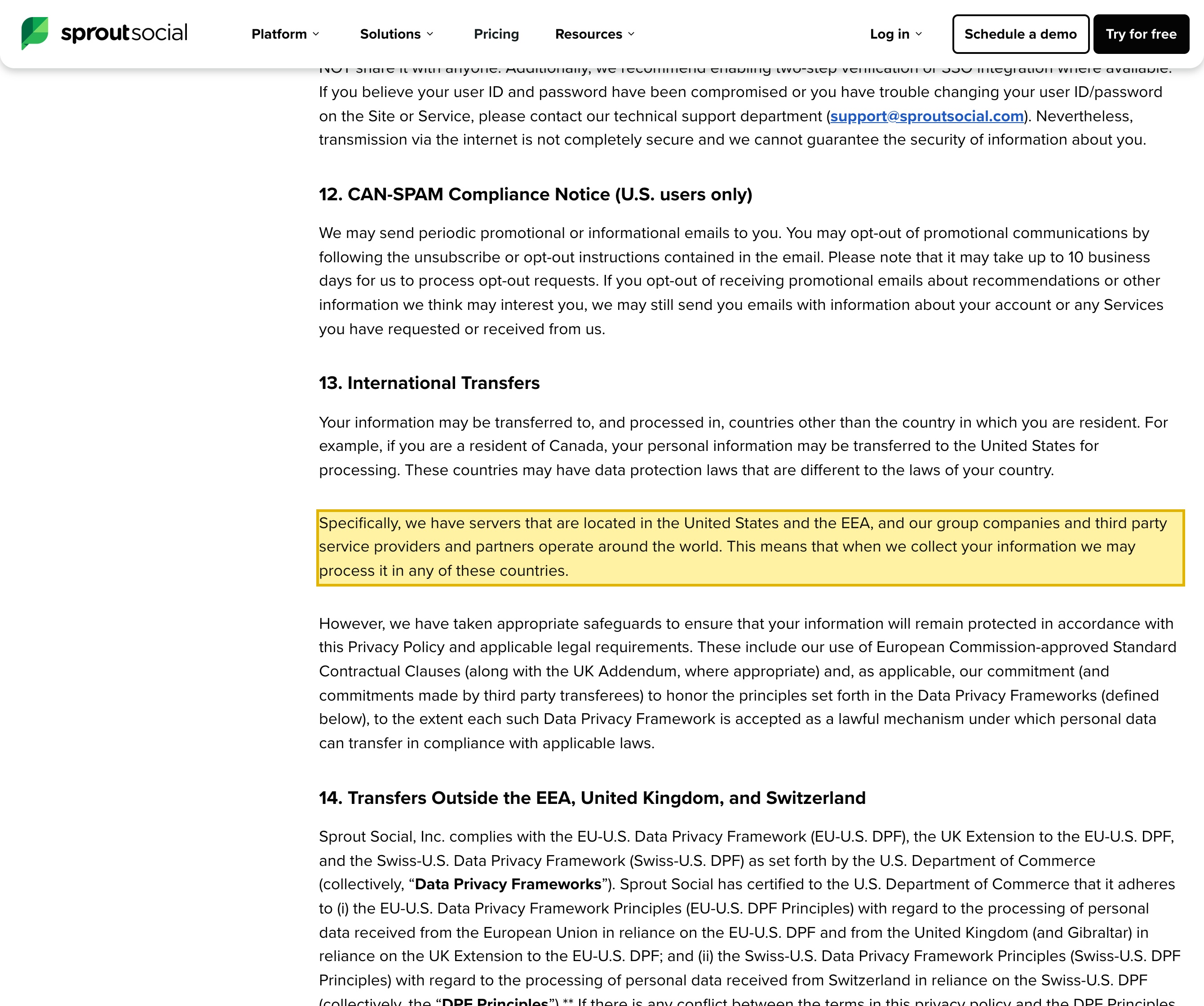
By Sprout Social's own privacy policy, “we have servers that are located in the United States and the EEA,” and “your personal information may be transferred to the United States for processing” — no mainland-China region. So the audience graph and message inbox it keeps for your brand cross the border, which is a cross-border transfer under PIPL on the Article 13/23 notice-and-consent. The half a speed test never sees: WeChat, Weibo, Douyin and RED are a real-name, content-reviewed, domestically licensed domain, and Sprout's own integrations list does not include them — so “does it work” is also a platform-access and content-compliance question.
This is a risk map, not a verdict — your duties turn on your entity, your data volumes and your role under Chinese law. Our China team can map your Sprout Social setup with you →
What Sprout Social's own documentation says about China
| Fact | Primary source |
|---|---|
| In Sprout Social's own words: “we have servers that are located in the United States and the EEA,” and “your personal information may be transferred to the United States for processing” — no mainland-China region is named. The same policy says it collects “Social Media Data” (handles, profiles, posts, comments, follower counts, “engagement and analytics metrics” and messages), plus “Communications Data” and “Uploaded Content.” So your China audience graph and its direct messages are held offshore. | Sprout Social — Privacy Policy (International transfers; Information Collected and Processed), retrieved 2026-10-12 |
| Sprout Social's own integrations page lists the networks it manages — Bluesky, Facebook, Instagram, LinkedIn, Pinterest, Reddit, Snapchat, Threads, TikTok, X and YouTube, plus WhatsApp and Facebook Messenger. WeChat, Weibo, Douyin and RED (Xiaohongshu) are not among them. The mainland platforms where a China audience actually lives are a walled, licensed, real-name, content-reviewed domain a western tool does not natively hold API access to. | Sprout Social — Networks and Integrations, retrieved 2026-10-12 |
| Holding a China audience's followers, messages, comments and engagement data offshore is a cross-border transfer of personal information. Under the Personal Information Protection Law, Articles 13 and 23 require notice and a consent basis, and Articles 38–40 require a transfer mechanism — a CAC security assessment, the CAC standard contract, or certification — before it leaves the country. Where direct messages carry sensitive personal information, Articles 28–29 add a separate-consent and necessity test. | PIPL — Articles 13, 23, 28–29, 38–40 (21YunBox translation & guide), retrieved 2026-10-12 |
| For a critical information infrastructure operator or a high-volume handler, the Cybersecurity Law's Article 39 (formerly Article 37) requires personal information generated in China to be stored in the mainland — which an offshore, US/EEA-hosted tenant cannot satisfy. The 2025 amendment, in force January 1, 2026, renumbered the data-localization article from 37 to 39, with its substance unchanged. | Cybersecurity Law — Article 39 (formerly Article 37) (21YunBox translation & guide), retrieved 2026-10-12 |
Sources verified by the 21YunBox compliance team on 2026-10-12.
For a brand running Sprout Social to reach a mainland-China audience, the deciding question is not how quickly the publishing calendar or the Smart Inbox paints from Shanghai. It is whether the audience data Sprout Social holds is allowed to live where it lives, and whether the networks that audience actually uses can be managed at all. Sprout Social is the system of record for your social presence: it stores your followers and member profiles, the engagement inbox of direct messages and comments, the community and user-generated posts you collect, and the engagement and analytics metrics built on top of them. It is a cloud-only SaaS platform, hosted in offshore regions with no footprint inside mainland China — so all of that audience personal information is held and processed abroad. And the mainland platforms a China audience lives on — WeChat, Weibo, Douyin and RED — are a walled, licensed domain Sprout Social does not natively reach. That makes this a compliance-risk question first, not a performance one.
Sprout Social in China at a glance
| What decides it | In Sprout Social's own terms — and China's law |
|---|---|
| What it holds | Your China social audience and everything attached to it: followers and member profiles, the engagement inbox of direct messages and comments, the community and user-generated posts you collect, and the engagement and analytics metrics built on them. Sprout's own privacy policy files these under “Social Media Data,” “Communications Data” and “Uploaded Content.” |
| Where it runs | Sprout Social is a cloud-only SaaS platform. By its own privacy policy, its servers are in the United States and the EEA; its subprocessor list names AWS as the hosting provider in the United States, with every subprocessor in the US or Germany and none inside mainland China. There is no mainland region to select. |
| Audience & engagement PII | Your China followers' and correspondents' personal information rests in an offshore region — a cross-border transfer under PIPL Articles 38–40, layered on the Article 13/23 notice-and-consent. Where a direct message carries sensitive personal information, Articles 28–29 add a separate-consent and necessity test. |
| The walled-platform gap | This is the half a speed test never sees. WeChat, Weibo, Douyin and RED are a licensed, real-name, content-reviewed domain reached through domestic APIs, and Sprout's own integrations list does not include them. So “does it work” is also a platform-access and content-compliance question, not only a residency one. |
| Data localization | For a critical information infrastructure operator or a high-volume handler, the Cybersecurity Law's Article 39 (formerly Article 37) requires personal information generated in China to be stored in the mainland — which an offshore, US/EEA-hosted account cannot satisfy. |
| A China-facing community surface | If your brand hosts a China-facing community or microsite that publishes mainland users' posts, that is a public internet information service — so it carries an ICP filing (备案) duty bound to mainland hosting, plus content-moderation obligations. |
| Reachability is not the axis | Whether the dashboard loads quickly from the mainland is operational, not the compliance question. What decides it is where the audience data lives and which networks you can lawfully manage. 21YunBox helps you keep the regulated data in-country, ICP-file any China-facing surface, and deliver it compliantly — the 21YunBox Optimizer — in front of the Sprout Social you already run. |
What it actually holds — your China audience graph and its inbox
Sprout Social is not a static asset like a font or a tag; it is the operational core of your social function, and it concentrates exactly the kind of data China’s law cares about. Its own privacy policy sets out what it collects: “Social Media Data” — social handles, usernames, profile pictures, bios, follower counts, posts, comments and “engagement and analytics metrics”; “Communications Data” — the messages and correspondence exchanged through the Smart Inbox; and “Uploaded Content” — including direct-messaging communications and the material you build into campaigns. Across Sprout’s three products — the core platform, Employee Advocacy and Influencer Marketing — that is a precise map of who follows your brand in China, what they say to you privately, and how they behave. Because Sprout Social is cloud-only and hosted in offshore US and EEA regions, that audience graph and its private messages are held and processed abroad by default.
Two gates, not one: where the data rests, and a platform it can’t natively reach
Most tools present a single China question. Sprout Social presents two, and both have to clear.
The first gate is personal-information residency. The follower profiles, comments and direct messages your Sprout Social account collects from people in China are personal information under China’s Personal Information Protection Law, and holding them in an offshore region is a cross-border transfer (数据出境). The duty lands on you, the brand, not on Sprout Social: Articles 13 and 23 require notice and a basis to collect the data, and Articles 38–40 require a transfer mechanism to send it abroad — a CAC security assessment, the CAC standard contract, or certification. Where a direct message carries sensitive personal information, PIPL Articles 28–29 raise the bar with a specific-purpose, necessity and separate-consent test. And for a critical information infrastructure operator or a high-volume handler, the Cybersecurity Law’s Article 39 (formerly Article 37 — the 2025 Cybersecurity Law amendment, in force January 1, 2026, renumbered the data-localization article from 37 to 39, with its substance unchanged) requires personal information generated in China to be stored in the mainland, which an offshore account cannot satisfy.
The second gate is the one that makes a social tool different from an ordinary SaaS: the networks themselves. A China audience does not live on the networks Sprout Social manages — it lives on WeChat, Weibo, Douyin and RED. Those are a walled, domestically licensed domain, governed by real-name registration and content review, and reached through domestic APIs that a western social-management tool does not natively hold. Sprout Social’s own integrations list covers Bluesky, Facebook, Instagram, LinkedIn, Pinterest, Reddit, Snapchat, Threads, TikTok, X, YouTube, WhatsApp and Facebook Messenger — and none of the mainland platforms. So “does Sprout Social work in China” is not only where does the data rest but also can it manage the platforms that matter, under China’s content rules — and if your brand stands up its own China-facing community or microsite to fill that gap, that surface is a public internet information service with an ICP filing (备案) duty bound to mainland hosting and content-moderation obligations of its own.
Why a reachability check can’t answer this
Sprout Social is not the kind of service that simply refuses to load in China — the exposure is quieter and more durable than a slow paint. Even if the dashboard and the Smart Inbox opened instantly, using them would still place your China audience’s profiles and private messages in offshore regions with no mainland option, the consent and cross-border-transfer duties would still apply, and the mainland networks your audience actually uses would still be outside what the tool can natively manage. A reachability test answers “did the page come back?”; it is blind to where the follower graph and the message history come to rest, to the legal basis they rely on, and to whether the platforms that matter can be reached under China’s rules. Where the data lives and which networks you can lawfully manage, not how fast the dashboard arrives, is what China’s law responds to.
This is a risk map, not a verdict that Sprout Social is “blocked” or “illegal” in China. Which duties bite your case turns on your entity, what your account actually holds, your data volumes, and your role under Chinese law — worth settling the specifics with counsel before your China presence depends on it.
The lawful path — map, localize, deliver
There is a compliant way to run social media management for a China audience, and it sits in front of the Sprout Social your team already uses — no rebuild, no second tool, no migration.
First, map: our China team inventories what your Sprout Social account holds — the follower and member profiles, the engagement inbox of direct messages and comments, the community and UGC posts, and the engagement metrics built on them — establishes where it is hosted (an offshore US or EEA region), the ICP status of any China-facing community surface, and the consent and residency basis each flow relies on. We build the technical picture; the legal conclusions are settled with counsel.
Then localize/govern: we help you keep the regulated China audience data on a lawful in-country path, obtain the Article 13/23 notice and the separate consent these flows require, honor the content-moderation duties that attach to any China-facing surface, and make sure audience and message data is not left to rest abroad by default. Localize means keeping the data on an in-country path — never a route that ships it offshore anyway.
Then deliver: any public China-facing community or microsite is an internet information service, so it carries an ICP filing duty bound to mainland hosting and needs compliant, in-country delivery. 21YunBox stands that up — the 21YunBox Optimizer — in front of what you already run, so it serves your users in China legally and compliantly. 21YunBox never uses or suggests circumvention of any kind — we keep in-country what the law says must stay, deliver the rest compliantly from inside the mainland, and never move personal information across the border by stealth. Making an offshore account merely reachable is not the answer; keeping the regulated audience data in-country, on a consented and ICP-filed path, is. 21YunBox is a compliance overlay and partner to the social platform you already run, not a competitor to it.
Related reading:
- China’s Personal Information Protection Law (PIPL)
- Cross-border data transfers under PIPL
- China’s Cybersecurity Law
- How to get an ICP filing for China


