Does Google Cloud Translation Work in China? PIPL Cross-Border Data Transfer & Content Residency
Google Cloud Translation is a raw machine-translation API with no mainland-China region: every string you send is shipped to Google's offshore servers to translate, making it a PIPL cross-border transfer of the personal and sensitive information inside it. A compliance-first look at Google Cloud Translation data residency and cross-border transfer.
Does Google Cloud Translation work in China?
Google Cloud Translation has no mainland-China region, so every string you send to translate is shipped to Google's offshore servers — a cross-border transfer of whatever personal or sensitive information is inside it.
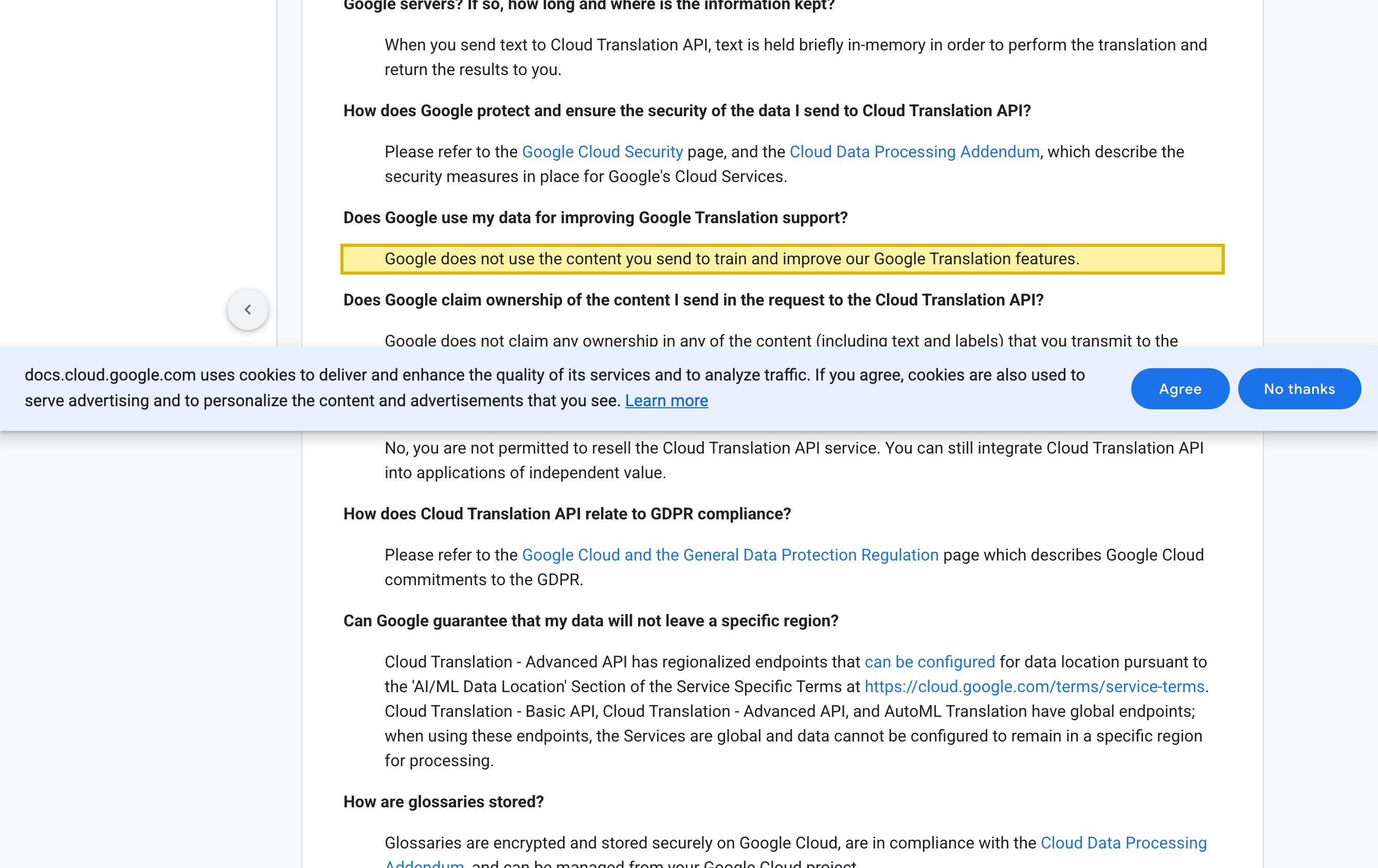
It is a raw machine-translation API: text in, text out, processed in Google's EU, US, or global regions, never in the mainland. Google's own Data usage FAQ says it does not train on or share your text and holds it only briefly in-memory — a favorable retention posture — but that does not change the fact that the content leaves China, which makes it a PIPL cross-border transfer of the personal information it carries (and Article 28 sensitive-data duties where they apply). The lawful lever is to keep China content's translation in-country — a licensed in-country alternative plus minimizing personal information in strings — not to make the offshore API reachable; Google Cloud Translation cannot be self-hosted.
This is a risk map, not a verdict — settle the specifics with counsel. Our China team can map your exposure →
What Google Cloud Translation's own documentation says about China
| Fact | Primary source |
|---|---|
Google Cloud Translation runs only in Google's offshore regions — none inside mainland China. The Basic API and AutoML Translation use a single global endpoint; the Advanced API adds EU and US multi-regional endpoints (translate-eu.googleapis.com, translate-us.googleapis.com) that keep data at rest and ML processing within the EU or US. There is no mainland-China endpoint, and — unlike AWS (Sinnet/NWCD) and Azure (21Vianet) — Google Cloud has no China partition to move to. The nearest Google regions are asia-east1 (Taiwan) and asia-east2 (Hong Kong), both outside the mainland. | Google Cloud — Cloud Translation, Global and multi-regional endpoints; Data usage FAQ, retrieved 2026-10-10 |
| By Google's own Data usage FAQ, Cloud Translation does not train on, retain, or share the text you send — but the text is still sent offshore. Google states it "does not use the content you send to train and improve our Google Translation features," that request text is "held briefly in-memory in order to perform the translation," and that it will not share it with any third party (distinct from the consumer Google Translate product). Note the limits: glossaries are "encrypted and stored securely on Google Cloud," custom AutoML models persist, and Advanced batch jobs read and write Cloud Storage — all offshore. A favorable retention posture mitigates the retention prong; it does not remove the cross-border transfer. | Google Cloud — Cloud Translation Data usage FAQ, retrieved 2026-10-10 |
| Sending text abroad to be translated is a cross-border transfer of the personal information inside it. Under PIPL Articles 38–40 (数据出境), the handler — you, the Cloud Translation customer, not Google — must give notice, obtain separate consent, and satisfy one transfer mechanism: a CAC security assessment, the CAC standard contract, or certification. Where the text carries sensitive personal information (medical, financial, legal, biometric, ID, religious), PIPL Article 28 adds separate consent and a prior protection impact assessment — and you cannot anonymize a document you need translated in full. | PIPL Chapter III, Articles 28 and 38–40 (cac.gov.cn), retrieved 2026-10-10 |
| For a CIIO or high-volume handler, China-collected personal information must be stored in-country — a duty Google Cloud Translation cannot satisfy, because it has no mainland region and no self-hosted deployment. The Cybersecurity Law Article 39 (formerly Article 37) in-country storage duty applies (the 2025 Cybersecurity Law amendment, in force January 1, 2026, renumbered the data-localization article from 37 to 39, its substance unchanged). The compliant arrangement is a licensed in-country translation path plus ICP-filed delivery in front of the stack you already run. | Cybersecurity Law Article 39 (formerly Article 37); PIPL Article 40; ICP filing — State Council Order No. 292, retrieved 2026-10-10 |
Sources verified by the 21YunBox compliance team on 2026-10-10.
For a product or support team serving mainland China, the deciding question about Google Cloud Translation is not whether the API answers from inside the country — it is what happens to the text you hand it. Cloud Translation is a raw machine-translation service: you send a string to an HTTPS endpoint and Google returns the translation, processed on its servers outside mainland China. The content you most need translated — support tickets, HR and legal files, contracts, product copy, user-generated content — is exactly the content most likely to carry names, email addresses, ID numbers, and confidential business information. Google’s own Data usage FAQ is reassuring on retention: it does not train on your text, holds it only briefly in-memory, and does not share it. But that does not change the fact that every call ships your content across the border — a cross-border transfer of personal information (PIPL Articles 38–40), with separate handling for sensitive content (Article 28), and content residency under the Cybersecurity Law where a CIIO or high-volume handler’s storage duty bites.
Google Cloud Translation in China at a glance
What decides whether you can send mainland-China content to Google Cloud Translation is not reachability — it is the content you transmit and where it is allowed to rest.
| What decides it | In Google Cloud Translation's own terms — and China's law |
|---|---|
| What you send, and that it carries personal data. Cloud Translation is text-in, text-out: UI strings, support tickets, HR and legal documents, contracts, knowledge-base articles, product copy, user-generated content. | The text you most need translated is the text most likely to contain names, emails, ID numbers, and confidential business information — and whatever you pass is what crosses the border. |
| It is sent offshore to be translated. | A cross-border transfer of personal information under PIPL Articles 38–40 (数据出境): notice, separate consent, and one transfer mechanism — a CAC security assessment, the CAC standard contract, or certification. |
| The content is sensitive. | PIPL Article 28: medical, financial, legal, biometric, ID, or religious text needs separate consent and a prior personal-information protection impact assessment (PIPIA). You cannot redact a document you must translate in full. |
| Where the content comes to rest. | Request text is "held briefly in-memory" and is not used to train models, but glossaries and custom models persist on Google Cloud and batch jobs read and write Cloud Storage — all offshore, with no self-hosted option. In-country storage under the Cybersecurity Law Article 39 (formerly Article 37) applies to a CIIO or high-volume handler. |
| Reaching the API is not the axis. | Whether the endpoint answers from China is beside the point; where your content rests is. The lever: a licensed in-country translation path and minimized PII — Cloud Translation cannot be self-hosted — plus an ICP filing for the China-facing site. |
What you actually send — and where it goes
Google Cloud Translation comes in two tiers, and both are managed cloud services with no on-premises option. The Basic API and AutoML Translation use a single global endpoint; the Advanced API adds EU and US multi-regional endpoints — translate-eu.googleapis.com and translate-us.googleapis.com — that keep data at rest and machine-learning processing within the EU or US. Useful as those are for EU or US residency obligations, none of them is in mainland China: the regional endpoints change where within Google’s offshore footprint your content sits, not whether it leaves China.
What you send is the exposure. For the raw online API, each translateText call ships a string to Google and returns the translation; Google’s Data usage FAQ says that text is “held briefly in-memory” to perform the translation and is not retained to train models or shared with third parties. That is a genuinely good retention posture — and it is the honest half a compliance-minded buyer should keep. But some things persist offshore even so: glossaries, which Google says are “encrypted and stored securely on Google Cloud,” and custom AutoML models, which are built from datasets you upload. And the Advanced API’s batch mode reads your source documents from, and writes translated output to, Cloud Storage buckets — so a batch localization job leaves a durable copy of your content in an offshore bucket. The content you most need translated — tickets, contracts, HR and legal files — is exactly the content most likely to carry the personal, sensitive, and confidential information that makes where it goes a legal question.
It’s a cross-border data transfer — under PIPL
Sending a document abroad to be translated is a cross-border transfer of everything in it. Because Google Cloud Translation processes your text outside mainland China, every call moves any personal information in that text across the border, and China’s Personal Information Protection Law governs the leg. Under PIPL Articles 38–40 (数据出境), the personal-information handler — you, the Cloud Translation customer, not Google — must give data subjects notice, obtain a separate consent for the cross-border transfer, and satisfy one transfer mechanism: a CAC security assessment, the CAC standard contract, or certification. The 2024 cross-border rules set volume-based exemptions, so the exposure scales with your data volume and role rather than merely with using the API.
Two further prongs attach. Where the text carries sensitive personal information — medical, financial, legal, biometric, religious, or ID data — PIPL Article 28 requires separate consent and a prior personal-information protection impact assessment, and you cannot anonymize a document you need translated in full. And where you are a critical information infrastructure operator or a high-volume handler, China-collected personal information must be stored in-country under the Cybersecurity Law — Article 39 (formerly Article 37); the 2025 Cybersecurity Law amendment, in force January 1, 2026, renumbered the data-localization article from 37 to 39, its substance unchanged — a duty no offshore translation region can satisfy. For the glossaries, custom models, and batch outputs that come to rest on Google’s infrastructure, that storage duty is the one to check.
Reaching the API isn’t the question — keeping the content in-country is
The instinct is to ask whether the endpoint responds from inside China. It is the wrong axis. The question is where your source content is allowed to come to rest, and for Google Cloud Translation the answer is “outside the mainland,” because Google runs no region there. Two moves follow, and neither is a tunnel that ships the content offshore anyway.
First, keep China-origin content in-country, and minimize what it carries. Google Cloud Translation cannot be self-hosted or deployed on-premises — unlike some machine-translation vendors, there is no private or in-country deployment of the Google engine to stand up — so for content that pertains to people in China, the lawful path is a licensed in-country machine-translation or localization service that keeps the text on mainland infrastructure, combined with minimizing and pseudonymizing the personal information in strings before anything is translated. Keep what must stay in China on an in-country path; send offshore only what lawfully may go.
Second, govern the transfer you do keep. Inventory which strings and documents flow to Cloud Translation, what personal or sensitive information they carry, and whether you have a lawful basis — notice, separate consent, and a transfer mechanism — for the cross-border leg; where you do use the offshore engine for non-China content, pin it to a regional endpoint, rely on Google’s no-retention posture, and document where glossaries, custom models, and batch outputs reside.
This is a risk map, not a verdict. Your exact duties turn on your data volumes, whether you are a CIIO, and the sensitivity of the content — settle the specifics with counsel.
The lawful path — map, localize, deliver
21YunBox is a compliant overlay and partner, not a competitor to your translation vendor. We map what content flows to Google Cloud Translation and the personal, sensitive, and confidential information it carries; we localize by keeping China-origin content’s translation on a lawful in-country path — a licensed domestic translation or localization service with data kept in China, plus minimized and pseudonymized personal information in strings — so China content stops being exported offshore to be translated; and we deliver the China-facing site or app that consumes the translations through the 21YunBox Optimizer, with a compliant ICP filing, in front of the stack you already run — no rebuild, no migration. The result runs legally and compliantly for your users in China. 21YunBox never uses or suggests circumvention of any kind.
Related reading
- Cross-border data transfers under PIPL
- China Cybersecurity Law
- China data export security assessment measures
- ICP license for your website