Does Coupa Work in China? Data Residency, PIPL Cross-Border & Spend Data
Coupa is a cloud spend-management platform, so whether it "works" in mainland China is first a data-residency question, not a speed one. Coupa's own documentation lists five Coupa Regions — APAC (Singapore), Australia, the EU, the UAE and the US — with none in mainland China, so the spend records, supplier master and employee expense data your China operations put into it rest offshore, making their collection a cross-border transfer of personal information under PIPL. A compliance-first look at the residency, cross-border and consent exposure — and the lawful, in-country path.
Does Coupa work in China?
Whether Coupa works in mainland China is a data-residency question before it is a speed one. Coupa is a cloud spend-management platform, and what settles it is where the spend records, supplier master and employee expense data it holds come to rest — not how fast a screen loads.
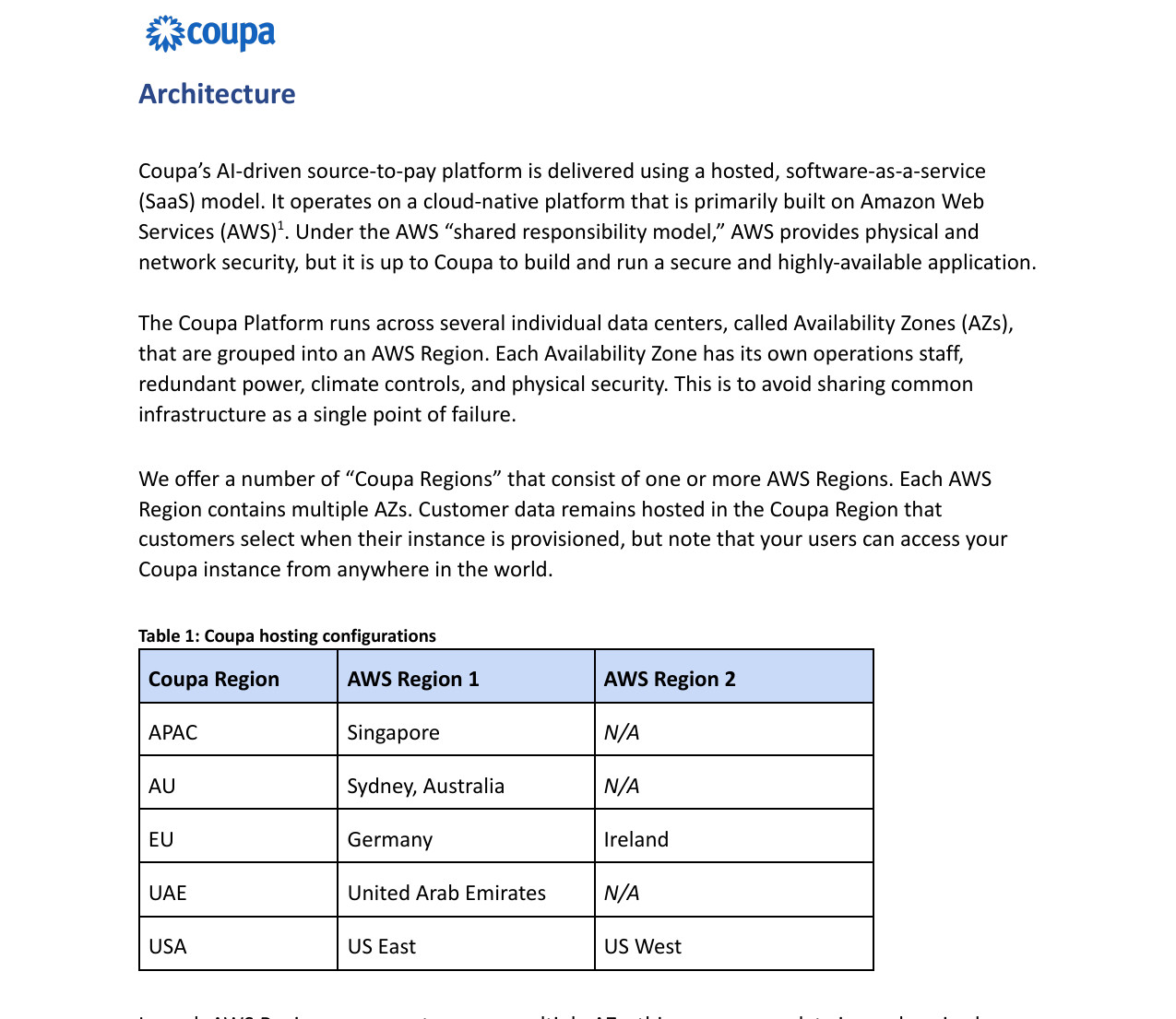
Coupa's own Platform Security & Architecture White Paper lists five "Coupa Regions" — APAC (Singapore), AU (Sydney), EU (Germany and Ireland), the UAE, and the USA — and states that "customer data remains hosted in the Coupa Region that customers select when their instance is provisioned." None is in mainland China. So the supplier contacts, supplier bank details and employee expense records your China operations enter into Coupa sit offshore — a cross-border transfer of personal information PIPL governs (notice, a separate consent and one transfer mechanism, Articles 38–40), with a data-export security assessment possible at volume and in-country storage for a CIIO under Cybersecurity Law Article 39 (formerly Article 37). Supplier bank details and employee expenses can also be sensitive personal information, raising the bar again. The table below is Coupa's own wording and the rule each line triggers.
This is a risk map, not a verdict — what you owe turns on your data volumes, which fields are sensitive and your role as handler, and it's worth settling with counsel. Our China team can map your exposure with you →
What Coupa's own documentation says about China
| Fact | Primary source |
|---|---|
| Coupa hosts customer data in five regions — none in mainland China. Coupa's own Platform Security & Architecture White Paper lists its "Coupa Regions" as APAC (Singapore), AU (Sydney), EU (Germany and Ireland), the UAE, and the USA (US East and US West), and states that "Customer data remains hosted in the Coupa Region that customers select when their instance is provisioned." There is no mainland-China region; the nearest, APAC, is Singapore — so spend, supplier and employee data entered from China rests offshore, making its collection a cross-border transfer of personal information under PIPL. | Coupa Platform Security & Architecture White Paper (July 2024), retrieved 2026-10-09 |
| Coupa confirms residency is a choice among its existing regions, not a China option. Coupa's live compliance and security page states that "Your data is always secured and protected by regional data residency models and privacy laws." The model is a selection among Coupa's regions — and none of them is in the mainland, so a regional-residency promise that offers no China region cannot satisfy a China data-localization duty for a CIIO or large-volume handler. | Coupa — Data Privacy, Compliance, & Security, retrieved 2026-10-09 |
| Loading China supplier and employee personal information into an offshore Coupa Region is a cross-border transfer. Supplier contacts and bank details and employee expense records are personal information; holding them outside the mainland is governed by PIPL as a cross-border transfer (Articles 38–40) — the handler (you, Coupa's customer, not Coupa) must give notice, obtain a separate consent for the transfer, and satisfy one transfer mechanism: a CAC security assessment, the CAC standard contract, or certification. Financial-account and some employee data can be sensitive personal information (PIPL Articles 28–29), adding a necessity test, separate consent and a protection-impact assessment. | PIPL Articles 38–40 (cross-border) and 28–29 (sensitive PI) |
| For some handlers the data must stay in China, and serving from inside the mainland triggers an ICP filing. Where the handler is a critical information infrastructure operator or moves personal information at volume, personal information collected in China must be stored in the mainland (PIPL Article 40; Cybersecurity Law Article 39 (formerly Article 37)) — a duty an offshore Coupa Region cannot meet — and above regulated thresholds a data-export security assessment may be required before data leaves. Any China-facing surface actually served from inside the mainland must carry an ICP filing bound to a mainland hosting resource Coupa does not provide. | PIPL Article 40; Cybersecurity Law Article 39 (formerly Article 37); Measures for the Security Assessment of Outbound Data Transfers |
Sources verified by the 21YunBox compliance team on 2026-10-09.
For a company running procurement, invoicing, expenses and supplier payments through Coupa for its China operations, the first instinct is to ask whether the platform is quick, or even reachable, from the mainland. That is the wrong place to start. Coupa is a hosted spend-management suite, and what actually decides whether you can use it in China is where the spend records, the supplier master and the employee expense data it holds come to rest — and whether that personal information had a lawful basis to leave the country in the first place. That is a data-residency and cross-border question under China’s law, and Coupa answers the factual half of it in its own documentation.
Coupa in China at a glance
| What decides it | In Coupa's own terms — and China's law |
|---|---|
| What it is | Coupa is a cloud spend-management platform — procurement, invoicing, expenses, supplier management and payments. It holds your spend records, the supplier master (supplier names, contacts and bank details) and employee expense data, so it is a continuous store of identifiable personal information about your China suppliers' staff and your own China employees. |
| Is it reachable from the mainland? | Coupa is a hosted SaaS your staff and suppliers open over the public internet; its own White Paper notes that once an instance is provisioned, your “users can access your Coupa instance from anywhere in the world.” Reachability is not the China question. (Cross-border access from the mainland to an offshore region can be inconsistent — an operational matter, below, not the decision.) |
| Where does the spend data sit? | Offshore. Coupa's White Paper lists exactly five “Coupa Regions” — APAC (Singapore), AU (Sydney), EU (Germany and Ireland), the UAE, and the USA (US East and US West) — and says data stays in the region you select at provisioning. There is no mainland-China region; the nearest, APAC, is Singapore. |
| Putting China spend, supplier & employee data into it | That data is personal information. Holding it in an offshore Coupa Region is a cross-border transfer (数据出境) under PIPL (Articles 38–40): notice, a separate consent, and one transfer mechanism. Supplier bank details and employee expenses can be sensitive personal information, adding a necessity test, separate consent and an impact assessment. A data-export security assessment may apply at volume; a critical information infrastructure operator owes in-country storage under Cybersecurity Law Article 39 (formerly Article 37). |
| The lawful path | Keep the China spend, supplier and employee data on a China-resident footing, send offshore Coupa only what may lawfully leave, keep Coupa for your other markets, and deliver the China-facing surfaces around the stack in-country on ICP-filed infrastructure. 21YunBox maps, localizes and delivers; it never uses or suggests circumvention of any kind. |
Reachable is not the same as compliant
Coupa is a SaaS that your staff and your China-based suppliers open over the public internet, and its own White Paper is explicit that once an instance is provisioned, your “users can access your Coupa instance from anywhere in the world.” So the question is not whether a buyer in Shanghai can open a requisition screen — it is where the data behind that screen lives. For that reason this page publishes no first-party China latency figure for Coupa: speed is not the axis for a decision that turns on residency and consent. Cross-border access from the mainland to an offshore region can be inconsistent, and the temptation is to force it through a network workaround — but that is both a compliance risk and beside the point, and 21YunBox neither uses nor suggests any form of circumvention. The productive question is how to keep the China spend data on a lawful footing.
The data-residency question: an offshore spend platform is a cross-border transfer
Coupa’s own Platform Security & Architecture White Paper settles where the data sits. It offers five “Coupa Regions” — APAC (Singapore), AU (Sydney), EU (Germany and Ireland), the UAE, and the USA (US East and US West) — and states that “Customer data remains hosted in the Coupa Region that customers select when their instance is provisioned.” None of the five is in mainland China; the nearest, APAC, is Singapore. So the spend records, the supplier master — supplier names, contacts and bank details — and the employee expense data your China operations enter into Coupa are held outside the mainland.
The moment that personal information collected in China lands in a Singapore, EU or US Coupa Region, you have made a cross-border transfer (数据出境) under China’s Personal Information Protection Law. PIPL puts the duty on the handler — you, Coupa’s customer, not Coupa the processor: Articles 38–40 require notice, a separate consent distinct from any general agreement to use the platform, and one transfer mechanism — a CAC security assessment, the CAC standard contract, or certification. Above the regulated thresholds, or where the data counts as “important data,” the transfer may first require China’s data-export security assessment (数据出境安全评估) before anything leaves. And if your organization is a critical information infrastructure operator, the Cybersecurity Law’s Article 39 (formerly Article 37 — the data-localization clause was renumbered by the 2025 amendment that took effect on January 1, 2026, with its substance unchanged) requires that personal information generated in China be stored in China, a duty an offshore Coupa Region cannot meet. Which of these bite your deployment is a risk to settle with counsel against what you actually collect and where your suppliers and staff sit.
Supplier bank details and employee expenses can be sensitive personal information
Spend data is not neutral traffic. A supplier master in Coupa typically carries bank-account and payment details used to pay those suppliers, and the expenses module carries employees’ reimbursement and travel records. Under PIPL, financial-account information is sensitive personal information (敏感个人信息), and processing it requires a specific purpose and a showing of necessity, a separate consent, and a personal-information protection impact assessment beforehand — obligations that stack on top of the cross-border duties, not in place of them. Employee personal information carries its own handling basis as well. Coupa’s security controls — encryption, access governance, and certifications such as ISO 27701 — genuinely reduce security risk, but they do not discharge the consent, necessity and residency duties, which sit with you as the personal-information handler. Whether a given field is sensitive, and what your consent and notice flow must say, are questions to confirm with counsel.
Why provisioning a “nearer” Coupa Region isn’t the fix
The obvious move is to provision the China entity’s instance in APAC, since Singapore is the closest region on the list. But closeness is not residency: Singapore, like the EU and US Regions, sits outside the mainland, so an APAC instance resolves no China data-localization duty — it merely relocates the same cross-border transfer to a different offshore country. Keeping China-collected spend, supplier and employee data in-country means standing up a China-resident footing for that data and sending to offshore Coupa only what may lawfully leave. Drawing that line — what must stay, what may go — is the heart of the work, and it is a legal question before it is a technical one.
The lawful path — map, localize, deliver
There is a compliant way to run spend management for a China operation, and it has three moves. First, map: our China team works through your PIPL exposure end to end — which spend, supplier and employee data collected in China must stay in the country, what may lawfully cross to Coupa, where a data-export security assessment or an Article 39 storage duty applies, which fields are sensitive, and what your consent and notice have to cover. The legal conclusions are settled with counsel; we build the technical picture that feeds them.
Then localize: we help stand up and integrate a China-resident footing for the China spend, supplier and employee data — a lawful in-country pattern of consented, in-country processing and storage, with a domestic procurement or spend option adopted where one fits cleanly — so the records that must stay in China stop leaving it by default, while you keep Coupa for the markets where it already serves you.
Then deliver: the China-facing surfaces around your spend stack — a supplier-onboarding or punch-out site, an approval portal, the integration edge your mainland users and suppliers actually reach — are public services in the mainland, so they carry an ICP filing (备案) duty and need compliant, in-country delivery. 21YunBox delivers them in-country — the 21YunBox Optimizer — in front of what you already run, with no rebuild and no re-platform. What we never do, and what no one lawfully can, is hand you a way around China’s data-export rules or around any network restriction. The result is a spend stack that runs legally and compliantly for your users in China.
Related reading:
- Cross-border data transfers under PIPL
- China’s data-export security assessment
- China’s Cybersecurity Law (data localization, Article 39)
- How to get an ICP filing for China