Does SAP Ariba Work in China? Data Residency, PIPL Cross-Border & the Shanghai Region
SAP Ariba and SAP Business Network do run a mainland-China data center — Shanghai — so the real question isn't whether the suite has a China home, but whether your tenant's procurement data actually rests on it, and what happens to the supplier and buyer personal information a buyer–supplier network moves across the border by design. That makes data residency and PIPL cross-border transfer (Articles 38–40) the axis, not speed. A compliance-first look at the Shanghai region, the cross-border network flows, and the lawful in-country path.
Does SAP Ariba work in China?
Mostly yes on the infrastructure — and that corrects a common assumption. SAP Ariba and SAP Business Network do run a mainland-China data center in Shanghai, so the suite is not a case of "no China home." The compliance question is narrower: whether your tenant's data actually rests there, and what happens to a supplier–buyer network that crosses the border by design.
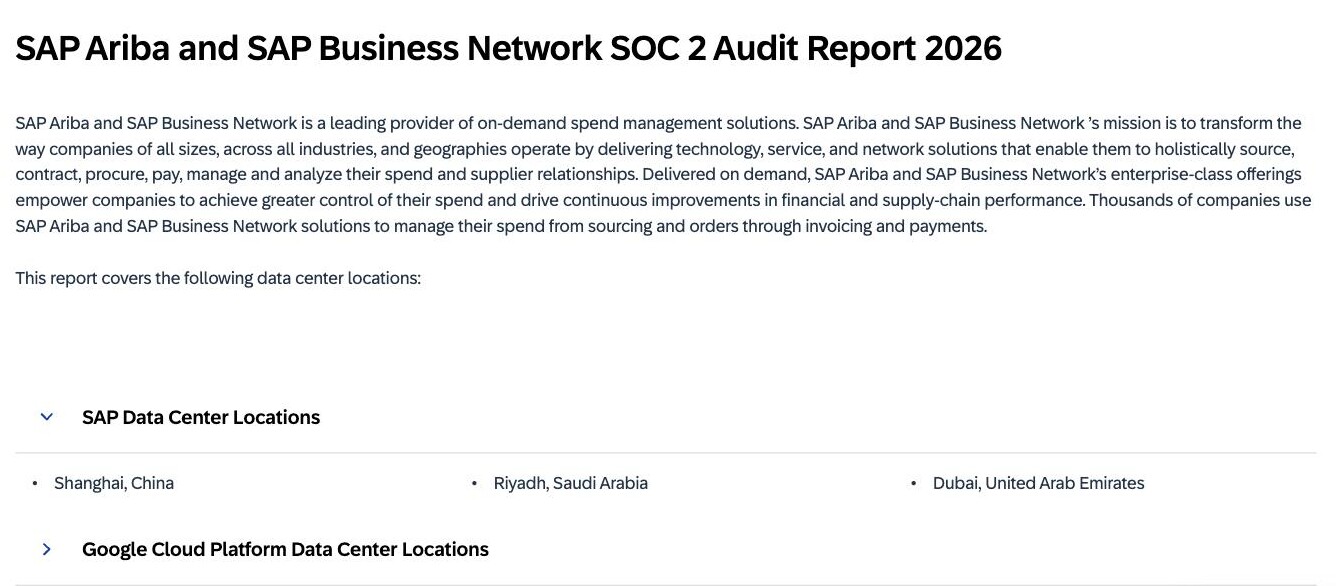
SAP's own 2026 SOC 2 audit report lists "Shanghai, China" under its "SAP Data Center Locations" for the suite. But residency is a provisioning fact about your tenant, not a property of the product — placement follows the account's country and existing accounts can switch, so a legacy or mis-set tenant can still hold procurement data offshore. And because the SAP Business Network connects a China party with counterparties abroad, supplier and buyer contact personal information, purchase orders and invoices move across the border as ordinary operation — a cross-border transfer under PIPL (notice, a separate consent, one transfer mechanism; Articles 38–40), with a possible data-export security assessment at volume or for "important data," and in-country storage under the Cybersecurity Law's Article 39 (formerly Article 37) for a CIIO.
21YunBox maps which of your procurement flows cross the border and whether your data sits on the China-resident footing, localizes what must stay in China, and delivers any public-facing procurement surface in-country on ICP-filed infrastructure — with no rebuild, and never any form of circumvention. Treat the specifics as a risk to confirm with counsel. Our China team can map your exposure with you →
What SAP Ariba's own documentation says about China
| Fact | Primary source |
|---|---|
| SAP Ariba and SAP Business Network run a mainland-China data center. SAP's own 2026 SOC 2 audit report states it "covers the following data center locations:" and lists, under "SAP Data Center Locations," "Shanghai, China" — a mainland region for the suite, alongside sites in Saudi Arabia and the UAE and Google Cloud locations outside China. So, unlike a tool with no China home, the suite can keep China customers' procurement data in-country. | SAP Trust Center — SAP Ariba and SAP Business Network SOC 2 Audit Report 2026, retrieved 2026-10-09 |
| Which data center holds your data follows your account — and can change. SAP's documentation for the suite's Cloud Integration Gateway describes placement as "automated data-center linkage based on the country defined in their company profiles" for new customers, while existing customers "choose which data center they want their data to be routed through" and can switch. So China residency depends on how your specific tenant is provisioned, not on the product alone. | SAP Ariba Cloud Integration Gateway release update 199577 (support.ariba.com), retrieved 2026-10-09 |
| A buyer–supplier network moves personal information across the border by design. The SAP Business Network connects a China party with counterparties abroad, so supplier and buyer contact information, purchase orders and invoices routinely cross the border — a cross-border transfer of personal information under PIPL Articles 38–40 (notice, a separate consent, and one transfer mechanism: a CAC security assessment, the CAC standard contract, or certification), regardless of where the home tenant sits. | Personal Information Protection Law of the PRC, Articles 38–40 (cac.gov.cn), retrieved 2026-10-09 |
| Residency and storage duties turn on your role, not the product. For a critical information infrastructure operator or large-volume handler, personal information collected in China must be stored in the mainland (PIPL Article 40; Cybersecurity Law Article 39 (formerly Article 37)), and above volume thresholds or for "important data" a CAC data-export security assessment may be required before anything leaves — gates the Shanghai region meets only for data actually held there. | PIPL Article 40; PRC Cybersecurity Law Article 39 (formerly Article 37, 2025 amendment in force 2026-01-01); CAC data-export security assessment measures, retrieved 2026-10-09 |
Sources verified by the 21YunBox compliance team on 2026-10-09.
Whether SAP Ariba “works” in mainland China is a data-residency and cross-border question long before it is a speed one — and the honest starting point corrects a common assumption. SAP Ariba and SAP Business Network (the former Ariba Network) do run a mainland-China data center: SAP’s own 2026 SOC 2 audit report lists “Shanghai, China” among its “SAP Data Center Locations” for the suite. So this is not a case of “no China home.” The real questions are narrower and sharper. Is your tenant’s procurement data actually provisioned onto that China-resident footing? And what happens to the supplier and buyer personal information — contacts, contracts, purchase orders, invoices — that a buyer–supplier network moves across the border as a matter of ordinary operation? SAP answers the first in its own documentation; China’s law decides the second.
SAP Ariba in China at a glance
| What decides it | In SAP Ariba's own terms — and China's law |
|---|---|
| What it is | A cloud procurement and supplier-network suite — sourcing, contracts, procurement, and the SAP Business Network connecting buyers and suppliers. It holds supplier and buyer master data and contacts, contracts, purchase orders and invoices: personal information plus commercial data, some of which may count as “important data.” |
| Is there a mainland-China region? | Yes. SAP's 2026 SOC 2 audit report lists “Shanghai, China” under “SAP Data Center Locations” for SAP Ariba and SAP Business Network. Unlike a tool with no China home, the suite can host China customers' data in-country. |
| Is your data actually resident there? | Only if your tenant is provisioned onto the China site. Per SAP's Cloud Integration Gateway documentation, placement is “automated data-center linkage based on the country defined in their company profiles,” and existing accounts “choose which data center they want their data to be routed through.” A legacy or mis-set tenant can still sit offshore. |
| A network that is cross-border by design | The SAP Business Network connects a China party with counterparties abroad, so supplier and buyer contact personal information, purchase orders and invoices move between the mainland and offshore as ordinary operation — a cross-border transfer PIPL governs (Articles 38–40), regardless of where the home tenant sits. |
| Storage, assessment & ICP | For a CIIO or large-volume handler, personal information collected in China must be stored in the mainland (Cybersecurity Law Article 39 (formerly Article 37); PIPL Article 40); above thresholds or for “important data” a CAC data-export security assessment may apply before anything leaves; and a public-facing supplier portal served from inside China turns on an ICP filing. |
A mainland-China region exists — but residency turns on where your tenant actually sits
Start with the correction, because it is the strongest fact here: SAP Ariba is not a foreign SaaS stranded outside the mainland. SAP’s own 2026 SOC 2 audit report names “Shanghai, China” as one of its “SAP Data Center Locations” for SAP Ariba and SAP Business Network, so the suite genuinely can keep China customers’ procurement data in-country — more footing than most foreign platforms offer.
Having a region and being on it, though, are different things. SAP’s documentation for the suite’s Cloud Integration Gateway describes placement as a property of the account, not the product: new customers get “automated data-center linkage based on the country defined in their company profiles,” while existing customers “choose which data center they want their data to be routed through” and can switch. So China residency is a provisioning fact about your specific tenant. An account opened before the China site was available, or one whose profile country is not set to China, can still hold your supplier and buyer data offshore. The first thing to settle is the plainest: which data center is your tenant actually on?
A buyer–supplier network is cross-border by design
The SAP Business Network exists to connect buyers and suppliers — and those counterparties sit in different countries. A China buyer transacting with offshore suppliers, or a China supplier serving offshore buyers, routes supplier and buyer contact personal information, purchase orders and invoices between the mainland and abroad as a matter of ordinary operation. Even when your home tenant sits in Shanghai, those network flows cross the border.
Under China’s Personal Information Protection Law that is a cross-border transfer of personal information, and the duty lands on the handler — you, not SAP: give notice, obtain a separate consent for the overseas transfer, and clear one transfer mechanism — a CAC security assessment, the CAC standard contract, or certification (Articles 38–40). A domestic region answers where data rests; it does not by itself discharge the obligation that attaches to data in motion across the border. This is the half a “we have a China data center” answer tends to miss, and for a buyer–supplier network it is the sharper half.
Residency is not the whole duty — storage, data-export assessment, and a public-facing surface
Three further gates sit beside the network question, and each turns on your posture, not on the product:
- Storage. If you are a critical information infrastructure operator or a large-volume handler, personal information collected in China must be stored in the mainland (Cybersecurity Law Article 39 (formerly Article 37 — the data-localization provision was renumbered by the 2025 Cybersecurity Law amendment that took effect on January 1, 2026, with its substance unchanged); PIPL Article 40). The Shanghai region satisfies this only for the data actually held there — which loops straight back to confirming your tenant’s placement.
- Data-export assessment. Above volume thresholds, or where procurement records amount to “important data,” moving them offshore may require China’s data-export security assessment (数据出境安全评估) before anything leaves.
- A public-facing surface. A supplier-registration or onboarding portal actually served to mainland users from inside China carries an ICP filing duty, bound to a mainland hosting resource.
None of this is a verdict that SAP Ariba is “blocked” or “illegal” — it plainly is neither, and it offers more China footing than most foreign SaaS. It is a risk map: which gate bites turns on your entity, your data volumes, your role as handler, and who your counterparties are — worth settling with counsel before your China procurement depends on it.
The lawful path — map, localize, deliver
There is a lawful way to run procurement for China, and it has a shape. First, map: our China team works through where your Ariba data actually rests and which of your buyer–supplier flows cross the border, against your entity and data volumes — what must stay in China, what may lawfully leave, where an Article 39 storage duty or a data-export security assessment bites, and what your consent and notice has to cover. The legal conclusions are settled with counsel; we build the technical picture that feeds them.
Then localize: we make sure the China procurement data sits on a China-resident footing — SAP’s own Shanghai region for the suite where your tenant can be provisioned onto it, or an in-country arrangement for the surfaces it does not cover — and, where a domestic procurement or ERP platform is the better fit for a given flow (the Yonyou or Kingdee ecosystem, for instance), we adopt and integrate one, so the data that must stay in China stops leaving it by default.
Then deliver: the China-facing surfaces — a supplier portal, an onboarding or registration page your mainland users actually open — are themselves a public service in the mainland, so they carry an ICP-filing duty and need compliant, in-country delivery. 21YunBox delivers them in-country — the 21YunBox Optimizer — in front of what you already run, with no rebuild and no re-platform. The result is procurement that runs legally and compliantly for your users in China. What we never do — and what no one lawfully can — is hand you a route around China’s data-export rules or around any network restriction; we localize what must stay and deliver in-country, and we never move personal information out of China by stealth.
Related reading:
- Cross-border data transfers under PIPL
- China’s data-export security assessment
- China’s Cybersecurity Law (data localization, Article 39)
- How to get an ICP filing for China