Does Aprimo Work in China? Data Residency, ICP & Cross-Border Rules
Aprimo is a cloud-only SaaS content-operations and digital-asset-management platform on Microsoft Azure, with no mainland-China region and no on-premise edition — so the brand and campaign content it holds, and the personal information embedded in it, come to rest offshore under PIPL's cross-border and data-localization rules.
Does Aprimo work in China?
The question isn't whether Aprimo loads in China — it does; it's where the content Aprimo holds is allowed to rest. Aprimo is a cloud-only SaaS content-operations and digital-asset-management platform running on Microsoft Azure, with no mainland-China region and no on-premise edition. So the brand and campaign content it holds — and the personal information embedded in it, from talent releases to the people depicted in creative — comes to rest offshore. Moving that mainland personal information abroad is a PIPL cross-border transfer (Articles 38–40), and a CIIO or high-volume handler owes an in-country storage duty an offshore library cannot meet (Cybersecurity Law Article 39 (formerly Article 37)). Reachability is the delivery half; residency is the question.
What Aprimo's own documentation says about China
| Fact | Primary source |
|---|---|
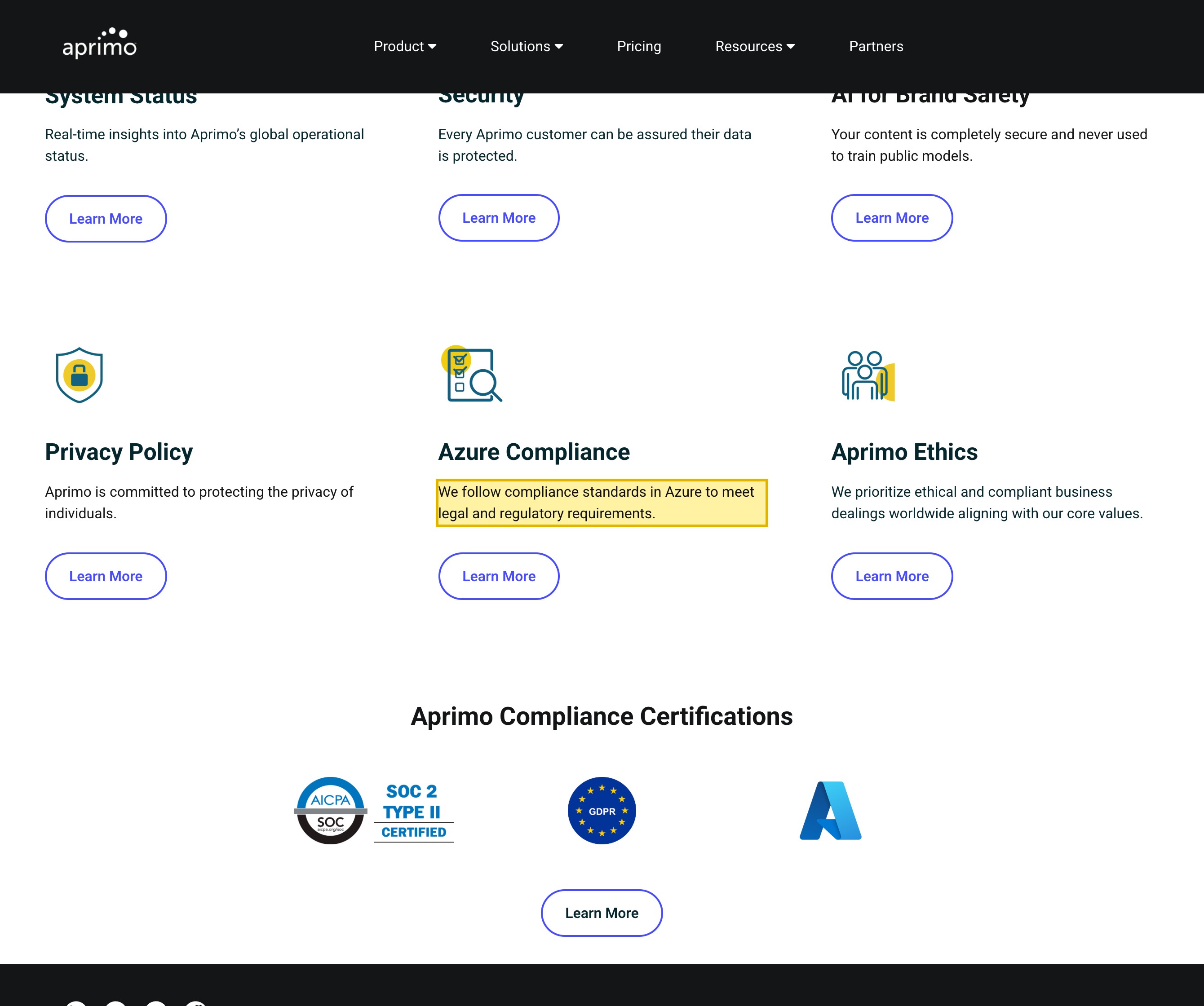
| Aprimo's own trust center describes the product as SaaS — "Trust is the Cornerstone of Aprimo SaaS" — and states "We follow compliance standards in Azure to meet legal and regulatory requirements," placing the platform on Microsoft Azure's global cloud. | Aprimo Trust Center (retrieved 2026-10-14) |
| Aprimo's developer documentation routes every tenant to a subdomain under aprimo.com and lists no mainland-China hosting region and no on-premise or self-hosted edition; the platform has been delivered as cloud SaaS on Azure since its 2017 SaaS launch. | Aprimo Developers — Introduction (retrieved 2026-10-14) |
| Moving personal information collected in the mainland out of China is a cross-border transfer that requires notice, a separate consent, and one of the statutory transfer mechanisms (PIPL Articles 38–40). | Personal Information Protection Law / Cross-border data transfers (21YunBox gov-doc) |
| A critical information infrastructure operator or high-volume handler must store mainland-collected personal information and important data inside China (PIPL Article 40; Cybersecurity Law Article 39 (formerly Article 37)). | China Cybersecurity Law — data localization (21YunBox gov-doc) |
Sources verified by the 21YunBox compliance team on 2026-10-14.
For a team serving mainland China, the real question about Aprimo was never whether the platform loads or whether marketers can reach the portal — it is a cloud application on Microsoft Azure, and it opens from the mainland. The question is a residency one: where is the content Aprimo holds allowed to come to rest? Aprimo is a content-operations and digital asset management (DAM) platform — the system of record for a brand’s images, video, creative files, logos and product media, together with the marketing plans, campaign content, workflows, reviews and approvals wrapped around them. It holds the actual files and records, not a pointer to them. Most of that is brand and marketing intellectual property, but a real slice is personal information — model and talent releases, the employees and customers depicted in photos and video, the identities of the marketers, reviewers and approvers moving work through the system, and the user accounts of everyone with access. And Aprimo is cloud-only: a SaaS running on Microsoft Azure, with no mainland-China region to select and no self-hosted or on-premise edition to run in-country.
Aprimo in China at a glance
| What decides it | In Aprimo's own terms — and China's law |
|---|---|
| Where the content physically rests | Aprimo is a SaaS running on Microsoft Azure — in its own trust center, "We follow compliance standards in Azure to meet legal and regulatory requirements." Azure's global cloud carries no mainland-China region, and Azure's separate mainland-China cloud is a distinct partition operated by a local partner that Aprimo does not deploy into. So the master files, metadata, campaign content and audit trail come to rest offshore. |
| What the library holds, and why residency bites | A content-operations and DAM platform is mostly brand and marketing intellectual property — creative, logos, product media, campaign plans — but it still carries personal information: model and talent releases, the employees and customers depicted in the files, the identities of the marketers, reviewers and approvers in workflow, and the accounts of everyone with access. It is not the uniformly Article 28 sensitive trove a legal or health repository is, yet specific items — a government-ID number captured in a release, an identifiable biometric likeness — can reach that bar, and the rest is personal information under PIPL all the same. |
| Your mainland users' content | Content created, and personal information captured, in China that comes to rest on an Azure region abroad is a cross-border transfer the Personal Information Protection Law governs: notice, a separate consent, and one transfer mechanism (PIPL Articles 38–40). The handler on the hook is you, the operator — not the vendor. |
| In-country storage duty | A critical information infrastructure operator or high-volume handler owes an in-country storage duty an offshore content library cannot meet — mainland personal information and important data must stay in the mainland (PIPL Article 40; Cybersecurity Law Article 39 (formerly Article 37)) — the 2025 Cybersecurity Law amendment, in force January 1, 2026, renumbered the data-localization article from 37 to 39, substance unchanged. |
| Is it reachable? | Treat reachability as the delivery half, not the question — the portal, APIs and web client load from the mainland. Because Aprimo is cloud-only with no self-hosted edition, the lawful lever is to run the content store in-country on a licensed in-country or sovereign equivalent, and any China-facing surface in front of it — the brand portal, share links, the web client or admin console — needs an ICP filing tied to a mainland hosting resource (State Council Order No. 292; MIIT Order No. 33). |
Where the content actually rests
Aprimo is delivered as a SaaS on Microsoft Azure, and its own trust center is explicit that the service runs on that platform: the headline is “Trust is the Cornerstone of Aprimo SaaS,” and the Azure entry reads “We follow compliance standards in Azure to meet legal and regulatory requirements.” What that leaves unsaid is just as decisive: Azure’s global cloud has no mainland-China region to select, and the mainland-China Azure cloud is a physically and operationally separate partition run by a local partner — not one a global SaaS like Aprimo is automatically present on, and not one Aprimo lists a residency option for. Point your brand and marketing teams at Aprimo and the content lands on an offshore Azure region.
Two things then rest abroad, not one. First the content itself — the master creative, product media, campaign files, the descriptive metadata that names people, products and usage rights, and the version and approval history around them. Second, delivery: to serve a global audience, a DAM distributes the web-ready derivatives of that content widely. Under the Personal Information Protection Law, moving the China personal information those assets and records carry out of the country is a cross-border transfer, and the handler responsible is you — the operator — not the vendor.
What it holds is personal information — and some of it sensitive
Be precise about a content-operations and DAM platform, because overstating it helps no one. A brand library is, in the main, intellectual property — the creative, the logos, the product imagery, the campaign plans — not a case file of health or financial records. But it is not free of personal information either. Model and talent releases carry names, signatures and sometimes a government-ID number; the photos and video themselves depict identifiable employees, customers and models, and an identifiable face or voice can be biometric; usage records name the people and parties a license runs to; and the workflow and user directory hold the names and email addresses of the marketers, reviewers, approvers and admins with access. Some of that reaches the Article 28 sensitive bar — a release that captures an ID number, a biometric likeness tied to an identity — while the rest is ordinary personal information under PIPL. Either way, the moment that material is stored and replicated on an offshore Azure region, that personal information has left the mainland.
That matters beyond best practice. For a critical information infrastructure operator, and for a handler whose volumes cross the regulators’ thresholds, personal information and important data collected in the mainland must be stored in the mainland (PIPL Article 40; Cybersecurity Law Article 39 (formerly Article 37)). An offshore content library structurally cannot satisfy that duty — the content is, by definition, in the wrong country. And where an export is permitted at all, crossing a volume or sensitivity threshold can trigger a CAC-led data-export security assessment before any of it lawfully leaves.
Why a reachability check misses this
Asking “does Aprimo open from Shanghai?” is answering the wrong question. The platform loads; that tells you nothing about compliance. The binding constraints are where the content rests and on what legal basis: a cloud-only SaaS on an offshore Azure region parks a brand’s creative, its campaign content, its metadata and its approval records outside the mainland, and the personal information embedded in that material travels with it. A speed or uptime probe cannot see any of that — it cannot see which Azure region holds the master files, whether a release in the library carries a government-ID number, or whether your entity owes an in-country storage duty. Those are the questions a mainland deployment actually turns on.
There is a wrinkle specific to this vendor: Aprimo is cloud-only. There is no self-hosted or on-premise Aprimo edition you can stand up on mainland-China infrastructure, so the in-country lever here is not “run the vendor’s binary locally.” It is to run the content store in-country another way — a lawful in-country or licensed sovereign-cloud equivalent that keeps the master files, metadata and records on mainland soil — while only a minimized, consented, lawfully transferable subset ever crosses the border. Pointing a mainland connector back at the offshore Aprimo endpoint is not localization and does not meet the storage duty; standing up a lawful in-country equivalent is.
This is a risk map, not a verdict. Whether you owe in-country storage, a transfer mechanism, a separate consent, an ICP filing, or some combination turns on your entity, your data volumes, how much of the library and its records is personal or Article 28 sensitive, and who those people are — and it is worth settling with counsel before you decide where a single mainland asset comes to rest.
The lawful path — map, localize, deliver
You do not have to drop Aprimo to run content operations lawfully for mainland China. 21YunBox is a compliant overlay, not a migration — and, for a platform you already run, a partner that sits alongside your stack, not a competitor to it. There are three moves, and they fit together.
Map. Our China compliance team reads your PIPL cross-border, data-residency and data-localization (CII) obligations against your actual entity, your content and user volumes, and whose personal information your releases, media, workflows and records carry — so the exposure is written down before anything is moved.
Localize. Because the risk is where the content library rests, we run the content store in-country — on a licensed in-country or sovereign-cloud equivalent — so the master files, metadata and records China requires to stay on mainland soil do. Localize means a lawful in-country deployment of the content store, never a route back to an offshore endpoint; only the minimized, lawfully transferable subset ever crosses.
Deliver. For any China-facing surface in front of the library — the brand portal, the share links, the reporting console, the web client your mainland users hit — the 21YunBox Optimizer provides ICP-filed, in-country delivery, in front of the stack you already run. No rebuild, no second codebase. 21YunBox never uses or suggests circumvention of any kind; the entire point is a lawful, filed, in-country path.
The goal is plain: your content operations run legally and compliantly for your users in China.
Related reading:
- How to get an ICP filing for China
- Cross-border data transfers under PIPL
- China’s Cybersecurity Law and data localization
- China’s data-export security assessment measures


