
Does Adobe Experience Manager (AEM) work in China?
Yes, AEM runs in China — but whether it "works" is a compliance question, and the answer rides on how you host it. Run AEM as a Cloud Service and it is Adobe-operated and, by Adobe's own account, delivered from outside the mainland; host it inside China and data residency becomes reachable — but the ICP filing and the PIPL posture for the public site stay with you on either path.
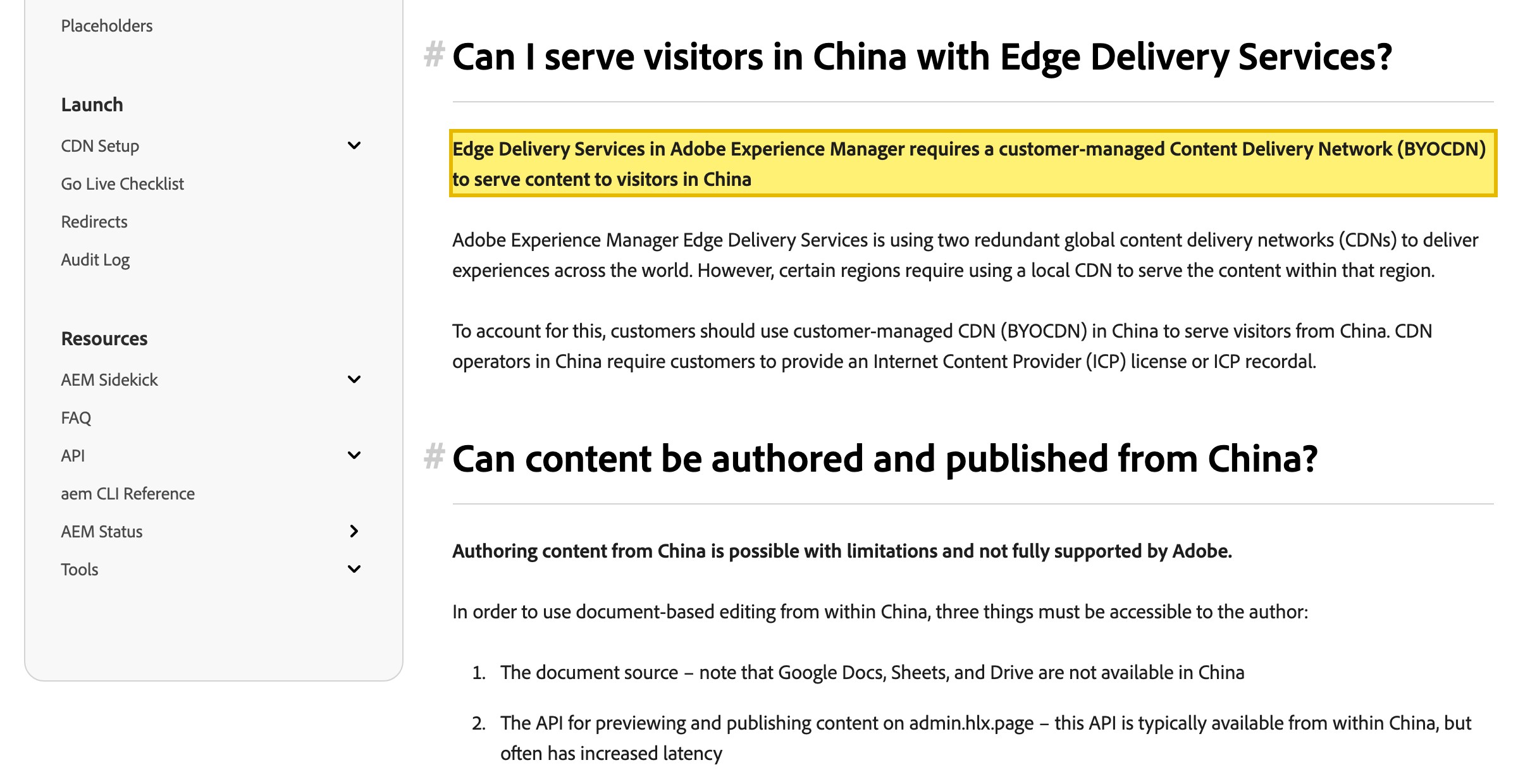
Adobe's own Edge Delivery Services China FAQ states its delivery networks "are currently operated outside of China" and that reaching the mainland "requires a customer-managed Content Delivery Network (BYOCDN) to serve content to visitors in China," where "CDN operators in China require customers to provide an Internet Content Provider (ICP) license or ICP recordal." Serve the mainland from the offshore Cloud Service and your users' personal information leaves China — a cross-border transfer PIPL governs, on delivery that still needs an ICP filing to run lawfully in-country. The table below pairs Adobe's wording with the rule each hosting door triggers.
This is a risk picture for counsel, not a ruling — what actually applies depends on your legal entity, the personal data you handle, and whether you serve the public in China. Have our China team map your AEM exposure with you →
Compliance snapshot
- ! AEM as a Cloud Service is Adobe-operated and, in Adobe's words, delivered from outside China
- ✕ An offshore Cloud Service can't hold the ICP filing a public mainland site needs
- ! Adobe's own China fix is a CDN you bring — and that CDN requires your ICP
- ✓ Self-managed or in-China hosting can keep your data inside the mainland
- ! Either way, the ICP filing and the PIPL cross-border call land on you, not Adobe
The compliance facts behind running an AEM experience in mainland China
| Fact | Primary source |
|---|---|
| On the Cloud Service, Adobe runs AEM's delivery — and it runs it outside China. Adobe's Edge Delivery Services China FAQ says the service is using "two redundant global content delivery networks" and that these "are currently operated outside of China." Reaching mainland visitors is therefore not something the Cloud Service does in-country — it is something you add. | Adobe — Edge Delivery Services China FAQ (aem.live/docs/china), retrieved 2026-10-07 |
| Adobe's own China fix is a CDN you supply — and it aims that CDN straight at an ICP filing. The FAQ says AEM "requires a customer-managed Content Delivery Network (BYOCDN) to serve content to visitors in China," and that "CDN operators in China require customers to provide an Internet Content Provider (ICP) license or ICP recordal" — the ICP regime under State Council Order No. 292 and MIIT Order No. 33. That filing attaches to a licensed mainland operator, never to Adobe's offshore delivery. | Adobe — Edge Delivery Services China FAQ (aem.live/docs/china), retrieved 2026-10-07; State Council Order No. 292; MIIT Order No. 33 |
| Adobe does offer an in-China hosting path — and it exists for compliance. The same FAQ addresses customers who "require all AEM servers to be hosted in China" for reasons "including, but not limited to, compliance such as Multi-Level Protection Scheme (MLPS), data residency, Baidu SEO," and answers that "Adobe Managed Services for Adobe Experience Manager are available in China." Putting servers in the mainland makes data residency achievable — but the ICP filing and the residency posture then belong to the operator, not to Adobe. | Adobe — Edge Delivery Services China FAQ (aem.live/docs/china), retrieved 2026-10-07 |
| Serve the mainland from the offshore Cloud Service and your China users' data crosses the border. Their personal information is then stored outside the mainland — a cross-border transfer under PIPL that requires notice, separate consent and one transfer mechanism (Articles 38–43). For a critical information infrastructure operator or a large-volume handler, personal information collected in China must be stored in the mainland (PIPL Article 40; Cybersecurity Law Article 39 (formerly Article 37)) — a duty no offshore deployment can meet. | PIPL Articles 38–43 & 40; Cybersecurity Law Article 39 (formerly Article 37) |
Sources verified by the 21YunBox compliance team on 2026-10-07.
For a global enterprise, Adobe Experience Manager usually sits at the center of the whole digital experience — every brand site, campaign and localized page published from one platform and one content model. That is exactly why the question “does AEM work in China?” is rarely answered by how quickly a page paints. The real question is whether you are permitted to serve that experience to people inside the mainland, and whose name the permission sits under — and Adobe answers it candidly in its own documentation. The honest answer comes in two shapes, decided by how you host AEM. (For a one-screen version of what follows, see our quick AEM compliance reference; this piece walks the full reasoning.)
Adobe Experience Manager in China at a glance
| What decides it | In Adobe's own terms |
|---|---|
| How you host AEM | AEM runs three ways — as an Adobe-operated Cloud Service, through Adobe Managed Services, or self-managed on infrastructure you choose. The China answer changes with the choice, so the hosting decision comes first. |
| Cloud Service delivery | Adobe-operated and global: its Edge Delivery Services, in Adobe's words, “are currently operated outside of China,” on “two redundant global content delivery networks.” Nothing in that network sits in the mainland. |
| Reaching mainland visitors | Adobe says the Cloud Service “requires a customer-managed Content Delivery Network (BYOCDN) to serve content to visitors in China” — a China CDN you bring, not one Adobe runs in-country. |
| The licensing gate | “CDN operators in China require customers to provide an Internet Content Provider (ICP) license or ICP recordal.” The filing binds to a mainland operator; it cannot attach to Adobe's offshore delivery. |
| Hosting inside China | Adobe acknowledges customers who “require all AEM servers to be hosted in China” for “compliance such as Multi-Level Protection Scheme (MLPS), data residency, Baidu SEO,” and offers Adobe Managed Services “available in China.” Residency becomes reachable — the ICP filing and residency duties become yours. |
Door one — AEM as a Cloud Service is Adobe-operated, and it runs offshore
Adobe Experience Manager as a Cloud Service is run by Adobe: you publish into it, but you do not choose its data centers, and — the part that matters for China — its delivery does not sit inside the mainland. Adobe says so plainly in its own Edge Delivery Services FAQ. The service, it writes, is using “two redundant global content delivery networks,” and those networks “are currently operated outside of China.” To reach the mainland at all, the FAQ continues, AEM “requires a customer-managed Content Delivery Network (BYOCDN) to serve content to visitors in China.”
Read that as Adobe being honest about a boundary rather than admitting a flaw: the Cloud Service hands you the China-delivery problem; it does not solve it in-country. And the moment you stand up that customer-managed CDN, a second, non-negotiable requirement appears in the same breath. Adobe writes that “CDN operators in China require customers to provide an Internet Content Provider (ICP) license or ICP recordal.” That is the ICP regime under State Council Order No. 292 and MIIT Order No. 33, and it means the in-country door is a China CDN bound to an ICP filing — a filing that attaches to a licensed mainland operator, never to Adobe. “We’ve standardized on AEM” is a sound platform decision; it is not, by itself, a China presence.
Door two — you can put AEM inside China, but the compliance moves with the servers
The other door is to place AEM’s servers in the mainland. Adobe’s own China FAQ is the clearest signpost that this path exists, and that it exists for compliance reasons: it addresses customers who “require all AEM servers to be hosted in China” for reasons “including, but not limited to, compliance such as Multi-Level Protection Scheme (MLPS), data residency, Baidu SEO,” and answers that “Adobe Managed Services for Adobe Experience Manager are available in China.” Alongside that managed route, AEM also ships as a self-managed product you can operate on infrastructure you pick — including mainland infrastructure.
What in-country hosting buys you is real: with content and user data on servers physically in China, data residency stops being a problem and becomes an answer. What it does not buy you is an exit from the paperwork. Putting the servers in the mainland does not make the licensing disappear — it relocates it onto you or your operator. The public site still needs its ICP filing, and the residency posture — where personal data lives, how it is replicated, who may reach it — is now yours to design and defend rather than Adobe’s. In-country hosting is the honest route to data residency; it is not a way around the filing.
Both doors arrive at the same two obligations — an ICP filing and a cross-border decision
Pull the two paths together and they converge, because in every case AEM is serving a public website to people inside China. The first shared obligation is the ICP filing: a site delivered to mainland visitors has to be filed against a licensed hosting or CDN resource inside the mainland (State Council Order No. 292; MIIT Order No. 33). On the Cloud-Service path Adobe makes that unavoidable in its own words — the China CDN operator “require[s] customers to provide an Internet Content Provider (ICP) license or ICP recordal” — and on the in-China path the filing simply attaches to the servers you placed there.
The second obligation is about data. Serve the mainland from the offshore Cloud Service and your users’ personal information is stored outside China — a cross-border transfer under PIPL, which calls for notice, separate consent and one lawful transfer mechanism (Articles 38–43). If you are a critical information infrastructure operator or a large-volume handler, personal information collected in China must be kept in the mainland (PIPL Article 40; Cybersecurity Law Article 39 (formerly Article 37)) — a residency duty the offshore Cloud Service cannot meet, and precisely the one an in-China deployment is built to satisfy. Which obligations bite, and how hard, depends on the door you pick and the data you hold.
This is a risk map, not a verdict: whether a given AEM rollout triggers an ICP filing, in-country storage, or both is a function of the deployment you choose, the volume and sensitivity of the personal data you hold, and whether you serve the public in China — settle it with counsel before you commit to a launch date.
Where 21YunBox fits — a compliant overlay, not a migration
Neither door asks you to leave AEM, and neither is something more performance tuning can close. Whichever way you host — Adobe-operated Cloud Service, Adobe Managed Services, or servers you run yourself — 21YunBox adds the single piece Adobe explicitly leaves to the customer: compliant, ICP-filed delivery from inside the mainland, set in front of the AEM origin you already publish from. No rebuild, no parallel codebase, no second content model to keep in sync. Our China team weighs which hosting door fits your entity and your data volumes, works the PIPL cross-border and data-residency questions through with you, and stands up the in-country delivery and the filing a lawful mainland presence depends on — while AEM stays the system of record it already is.
Related reading:
Frequently Asked Questions
Does moving to AEM as a Cloud Service give us a China presence?
No. The Cloud Service is Adobe-operated and, in Adobe's words, its delivery networks "are currently operated outside of China"; reaching the mainland "requires a customer-managed Content Delivery Network (BYOCDN)" that you bring. It is an excellent global DXP, but it does not place an ICP-filed, in-country presence under your site — that part is still yours to arrange.
Can we just host AEM inside China to be compliant?
Hosting in the mainland — self-managed, or via Adobe Managed Services, which Adobe says are "available in China" — can keep data in-country, and it is why Adobe's FAQ acknowledges customers who "require all AEM servers to be hosted in China" for MLPS and data-residency reasons. But in-country hosting is the honest route to data residency, not a shortcut around the licensing: the public site still needs an ICP filing, and the residency posture becomes yours to design and defend. Where the line falls for your data and entity is a question for counsel.
Can 21YunBox help our AEM site work in China without leaving Adobe?
Yes. You keep AEM — Cloud Service, Adobe Managed Services or self-managed — and we add the piece Adobe tells you to supply: ICP-filed, in-country delivery placed in front of your existing AEM origin, with no rebuild and no second codebase. Our China team assesses your PIPL cross-border and data-residency exposure for your entity and data volumes, and handles the filing alongside delivery. Get in touch to work through your specific case.
