What the filing authorities and access providers actually require
| Fact | Primary source |
|---|---|
| The filing/licence split is set by statute, not by practice: a licence is required for commercial internet information services and a filing for non-commercial ones, and without one or the other, one may not engage in internet information services at all. | State Council Decree No. 292, Article 4 — Administrative Measures on Internet Information Services |
| The dividing line is whether users are charged: commercial means providing information or web page services for a fee; non-commercial means openly available information provided free of charge. A corporate marketing site is ordinarily non-commercial. | State Council Decree No. 292, Article 3 |
| The enforcement mechanism for the filing regime is not primarily monetary: a site operating without a filing is ordered to rectify within a time limit, and on refusal the website is ordered closed. | State Council Decree No. 292, Article 19 |
| Decree 33, Article 5: without a filing, one may not engage in non-commercial internet information services inside the territory — and the scope is defined by the website, including one reachable only by IP address, not only by domain. | MII Decree No. 33, Article 5 — Measures on the Filing of Non-Commercial Internet Information Services |
| Decree 33, Article 12: where the materials are complete, the provincial communications administration shall complete the filing within 20 working days; where incomplete, it refuses and notifies with reasons within the same window. | MII Decree No. 33, Article 12 |
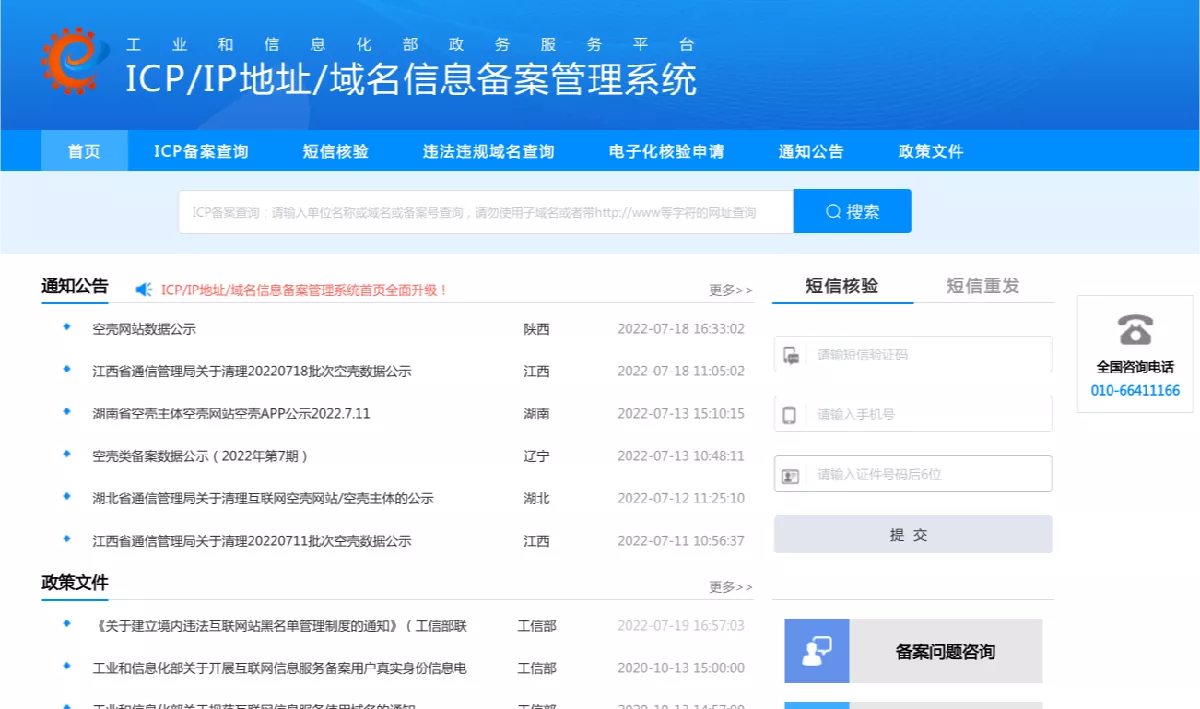
| Decree 33, Article 13: the filing number must be shown at the centre of the bottom of the homepage, with a link beneath it to the ministry filing system so the public can verify it. | MII Decree No. 33, Article 13 |
| Decree 33, Article 18: an internet access service provider is prohibited from providing access to an unfiled party, and must immediately suspend or terminate access to one that has been penalised with closure. | MII Decree No. 33, Article 18 |
| Decree 33, Articles 20 and 14: filings are subject to annual review, and changes to the declared information must be filed 30 days in advance. | MII Decree No. 33, Articles 14 and 20 |
| Decree 33, Article 22: serving without a filing draws an order to rectify plus an RMB 10,000 fine; if rectification is refused, the website is closed. Article 23: filing false information leads to closure and cancellation with no rectification step. | MII Decree No. 33, Articles 22 and 23 |
| The filing requirement is triggered by where the server is, not by who owns the site: "ICP filing applies only to servers located in the Chinese mainland", and "Websites, apps, and other services with domain names resolving to servers in the Chinese mainland must obtain an ICP filing." | Alibaba Cloud — ICP filing prerequisites |
| The requirement follows delivery, not only server location — keeping the origin abroad and pointing a China CDN at it does not avoid it: it applies "whether the site is hosted on a server in Mainland China or delivered to visitors in China through a CDN", and without a licence "your site can be shut down." | Cloudflare — China Network: Internet Content Provider (ICP) |
| The filing is tied to the access provider, not just the domain. Moving delivery to a new provider requires adding that provider to the filing: "If you already have an ICP filing from another provider and want to resolve your domain name to an Alibaba Cloud server in the Chinese mainland, you must add Alibaba Cloud as a service provider." | Alibaba Cloud — ICP filing prerequisites |
| Leaving a filing without a current access provider is not neutral — the site is reclassified: after removing a provider you must "add a new service provider promptly. Otherwise, your website or app may be classified as an empty shell" (空壳网站), which leads to the filing being cancelled. | Alibaba Cloud — ICP filing prerequisites |
| A domain registered outside mainland China must be transferred to a MIIT-approved mainland registrar before it can be filed, and the TLD itself must be one MIIT has approved. | Alibaba Cloud — ICP filing required materials |
| Every filing is publicly verifiable. The issued number must appear in the site footer, linked to MIIT's public records system, where any filing can be checked by domain or company name. | MIIT — public ICP/IP/domain filing records |
Sources verified by the 21YunBox compliance team on 2026-08-28.

Navigating the complexities of China’s internet regulations can be challenging for businesses. This comprehensive guide explains everything you need to know about China ICP licenses and ICP filings (备案 - Bei’an) (备案 - Bei’an). Learn what an ICP license is, why it’s crucial for operating websites and apps online in China, and how to obtain one for your digital presence.
What is an ICP license, and what is an ICP filing?
An ICP (Internet Content Provider) license, also known as ICP备案 (Bei’an) in Chinese, is the official permit required for websites, mobile apps, and online content to operate legally within mainland China. Introduced in 2000 by the Telecommunications Regulations of the People’s Republic of China, this license system is a cornerstone of China’s internet governance and cybersecurity framework.
Key points about the China ICP license:
- Mandatory for all websites and apps accessible in mainland China
- Issued by the Ministry of Industry and Information Technology (MIIT)
- Ensures compliance with Chinese internet regulations and cybersecurity laws
- Different types available based on the nature of online activities
- Critical for businesses targeting the Chinese market
</div>ICP filing vs ICP licence: which one do you actually need?
It’s crucial to understand the distinction between an ICP Filing and an ICP License:
ICP Filing (备案 - Bei’an)
- Required for all websites accessible in mainland China
- Applies to non-commercial, informational websites
- Simpler application process
- Statutory review window of 20 working days from a complete file (Decree 33, Article 12); 20–40 working days is what the round trips add up to in practice
- Allows hosting on mainland China servers
ICP License (许可证 - Xu Ke Zheng)
- Required for commercial websites and online services
- Allows for online transactions and profit-generating activities
- More complex application process with stricter requirements
- Usually takes 60-90 working days to obtain
- Necessary for e-commerce, paid content, and other commercial online activities
Understanding which type you need is the first step in your China ICP journey.
For more detailed information on commercial ICP licenses, including requirements and application processes, check out our comprehensive guide on China Commercial ICP Licenses.
Why is an ICP required at all?
The Chinese government strictly regulates internet content and services within its borders. An ICP license is not just a legal requirement; it’s a necessity for any entity looking to establish a digital presence in China.
According to Article 4 of the Administrative Measures on Internet-Based Information Systems:
“Those who have not obtained a license or have not performed the filing procedures shall not engage in Internet information services.”
This regulation applies to:
- Websites hosted on mainland China servers
- Mobile applications available for download in China
- E-commerce platforms operating in the Chinese market
- Content delivery networks (CDNs) serving Chinese users
- Cloud services and data centers operating within China
If you’re specifically interested in ICP requirements for mobile apps, our detailed guide on How to Get a Mobile App ICP Filing Number in China provides all the necessary information.
Failure to obtain an ICP license can result in:
-
Website blocking
-
App removal from Chinese app stores
-
Potential legal consequences and fines
-
Inability to monetize your online presence in China
-
Loss of credibility with Chinese partners and customers
What do you get once the filing is in place?
Obtaining an ICP license offers numerous advantages for businesses targeting the Chinese market:
- Legal Compliance: Operate your website or app without fear of government intervention.
- Improved Performance: Host your content on mainland servers for faster loading times and better user experience.
- SEO Advantages: Chinese search engines like Baidu favor sites with ICP licenses. Learn more about SEO strategies for China.
- Access to Chinese Domains: Eligibility to use .cn and .com.cn domains. Check out our guide on domain name suffixes available for ICP filing.
- App Store Distribution: Publish your apps on Chinese app stores, reaching a wider audience.
- WeChat Integration: Display content on the leading popular social platform, WeChat, without being blocked.
- Enhanced Credibility: Build trust with Chinese users, partners, and potential investors.
- Access to Chinese Cloud Services: Utilize local cloud providers for optimized performance.
- Compliance with Data Localization Laws: Meet requirements for storing Chinese user data within mainland China.
What happens if you serve China without one?
Operating without an ICP license in China carries significant risks:
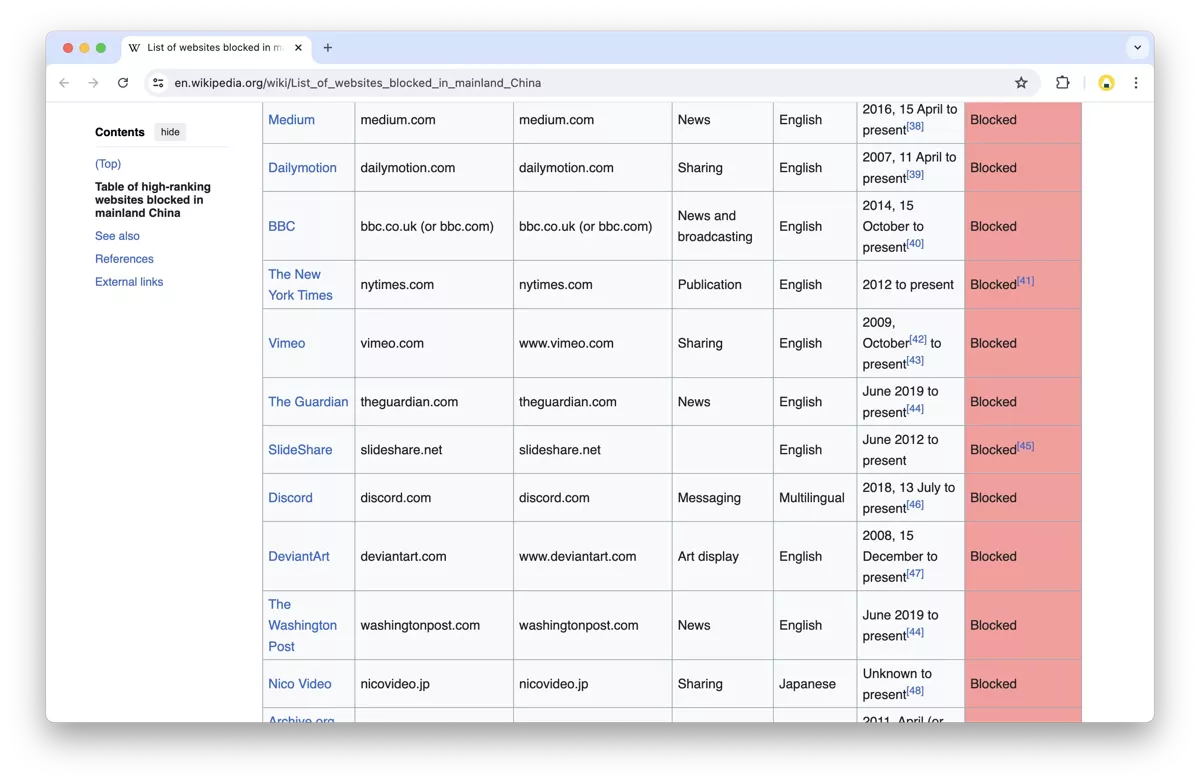
- Website Blocking: Your site may be inaccessible within mainland China, losing potential traffic and customers.
- Legal Consequences: Potential fines and legal action by Chinese authorities, which can be costly and damage your reputation.
- Loss of Market Access: Inability to reach the vast Chinese online audience, estimated at over 1 billion internet users.
- Reputation Damage: Reduced trust from Chinese consumers and partners, affecting your brand’s credibility.
- Missed Opportunities: Exclusion from Chinese digital ecosystems, e-commerce platforms, and marketing channels.
- Technical Limitations: Inability to use Chinese CDNs or optimize your site for the local internet infrastructure.
- Financial Losses: Potential revenue loss from blocked transactions or inaccessible services.
What does the ICP filing regulation actually say?
Decree 292 above establishes that a filing is required. A second instrument sets out how the filing works, how long it takes, and — the part that decides your launch — who else is bound by it. It is short, and the operative articles are worth reading in the original.
Instrument: 《非经营性互联网信息服务备案管理办法》 — Administrative Measures on the Filing of Non-Commercial Internet Information Services, Ministry of Information Industry Decree No. 33, in force since 20 March 2005. The Ministry of Information Industry is the predecessor of today’s MIIT; the decree remains the filing rule.
Filing is a precondition, and the scope is defined by the site, not the company
第五条 在中华人民共和国境内提供非经营性互联网信息服务,应当依法履行备案手续。未经备案,不得在中华人民共和国境内从事非经营性互联网信息服务。
本办法所称在中华人民共和国境内提供非经营性互联网信息服务,是指在中华人民共和国境内的组织或个人利用通过互联网域名访问的网站或者利用仅能通过互联网IP地址访问的网站,提供非经营性互联网信息服务。
Article 5. Anyone providing non-commercial internet information services within the territory of the People’s Republic of China shall complete filing formalities in accordance with law. Without a filing, one may not engage in non-commercial internet information services within the territory. “Providing non-commercial internet information services within the territory” means an organisation or individual within the territory providing such services through a website reachable by internet domain name, or through a website reachable only by IP address.
In practice: the second paragraph is the one engineers should read. The obligation attaches to the website — including one served on a bare IP with no domain at all. A staging host, an API endpoint, an internal tool on a mainland address: none of these fall outside the definition because they lack a public domain name.
The clock is 20 working days once the file is complete
第十二条 省通信管理局在收到备案人提交的备案材料后,材料齐全的,应在20个工作日内予以备案,向其发放备案电子验证标识和备案编号……材料不齐全的,不予备案,在20个工作日内通知备案人并说明理由。
Article 12. After receiving the materials submitted by the applicant, the provincial communications administration shall, where the materials are complete, complete the filing within 20 working days and issue an electronic verification mark and a filing number … Where the materials are incomplete, it shall not file, and shall notify the applicant with reasons within 20 working days.
In practice: 20 working days is the statutory review window, and it is measured from a complete submission. That is why the elapsed time teams actually experience is longer than 20 days without the authority ever missing its deadline — each incomplete submission is refused and the clock starts again. The lever you control is completeness, not urgency. The realistic end-to-end range we see is in the table further down.
The number has to be in a specific place, and it has to link
第十三条 非经营性互联网信息服务提供者应当在其网站开通时在主页底部的中央位置标明其备案编号,并在备案编号下方按要求链接信息产业部备案管理系统网址,供公众查询核对。
Article 13. A non-commercial internet information service provider shall, when its website goes live, indicate its filing number at the centre of the bottom of the homepage, and beneath the filing number link to the ministry’s filing management system as required, so the public can query and verify it.
In practice: Decree 292 says “a prominent position”. This decree says centre-bottom of the homepage, with a link to the ministry’s system underneath. That is the standard the check is run against, and it is why compliant Chinese sites all look the same in the footer. A filing number rendered as plain text with no link is a defect under this article, not a stylistic choice.
The article that actually decides whether you can launch
第十八条 互联网接入服务提供者不得为未经备案的组织或者个人从事非经营性互联网信息服务提供互联网接入服务。
对被省通信管理局处以暂时关闭网站或关闭网站处罚的非经营性互联网信息服务提供者或者非法从事非经营性互联网信息服务的组织或者个人,互联网接入服务提供者应立即暂停或终止向其提供互联网接入服务。
Article 18. An internet access service provider shall not provide internet access services to an unfiled organisation or individual for the purpose of non-commercial internet information services. Where a provider has been penalised by the provincial communications administration with temporary or permanent closure of its website, or is unlawfully providing such services, the access service provider shall immediately suspend or terminate access services to it.
In practice: this is the mechanism, and it is not aimed at you. It binds the data centres, access carriers and hosting providers. They are prohibited from carrying an unfiled site, and required to cut off a penalised one — which is why “we will file it later, after launch” is not a plan that any compliant mainland provider can accept. The failure mode is not an argument with a regulator; it is that no lawful network inside the country will connect you in the first place. Article 10 puts a matching duty on the provider not to file on someone’s behalf when it knows the information is untrue.
Filing is not one-and-done
第二十条 省通信管理局依法对非经营性互联网信息服务备案实行年度审核。
第十四条 非经营性互联网信息服务提供者在备案有效期内需要变更其《备案登记表》中填报的信息的,应当提前30日……履行备案变更手续。
Article 20. The provincial communications administration conducts annual review of filings in accordance with law. Article 14. Where a provider needs to change the information declared in its filing form during the validity period, it shall complete the change formalities 30 days in advance …
In practice: an annual review obligation and a 30-day-notice change obligation. Changing the responsible entity, the site’s stated purpose, or the hosting arrangement is a filing event, not an internal one. Article 28 provides that failing to submit the annual review information on time leads to an order to rectify, and on refusal, closure of the site and cancellation of the filing.
And the penalty is closure, with a fine attached
第二十二条 违反本办法第五条的规定,未履行备案手续提供非经营性互联网信息服务的,由住所所在地省通信管理局责令限期改正,并处1万元罚款;拒不改正的,关闭网站。
Article 22. Where non-commercial internet information services are provided without completing filing formalities in breach of Article 5, the provincial communications administration of the place of domicile shall order rectification within a time limit and impose a fine of RMB 10,000; if rectification is refused, the website shall be closed.
In practice: the fine is small and the consequence is not. Read alongside Article 18, the enforcement story is coherent: the money is nominal because the real sanction is that the site stops existing in that market and its access provider is obliged to help. Article 23 adds that filing on false information leads directly to closure and cancellation, with no rectification step — which is the reason to get the entity and the site description right rather than plausible.
Where this leaves the architecture decision
Article 5 attaches to serving from inside the territory, so this decree is the price of being inside. The other gate — whether the page loads at all — is a separate question with a separate answer, and being filed and inside China does not settle it: we measured four delivery arrangements from a mainland probe and the in-country, filed, unoptimised path still failed to finish loading. Permission and reachability have to be designed together, or you buy one and discover you needed both.
Primary source: 《非经营性互联网信息服务备案管理办法》(信息产业部令第33号), full text in the State Council Gazette: State Council Gazette, 2005, No. 32. Filing records are queryable at beian.miit.gov.cn. Translations here are ours and are for orientation only; where the English and the Chinese differ, the Chinese governs. This is not legal advice.
How do you get an ICP filing? The eight steps
Obtaining an ICP license involves several steps and can be complex, especially for foreign entities. Here’s a detailed overview of the process:
- Determine License Type
- Decide between ICP Filing or Commercial License based on your activities
- ICP Filing: For non-commercial, informational websites
- Commercial License: For e-commerce and other profit-generating online activities
For a deeper dive into the commercial ICP license process, see our China Commercial ICP License Guide. If you’re focusing on mobile apps, our Mobile App ICP Filing Guide offers specific insights for app developers.
-
Establish Legal Presence
- Foreign companies typically need a local Chinese entity or partnership
- Options include:
- Setting up a Wholly Foreign-Owned Enterprise (WFOE)
- Partnering with a Chinese company
- Using a local representative office (available in some regions)
-
Choose a Hosting Provider
- Select a licensed Chinese hosting service that supports ICP applications
- Ensure the provider is familiar with ICP regulations and can guide you through the process
- Consider providers like Alibaba Cloud, Tencent Cloud, or specialized services like 21YunBox
-
Prepare Documentation
- Gather required documents, including:
- Business license or company registration documents
- Personal identification of the legal representative
- Website information (domain name, site purpose, content description)
- Server location information
- Content compliance statement
- Network security commitment letter
- Gather required documents, including:
-
Submit Application
- File your application through your hosting provider or directly with MIIT
- Ensure all information is accurate and consistent across all documents
-
Verification Process
- Undergo checks by the hosting provider and government authorities
- This may include content reviews and technical inspections
- Be prepared to make adjustments based on feedback
-
Approval and Issuance
- Receive your ICP license number upon successful verification
- Display the ICP number prominently on your website’s footer
- Ensure ongoing compliance with Chinese internet regulations
-
Post-Approval Compliance
- Regularly review and update your website content to maintain compliance
- Report any significant changes in your business or website to the authorities
- Renew your ICP license as required (typically annually)
For foreign businesses, navigating this process can be challenging due to language barriers and complex regulations. Many opt to work with experienced local partners or services like 21YunBox to streamline the application process and ensure compliance.
</div>What has changed recently?
The regime moves, and it moves in one direction — wider scope and tighter checks. The shifts that matter to a foreign applicant:
- Stricter Data Localization: Enhanced requirements for storing Chinese user data within mainland China, affecting cloud service providers and multinational corporations.
- Expanded Scope: New categories of online services now requiring ICP licenses, including certain types of SaaS platforms and IoT services.
- Accelerated Processing: Streamlined application processes for certain business types, particularly in strategic industries like AI and green technology.
- Increased Scrutiny: More rigorous content and security checks during the application process, with a focus on cybersecurity and content moderation capabilities.
- Cross-border E-commerce Regulations: New guidelines for foreign e-commerce platforms serving Chinese consumers, impacting ICP licensing requirements.
- Mobile App Compliance: Stricter rules for mobile apps, including mandatory security assessments for apps in sensitive categories.
- Blockchain Service Regulations: New ICP filing requirements for blockchain-based services operating in China.
The practical consequence is that an application prepared against last year’s checklist gets rejected on this year’s. That is also why an existing filing is worth re-verifying rather than assuming — see what gets applications rejected.
How long does an ICP filing take?
Plan the schedule around the paperwork, not the engineering. The technical work is days; the filing is weeks, and it cannot be compressed by paying more.
| Stage | Typical duration | What actually drives it |
|---|---|---|
| Domain transfer to a mainland registrar | 1–2 weeks | Finding who inside your company controls the registrar account, and getting the auth code |
| Document gathering | 1–3 weeks | Business licence, legal-representative ID, notarised translations. This is where most slippage happens |
| Provincial review of an ICP filing (备案) | 20 working days by statute; 20–40 in practice | Article 12 of Decree 33 gives the authority 20 working days from a complete file. Each incomplete submission is refused and restarts it, so province and completeness — not urgency — set the real elapsed time |
| Commercial ICP licence (B25) | Substantially longer | It is a licensing process with capital, staffing and infrastructure requirements, not a registration |
| PSB filing after approval | Within 30 days of going live | A separate obligation people forget until they are already live |
Two things routinely surprise teams. The domain step comes before everything else and is frequently the longest, because it is an internal-ownership problem rather than a regulatory one. And if you also need to incorporate a mainland entity first, add months — entity formation, not the filing, becomes the schedule.
How much does an ICP filing cost?
The MIIT filing itself carries no government fee. What you pay for is everything around it, and the shape of the bill depends entirely on which of two situations you are in.
What you are actually paying for is the work around the filing: document review, translation and notarisation, submission, and the clarification rounds with the provincial authority until the number is issued. Priced by whoever does it — you, a local agency, or a partner.
Five things move that number, and none of them is traffic:
- Whether you hold a mainland entity. This is the order-of-magnitude variable. Everything below is rounding error next to it.
- How many domains and subdomains need to be on the filing.
- Whether a mobile app filing runs alongside the website filing — separate, and one per app.
- Whether you need the PSB filing as well, which is due within 30 days of going live.
- Filing (备案) or commercial licence (B25). The licence is a licensing process with capital, staffing and infrastructure requirements — a different order of cost and time entirely.
If you already have a mainland entity, the rest is administrative: mainland hosting, a mainland domain registration, and the notarised documents. Public guides from China-market consultancies commonly quote total project costs of US$3,000–US$15,000 for this route. That figure is theirs, not ours, and it applies to the simple case — an existing entity, one domain, a plain filing. Use it as a sanity check on any quote you receive, including ours.
If you do not have a mainland entity, that range does not apply to you, because the dominant cost is no longer the filing. Your two options are to form one — incorporation, registered capital, and ongoing corporate obligations, measured in months and tens of thousands of dollars — or to work with a partner that holds the filing and stands as the entity of record. The second is not a cheaper version of the first; it is a different arrangement, in which someone else carries the compliance liability. Which of those is right depends on whether China is a market you are entering or a market you are testing.
The mistake to avoid is budgeting the filing and not the prerequisite. Almost every over-run we see comes from a project that costed the application and discovered the entity requirement afterwards.
What gets ICP applications rejected?
When applying for an ICP license in China, be aware of these common pitfalls:
-
Incomplete documentation: Ensure all required documents are properly prepared and submitted. Missing or incorrect paperwork can significantly delay your application.
-
Inconsistent information: Make sure all information across your application, website, and business registration is consistent. Discrepancies can raise red flags.
-
Ignoring content regulations: Familiarize yourself with China’s content restrictions and ensure your site complies. Remove or modify any potentially sensitive content before applying.
-
Underestimating timelines: Start the application process well in advance of your planned launch date. Delays are common, and rushing can lead to errors.
-
Neglecting ongoing compliance: Remember that maintaining compliance is an ongoing process, not a one-time task. Regular audits and updates are necessary.
-
Using unlicensed hosting providers: Ensure your chosen hosting provider is fully licensed to operate in China and experienced with ICP applications.
-
Misunderstanding license types: Applying for the wrong type of ICP license can waste time and resources. Understand whether you need an ICP Filing or a Commercial License.
-
Overlooking mobile requirements: If you have a mobile app, ensure it complies with additional mobile-specific regulations in China.
-
Ignoring data localization laws: Ensure your data storage and processing practices comply with Chinese data localization requirements.
-
Failing to display ICP information correctly: Once obtained, your ICP license number must be prominently displayed on your website, usually in the footer.
By avoiding these common mistakes, you can streamline your ICP application process and increase your chances of success in the Chinese market.
</div>What our China compliance lead sees on live applications
We spoke with Sam Hoi, a senior consultant at 21YunBox, about the latest trends in China’s ICP regulations:

Sam also highlighted some key points for businesses to consider:
-
Increased focus on cybersecurity: “The Chinese government is placing more emphasis on network security. Companies should be prepared to demonstrate robust cybersecurity measures as part of their ICP application.”
-
Mobile-first approach: “With the majority of Chinese internet users accessing content via mobile devices, having a mobile-optimized presence is crucial. This often means obtaining ICP licenses for both websites and mobile apps.”
For businesses focusing on mobile apps, understanding the specific ICP requirements for mobile applications is crucial. Our Mobile App ICP Filing Guide provides in-depth information on this topic.
-
Localization is key: “Beyond just translating content, businesses need to truly localize their digital presence for the Chinese market. This includes adapting to local user preferences and integrating with popular Chinese platforms.”
-
Prepare for ongoing compliance: “Obtaining an ICP license is just the first step. Businesses must be prepared for ongoing compliance checks and potential regulatory changes.”
How 21YunBox handles the filing
Navigating China’s ICP licensing process can be daunting, especially for foreign businesses. At 21YunBox, we specialize in simplifying this journey:
-
Expert Guidance: Our team of China internet compliance experts understands the nuances of Chinese internet regulations and stays up-to-date with the latest changes.
-
End-to-End Support: We handle the entire ICP application process on your behalf, from initial assessment to final approval.
-
Compliance Assurance: Ensure your online presence fully complies with Chinese laws, including content regulations and data localization requirements.
-
Hosting Solutions: We offer optimized hosting services specifically designed for the Chinese market, ensuring fast load times and reliable access for your Chinese audience.
-
Ongoing Support: Stay updated with changing regulations and maintain compliance with our continuous monitoring and advisory services.
-
Localization Services: Beyond ICP licensing, we can help you adapt your digital presence for the Chinese market, including website localization and integration with local platforms.
-
Custom Strategies: We develop tailored strategies for each client, considering their specific business needs and goals in the Chinese market.
Don’t let the complexity of China’s internet landscape hold your business back. Contact 21YunBox today to start your journey towards a successful online presence in China.
Conclusion
Obtaining an ICP license is a critical step for any business looking to establish a digital presence in China. While the process can be complex, especially for foreign entities, the potential rewards of accessing the world’s largest online market make it a worthwhile endeavor.
Key takeaways:
- Understanding the difference between ICP Filing and ICP License is crucial.
- Start the application process early and be prepared for potential delays.
- Ensure full compliance with Chinese content and data regulations.
- Consider working with experienced partners like 21YunBox to navigate the process smoothly.
- Stay informed about the latest regulatory changes and market trends.
By following the guidelines in this comprehensive guide and leveraging expert assistance, you can successfully obtain your ICP license and tap into the vast opportunities of the Chinese digital market.
Ready to expand your digital footprint in China? Contact our ICP experts for a personalized consultation and take the first step towards China ICP compliance today!