
How do you actually test whether an app or game works in China?
The single most common testing mistake is checking for a response instead of checking for completion. Measured fact: across 280 enterprise sites requested three times each from a probe inside mainland China on 2026-08-28~29, 34% finished none of their attempts — and roughly two thirds of those had already returned a first byte, most of them painting content before stalling. A connectivity check passes on every one of those. So does an uptime monitor that waits for a 200. The second mistake is where you test from: in a paired run, hosts that answered 100% of the time from a mainland cloud probe answered 0% of the time from a Beijing consumer broadband line — a cloud instance and a home line inside the same country are not the same network, and almost every published China measurement is taken from the former. A test that produces a usable answer therefore has to do three things: load the whole thing rather than ping it, record what did not return rather than only what did, and state the vantage it was taken from. Whatever the test finds, the fix that removes the border crossing is also the one that brings the ICP filing into scope.What we learned building the test
| Fact | Primary source |
|---|---|
| Across 280 enterprise sites requested three times each from a probe inside mainland China on 2026-08-28~29, 34% finished none of their attempts within a 60-second ceiling, and roughly two thirds of those had returned a first byte and painted content before stalling. Checks that test for a response rather than for completion pass on all of them. | 21YunBox — 280-site China delivery census, measured from inside mainland China |
The vantage changes the answer completely for some hosts. In a paired run, www.googletagmanager.com answered 72 of 72 requests from a mainland cloud probe and 0 of 112 from a Beijing China Mobile residential line — including 14 requests inside pages that finished loading, so it was not a timeout artifact. | 21YunBox — paired measurement from a Beijing residential broadband line |
| What fails is usually a dependency rather than the thing under test. Measured across 88 real page loads from a Beijing residential line, 102 hosts never returned a response and 101 of them were third parties, while every one of the 57 failing sites returned a first byte itself. A test that reports only a page-level pass or fail cannot tell you which request to act on. | 21YunBox — paired measurement from a Beijing residential broadband line |
Sources verified by the 21YunBox China engineering team on 2026-08-30.
Testing your mobile app or game for the Chinese market is a crucial step to ensure its success. However, the Chinese digital landscape presents unique challenges that can affect app functionality and performance. In this comprehensive guide, we will walk you through the essential steps to test your app in China and highlight how 21YunBox can assist you in this journey.
Navigating the Challenges
While your app may operate seamlessly in your home country, ensuring its functionality in China presents a unique set of challenges. The formidable Great Firewall of China imposes restrictions on various international services, including well-known platforms such as AWS Global, Google Cloud Services, Azure Global, and Firebase. If your app heavily relies on these services, it may encounter hurdles when accessed in Mainland China. A notable example is Android apps that depend on Google Play Services, facing compatibility issues with many Chinese-brand phones, even when attempting installation through a VPN.
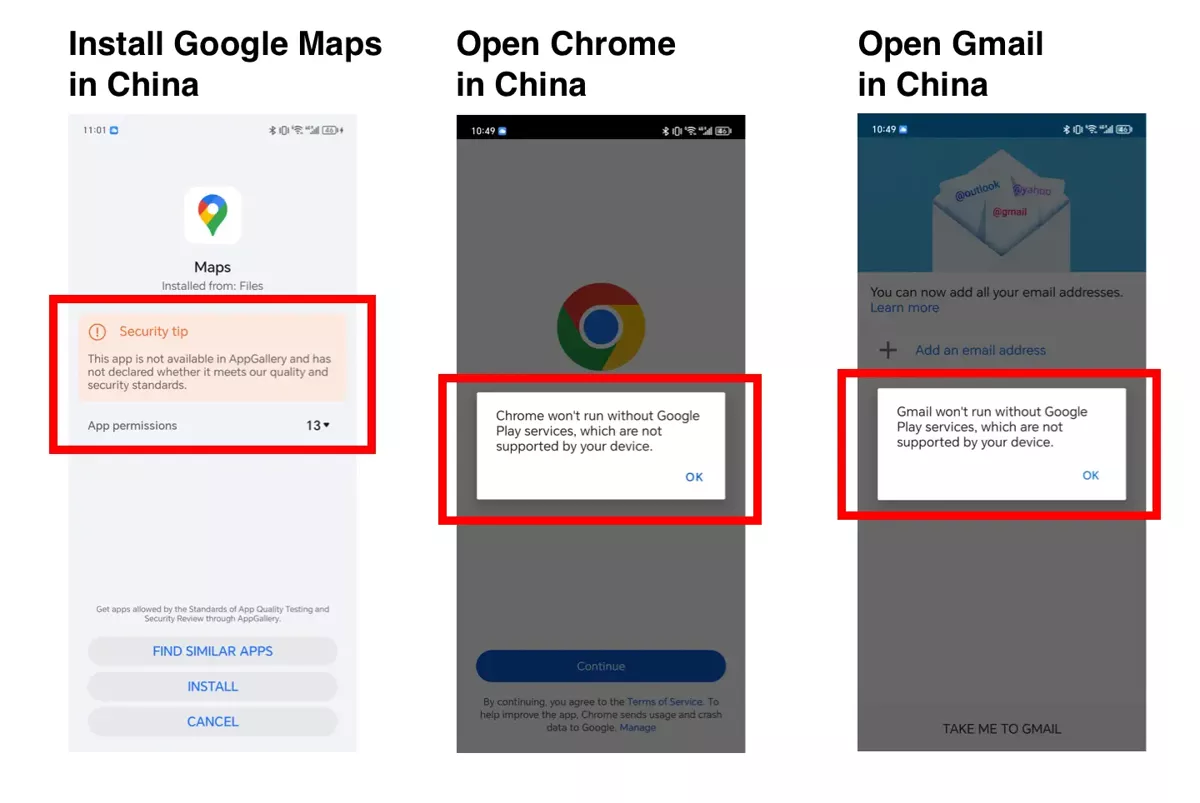
Upon attempting to install your app in China, especially through platforms like Huawei’s Android App Store (AppGallery), users may encounter a warning message stating: “This app is not available in AppGallery and has not declared whether it meets our quality and security standards.”
Similar warnings and policies are prevalent in other app stores in China.
Link: Explore Top App Stores in China.
Users may proceed to click “Install,” but upon opening the app, they will confront a discouraging message: “[APP NAME] won’t run without Google Play services, which are not supported by your device.”
These instances serve as just a glimpse into the potential challenges your app may face in China. That’s where we come in – our comprehensive testing services are designed to help you navigate and address these issues, ensuring your app functions flawlessly in the Chinese market.
Link: Discover Google and Firebase Solutions for China.
Unlock App Success with Our Testing and Compliance Services
Explore our comprehensive testing and compliance services to ensure your app's seamless performance in the Chinese market. Our experts are ready to assist you in every step of the way, from testing to compliance, to make your app shine in China.
Request a Free Consultation CallEnsuring Optimal Speed
Beyond functionality, consider the speed of your app in China. If your app or game communicates with servers outside of China, expect potential slowdowns for your Chinese users. Factors such as geographical distance and the Chinese government’s traffic filtering can significantly impact the user experience, especially in the case of games.
To evaluate your app’s availability and speed in Mainland China, you can use services like 21YunBox’s Site Testing.
Partnering with 21YunBox
21YunBox offers a comprehensive testing solution for your app or game in Mainland China. Our testing services cover various aspects, including:
- Availability and Loading Speeds
- Crash Testing and Error Detection
- Correct Rendering of UI Elements
- Font Compatibility
- Translation Quality Assurance (English and Chinese)
- Additional Testing Tailored to Your Needs
Moreover, if you plan to distribute your app or game in China through our platform, we will continue to test each iteration and update you submit to Chinese app stores.
Contact us with your specific requirements and concerns, and our international team will provide a customized quote to meet your needs.