What is Baidu and how to get started
Baidu, also known as 百度, is China's dominating search engine, with about 70% market share in China's search engine market.
What does a foreign company need to rank and advertise on Baidu in China?
Showing up on Baidu is a filing question before it is a marketing one. A mainland-hosted site cannot legally go live without an ICP filing, Baidu reaches and indexes an in-country filed site far more reliably than an unfiled offshore one, and to run Baidu paid search on top of that you clear a separate business-qualification review.
Two gates sit in front of a foreign company. First the host: Chinese law lets no one provide Internet information service without a license or ICP filing (备案), so the site Baidu points to — served from inside the mainland, where it is crawled and reached most reliably — must be ICP-filed in a China entity's name. Second the ad account: Baidu Ads (百度营销) puts every advertiser through a qualification review (资质审核) of a valid business license and supporting documents, requires the advertised site to be mainland-hosted and ICP-filed with the filing name matching the license, and asks regulated sectors — healthcare, education, food, finance — for extra category permits; a foreign company with no mainland entity typically onboards through a licensed local partner. And the visitor and lead data you collect from Baidu-referred users in China is personal information the PIPL governs once it leaves the mainland. The guide below walks the sign-up steps; the facts here are the gates that decide whether those steps are open to you.
Treat this as a risk map to work through with counsel, not a yes/no — which path fits turns on your entity, your sector and whose data you handle. Our China team can map your Baidu path with you →
What a foreign business must clear to rank and advertise on Baidu
| Fact | Primary source |
|---|---|
| By law, nothing goes live from a mainland server without a license or an ICP filing — and that filing is held by a China entity. The Measures for the Administration of Internet Information Services (State Council Order No. 292) establish "a licensing system for commercial Internet information services and a filing system for non-commercial Internet information services," and provide that anyone who has not obtained a license or completed filing formalities "may not engage in Internet information services" (Article 4). Hosting a site on mainland servers therefore runs through an ICP filing (备案) made by a licensed provider (MIIT Order No. 33) — which is why Baidu indexes and reaches an in-country, filed site far more dependably than an unfiled offshore one. How ICP filing works → | Measures for the Administration of Internet Information Services (State Council Order No. 292), gov.cn Gazette text, retrieved 2026-10-07; MIIT Order No. 33 |
| To run paid search, the advertiser is vetted and the advertised site must be ICP-filed to the business behind it. China's Measures for the Administration of Internet Advertising place registration, review and record-keeping duties on advertising operators and publishers: the platform builds and keeps files on each advertiser's real identity, address and contact details, verifies the supporting documents, checks the advertisement before it runs, and keeps the records on file. So an ad account is cleared through a documented review, which in practice keys to a valid mainland Chinese business license. Separately, any mainland-hosted site the ads point to must itself be ICP-filed under the ICP regime (State Council Order No. 292; MIIT Order No. 33), with the filing resolving to the same accountable business — so the ad account, the website and its filing all line up to one entity. How ICP filing works → | Measures for the Administration of Internet Advertising (SAMR Order No. 72, effective 2023-05-01) — advertising operator/publisher registration, verification and record-keeping duties; neutral summary (Securiti), retrieved 2026-10-08. ICP-filing requirement per State Council Order No. 292 and MIIT Order No. 33. |
| A business license alone is not always enough — regulated categories carry extra advertising requirements. Under China's Measures for the Administration of Internet Advertising, advertisers must meet the law's qualification, approval and supporting-document requirements for whatever they promote, and sensitive categories face a harder gate: advertisements for medical treatment, drugs, medical devices and health food must be reviewed and approved by a competent advertising-review authority before they can be published online, and then run only as approved. So which extra documents and approvals apply is sector-specific — confirm your category's requirements before you file, because a business license that does not cover the advertised activity will not carry the ad. | Measures for the Administration of Internet Advertising (SAMR Order No. 72, effective 2023-05-01) — advertiser qualification/approval requirements and pre-publication review for regulated categories; Morgan Lewis LawFlash, "New Measures for Online Advertising in China: What You Need to Know" (2023-04-10), retrieved 2026-10-08 |
| An overseas applicant carries a heavier document burden than a domestic one. For a foreign company, Baidu account setup "requires enterprise-level verification," typically with a Baidu paid-search account "as the entry point." The applicant submits a "copy of your company's business registration certificate (e.g., Certificate of Incorporation or equivalent)" bearing a handwritten note that it "is the same as the original" (文件与原文件一致) plus the registering office and contact details, and "all non-Chinese documents must be translated into Simplified Chinese by a certified translator" with notarization — "Baidu rejects untranslated or unnotarized submissions." Sensitive sectors such as finance or pharmaceuticals "may need extra licenses or pre-approvals from Chinese authorities." | Ecommerce China Agency — Opening a Baidu Company Account for Overseas Businesses (protocols as of late 2025), retrieved 2026-10-07 |
| The visitor and lead data you collect from Baidu-referred users in China is regulated personal information — and handling it offshore is a cross-border transfer. Traffic and form data from mainland users is personal information under the PIPL, so moving it out of the mainland (for example to an offshore CRM or analytics stack) triggers the PIPL's cross-border transfer rules — notice, separate consent and a transfer mechanism such as a CAC security assessment, standard contract or certification (Articles 38–43). For a critical-information-infrastructure operator or a high-volume handler, that data must be stored in China (Cybersecurity Law Article 39 (formerly Article 37); PIPL Article 40). | Personal Information Protection Law (PIPL) Articles 38–43 & 40 (China Law Translate); Cybersecurity Law Article 39 (formerly Article 37) (2025 amendment, effective 2026-01-01, renumbered from the 2016 Article 37), retrieved 2026-10-07 |
Sources verified by the 21YunBox compliance team on 2026-10-07.
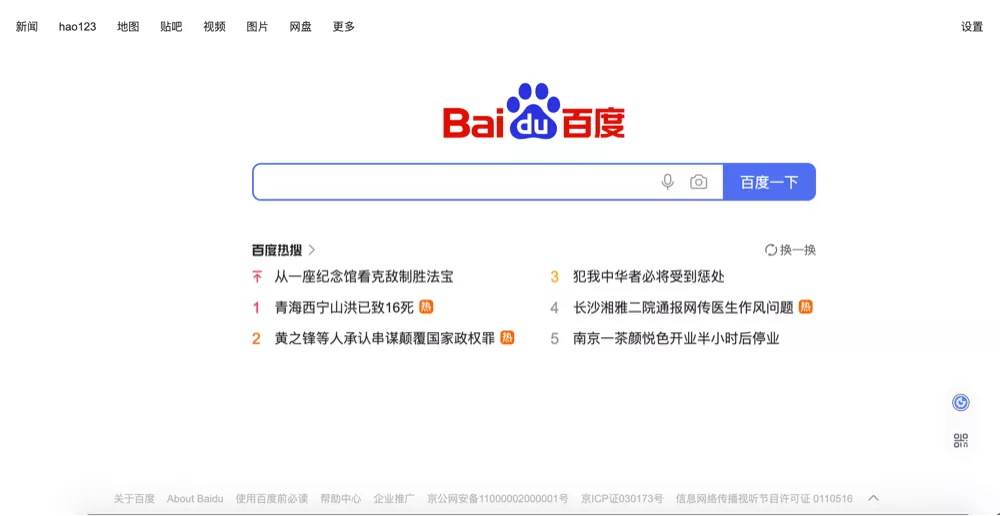
About Baidu
Baidu, also known as 百度, is China’s dominating search engine, with about 70% market share in China’s search engine market.
Incorporated in 2000, Baidu held a 76.05% market share in China’s search engine market and has the second largest search engine worldwide. In 2007, Baidu became the first Chinese company to be included in the NASDAQ-100 index. It is currently the sixth largest website and one of the world’s most significant AI and Internet companies.
Besides a Chinese search engine, Baidu offers various services, such as a mapping service called Baidu Maps, a Cloud Storage service called Baidu Wangpan, and a query-based search community called Baidu Baike (akin to Wikipedia), etc.
How To Get Started On Baidu
SEO (Search Engine Optimisation) and SEM (Search Engine Marketing) in China are very different from those in the rest of the world, especially the technical and legal requirements. Because Google is completely blocked in China due to its reluctance to comply with the Chinese government’s regulations regarding censorship, 75% of all local searches are done on Baidu, the leading Chinese search engine, and other local China-specific search engines.
To develop an SEO or SEM strategy for China, you can read our previous article about SEO in China.
Do not have a Chinese entity, Chinese phone number or Chinese ID? We can help!
If you do not have a Chinese entity, Chinese ID, or Chinese phone number, which is essential to get started on Baidu, 21YunBox is here to help.
We can provide the necessary supporting documents to get started on Baidu and walk you through the process. Meanwhile, we will also bring your company, product, and service into full compliance with Chinese law.
Contact us now to learn more about our solutions for doing business in China legitimately!
RELATED COMPANIES

ARTICLES RELATED TO BAIDU

PARENT COMPANY
Baidu Inc.
OWN BY THE SAME PARENT COMPANY
WESTERN EQUIVALENTS
- Bing
Ready to Accelerate Your Site in China Legitimately?
Join 21YunBox and the 5,000+ developers and enterprises to use modern deployment technology
Get StartedLaunch Your Site in China with Confidence
