
Does Adobe Experience Manager (AEM) work in China?
Whether AEM works in China is a data-residency, reachability and ICP question before it is a performance one — and for the AEM that Adobe hosts, the servers sit outside the mainland. Adobe Experience Manager is Adobe's enterprise digital experience platform, and where each deployment runs is what sets the China answer.
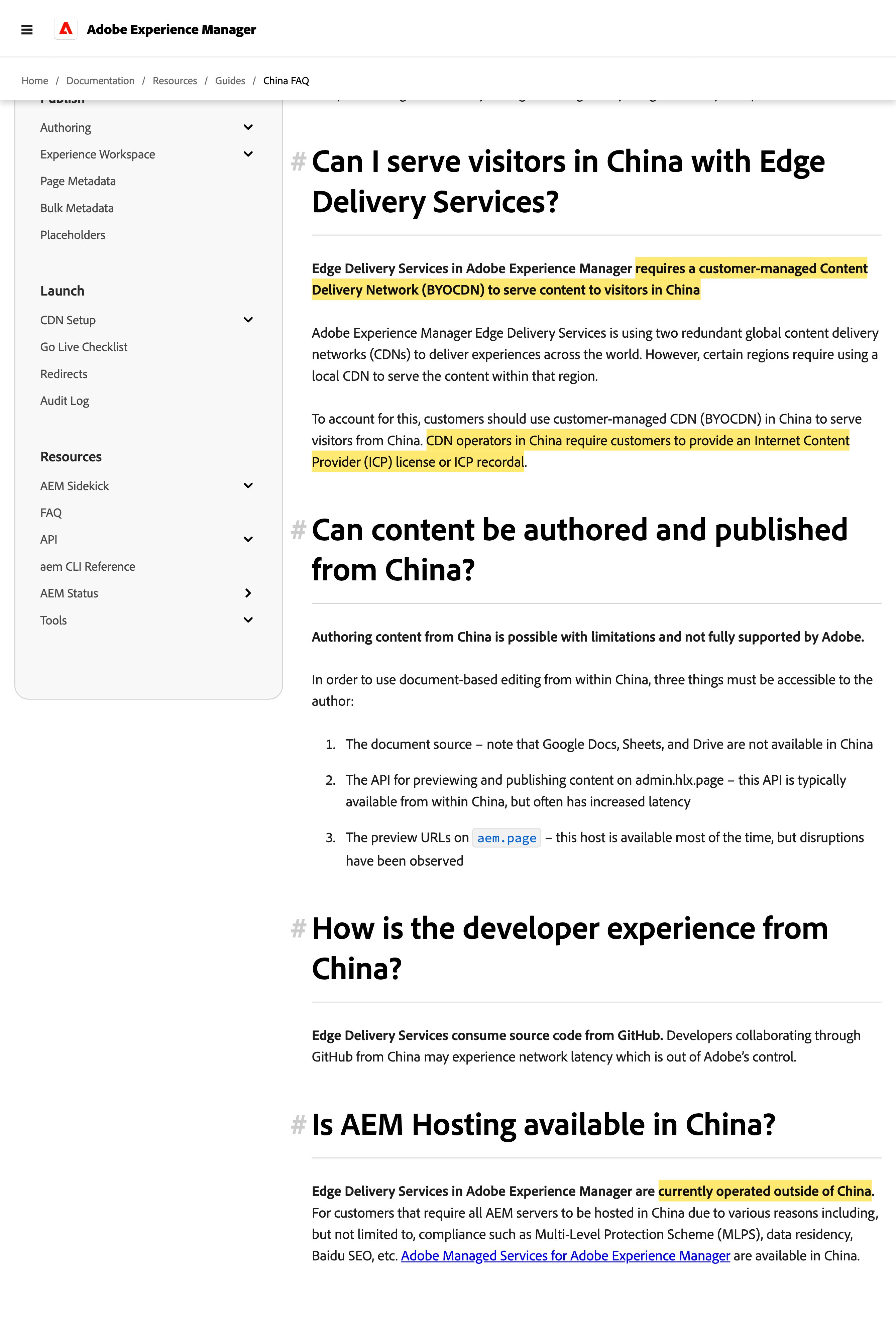
In its own China FAQ Adobe states that "Edge Delivery Services in Adobe Experience Manager are currently operated outside of China," tells customers to "use customer-managed CDN (BYOCDN) in China to serve visitors from China," and notes that "CDN operators in China require customers to provide an Internet Content Provider (ICP) license or ICP recordal." Two doors follow for a mainland audience: a public site needs an ICP filing an offshore host has nothing to anchor, and the content and personal data AEM holds — form submissions, visitor profiles, author and workflow accounts — kept offshore becomes a cross-border transfer PIPL governs. Adobe adds that "Adobe Managed Services for Adobe Experience Manager are available in China" — the in-country path. The table below sets Adobe's own wording against the rule each door triggers.
This is a risk picture, not a verdict — what applies turns on how you host AEM, whether you serve the public in China, and the data your site collects. Our China team can map your AEM hosting and data exposure with you →
Compliance snapshot
- ! AEM as a Cloud Service and Edge Delivery are hosted by Adobe — in Adobe's own words, "currently operated outside of China"
- ✕ Served from offshore, a public mainland site has no ICP-filing path — Adobe itself says China delivery needs "an ICP license or ICP recordal"
- ! Content, form data, visitor profiles and author accounts in an offshore AEM are a cross-border PI transfer under PIPL
- ! Authoring and parts of the toolchain are "not fully supported" from China — but reachability is delivery, not the compliance answer
- ✓ Compliant path: ICP-filed in-country delivery in front of AEM, plus in-country AEM (AMS/on-prem) where residency requires it — an overlay, not a rebuild
What actually decides whether AEM works in China
| Fact | Primary source |
|---|---|
| In Adobe's own words, the AEM it hosts runs outside mainland China. Adobe's Edge Delivery Services "China FAQ" states that "Edge Delivery Services in Adobe Experience Manager are currently operated outside of China," while "Adobe Managed Services for Adobe Experience Manager are available in China." AEM as a Cloud Service and Edge Delivery are Adobe-hosted; on-premise and Adobe Managed Services can be run in-country. Where your AEM runs is the choice that sets every answer below. | Adobe — Edge Delivery Services China FAQ (aem.live), retrieved 2026-10-07 |
| Adobe itself ties serving China to an ICP license or recordal. The same FAQ tells customers to "use customer-managed CDN (BYOCDN) in China to serve visitors from China," and that "CDN operators in China require customers to provide an Internet Content Provider (ICP) license or ICP recordal." So even Adobe's own China delivery path turns on the filing before it serves a byte. | Adobe — Edge Delivery Services China FAQ (aem.live), retrieved 2026-10-07 |
| A public mainland site needs an ICP filing, and offshore AEM delivery has nothing in-country to file against. Under State Council Order No. 292 (Article 4) and MIIT Order No. 33, an ICP filing (备案) attaches to a hosting resource physically inside mainland China and to a mainland legal entity. Adobe-hosted delivery operated outside China offers no in-country resource for it; in-country AEM or in-country delivery does — the door is the hosting location, not AEM. | State Council Order No. 292 (Measures for the Administration of Internet Information Services), Article 4; MIIT Order No. 33 |
| The content and personal data inside AEM, held offshore, is a cross-border transfer under PIPL. AEM's repositories carry your pages plus personal information — form and campaign submissions, visitor profiles and personalization data, author and workflow accounts. Gathered from people in China and kept in an offshore AEM, that is a transfer PIPL governs (Chapter III, Articles 38–43: notice, separate consent, and one transfer mechanism — a CAC security assessment, the CAC standard contract, or certification). A CIIO or large-volume handler must keep personal information collected in China inside the mainland (PIPL Article 40; Cybersecurity Law Article 39 (formerly Article 37)). | PIPL Chapter III, Articles 38–43 and Article 40; Cybersecurity Law Article 39 (formerly Article 37) |
| The weight of that duty scales with volume and role, not with using AEM. Under the CAC's March 2024 Regulations on Promoting and Regulating Cross-border Data Flows, a non-CIIO transferring fewer than 100,000 individuals' non-sensitive personal information in a calendar year is exempt from the security assessment, the standard contract and certification — which is why the specifics are a question for counsel, not a default. | CAC — Regulations on Promoting and Regulating Cross-border Data Flows, March 2024 |
Sources verified by the 21YunBox compliance team on 2026-10-07.
Adobe Experience Manager is one of the enterprise web’s most widely deployed digital experience platforms, and “does AEM work in China” has the same shape as the question for anything someone else hosts for you: it depends on where the AEM you run actually sits. AEM is not one endpoint the mainland allows or blocks — it ships as deployments that live in very different places. AEM as a Cloud Service and its Edge Delivery Services are hosted by Adobe; AEM on-premise and Adobe Managed Services can be run by you or a partner, including inside the mainland. So the honest version of the question is not “is AEM blocked,” but “is the place you run AEM licensed to serve the public in mainland China, and is the data it holds allowed to live there.”
Those are two compliance questions, and they are the half of “does AEM work in China” that no amount of CDN, caching or front-end tuning answers. Below is what Adobe documents about where its hosted AEM runs, the ICP filing a public mainland site turns on, and how China’s Personal Information Protection Law treats the content and personal data AEM holds — in Adobe’s own words and China’s own law, so you can take it to counsel rather than to a benchmark.
AEM in China at a glance
| What decides it | In Adobe's own words — and China's own law |
|---|---|
| What AEM is | Adobe's enterprise DXP, shipped as deployments that sit in different places. The Adobe-hosted paths — AEM as a Cloud Service and Edge Delivery Services — are, in Adobe's words, “currently operated outside of China,” while “Adobe Managed Services for Adobe Experience Manager are available in China” and on-premise AEM can run in-country. Where AEM runs is a choice, and it sets the China answer. |
| Is it blocked? | That is the wrong question — there is no single AEM endpoint for the mainland to switch on or off. The offshore author/publish and Adobe's managed delivery reach across the border; Adobe says authoring from China “is possible with limitations and not fully supported,” and parts of the toolchain are unavailable there. Reachability is a delivery matter, not what decides whether you may operate. |
| Serving the public in China | A public mainland site needs an ICP filing (备案) tied to a licensed in-country host and a mainland legal entity (State Council Order 292, Article 4; MIIT Order 33). Adobe says so itself: its China delivery path “require[s] customers to provide an Internet Content Provider (ICP) license or ICP recordal.” Offshore AEM delivery has nothing in-country to file against. |
| Content & data in AEM | AEM holds your pages plus personal information — form submissions, visitor profiles and personalization data, author and workflow accounts. Held in an offshore AEM, data gathered from people in China is a cross-border transfer PIPL governs; a CIIO or large-volume handler must keep personal information collected in China inside the mainland. |
| The working design | Keep AEM. Add ICP-filed, in-country delivery in front of your AEM origin — and where the law requires, run the in-country AEM (Adobe Managed Services or on-premise) Adobe says is available in China, with in-country storage. An overlay, not a re-platform. |
What AEM actually is — a platform someone hosts, and the host decides the answer
Most “optimize AEM for China” advice skips the question that actually settles the matter: where does the AEM you run physically sit? AEM is not a single service at a fixed address — it comes in deployments that live in different places. AEM as a Cloud Service and Edge Delivery Services are operated by Adobe, and Adobe’s own China FAQ states plainly that “Edge Delivery Services in Adobe Experience Manager are currently operated outside of China.” AEM on-premise and Adobe Managed Services, by contrast, can run on infrastructure you or a partner choose — and Adobe notes that “Adobe Managed Services for Adobe Experience Manager are available in China.” That single fact of location is what reframes the whole question.
Reachability still matters at the edges, but it is a delivery story, not a verdict. Adobe says authoring “from China is possible with limitations and not fully supported by Adobe,” and that developer collaboration through GitHub from China “may experience network latency which is out of Adobe’s control”; Adobe’s own remedy for serving mainland visitors is to “use customer-managed CDN (BYOCDN) in China to serve visitors from China.” None of that decides whether you may legally run AEM for a Chinese audience. What decides that are the two doors below — and both turn on where the AEM, and the delivery in front of it, actually sit.
The first door: an ICP filing for a public mainland site
Showing a public website to people in mainland China turns on a permission that has nothing to do with AEM’s templates or components: an ICP filing (备案). Under State Council Order No. 292 (Article 4) and MIIT Order No. 33, that filing binds to a hosting resource physically inside the mainland and to a mainland legal entity — delivery served from offshore has nothing in-country for it to attach to.
Adobe does not leave this to inference. Its China FAQ tells customers that a China CDN “require[s] customers to provide an Internet Content Provider (ICP) license or ICP recordal” before it will serve their traffic — so even Adobe’s own prescribed path into China runs through the filing first. Keep AEM’s delivery offshore and the filing has no resource to sit on; place ICP-filed, in-country delivery in front of the same AEM, or run AEM in-country, and the public site becomes filable without changing a line of your authored experience. The filing follows the hosting, and the hosting is your choice — which is why this door is about your deployment, not about AEM.
The second door: the content and personal data inside AEM
An AEM site rarely just paints pages. Form and campaign submissions, visitor profiles and personalization data, and the author and workflow accounts that run the CMS all live in AEM’s repositories — and those repositories live wherever your AEM instance lives. For a mainland audience, that makes data residency the second door.
A visitor in China’s submissions and profile attributes are personal information. Keep them in an offshore AEM and you are carrying that personal information out of the mainland, which China’s Personal Information Protection Law governs as a cross-border transfer (Chapter III, Articles 38–43: notice, separate consent, and one permitted transfer mechanism — a CAC security assessment, the CAC standard contract, or certification). The weight scales with volume and role rather than with using AEM at all: under the CAC’s March 2024 cross-border rules, a non-CIIO moving fewer than 100,000 individuals’ non-sensitive personal information in a calendar year is exempt from those mechanisms, while a CIIO or large-volume handler must keep personal information collected in China inside the mainland (PIPL Article 40; Cybersecurity Law Article 39 (formerly Article 37)). Adobe frames its side of this the same way, asking customers to “follow[] the relevant laws and regulations in China” and to “seek independent legal advice.” Which of these applies to you is a question for counsel, so treat the specifics as a risk picture rather than a default.
Where 21YunBox fits — a compliant overlay, not a migration
You keep AEM exactly as you build it today — same authoring, same components, same templates, same Adobe tooling. What a mainland-China audience adds is the one thing a deployment’s location dictates and tuning cannot: ICP-filed delivery from inside the mainland, placed in front of your existing AEM origin, with a fixed in-country entry so each visitor’s real IP is not carried across the border. Our China team maps which obligations apply to your entity and the data your AEM holds, handles the ICP filing, and stands up the in-country entry — and where the law requires your users’ data to stay on Chinese soil, helps you run AEM and its storage inside the mainland, on the Adobe Managed Services or on-premise footing Adobe says is available there. No rebuild, no second codebase, no re-platform.
Related reading:
Frequently Asked Questions
Is AEM blocked in China?
No — AEM is not a single endpoint the mainland switches off, so "is it blocked" is the wrong lens. Adobe hosts the AEM-managed paths (AEM as a Cloud Service and Edge Delivery Services) outside mainland China — in Adobe's words they are "currently operated outside of China" — so a China-facing site reaches across the border for delivery, and Adobe notes authoring from China "is possible with limitations and not fully supported." What decides whether AEM "works" is where you host it, the ICP filing for a public site, and where the data lives — not whether a URL resolves.
Can AEM be hosted in China?
Yes. Adobe states that "Adobe Managed Services for Adobe Experience Manager are available in China," and an on-premise AEM can run on in-country infrastructure too; Adobe's own guidance is to put a customer-managed CDN in China in front for mainland visitors. That in-country footing is what lets a public site complete an ICP filing and keeps your users' data on Chinese soil. The hosted AEM as a Cloud Service / Edge Delivery tier runs offshore by default. Treat which model fits as a risk to confirm with counsel.
Can 21YunBox help make our AEM site compliant in China?
Yes. Our China team can assess your ICP and data-residency exposure for your entity and the data AEM holds, handle the ICP filing, and stand up ICP-filed, in-country delivery in front of your AEM origin — and, where the law requires your users' data to stay on the mainland, help you run AEM and its storage inside the country. Get in touch to work through your specific setup.
