
Does Surge.sh work in China?
Whether a Surge.sh site works in China is a reachability and ICP question, not a speed trick — Surge publishes your static site to its own offshore CDN, which has no mainland-China region and cannot hold a China filing. The site still loads; what it cannot do on its own is serve the public mainland from licensed, in-country hosting.
Surge describes itself as a tool that lets you "deploy projects to a production-quality CDN," and its tour notes you need only "a working email address" to publish — it serves static files, so there is no store of your visitors' personal data sitting on Surge. Two things follow for a China audience. Served only from an offshore CDN, a Surge site reaches mainland visitors cross-border over the international gateways, with no in-country acceleration; and a public site shown to people in mainland China needs an ICP filing (备案) tied to a licensed in-country host — something an offshore Surge deployment has nothing to bind to. The table below sets Surge's own wording against the rule each door turns on.
This is a risk picture, not a verdict — what applies turns on whether you serve the public in China. Our China team can map your reachability and ICP exposure with you →
Compliance snapshot
- ✓ Surge is a CLI that deploys your static site to its own production-quality CDN — nothing here is "blocked" in China
- ! That CDN is offshore with no mainland-China region, so mainland visitors are served cross-border, with no in-country acceleration
- ✕ A public site shown to mainland visitors needs an ICP filing tied to a licensed in-country host — an offshore Surge deploy has nothing to file against
- ✓ Surge serves static files and asks only for your email — so this is a reachability + ICP question, not a PIPL data-residency one
- ✓ Compliant path: serve the same static build from ICP-filed, in-country delivery — an overlay for the mainland, keep Surge elsewhere
What actually decides whether a Surge.sh site works in China
| Fact | Primary source |
|---|---|
In Surge's own words, it is a CLI that publishes your static site to its own CDN. Surge's homepage says it "makes it easy for developers to deploy projects to a production-quality CDN," and its tour bills the product as "Static web publishing for Front-End Developers." You run surge from the command line and your static build is served from Surge's content-delivery network — a network operated from outside mainland China, with no in-country region offered. | Surge.sh — homepage and Tour, retrieved 2026-10-07 |
| A public mainland site needs an ICP filing, and an offshore Surge deployment has nothing to file against. Under State Council Order No. 292 (Article 4) and MIIT Order No. 33, an ICP filing (备案) attaches to a hosting resource physically inside mainland China and to a mainland legal entity. A site served only from Surge's offshore CDN has no in-country resource for the filing to bind to — the door is the hosting location, not Surge's code. | State Council Order No. 292 (Measures for the Administration of Internet Information Services), Article 4; MIIT Order No. 33 |
| Surge holds a static site, not your visitors' personal data — so this is not a PIPL data-residency story. Surge's tour states that to publish "you don't have to provide any personally identifying details—you only need a working email address." It serves static files, so there is no store of your users' personal information on Surge to localize. The China questions that remain are reachability and the ICP filing above — not a cross-border personal-data transfer created by the host. | Surge.sh — Tour (Privacy), retrieved 2026-10-07 |
| Everything is served from "the Surge CDN" — one offshore network, reached from the mainland cross-border. Surge's tour notes that "everything published on the Surge CDN" is served from that network. With no in-country point of presence, mainland requests cross the international gateways, so reachability can be slow or uneven and any third-party assets your static site embeds travel the same path. This is a delivery matter — Surge is not blocked in China. | Surge.sh — Tour ("the Surge CDN"), retrieved 2026-10-07 |
Sources verified by the 21YunBox compliance team on 2026-10-07.
Surge.sh is a favorite with front-end developers because it collapses deployment to a single command: run surge in a project directory and your static build is live. “Does Surge.sh work in China” has the same shape as the question for any offshore static host — the site is reachable, but reachability and legality are two different things, and only one of them is about speed. Surge publishes your project to its own content-delivery network, and that network sits outside mainland China.
So the honest version of the question is not “is Surge blocked” — it isn’t — but “is a site served only from Surge’s offshore CDN reaching the mainland well, and is it allowed to serve the public there.” The first is a delivery matter; the second turns on an ICP filing that has nothing to do with Surge’s code. Below is what Surge documents about being a static-publishing CDN, the reachability that follows from serving the mainland cross-border, and the ICP door a public mainland site runs into — in Surge’s own words and China’s own law, so you can take it to counsel rather than to a benchmark.
Surge.sh in China at a glance
| What decides it | In Surge's own words — and China's own law |
|---|---|
| What Surge.sh is | A command-line tool that publishes a static site to Surge's own CDN. In its own words it “makes it easy for developers to deploy projects to a production-quality CDN,” and its tour calls the product “Static web publishing for Front-End Developers.” You run surge and your static build goes live on an offshore network. |
| Is it blocked? | No. Surge is not blocked in the mainland. But its CDN sits offshore with no in-country point of presence, so mainland visitors are served cross-border over the international gateways — a delivery matter, not a switch the mainland flips. |
| Serving the public in China | A public site shown to mainland visitors needs an ICP filing (备案) tied to a licensed in-country host and a mainland legal entity (State Council Order 292, Article 4; MIIT Order 33). A site that lives only on Surge's offshore CDN has nothing in-country for the filing to attach to. |
| Personal data | Surge serves static files and asks only for a working email to publish, so there is no store of your visitors' personal data on Surge to localize. If the static site you ship collects personal information itself — a form, analytics, a login — that data path is yours to assess under PIPL, independent of Surge. |
| The working design | Keep your Surge deploy workflow; for the mainland audience, serve the same static build from ICP-filed, in-country delivery placed in front of your origin. An overlay, not a re-platform. |
What Surge.sh actually is — a CLI that publishes static sites to an offshore CDN
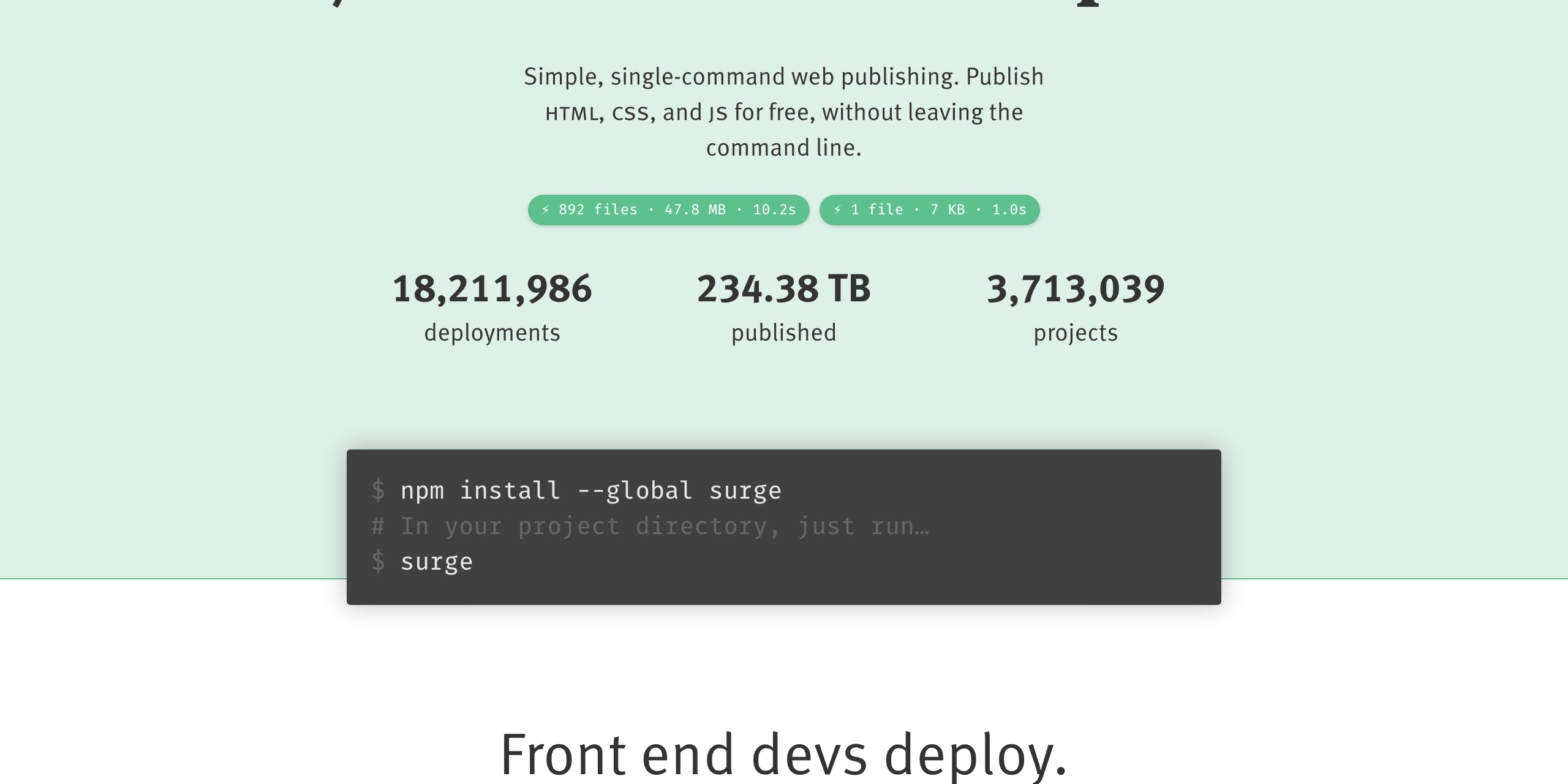
Surge’s homepage is the place to start, because it settles what Surge is before anyone argues about speed: it “makes it easy for developers to deploy projects to a production-quality CDN,” and its tour bills the product as “Static web publishing for Front-End Developers.” You install the CLI, run surge in a project directory, and your static assets are served from Surge’s content-delivery network. It is a publishing tool plus a CDN, not a service with a mainland endpoint anyone can allow or deny — which is exactly why “is Surge blocked” is the wrong lens. What matters for China is where that CDN lives, and whether you may serve the public from it.
Reachability: an offshore CDN, reached from the mainland cross-border
Surge’s CDN is operated from outside mainland China, and nothing in the product offers an in-country region. A site served only from that network reaches Chinese visitors cross-border, across the international gateways, with no local point of presence to shorten the trip — so delivery can be slow or uneven, and any third-party fonts, analytics or scripts your static site pulls in travel the same path and may degrade with it. None of that is Surge being “blocked”; it is the physics of serving the mainland from offshore. It is also fixable without leaving Surge, which is the last section below.
The compliance door: an ICP filing for a public mainland site
The part tuning cannot touch is permission. Serving a public website to people in mainland China from licensed, in-country hosting turns on an ICP filing (备案). Under State Council Order No. 292 (Article 4) and MIIT Order No. 33, that filing attaches to a hosting resource physically inside the mainland and to a mainland legal entity — and a site that lives only on Surge’s offshore CDN has no in-country resource for it to bind to. This is where “where you serve it” becomes decisive: the filing follows in-country hosting, and an offshore static deployment has none to follow. The door is your delivery location, not Surge.
Why this isn’t a PIPL data-residency story — and the one case where it could be
It is worth being precise about what Surge does not add. Surge serves static files, and its tour says that to publish “you don’t have to provide any personally identifying details—you only need a working email address.” There is no pool of your visitors’ personal data sitting on Surge to localize, so — unlike a hosted app with a database — Surge itself does not create a cross-border personal-data transfer under the Personal Information Protection Law. The one caveat is your own content: if the static site you ship collects personal information directly — an embedded form, an analytics tag, a login widget — that data path is yours to assess under PIPL, independent of where Surge serves the files. Treat that as a question for counsel if it applies to you.
Where 21YunBox fits — a compliant overlay, not a migration
You keep Surge exactly as you use it today — same CLI, same static build, same workflow — and you can keep serving the rest of the world from Surge’s CDN. What a mainland-China audience adds is the one thing an offshore CDN cannot: ICP-filed delivery from inside the mainland, serving the same static build, with a fixed in-country entry in front of your origin. Our China team maps which obligations apply to your entity, handles the ICP filing, and stands up the in-country delivery — no rebuild, no second codebase, no leaving the toolchain you already like.
Related reading:
Frequently Asked Questions
Is Surge.sh blocked in China?
No — Surge.sh is not blocked, but it is served from its own offshore CDN with no mainland-China region. Requests from Chinese visitors cross the international gateways with no in-country point of presence, so reachability can be slow or uneven — a delivery matter, not a block. The compliance question is separate: a public site served to the mainland needs an ICP filing tied to licensed in-country hosting, which an offshore Surge deployment cannot hold.
Do I need an ICP filing to serve a Surge.sh site in mainland China?
To serve a public website to mainland-China visitors from licensed, in-country hosting, yes — an ICP filing (备案) is required, and it attaches to a hosting resource inside the mainland and a mainland legal entity (State Council Order No. 292, Article 4; MIIT Order No. 33). A Surge deployment lives only on Surge's offshore CDN, so there is nothing in-country for the filing to bind to. Treat the specifics as a risk to confirm with counsel.
Can 21YunBox help make our Surge.sh site work in China?
Yes. Keep building and deploying your static site the way you do today; for the mainland audience, our China team can assess your reachability and ICP exposure, handle the ICP filing, and serve the same static build from ICP-filed, in-country delivery in front of your origin — no rebuild, and you can keep Surge for the rest of your audience. Get in touch to work through your specific setup.
